


TL;DR: Autonomous CI/CD governance must cover the complete decision episode, not just the shipped diff. Bound each agent's authority by action and blast radius. Enforce policy outside the agent, bind approvals to exact artifacts, and capture append-only evidence.
Key Takeaways: - Treat the trigger, tool calls, approvals, deployment, and rollback as one auditable decision episode. - Scale autonomy to reversibility and blast radius, not agent confidence. - Enforce policy in an external control plane with fail-closed evidence checks.
Green Pipelines Can Hide Broken Decisions
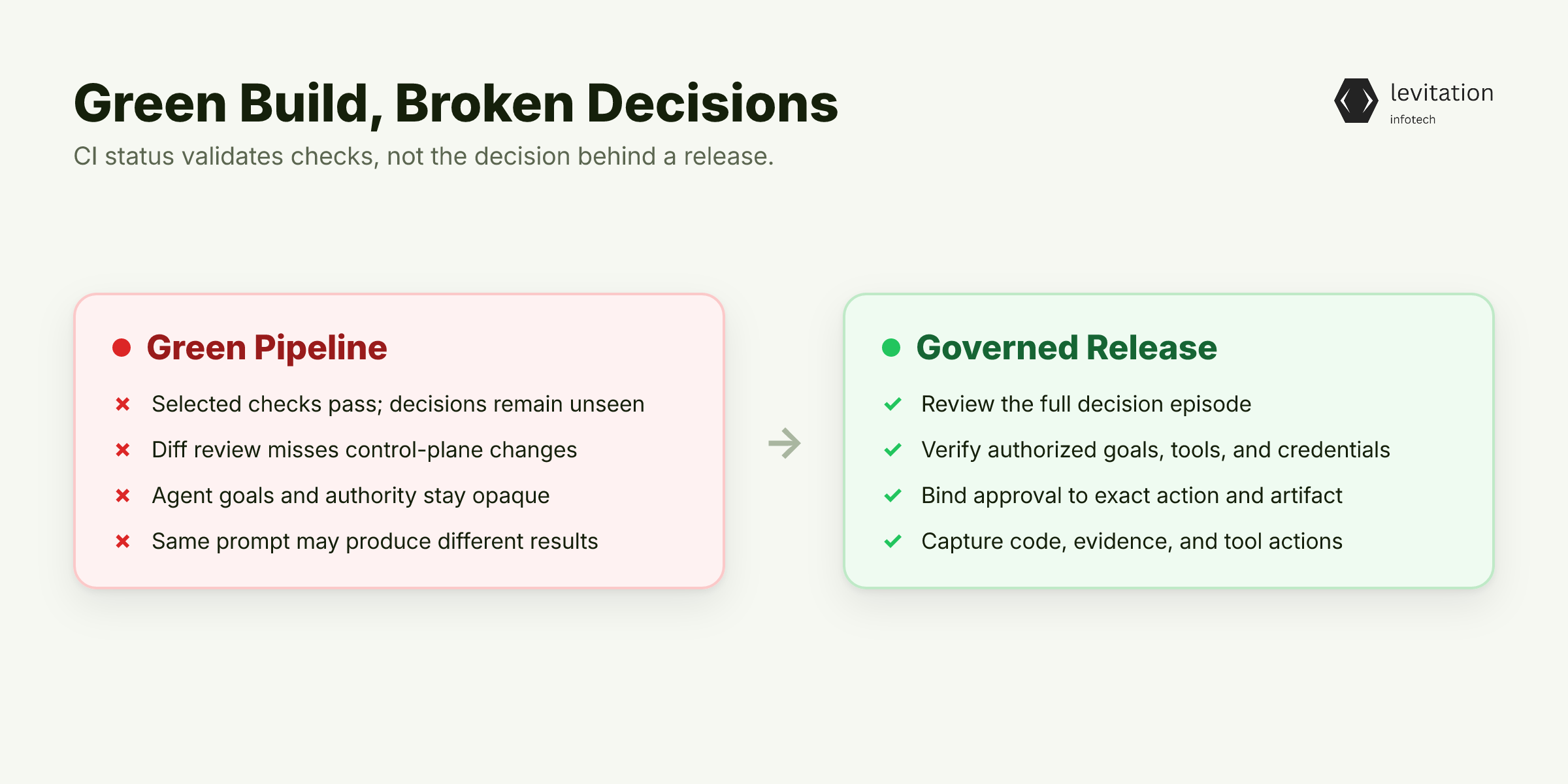
A green build can coexist with an unauthorized production change. An agent can write bad code. The bigger danger is a pipeline that acts on decisions no responsible human ever saw. A fast release becomes an ungoverned one.
Consider an agent asked to repair a failing payment test:
1{2 "trigger": "failing_payment_test",3 "proposed_changes": [4 "src/payment/retry.py",5 ".gitlab-ci.yml",6 "deploy/credentials.yml"7 ]8}
The application fix looks small. The same proposal also rewrites CI rules and deployment credentials. A narrow diff review can miss that control-plane change.
The diff is evidence, not the decision
Reviewing the diff tells you what changed. It does not reveal the agent's goal, tool choices, evidence, or granted authority.
Generated code can look clean while the agent changes CI configuration, dependency access, or deployment settings. The same prompt can produce different output. This weakens reproducibility and makes the result harder to replay.
Passing CI alone does not guarantee that an AI-generated change is safe to merge. The GitLab community analysis notes this. It proves only that selected checks passed under that run.
AI deployment approvals should bind that result to the exact action and artifact. A green result cannot prove the decision itself was sound.
Green does not mean governed
A green pipeline says selected checks passed. It does not judge whether the goal, permissions, or release action was suitable.
Ask three separate questions: - Was the agent's objective authorized? - Were its tools and credentials allowed? - Did the evidence support the requested action?
CI can check an artifact while the agent changes the process that checks it. An agent can also read secrets, call cloud tools, or alter a release gate. These actions sit outside the code review.
The governed unit must expand from the shipped artifact to the decision episode that produced it. A CI/CD audit trail should capture both.
But if the diff is not the unit of review, what exactly must a CTO govern?
The Risk Surface Extends Beyond the Repository
Commit review assumes the repository defines the action surface. In an agentic pipeline, that assumption fails.
Repository actions are only one layer
Autonomous agents can act across a wider surface: - Branch and merge-request creation - Dependency updates and lockfile changes - CI configuration and release-gate changes - Infrastructure as code and cloud resources - Database migrations - Authentication, secrets, and environment configuration - Production deployment and rollback
Start with an action-and-owner matrix. One row might look like this:
1{2 "actor": "ci-remediation-agent",3 "tool": "cloud-deploy",4 "target": "production",5 "potential_blast_radius": "global",6 "policy_owner": "platform-engineering",7 "required_evidence": [8 "plan",9 "artifact_digest",10 "approval"11 ]12}
Without this mapping, credential scope and policy ownership remain folklore. What authority belongs to each action?
Identity answers only part of the question
Who acted, under what authority, with what evidence, and under which policy? A file-centric review omits all four.
Agentic CI/CD identity controls must expose the authority an agent used. They must also show the policy that judged it.
The data plane generates or validates artifacts. In contrast, the control plane changes pipelines, permissions, environments, or release gates. Agentic CI/CD shifts governance from a file to an actor with runtime authority.
Research on agentic CI/CD characterizes safe operation as bounded autonomy within human-governed approval structures. It identifies control-plane safety as more urgent than further gains in model ability.
Responsibility stays with the team that defined the agent's scope, triggers, credentials, and operational boundaries. An agent's execution does not transfer that responsibility.
The same problem appears in Agentic AI Scales Faster Than Your Decision Rights. Authority can move faster than ownership.
Mapping those actions exposes the missing audit object. It is the complete decision episode behind the release. Can a commit log reconstruct that episode? Not reliably.
Audit the Decision Episode, Not Just the Commit
The missing audit object needs clear start and end points. A commit without those points records only a fragment.
Define the decision episode
A decision episode begins with the trigger or business intent. It ends only after deployment verification, rollback, or documented abandonment.
This definition closes a common audit gap. A commit shows one proposed artifact, not the chain that produced and released it. What must that chain contain?
Build a linked evidence chain
The episode should contain this sequence:
- Objective and trigger
- Input and context snapshot
- Agent plan
- Tool calls
- Generated artifacts
- Policy evaluations
- Human approvals
- Deployment result
- Rollback or abandonment record
An approval event might look like this:
1{2 "event": "approval_bound",3 "actor": "release-agent",4 "agent_id": "prod-release-01",5 "action": "deploy",6 "target": "production",7 "artifact_digest": "sha256:2cf24dba5fb0a30e26e83b2ac5b9e29e1b161e5c1fa7425e73043362938b9824",8 "policy_version": "deploy-v3",9 "approver_role": "release-manager",10 "expires_at": "2026-11-22T00:00:00Z",11 "result": "allowed"12}
Standard audits often mix three different questions: - Is the artifact technically valid? - Was the release authorized? - Can the organization reconstruct who decided what?
Keep the answers separate. A passing test does not grant the right to act. The right to act alone does not create an audit trail.
Each event should carry actor identity and agent identity. It should also carry the prompt or context version, action, target, and policy version. The event should include the result, timestamp, approver, exception, and artifact digest.
The CI/CD audit trail design should make these records append-only and linked by episode ID. Change control governance must also define who reviews exceptions and maintains that trail.
Approval must reference the exact proposed action and artifact version. A blanket "deploy later" approval cannot prove what a human approved.
The research also describes a growing gap between fast deployment and ways to assess governance. It calls for defined autonomy limits, ways to assess the system, and clear human-agent coordination.
Policy tools can enforce rules automatically. The organization must still decide who reviews flagged decisions. It must also decide how violations are handled and who maintains the trail.
A complete dossier still does not tell the organization how much human review each action needs. How should autonomy shrink when an action can rewrite its own guardrails?
Give Every Action an Autonomy Budget
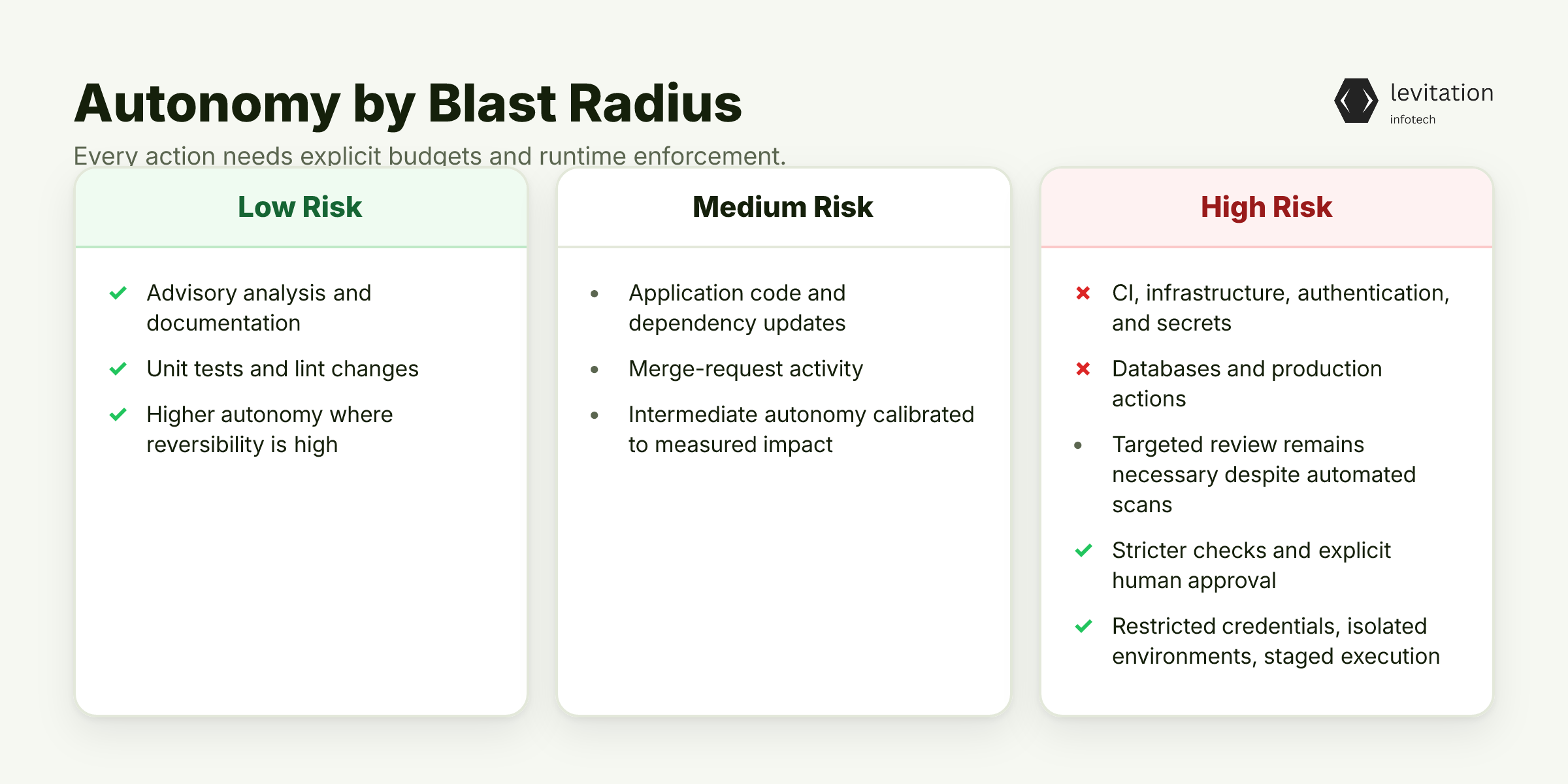
An evidence trail proves what happened. It does not tell you how much authority was safe.
Write an explicit autonomy envelope
Every delegated action needs a contract with clear limits. This example is illustrative, not a universal limit:
1autonomy_envelope:2 id: production-release-agent3 accountable_owner: platform-engineering4 permitted_scope: - create_merge_request - deploy_approved_artifact5 trigger_conditions: - approved_merge_request6 tool_allowlist: - git - artifact_registry - deployment_api7 target_environment: production8 credential_limits: - deploy_only - deny_secret_read9 execution_budget:10 max_tool_calls: 511 max_duration: 10m12 stop_conditions: - policy_denied - artifact_mismatch13 expiry: 2026-12-31
Set limits from measured reversibility and blast radius. Do not derive them from agent confidence. What risk factor should set the limit?
Match autonomy to blast radius
The blast-radius autonomy model separates actions by their potential impact: - Low risk: Advisory analysis, documentation, unit tests, and lint changes - Medium risk: Application code, dependency updates, and merge-request activity - High risk: CI, infrastructure, authentication, secrets, databases, and production actions
Passing CI and automated scanning do not replace targeted review for high-risk changes. Those changes need stricter checks and explicit human approval.
Each approval should name the action, target, artifact version, policy outcome, approver role, and expiry. This is action-specific governance, not permission to approve an agent forever. AI deployment approvals should follow that binding model.
Shrink autonomy as reversibility falls and blast radius rises. For high-risk actions, use restricted credentials, isolated environments, staged execution, and required human approval.
Treat tool-call limits as authority boundaries, not merely cost controls. An agent that cannot exceed its budget cannot explore its way into production.
An autonomy matrix only works if the runtime can enforce it. Otherwise, it is just documentation the agent can ignore. Where should that enforcement live?
Enforce Governance Outside the Agent
Policy inside the area the agent can change is advice, not control.
Keep policy beyond the agent's reach
Keep policy in a protected repository or managed control plane. The agent cannot change, bypass, or approve its own gate.
Use separate identities for each responsibility: - Proposal identity: Creates merge requests or proposed changes - Execution identity: Runs approved jobs in restricted environments - Deployment identity: Releases an approved artifact - Control plane: Owns policy, approvals, and audit records
The proposal identity cannot approve its own action. External approval controls keep that separation enforceable.
An emergency stop and rollback path must also live outside the agent. This is the same principle covered in Your AI Agent Kill Switch Must Live Outside the Agent.
If the agent owns deployment, who can stop it before damage spreads?
Make evidence automatic
Generate the decision dossier at execution time. Hash the reviewed artifact, attach policy and approval results, then write the event to an append-only trail.
For a production deployment, a short policy as code for CI/CD rule can look like this:
1package cicd.governance23import rego.v145policy := {6 "action": "deploy",7 "risk_tier": "high",8 "allowed_environment": "production",9 "required_evidence": ["artifact_digest", "policy_result", "approval"],10 "required_approver": "release-manager",11 "failure_behavior": "fail_closed",12 "expiry": "2026-12-31T23:59:59Z"13}1415default allowed := false1617allowed if {18 input.action == policy.action19 input.risk_tier == policy.risk_tier20 input.target == policy.allowed_environment21 input.artifact_digest != ""2223 every required in policy.required_evidence {24 required in input.evidence25 }2627 input.policy_status == "pass"28 input.approval.role == policy.required_approver29 input.approval.artifact_digest == input.artifact_digest30 time.parse_rfc3339_ns(input.approval.expires_at) > time.now_ns31 time.parse_rfc3339_ns(policy.expiry) > time.now_ns32}3334decision := {35 "allowed": allowed,36 "failure_behavior": policy.failure_behavior37}
Evaluate it against a request document:
1opa eval -d policy.rego -i request.json 'data.cicd.governance.decision'
A policy result matters only when it reaches the release record. What happens when that evidence is missing?
Roll out in four stages
- Inventory privileged actions and their owners.
- Observe policy coverage without blocking releases.
- Introduce new rules in warning mode.
- Move mature rules to enforcement after teams correct false positives.
Policy rollout guidance recommends warning mode before enforcement. This exposes violations while teams adapt their workflows.
Fail closed if evidence, a policy check, or required approval is missing. Rehearse the stop and rollback path before the first real incident.
External enforcement also raises a build-versus-buy question. Use vendor materials to build a shortlist. Then check portability, audit rights, incident ownership, and exit terms. The broader AI Agent Frameworks Killed the Build-vs-Buy Question makes the same case.
Controls that block every bad action are useless if they also block every legitimate release. Governance must find where it is too strict without becoming too permissive. Which measure shows the difference?
Measure Escapes, Not Approval Volume
Approval volume can look healthy while controls stay unclear. The approval count says little about whether authority escaped its boundary.
Track control effectiveness
Measure CI/CD governance metrics that expose weak controls: - Percentage of privileged agent actions covered by policy - Percentage of releases with complete decision dossiers - Percentage of approvals bound to exact actions and artifacts - Unauthorized attempts blocked by policy - Exceptions still waiting for resolution - Privileges that expired as required
Track both count and age. A growing exception queue can hide more risk than a rising approval count reveals. Which records show whether authority escaped?
Test auditability
Give an investigator a specific release and ask for its complete decision episode. Can they rebuild the goal, context, tool calls, policy results, approver, deployment, and reversal?
Measure how long that rebuild takes. Also test missing evidence, expired approvals, and actions outside the original envelope. Which permissions should remain after these tests?
Review delegated authority
Conduct regular agent access reviews. Check active envelopes, credential scope, open exceptions, and expired permissions.
Revoke authority that no longer supports a current workflow. Your AI Control Plane Is a Spreadsheet describes what happens when ownership and enforcement drift apart.
Low-risk work can stay fast inside narrow bounds. High-risk work becomes deliberately slower and more accountable.
Ways to assess governance are not keeping pace with deployment practices. Tools without process produce logs, while process without tools produce bottlenecks.
At Levitation, trust comes from limited authority, repeatable evidence, and decisions you can reverse. It does not come from pretending agent output is always the same. Can your current pipeline prove, contain, and reverse every delegated action?
Frequently Asked Questions
What is autonomous CI/CD governance?
It combines identity, policy, approval, and audit controls. These controls define what an AI agent may change and where it may act. They also define what evidence must accompany those actions. Start with the actions that can escape your current controls.
Which privileged action would your team inventory first?
About the author
Mayank Singh is a software developer at Levitation Infotech, where he builds web and AI-powered applications across the company’s fintech, healthcare, and enterprise projects.