


TL;DR: Eighteen Indian vendors quoted ₹6 lakh to ₹40 lakh for the same CRM brief, a 6.7x spread that signals scope mismatch, not price gouging. The gap exists because vendors interpret "custom CRM" through three different lenses, and founders pick quotes without understanding which lens is right for their business. Match the quote to the tier your business actually needs, and the variance disappears.
Key Takeaways: - The real cost of a custom CRM in India runs ₹3-15 lakh for a one-time build, depending on feature scope. - The ₹6L-₹40L spread comes from vendors interpreting the same brief as a lean build, a mid-tier system, or an enterprise platform. - Post-launch AMC and hidden line items push a cheap quote well above its original sticker price within the first year. - Founders who match vendor tier to actual business complexity launch faster and spend less on rework.
The ₹34 Lakh Gap Nobody Warned You About
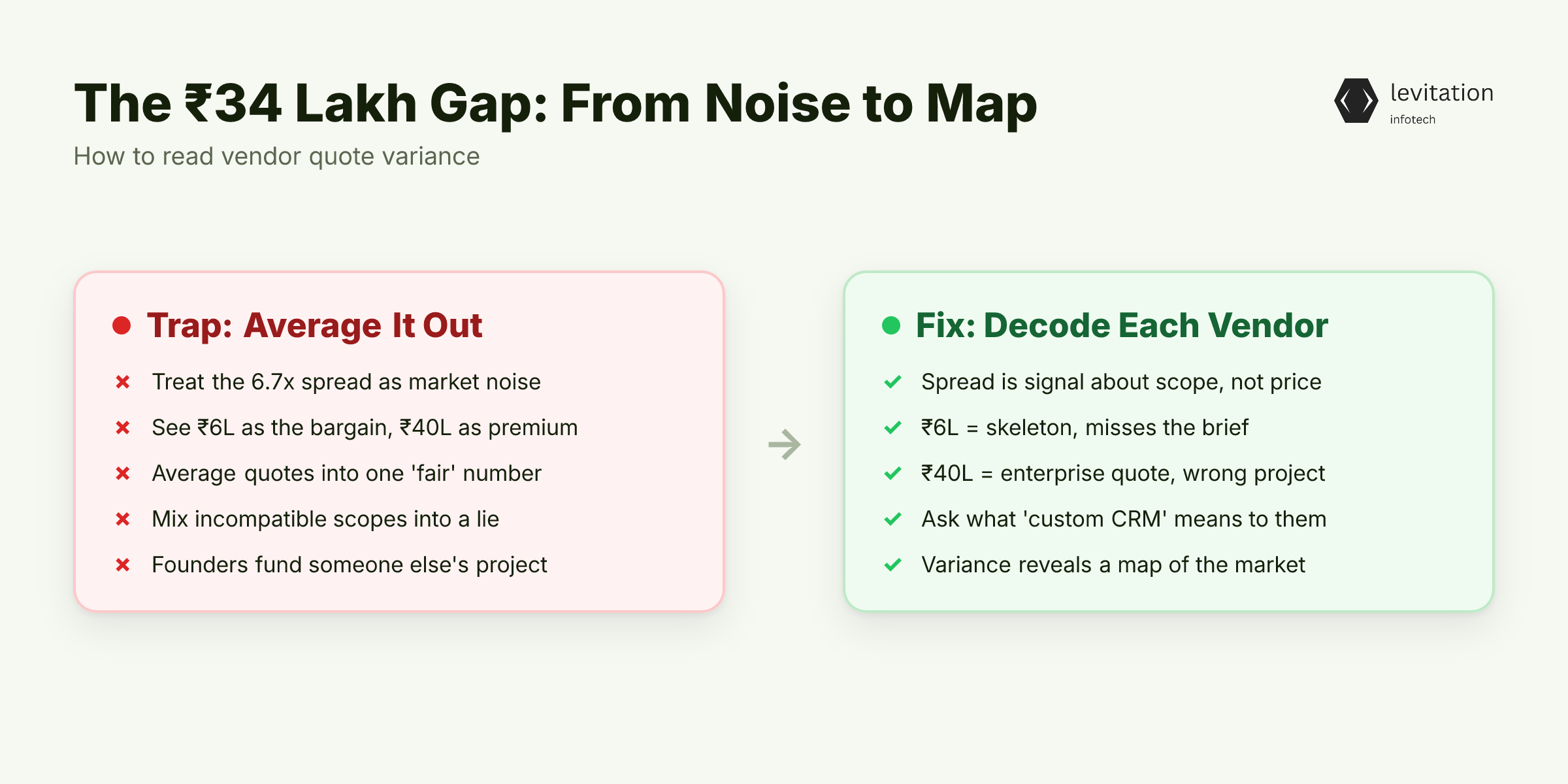
Eighteen vendors received the same CRM brief. Quotes came back between ₹6 lakh and ₹40 lakh.
The cheapest wasn't a bargain. It was a skeleton. The most expensive wasn't premium. It was quoting someone else's enterprise project.
That 6.7x spread isn't market noise. It's signal. The market baseline for a custom CRM development cost in India sits at ₹3-8 lakh for a lean build. A fuller one runs ₹8-15 lakh.
So the ₹6L quote barely scrapes the floor. The ₹40L quote is 2.7x above the ceiling. Both extremes sit far outside the norm. Both tell you something is being miscommunicated.
Most founders default to averaging quotes. They see ₹6L, ₹10L, ₹15L, ₹40L and assume the "fair" answer is somewhere in the middle. This is wrong.
The spread signals that vendors are solving different problems under the same label. Averaging them doesn't give you a fair price. It gives you a meaningless number built from incompatible scopes.
The gap isn't random. It reveals exactly what each vendor thinks "custom CRM" means.
Once you decode that, the variance stops looking like chaos. It starts looking like a map.
What 'Same Build' Actually Means to 18 Different Vendors
The brief was specific: lead tracking, pipeline stages, automation, and multi-team access. Nothing exotic. Yet vendors translated those four requirements into radically different deliverables.
Cheap quotes assumed a single-team system. One sales vertical, manual workflows, no third-party integration. The vendor read "multi-team" as "five logins," not "role-based access across departments with different data visibility rules."
Expensive quotes did the opposite. They layered in role-based access control, audit logs, custom dashboards, an API-first architecture, and infrastructure hardening. The brief never mentioned these features.
Neither vendor was dishonest. They each interpreted "custom CRM" through their default client profile.
Solo developers and small studios default to simple builds. Enterprise vendors default to hardened builds because their regulated clients can't deploy anything else.
The variance comes from scope interpretation, not from one vendor being greedy and another generous. The cheap vendor wasn't leaving money on the table. They were quoting a different product.
The expensive vendor wasn't inflating prices. They were quoting a custom CRM for a buyer with compliance auditors and a security review board.
So which interpretation is right? It depends on the tier of vendor you're talking to.
The Three Quote Tiers Indian CRM Vendors Operate In
Indian CRM vendors cluster into three tiers. The tier determines what you actually get for your money.
Tier 1 (₹3-8L) is the solo developer or small studio. You get lead tracking, pipeline stages, and basic automation. No custom dashboards. No integration architecture. One delivery team, often a single person.
The output is functional but narrow. It works for a 5-10 person sales team with a straightforward pipeline.
Tier 2 (₹8-15L) is the mid-size firm. You get the full feature set: third-party integration, custom dashboards, multi-team access, and annual maintenance included. These firms have PMs, QA, and delivery structure.
Most growing businesses land here. It's the realistic range for a company that needs integrations with payment, accounting, or marketing tools.
Tier 3 (₹15-40L+) is the enterprise vendor. You get role-based access, audit logs, API-first design, infrastructure hardening, a dedicated PM, and a separate QA team. These vendors serve regulated industries and compliance-heavy clients, which shapes their default scoping.
They assume every client needs enterprise-grade access controls, even when the client is a 12-person startup.
Vendors in higher tiers don't always build better. They build for buyers with compliance, scale, and security requirements that founders often don't have. The cost to build a CRM at Tier 3 isn't inflated greed. It's the cost of building for an enterprise audience by default.
Here's where it gets dangerous: the quote you pick usually determines what gets left out, and most founders don't notice until launch.
The Hidden Line Items That Double a ₹6 Lakh Quote
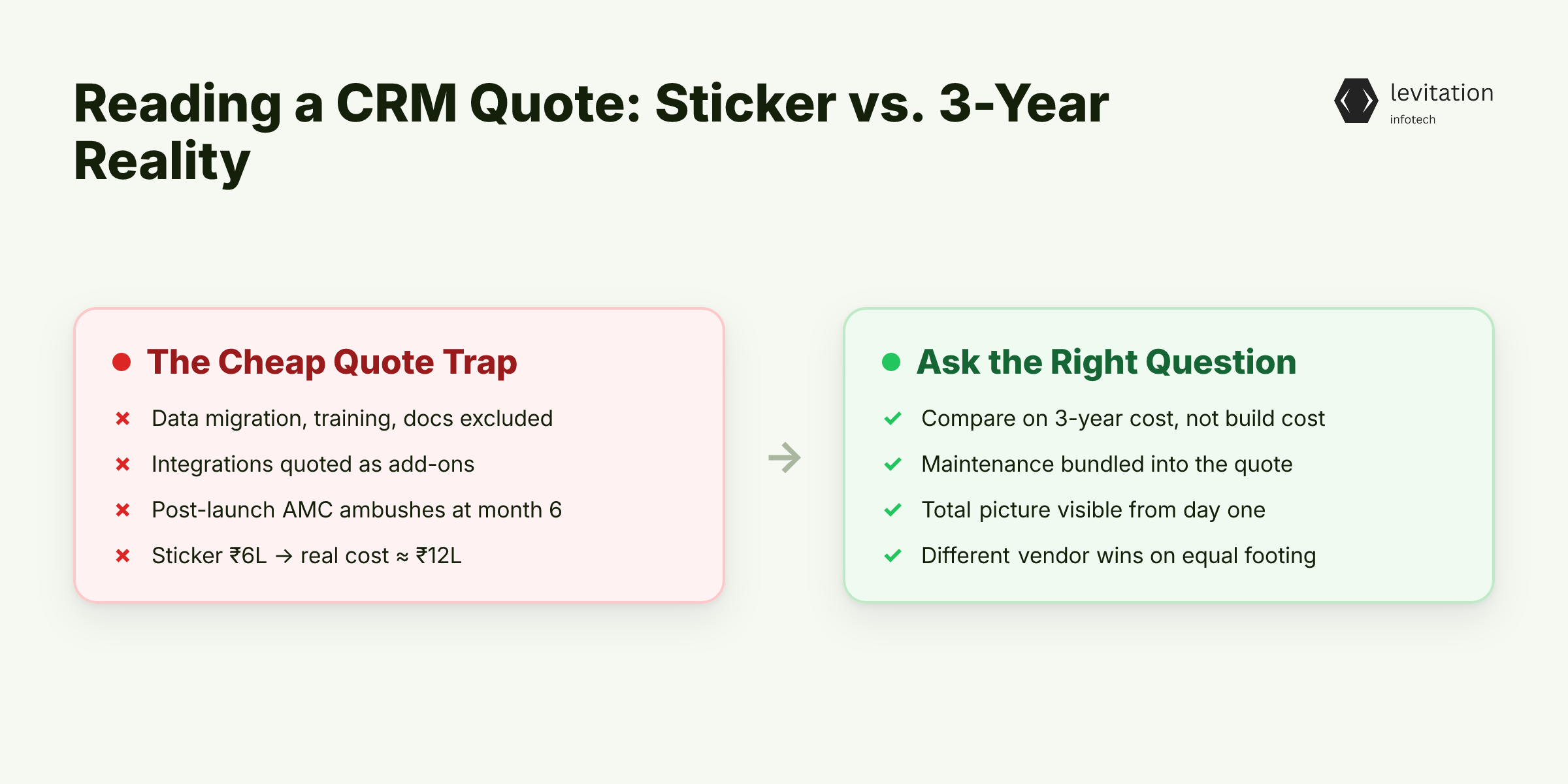
A ₹6 lakh quote that becomes ₹12 lakh by month six isn't dishonest. It's just missing the total cost picture from day one.
Cheap quotes skip the line items that experienced vendors treat as standard. Data migration from spreadsheets or a legacy CRM is almost never included. User training isn't included.
Admin documentation is treated as an extra. This is the kind your ops team needs to maintain the system. Cloud deployment to a production environment is often a separate line.
Then come the "extras" the brief implied but the quote excluded. WhatsApp integration. Email and SMS hooks. Payment gateway connections. Mobile responsiveness.
These are core to how modern sales teams work. Cheap vendors quote them as add-ons because the brief said "automation" without specifying which channels.
The real ambush is post-launch AMC. Annual maintenance contracts add a recurring cost layer on top of the build price. Over multiple years, this AMC can approach or exceed the original build cost.
Over three years, that recurring maintenance layer adds up. The total cost of a supposedly cheap build ends up close to a fuller-priced quote with maintenance bundled in.
The right question isn't "What's the build cost?" It's "What's the three-year cost?"
Founders who ask only the first question get surprised at month six. Those who ask both can compare quotes on equal footing. They almost always pick a different vendor than the one with the lowest sticker price.
So how do you read a quote before it ambushes you six months in?
How to Stress-Test a CRM Quote Before You Sign
Most CRM quotes fail one simple test: they don't survive a line-item breakdown.
First, ask for separation. Features, integrations, infrastructure, training, and post-launch support should each be priced independently, not bundled into a lump sum.
A vendor who refuses to break out line items is either lazy, hiding margin, or doesn't understand their own scope. All three are red flags.
Second, test with five specific scenarios from your actual workflow. "What does this quote cover for lead-to-quote handoff when the deal involves three approval layers?"
If the vendor can't answer concretely, the scope is guesswork. Vendors with experience in your industry will answer in specifics. Vendors who are winging it will hedge.
Third, compare quotes on AMC terms, not just build cost. A higher quote with maintenance included often beats a lower quote with a separate annual retainer. The difference shows up once you calculate the cumulative cost over multiple years.
The lower-sticker vendor has less skin in the game when the system breaks. You pay for that misalignment over time.
Fourth, ask which stack they're proposing. Zoho CRM customization, Salesforce, or Microsoft Dynamics 365 customization each change the cost math.
A vendor proposing Salesforce customization at ₹8L is using a different cost model than one building on open-source. Neither is wrong, but you need to know which world you're buying into before comparing prices.
Fifth, request a phased delivery plan. A lean MVP first, then a full build. Vendors who resist phasing are either overcommitted to other projects or hiding scope gaps they haven't fully scoped.
A vendor's willingness to break work into stages is itself a signal. Vendors who scope honestly and phase delivery keep clients long after launch.
The CRM system you pick should match your business, not the vendor's default template. Once you can read quotes, the real question becomes: which tier actually matches what your business needs?
Matching Your Build to Your Quote (Without Overpaying)
Here's the honest tier-to-need mapping most vendors won't draw for you.
If you're under 20 users with a straightforward sales process, Tier 1 (₹3-8L) is the right answer. Don't let a Tier 3 vendor sell you enterprise complexity you won't use.
Role-based access for a team of eight is overhead, not value. Audit logs when no auditor is asking are a feature you'll disable in month three.
If you need integrations (payment, accounting, marketing tools) and multi-team access, Tier 2 (₹8-15L) is the realistic range. This is where most growing businesses land. The custom CRM cost here includes the things Tier 1 skips: third-party connections, dashboard customization, and structured maintenance.
If you're in a regulated industry or handling sensitive customer data at scale, Tier 3 (₹15L+) is justified. Security architecture, audit trails, and compliance scaffolding aren't optional in banking, insurance, or healthcare.
For these industries, the right tier isn't optional. It's structural.
The ₹40L quote in the original round was likely a Tier 3 vendor applying enterprise defaults to a Tier 1 brief. That's a mismatch, not a rip-off.
The vendor's process assumed compliance and hardening because most of their clients need it. The founder paid for features they'll never audit and security they'll never exercise.
What changes when founders stop comparing quotes and start matching tiers to actual needs?
Their launch dates move forward. Their post-launch rework budget drops sharply. The three-year cost (the only cost that matters) falls when scope matches need.
What the Right Quote Actually Buys You
A matched quote launches faster because the vendor isn't building features you'll disable or workflows you'll override. The system fits the actual sales process from day one, which means users adopt it without a change management campaign.
Post-launch, you spend less on rework. The six-month "why isn't anyone using it" problem disappears when the CRM mirrors how your team already sells. This is a common CRM integration failure.
Annual cost over three years for a correctly-tiered build is typically lower than three years of ready-made CRM subscriptions for a 10-person team.
At ₹1-6L per year for off-the-shelf platforms (per CRM development cost in India benchmarks), you're paying ₹3-18L. That's for a subscription that still doesn't fit your pipeline.
A Tier 2 build at ₹10L with annual maintenance included stays below that subscription range over the same three years. It actually matches your workflow.
For regulated industries, the math isn't even close. A vendor with experience in security-critical systems understands audit trails, access controls, and infrastructure hardening as defaults, not extras.
That experience is what you're paying for in Tier 3. It's why the higher quote is justified for the right buyer.
The right tier doesn't just save money. It removes the rework loop that kills most CRM rollouts.
Frequently Asked Questions
How much does it cost to build a custom CRM in India?
A lean custom CRM covering lead tracking and pipeline stages runs ₹3-8 lakh one-time. A fuller build with automation, custom dashboards, and multi-team access runs ₹8-15 lakh.
Enterprise-grade builds with compliance and security architecture can exceed ₹15 lakh. The variance depends almost entirely on feature scope, not vendor greed.
Why do CRM development quotes vary so much between Indian vendors?
Same brief, different interpretations. A ₹6 lakh quote might exclude integrations, training, and post-launch support. A ₹40 lakh quote might include enterprise features like audit logs, role-based access, and infrastructure hardening.
The brief didn't actually require these. The spread reflects scope gaps, not pricing dishonesty. Founders need line-item breakdowns before comparing.
Is a custom CRM cheaper than Salesforce or Zoho over time?
For a 10-person team, a custom build at ₹8-12 lakh typically costs less over 3 years. Compare that to ₹1-6 lakh per year in ready-made subscriptions.
But the math only works if your sales process genuinely needs custom logic. If Zoho CRM or HubSpot fits your pipeline out of the box, a custom build is an expensive reinvention.
What should be included in a CRM development quote?
At minimum, a quote should include feature breakdown by module, third-party integration costs, and data migration scope. It should also cover user training, admin documentation, cloud deployment, and annual maintenance terms.
Any quote missing three or more of these is incomplete. The missing items will appear as change orders soon after signing.
How long does it take to build a custom CRM in India?
A lean MVP can be delivered in a matter of weeks. A full multi-team build with integrations and dashboards typically runs several months. Enterprise-grade builds with compliance architecture extend further.
Vendors who promise faster timelines for complex scopes are either underquoting effort or planning to deliver in phases. Both are red flags unless explicitly stated.
If you're comparing quotes this quarter, start by asking each vendor for a line-item breakdown before deciding.
About the author
Mayank Singh is a software developer at Levitation Infotech, where he builds web and AI-powered applications across the company’s fintech, healthcare, and enterprise projects.