


TL;DR: The 40% disagreement number Indian banking headlines keep quoting actually measures human credit officers. It does not measure AI models. The real, undocumented failure mode is different. It measures how often AI underwriting models from different banks would disagree on the same thin-file borrower. This article gives CTOs a five-step audit framework. It helps them make their AI underwriting stack defensible to both regulators and internal risk committees.
Key Takeaways: - The famous 40% number is inter-rater disagreement between human officers. These officers review the same file, not AI disagreement. This misattribution is causing CTOs to audit the wrong failure mode. - AI models from different banks diverge because inputs diverge. About 40% of Indians have no bureau history. So each bank fills that gap with a different mix of alternative data. - A defensible AI underwriting benchmark measures consistency, not raw accuracy. Population Stability Index and Kolmogorov-Smirnov tests on score distributions are the right tools. A five-step framework helps put them into practice.
The 40% Disagreement Everyone Misquotes
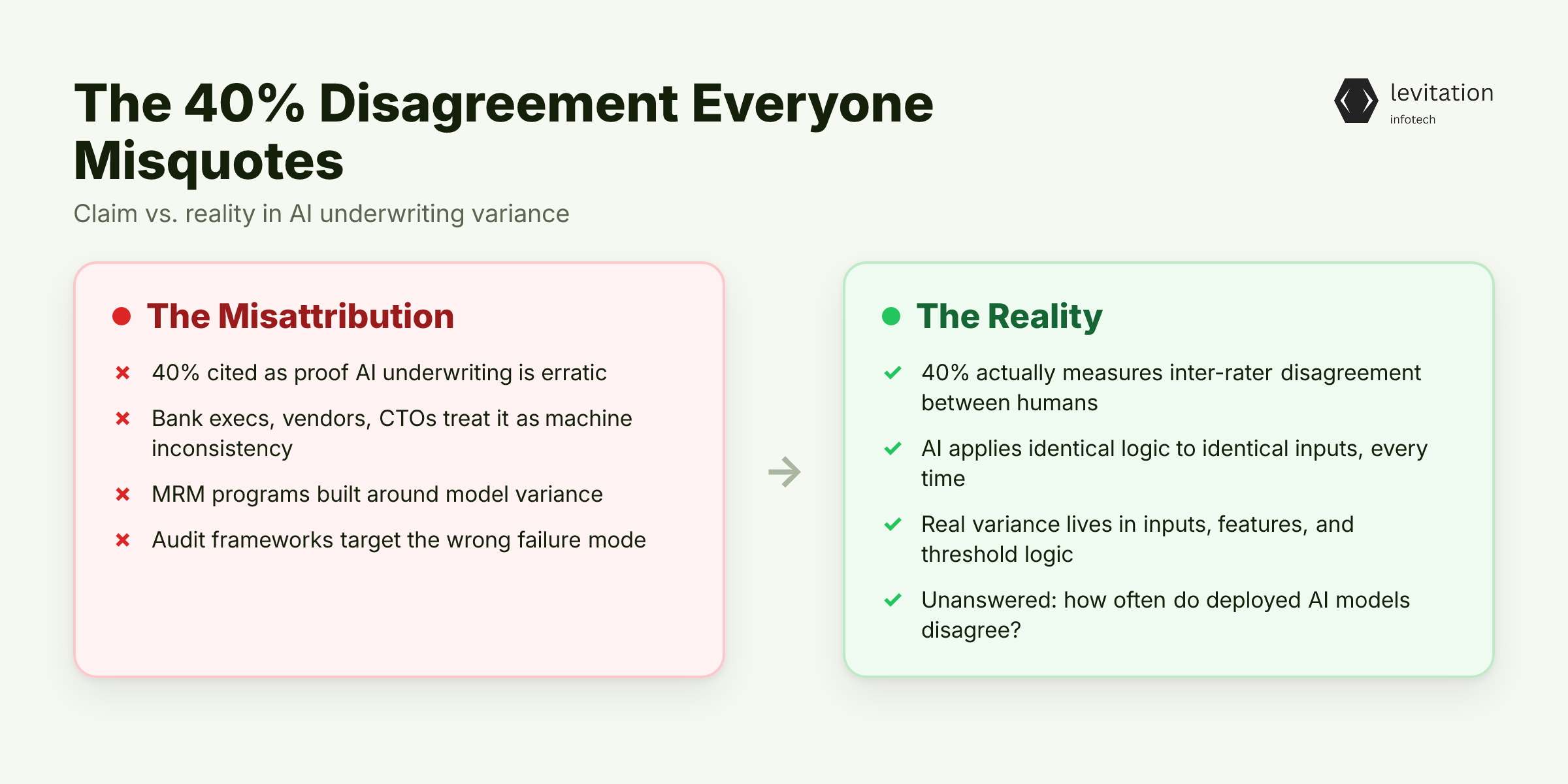
The "40% AI disagreement" headline is everywhere. Bank executives cite it in board decks. Vendors quietly use it to justify their engines. CTOs have also built model risk programs around it. They treat it as proof that AI underwriting is erratic.
The number is real. The attribution is not.
It comes from inter-rater disagreement. Two human credit officers review the same loan file. They reach different decisions roughly 30-40% of the time. The finding is well-documented. It measures human inconsistency, not machine inconsistency. AI applies identical logic to identical inputs, every time. That is the entire point of automating underwriting.
So why does the misattribution matter? CTOs are now designing audit programs around the wrong failure mode. If you believe AI is the source of 40% disagreement, you build for variance in models. You do not build for the variance that actually matters. That variance lives in inputs, feature engineering, and threshold logic across banks. For a foundational overview, model risk management basics explain how MRM is structured. Also, AI underwriting explained gives the operating context for Indian lenders.
The undocumented question is sharper. How often would two deployed AI models disagree? They would be running in production at different banks. They would see the same application given identical bureau and alternative data. No public benchmark exists. No vendor publishes this number. And no CTO is measuring it.
That gap is the article.
Once you strip away the misattribution, a more dangerous question surfaces. Why do AI models from different banks still produce different verdicts on the same borrower? They are built on supposedly similar data.
Why AI Underwriting Models Diverge on Identical Applications
In theory, two AI models trained on the same features should converge. In practice, they rarely get the same features to start with.
The starting point is the bureau layer. About 40% of Indians have no bureau history. For that thin-file population, the bureau returns nothing useful. Every bank then fills the gap with its own mix. It uses GST filings, utility payments, cash flow signals, and transaction categorization. The alternative credit data in India landscape is now a patchwork. No two banks stitch it the same way. Transaction categorizers tag the same outflow differently. Cash flow signals get weighted differently. GST mismatches get handled differently. None of this is standardized.
Model architecture makes it worse. A gradient boosting tree and a neural network can use the same feature set. On edge cases, they will still produce significantly different approval outputs. Ensembles add another layer of opaque weighting. Add feature engineering choices and you get silent disagreement. This includes choices like which cash flow signals to weight and how to handle noisy GST data. No benchmark currently captures this. For lenders focused on this segment, thin-file borrower underwriting is now a separate engineering discipline. It is no longer just a bureau gap.
The result is structural. Two banks can look at the same shopkeeper, the same GST return, and the same bank statement. They can still produce different verdicts. Not because one is wrong and one is right. They are answering different questions.
If the inputs and architectures diverge this much, the next step is clear. The next step is to build a benchmark. But what should that benchmark actually measure?
What a Real AI Underwriting Benchmark Measures
Most teams benchmark the wrong dimension. They chase accuracy on labelled outcomes and call it done. That approach misses the failure mode that breaks in production.
A defensible AI underwriting benchmark splits into two questions. First, intra-model consistency: does your own model produce stable scores across retraining cycles? Second, inter-model consistency: how would competing models score your applicants? The Population Stability Index explained framework is one right statistical tool. Kolmogorov-Smirnov tests on score distributions are the other. Accuracy metrics alone are not.
There is a tradeoff most risk teams miss. A model that is more consistent but slightly less accurate on edge cases is often more defensible to examiners. It is more defensible than a high-accuracy black box. RBI examinations of underwriting processes reward explainability. Consistency documentation is the bridge between a score and a defensible decision. It is the kind of bridge the RBI model risk guidelines are built around. Teams that treat consistency as a second-class metric end up with models that look strong in a lab. They fall apart in a supervisory review.
Documented industry outcomes bear this out. The 30-80% TAT reduction, 25-40% approval rate uplift, and 20-50% delinquency reduction figures only hold under one condition. The same applies to the 30-50% operational cost reduction. Consistency must be maintained across the population. Inconsistent scoring inflates approval counts on paper. Then it bleeds through as delinquency within two cycles. The benchmark is not optional. It is the precondition for those numbers to survive an external audit.
A benchmark is only useful if it changes how you build. Here is the five-step audit framework. It turns measurement into a governance artifact.
A Five-Step Audit Framework for Your Lending Stack
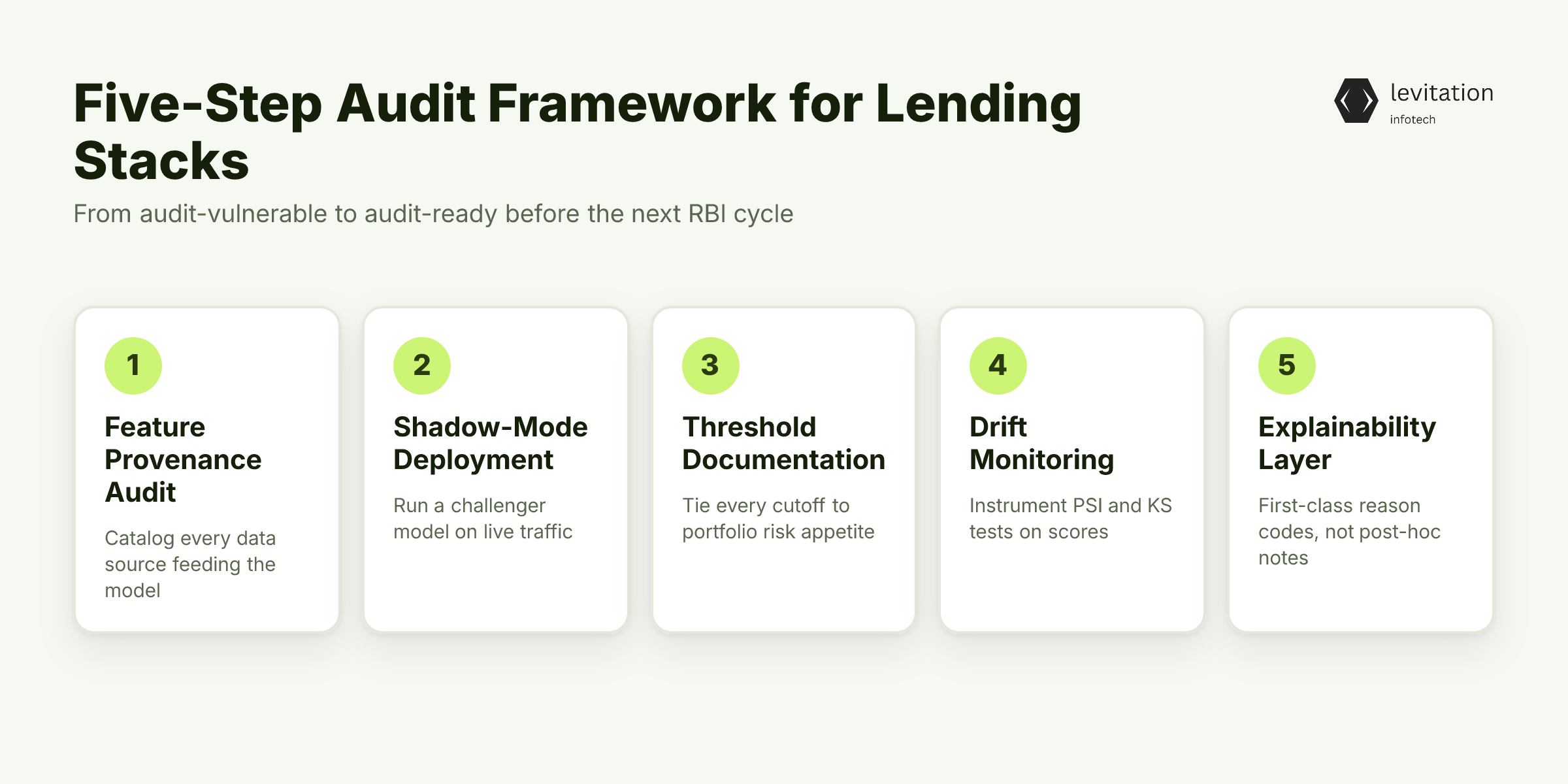
Most underwriting stacks were not designed to be audited. They were designed to ship. The gap between those two goals is where the next regulatory cycle will land.
Step 1 is a feature provenance audit. Catalog every data source feeding your model. Document refresh schedule. Flag any input that would not be reproducible by a competing bank. If your model leans on a cash flow signal that only your data partner provides, that is a problem. The dependency is a governance liability.
Step 2 is shadow-mode deployment. Run a challenger model in parallel on production traffic. Run it for at least one full credit cycle before any cutover. The shadow model deployment guide covers the operational mechanics. But the point is simple. Never let your live model be the only one that has seen real applicants.
Step 3 is threshold documentation. Every cutoff score needs a written rationale. It must be tied to portfolio-level risk appetite, not a model's default output. If a credit officer cannot explain why 720 is the cut, an examiner will not accept it either.
Step 4 is drift monitoring. Instrument PSI and KS tests on score distributions. Set alert thresholds to the magnitude of drift your approval logic can absorb. This must happen before your portfolio risk profile shifts significantly. The model monitoring checklist is a starting point. But the threshold logic must be tuned to your population. It should not be borrowed from a vendor deck.
Step 5 is an explainability layer. Generate reason codes for every decision. Format them for both customer disclosure and RBI examination. Post-hoc explanations do not survive regulatory scrutiny. Reason codes have to be first-class outputs of the model. They cannot be annotations added later.
The deployment speed gap is real. Vendor-led frameworks with all five steps in place typically reach production faster than in-house builds. In-house builds historically extend across multiple quarters. The framework components are assembled rather than inherited. That difference is the gap between audit-ready and audit-vulnerable by the next RBI cycle. Teams that want a head start can also look at RBI's 2026 AI audit will catch your vendor's mistakes first. It shows what examiners are already flagging.
The framework only works if your vendor can operate inside it. Most cannot. The questions to separate them are sharper than the ones in typical RFPs.
Three Questions to Ask Any AI Underwriting Vendor
Procurement teams usually ask about accuracy, latency, and price. Those questions are not wrong. They are just insufficient.
Question 1: "Show me your PSI across the last four model versions." If they cannot produce this, their model governance is not audit-grade. Consistency across versions is the only signal that retraining cycles are not silently shifting your portfolio's risk profile. The AI underwriting vendor evaluation process should treat this as a gate. It is not a nice-to-have.
Question 2: "What is your documented inter-model disagreement rate on the same applicant pool?" This is the real number behind the 40% headline. The vendor should be measuring it against competing models. They should not just measure it against their own prior versions. If they only track intra-vendor consistency, they are benchmarking the wrong axis. For context on what examiners expect, see RBI examination preparation.
Question 3: "Can you produce reason codes that survive an RBI examination?" If their explainability is post-hoc, the answer is no. Reason codes must originate from the inference pipeline itself. They cannot be reconstructed by a separate interpretability wrapper bolted on for the demo.
A useful procurement rule of thumb: prioritize vendors whose systems have shown longevity across multiple audit cycles. Do not prioritize just initial deployment. The what sets them apart is whether their architecture supports the five-step framework without retrofitting. Their track record is shaped by surviving enough regulatory cycles to know where the audit traps are.
Once the framework is live and the vendor can answer those three questions, what actually changes in your portfolio?
What Changes When Audit-Ready AI Underwriting Goes Live
The hard part of an audit-ready stack is not the build. It is the day-two question: does it actually do anything for the business?
Documented outcomes say yes. Production deployments show TAT reduction of 30-80%. They show approval rate gains of 25-40% at the same or lower default rate. Delinquency reductions of 20-50% and operational cost savings of 30-50% also show up. None of these are theoretical. They show up in production systems that maintain score consistency across cycles.
The strategic unlock is the thin-file segment. The MSME credit gap in India sits at roughly $330 billion. It is addressable only when consistency holds across populations. Manual underwriting economics cannot reach these populations. A model that produces stable scores on a first-time GST filer is the prerequisite. It is needed for serving that segment at a profit.
Consistency is also a regulatory asset. When RBI examiners review your underwriting process, a documented consistency record shortens the examination. It also reduces supervisory follow-up. Teams that treat this as a defensive exercise miss the upside. A clean exam lowers the cost of capital on the next audit cycle. See case studies from regulated deployments for how this plays out in practice.
A framework that survives leadership changes is the key. It also has to survive model retraining cycles and regulatory updates without rebuilding. It is the difference between a system that lasts one audit cycle and one that lasts a decade. Production systems have to keep running, not just ship. That is what the next regulatory cycle will demand. The model risk teams preparing for that demand now will have the shortest reviews. Their next supervisory review will be the shortest.
Frequently Asked Questions
How accurate is AI underwriting in India compared to manual underwriting?
Documented outcomes from deployed systems show 30-80% TAT reduction. They also show 25-40% approval rate uplift at the same or lower default rate. The accuracy advantage compounds over the thin-file population. That population is about 40% of Indians. Manual underwriting has historically been not profitable for this group.
What alternative data sources does AI use for credit scoring in India?
Production AI underwriting models in India use several data sources. These include cash flow analysis, GST filings, utility payment history, and transaction categorization from bank statements. These sources matter because about 40% of Indians have no bureau history. So bureau data alone is not enough for inclusive lending.
How do Indian banks benchmark AI underwriting models for regulatory compliance?
The defensible approach uses Population Stability Index and Kolmogorov-Smirnov tests on score distributions across model versions. It also uses documented reason codes for every decision. RBI examinations reward explainability. So consistency documentation is the primary benchmark, not accuracy metrics alone.
Can AI underwriting be biased in India?
Bias enters through training data and feature selection, not the algorithm itself. If two banks use different alternative data sources to score the same thin-file borrower, they will produce different outcomes. These outcomes can be not equally fair. An audit framework that documents feature provenance is the main defense. Running shadow-mode comparisons also helps. Together, they protect against undocumented bias.
What is the typical deployment timeline for an AI underwriting system in an Indian bank?
Vendor-led deployments with a defined framework inherit pre-built governance, monitoring, and explainability components. This reduces the build phase. It reduces it relative to in-house deployments where each of those layers is built from scratch. The exact window depends on data pipeline complexity. It also depends on regulatory pre-work and the maturity of the existing model risk infrastructure.
About the author
Mayank Singh is a software developer at Levitation Infotech, where he builds web and AI-powered applications across the company’s fintech, healthcare, and enterprise projects.