

TL;DR: RAG that nails top-k retrieval on a notebook-scale corpus falls apart at 5 million documents. The failure looks like a hallucination, but it is a retrieval problem. Five engineering levers (reranking, query generation, metadata injection, query routing, and hybrid search) recover the lost recall. They only work if the indexing pipeline and latency model are built like a distributed system, not a notebook script.
Key Takeaways: - Production RAG breaks because semantic collisions in dense regions destroy top-k precision. The embedding model is rarely the culprit. - A cross-encoder reranker with 50 candidates in and 15 out is the single best change per dollar. - Treat the indexing pipeline as a distributed system. A script is how retrieval drifts silently for months.
The Notebook-to-Production Cliff
Your retrieval accuracy on a notebook corpus is a number. At 5 million, it is a lie. Your retrieval stack is the first thing to break under the weight, not the last.
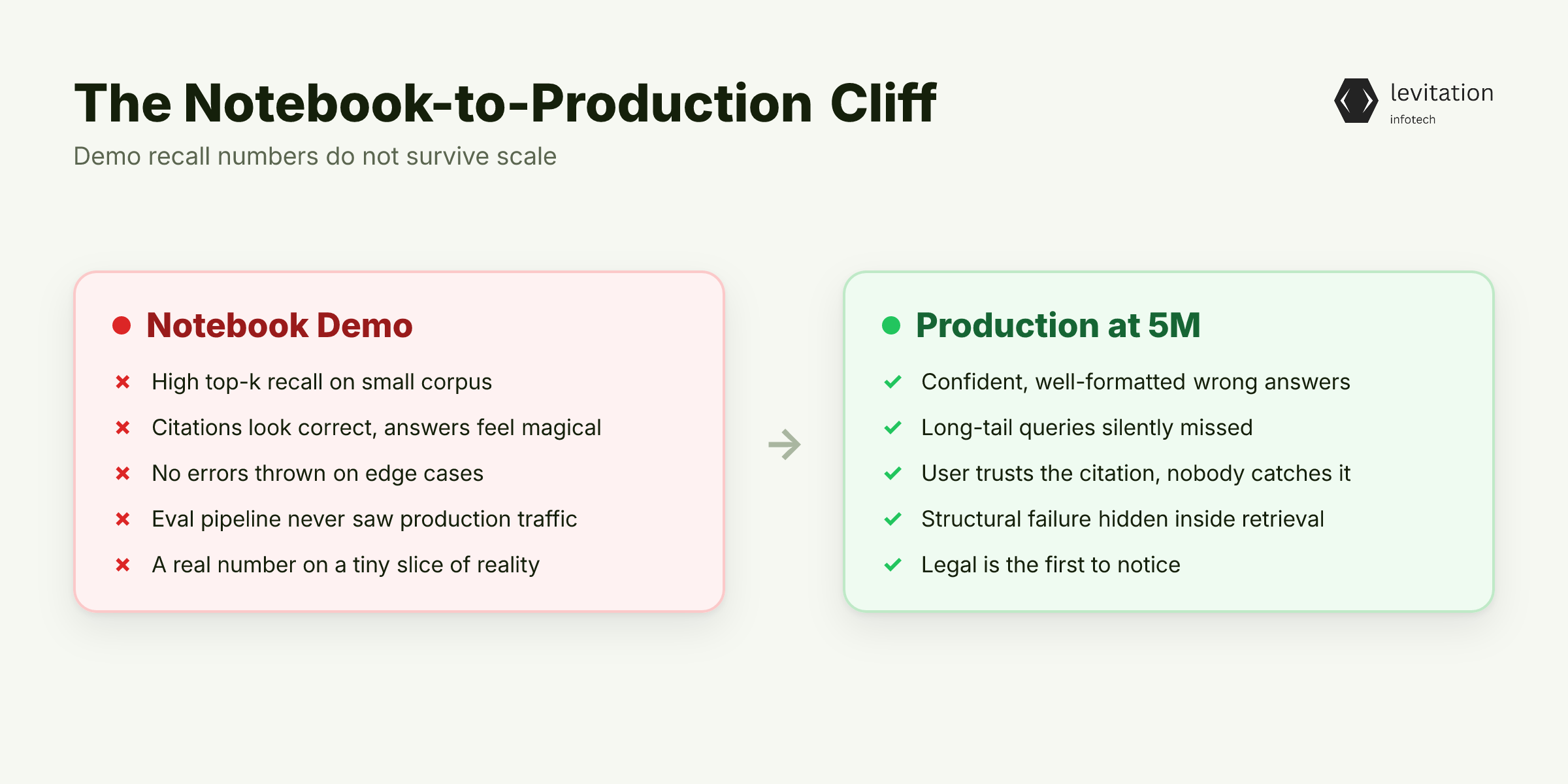
Most RAG demos are tuned on a notebook-scale corpus. You embed a few PDFs, push them into a local Chroma, and top-k retrieval feels magical. The answers come back with citations. You ship the demo.
Then production lands a different world on your desk. You get a corpus with collisions, stale chunks, and query distributions the prototype never saw. The system does not throw errors. It returns confident, well-formatted answers that are subtly, confidently wrong.
The LLM reasoned faithfully over the wrong context. The user trusts the citation. Nobody catches the failure until legal does.
This is the silent failure mode that makes RAG production work so hard. A demo that achieves high top-k recall on a notebook corpus is a real number. A system that achieves the same recall at 5 million is missing every long-tail query the business cares about. If your AI/ML training pipeline never saw production traffic, the eval is a fiction.
The first instinct is to blame the embedding model or the vector database. Both guesses miss the real failure mode by an order of magnitude. The failure is structural, and it lives in the assumption that more vectors should make retrieval better.
Why More Vectors Make Retrieval Worse, Not Better
The naive top-k mental model was designed for a regime that no longer exists.
In a small notebook corpus, the chance of two chunks landing near each other in embedding space is low. Queries have unique neighborhoods. Top-k is essentially a recall oracle.
At 5 million, every dense region of the vector space is crowded, and your top-k budget is now a competition. The recall curve is not linear. Adding orders of magnitude more documents does not reduce precision proportionally. It destroys it. Semantic collisions in dense regions now outnumber your retrieval slots.
Query ambiguity multiplies with the same force. A small corpus has near-zero semantic overlap, so each user query maps to a clear cluster. A 5-million-document corpus is full of near-duplicates competing for the same vector slot.
The query "termination policy for SaaS contracts" now has to beat out hundreds of similar-sounding clauses. Regulatory documents, employment handbooks, and vendor agreements all cluster in the same region.
Latency budgets break too, and not in the way you expect. A single vector store round trip at 5 million is not the same primitive as at notebook scale. Index partitioning, ANN parameter choices, and shard fan-out change the math. Latency that felt instant on your laptop now grows as index type and recall target change. The cost compounds with every additional hop in the pipeline.
The composite effect is brutal. The same retriever that delivered strong recall on a notebook corpus can see recall collapse at 5 million documents, even if you never touched the embedding model. The corpus did not get worse. Your retrieval stack just stopped being adequate for it.
A RAG deployment that scaled to production can break with the same embedding model and chunking strategy, because the bottleneck moved up the stack. If your AI/ML training corpus looks nothing like the production corpus, you measured the wrong system.
If adding vectors is the problem, the answer is not fewer vectors. It is a different retrieval stack layered on top of them.
The Five Levers That Actually Move Production Retrieval
These five levers run at query time. The other half of the problem lives in the indexing pipeline, and most teams underinvest there. Not all of them carry equal weight or cost, but these are the five that move production retrieval.
- Reranking. The best change per dollar. Pass 50 candidate chunks through a cross-encoder, return the top 15. This is often the difference between a failing and shipping system. The cross-encoder uses full pairwise attention between query and chunk, which cosine similarity cannot replicate. It is the highest-impact 5 lines of code in your RAG stack.
- Query generation. One user query is not enough surface area. An LLM rewrites the question into multiple semantic and keyword variants, all run in parallel, then merged. A query like "What is the refund window for annual plans?" can be expanded into "refund policy subscription," "cancellation terms yearly plan," and "money-back guarantee SaaS." Each variant surfaces different chunks.
- Metadata injection to the LLM. Pure chunk text is a stripped-down representation. Prepending title, author, date, and document type measurably improves answer quality. A chunk about "Apple" the company and "apple" the fruit are close in vector space. The metadata tells the LLM which one to trust.
- Query routing. A meaningful fraction of production traffic is not retrieval questions at all. Summarization, authorship, chitchat. Route these to a lightweight path before they pollute retrieval metrics and waste vector budget. Without routing, you are burning a reranker call on "tell me a joke."
- Hybrid search as a default, not an option. Dense retrieval alone fails on exact-match entities, codes, and proper nouns. Lexical fallback is not a luxury at scale, it is load-bearing. BM25 over the same corpus catches what embeddings miss, and the reciprocal rank fusion of dense plus lexical is the operating point most production systems converge on.
Here is what the retrieval stage typically looks like when these are wired together:
1async def retrieve(query: str, k: int = 15):2 variants = await query_rewriter.expand(query)3 candidates = await asyncio.gather(*[4 hybrid_search(v, n=50) for v in variants5 ])6 merged = rrf_dedupe(candidates)7 reranked = await cross_encoder.rerank(query, merged[:50])8 return reranked[:k]
The function looks small. The infrastructure behind each line is what makes it production-grade, and that infrastructure is where the next problem lives.
Engineering the Indexing Pipeline, Not Just the Query
A correct index with an unmeetable latency budget is still a failed system. The next constraint is the pipeline that built the index.
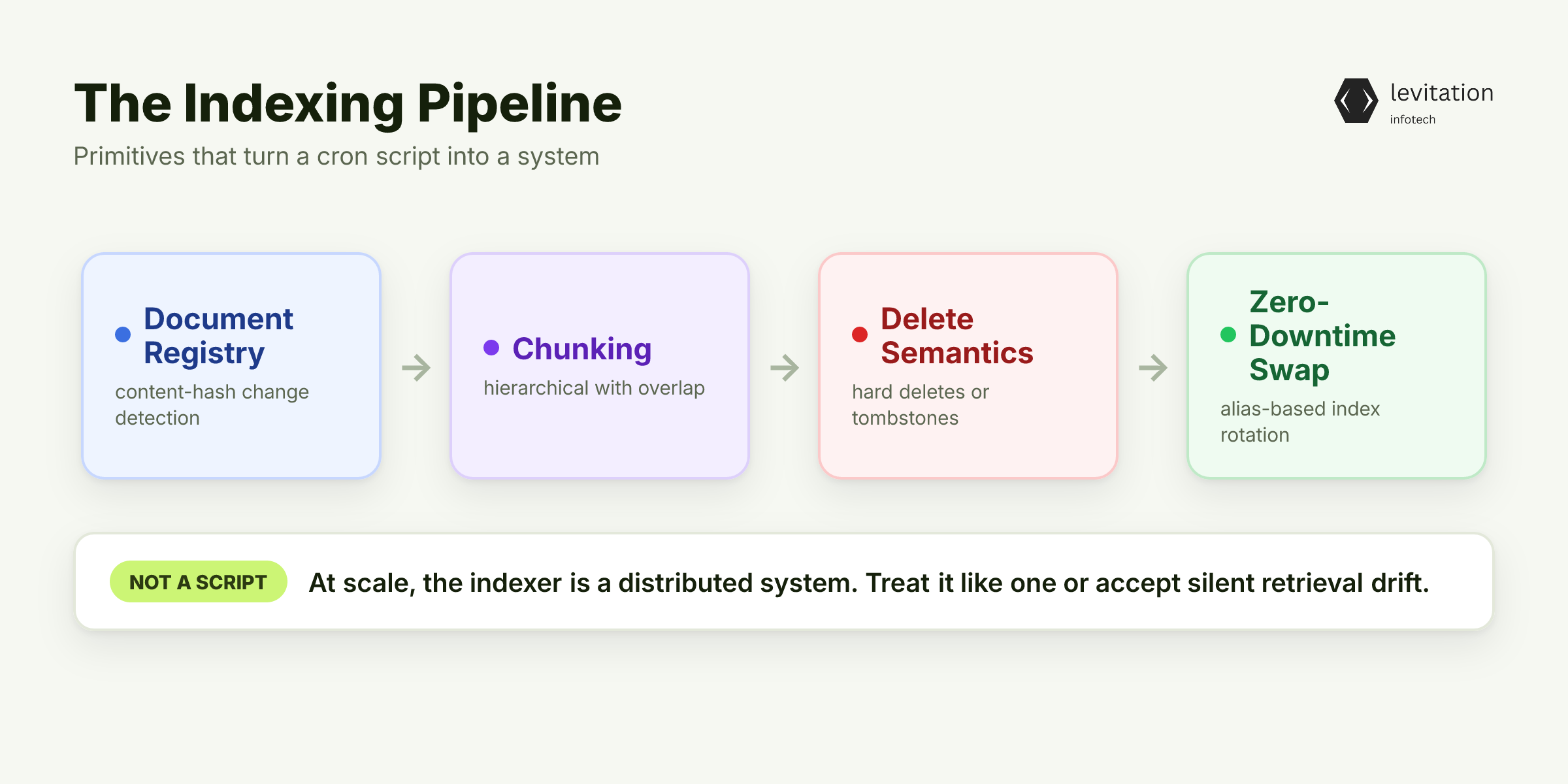
Most teams treat indexing as a script that runs nightly. At 5 million documents, that script is a distributed system whether you admit it or not. Pretending otherwise is how retrieval drifts silently for months.
A few primitives make the difference. A document registry with content-hash-based change detection lets you tell which documents changed since the last run. Without it, you re-embed everything, or worse, you re-embed nothing and your index goes stale.
Delete semantics must work. Soft-deletes in vector stores are not free, and stale chunks silently corrupt retrieval for months. You need hard deletes that propagate through the index, or tombstones that the retriever respects.
Alias-based zero-downtime deployment lets you build a new index, swap the alias, and retire the old one. Without this, every reindex is an outage.
Chunking strategy is upstream of every retrieval metric. Fixed-size splits lose semantic boundaries. Semantic splits explode variance. The right answer is almost always hierarchical with overlap, so a query can hit a small chunk and the LLM still gets the surrounding context.
A vector index migration that breaks nothing in dev and everything in prod is the kind of failure that turns a reindex into a week-long incident.
The pipeline is a distributed system, not a script. Treat it like one or accept that your retrieval will drift, and the latency story is the next thing to get right.
Latency, Cost, and the Distributed Systems Reality
The pipeline above is the design. Latency and cost are where it meets the budget.
A production RAG query path is not a single embedding lookup. It fans out to a vector store, a keyword index, sometimes a relational or graph store, then merges, reranks, and generates. Each hop adds latency.
A 50-candidate reranker over your chosen chunk size is not free. A hybrid search that hits two indices and fuses results is not free. The LLM call is the dominant cost, but the second-biggest line item is almost always the reranker.
Latency budgeting must be explicit. Allocate budget per stage before you tune, or you will optimize the wrong link in the chain. A reasonable allocation for a target under two seconds might look like: - Query rewrite: bounded by LLM latency, runs in parallel - Vector search: dominated by ANN traversal cost and shard fan-out - BM25 search: indexed lookup, grows with corpus size - RRF merge: in-memory fusion, cheap relative to retrieval - Reranker (50 in): full pairwise attention, the second-largest cost after generation - LLM generation: the dominant cost in the pipeline - Streaming overhead: bounded by token-by-token emission rate
ANN parameters are not defaults you can leave alone at scale. `ef`, `nprobes`, HNSW `M` are knobs you tune against recall, and the operating point moves as the corpus grows. A corpus that doubled since your last tune will have moved off its operating point, and your recall will quietly degrade.
Observability is not optional. You cannot tell a retrieval failure from a generation failure without end-to-end tracing, and the two require completely different fixes. Most production RAG failures look like LLM problems but are actually retrieval problems. The answer is confidently wrong because the model faithfully reasoned over the wrong context.
Get the five levers, the indexing pipeline, and the latency model right, and RAG stops being a demo architecture. It starts being a platform, which is a different problem to operate.
From Demo Architecture to Durable Platform
The shift is from prompt pattern to systems engineering. Ingestion, retrieval, generation, evaluation, and observability become first-class subsystems with their own owners and SLOs.
Evaluation becomes continuous, not a one-time gate. LLM-as-judge gives you automated regression coverage on a held-out query set. Targeted human review catches distribution shifts the LLM judge misses. The two layers together give you a system that knows when it is broken, not one that finds out from a customer.
Long-term value is in the engineering judgment, not the model. The same pipeline runs across model upgrades because the retrieval layer is decoupled from the generator. A swap from one frontier model to another is a config change, not a rewrite.
The pattern is the same across deployments: build the retrieval stack like a distributed system, and the model is interchangeable. The AI/ML training cycle is what keeps the whole platform honest as the underlying models and corpora shift under it.
The questions that follow are the ones CTOs ask when the corpus number stops being a slide and starts being a procurement requirement.
Frequently Asked Questions
Q: At what corpus size does naive RAG start to break?
A: There is no single threshold, but recall degradation becomes visible as the corpus grows. The drivers are embedding dimensionality, chunk overlap, and query diversity. The real inflection point is when semantic collisions in dense regions of the vector space start outnumbering your top-k budget.
Q: Is reranking really necessary if I already use a good embedding model?
A: At production scale, yes. Cross-encoder reranking operates on a candidate set the embedding model has already filtered. It uses full pairwise attention rather than cosine similarity. The 50-in, 15-out pattern reliably recovers recall that the retriever loses to collisions.
Q: How do I evaluate a production RAG system without a giant human labeling team?
A: Layer automated LLM-as-judge evaluation for regression coverage on a held-out query set. Supplement with targeted human review on distribution shifts and high-stakes queries. Instrument retrieval-specific metrics (recall@k, MRR, nDCG) separately from generation metrics so you can localize failures to the right subsystem.
Q: What is the single highest-impact change for a RAG system that is failing in production?
A: Add a cross-encoder reranker with a wide candidate window, 50 chunks in and 15 out. It is the best change per dollar, and it is the move most teams skip because the retriever alone looked fine in the demo.
Q: How long does a production RAG deployment typically take?
A: Timelines vary widely. Teams that treat RAG as a distributed systems problem tend to ship faster and evolve their systems more cleanly than teams that treat it as a prompt pattern bolted onto a vector store.
The notebook demo is the easy part. The distributed system is the part that ships.
About the author
Mayank Singh is a software developer at Levitation Infotech, where he builds web and AI-powered applications across the company’s fintech, healthcare, and enterprise projects.