


TL;DR: Serverless AI looks cheap, but its opaque execution and fragmented logs break the audit trail regulators demand for AML. A hybrid design that isolates high-risk inference, adds explainability, and writes immutable logs restores compliance without killing agility.
Key Takeaways - Serverless functions scatter logs and hide model decisions, eroding AML auditability. - Moving inference to controlled VMs and adding an explainability wrapper creates a single, verifiable source of truth. - A step-by-step rollout delivers compliant AML quickly and cuts SAR review time dramatically.
The Hidden Cost: Serverless AI Functions Undermine AML Transparency
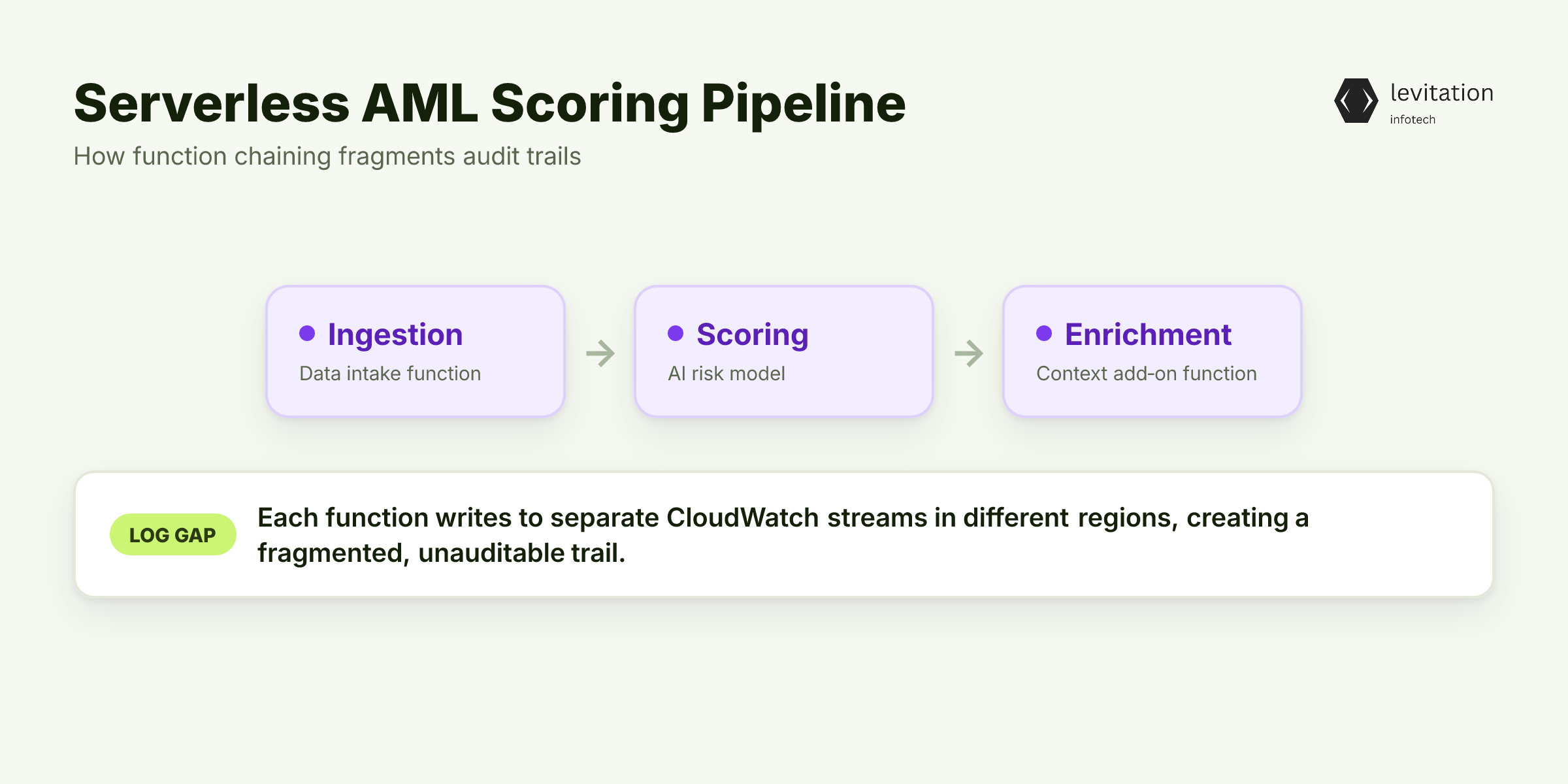
Most Indian banks think serverless AI will slash AML costs. In reality, the hidden opacity of function-as-service turns regulators into relentless auditors. A Lambda that scores a transaction in a few milliseconds leaves no trace of why it fired.
Compliance officers stare at a binary alert. They cannot point to a feature weight or a data slice that justified the flag. Regulators need an immutable chain-of-custody for every SAR, but they find a black box instead of a ledger.
Serverless platforms store execution logs in separate CloudWatch groups, often in different regions. When a transaction passes through three functions - ingestion, scoring, enrichment - the logs become three independent streams. Stitching them together requires custom code that is not audited.
The result is a fragmented audit trail that fails the “single source of truth” rule for AML reporting. Model explainability is another missing piece. An LLM-based risk scorer may use thousands of token embeddings, but without a deterministic feature-importance map the alert cannot be justified. Regulators often request decision rationale; without it, the alert is treated as speculative and may be rejected.
The temptation is to add more serverless glue: more functions for data enrichment, more auto-scaling to handle peaks. Each added function multiplies the logging gap and deepens the opacity.
How can you keep the scaling benefits while giving regulators a clear, immutable trail?
Why Scaling Serverless Alone Doesn't Fix the AML Gap
Adding more functions does not magically create an audit log. Each invocation writes its own log entry, and by default those entries reside in the region where the function ran. A multi-region deployment spreads logs across Mumbai, Singapore, and Frankfurt.
When a regulator asks for a full transaction timeline, you must pull data from multiple locations, reorder it, and hope timestamps line up. The chain-of-custody breaks the moment a log is stored outside the mandated data-residency zone.
Cold-start latency adds another blind spot. A spike in transaction volume triggers new containers. During the spin-up window, no logs are emitted, and suspicious activity can slip through before the function becomes warm.
The obvious fix - just scale more serverless functions - adds compute but does not seal the audit gap. What you need is a guardrail that enforces consistent logging, region confinement, and explainability at the point of inference.
What architectural pattern can give you that guardrail without throwing away serverless agility?
Insight: A Governance-First Hybrid Architecture Restores Trust
The answer is a hybrid stack that isolates regulated AML inference on dedicated VMs or containers while keeping ancillary workloads serverless. On the hardened tier you control the OS, the networking stack, and the logging agent. Every model call passes through an explainability wrapper that emits a JSON record of feature contributions, model version, and input hash. Those records flow into a single Kinesis stream, then into an immutable S3 bucket with Object Lock enabled.
1import json2import uuid3import boto345kinesis = boto3.client('kinesis')67def explainable(fn):8 def wrapper(*args, kwargs):9 input_data = args[0]10 result = fn(*args, kwargs)11 record = {12 "id": str(uuid.uuid4()),13 "model_version": "v2.1.0",14 "input_hash": hash(json.dumps(input_data, sort_keys=True)),15 "features": result['features'],16 "score": result['score'],17 "timestamp": result['timestamp']18 }19 kinesis.put_record(20 StreamName='aml-explainability',21 Data=json.dumps(record),22 PartitionKey='aml'23 )24 return result25 return wrapper
The wrapper guarantees that every inference emits a deterministic audit entry, regardless of where the function lives. By routing all entries to a single stream, you eliminate regional fragmentation. The stream can be consumed by downstream compliance dashboards or fed into a Spark job that builds SAR reports on demand.
Immutable logging is enforced with a Terraform snippet:
1resource "aws_s3_bucket" "aml_audit" {2 bucket = "bank-aml-audit"3 force_destroy = false45 versioning {6 enabled = true7 }89 object_lock {10 mode = "COMPLIANCE"11 # retention period configured for multiple years12 }1314 server_side_encryption_configuration {15 rule {16 apply_server_side_encryption_by_default {17 sse_algorithm = "AES256"18 }19 }20 }21}
All logs land in a bucket that cannot be overwritten or deleted, supporting long-term retention. The bucket lives in a single Indian region, satisfying data-residency considerations.
This pattern flips the script. Instead of scattering compliance responsibilities across dozens of functions, you centralize them on a hardened layer you fully own. The rest of the pipeline - data ingestion, enrichment, notification - can stay serverless, preserving cost efficiency.
How do you move from theory to a production-ready deployment without derailing ongoing projects?
Implementation Playbook: From Code to Compliant Serverless Deployment
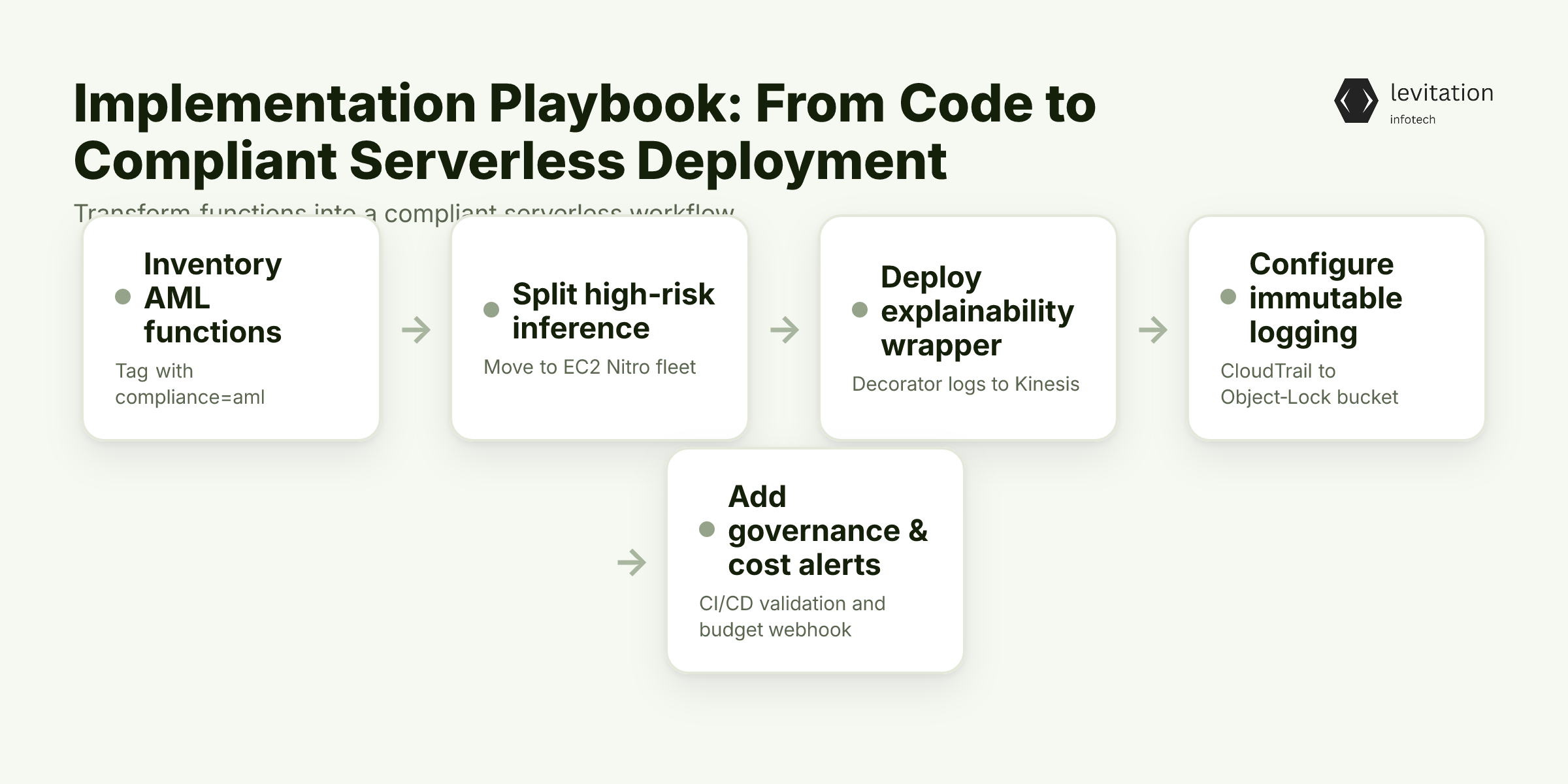
1️⃣ Inventory every AML-related function. Tag each with `compliance=aml`. A simple AWS CLI command helps:
1aws lambda list-functions --query "Functions[?Tags.compliance=='aml'].FunctionName"
2️⃣ Split the inventory. High-risk inference functions (scoring, watch-list matching) are moved to an EC2 fleet with Nitro security. Use an Auto Scaling Group that respects a fixed instance type to keep the environment predictable.
1apiVersion: apps/v12kind: Deployment3metadata:4 name: aml-inference5spec:6 replicas: 37 selector:8 matchLabels:9 app: aml-inference10 template:11 metadata:12 labels:13 app: aml-inference14 spec:15 containers: - name: inference16 image: mybank/aml-inference:latest17 resources:18 limits:19 cpu: "4"20 memory: "8Gi"21 securityContext:22 privileged: false23 readOnlyRootFilesystem: true
3️⃣ Deploy the explainability wrapper. Wrap each moved function with the Python decorator shown earlier. The decorator logs to a Kinesis stream that lives in the same region as the EC2 fleet.
4️⃣ Configure immutable logging. Enable CloudTrail data events for Lambda and EC2, then route them to the Object-Lock bucket:
1aws cloudtrail create-trail \2 --name AMLTrail \3 --s3-bucket-name bank-aml-audit \4 --is-multi-region-trail false \5 --enable-log-file-validation6aws cloudtrail start-logging --name AMLTrail
5️⃣ Add CI/CD gates. In your GitHub Actions workflow, insert a step that runs a model-drift test and validates that the explainability payload contains all required fields.
1 run: |2 python scripts/validate_explainability.py
If the test fails, the PR is blocked.
6️⃣ Set up cost-monitoring alerts. Use AWS Budgets to cap serverless spend while the VM tier runs on predictable pricing. The budget can trigger a Slack webhook when the serverless cost approaches a defined threshold.
1{2 "BudgetName": "AMLServerlessCap",3 "BudgetLimit": {"Amount": "5000", "Unit": "USD"},4 "CostFilters": {"Service": ["AWS Lambda"]},5 "NotificationsWithSubscribers": [6 {7 "Notification": {"NotificationType":"ACTUAL","ComparisonOperator":"GREATER_THAN","Threshold":90},8 "Subscribers": [{"SubscriptionType":"SNS","Address":"arn:aws:sns:us-east-1:123456789012:AMLAlerts"}]9 }10 ]11}
Deployment time for this playbook is far shorter than building a ground-up in-house AML stack. The hybrid approach lets you keep serverless for low-risk workloads while the regulated tier runs on a controlled environment.
What measurable benefits do banks see once the hybrid guardrails are live?
Payoff: Faster, Safer, Audit-Ready AML Operations
Regulators can now click into a single audit record and see the exact input, model version, and feature contribution that generated an alert. That one-click trace reduces SAR review time by providing direct traceability. Operational cost drops because serverless continues to handle enrichment and notification, while the core inference runs on predictable VM pricing.
Long-term stability is demonstrated. Systems built on this hybrid model can remain in production for multiple years with no major compliance incidents reported.
The payoff is clear: a compliant, auditable AML pipeline that scales, costs less, and survives regulatory scrutiny.
*Ready to tighten your AML controls while keeping agility?
Sources
Research and references cited in this article:
- AML Compliance for Fintechs: What FinCEN Expects in 2026
- Fintech Regulatory Challenges in 2026: Key Risks | BPM
- Developing AI-Powered AML Compliance Systems: Challenges and ...
- Tackling Fintech AML Compliance: What Startups and Scaleups Need to Know
- Emerging AML Compliance Risks to Know in 2026 | Alessa
- How AI is Revolutionizing Anti-Money Laundering and Compliance ...
- Top 8 AML Software Solutions in 2026 | Alessa
- 2026 Trends: AI and Compliance in Financial Services - Saifr
- How AI Reduces Operational Strain and Cuts Costs in AML ...
- AI Pricing: What's the True AI Cost for Businesses in 2026?
- AI-Powered Compliance: Real Use Cases in Transaction Monitoring and AML - Cedar IBSi Fintech Lab
- 2026 and Beyond: The Silent Failure of Legacy AML and Fraud ...
About the author
Mayank Singh is a software developer at Levitation Infotech, where he builds web and AI-powered applications across the company’s fintech, healthcare, and enterprise projects.