


TL;DR: Serverless can beat a small VM for a 100-user, low-usage SaaS, but only under a stated traffic shape and peak. Model the current baseline, forecast peak and growth, then prove the candidate with a controlled load test. Set a trigger for moving sustained hot paths to containers.
Key Takeaways: - A $10 to $50 serverless estimate is not a quote until request volume, traffic shape, service mix, and support assumptions are attached. - Peak-month total cost, not average request price, should drive the runtime decision. - A 90-day baseline and load test turn architecture and vendor pricing into testable commercial terms.
The $10 to $50 Serverless Estimate Is Only a Traffic Forecast
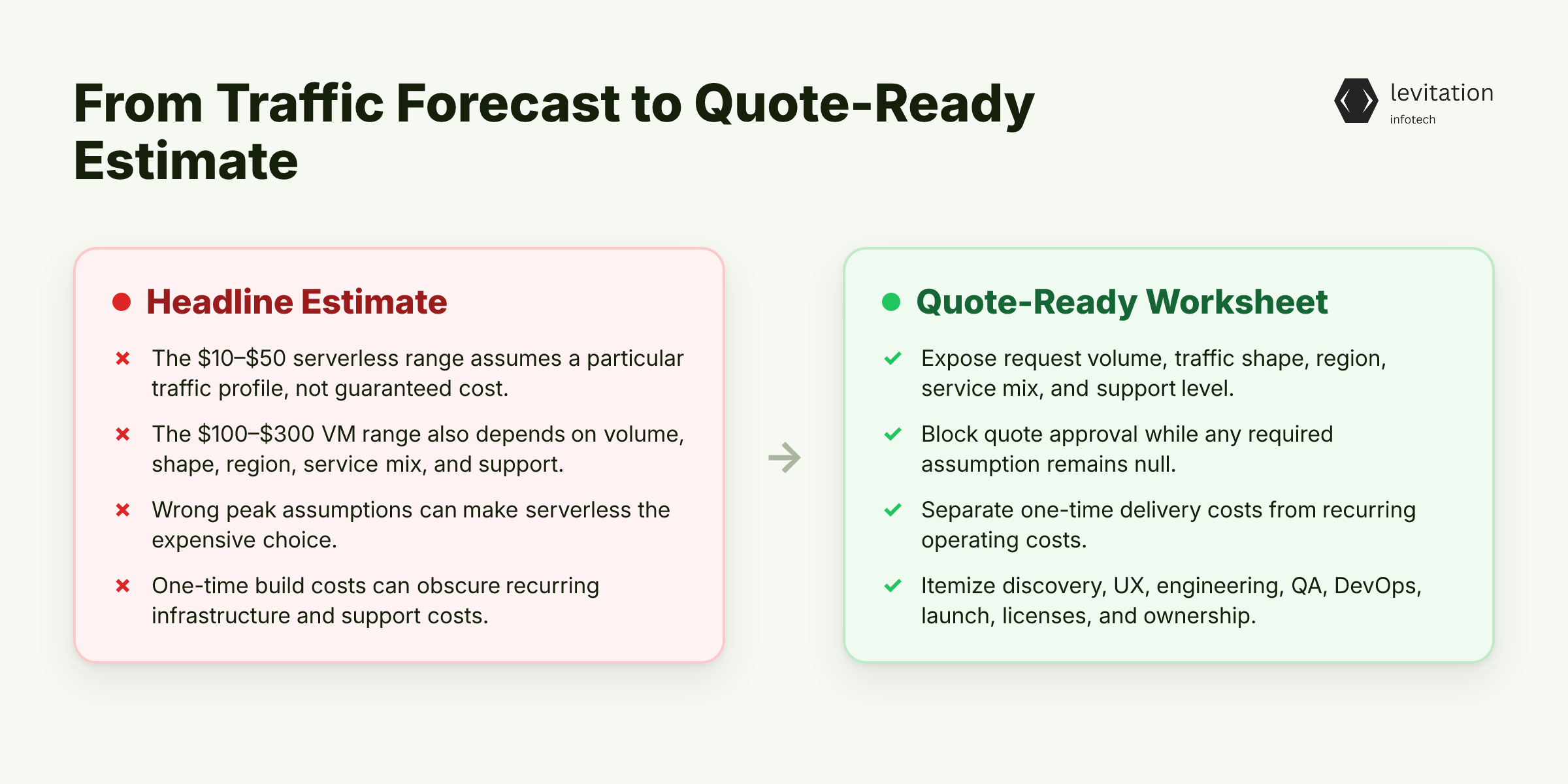
A 100-user SaaS can look like a $10 to $50 monthly serverless bargain against a $100 to $300 small VM scenario. Yet the wrong peak assumption can make that same architecture the expensive choice.
The headline range is not a cost estimate. It is a traffic forecast with a price attached.
Neither range is a quote because both embed assumptions about request volume, traffic shape, region, service mix, and support requirements. A valid worksheet exposes those gaps before anyone signs a commercial proposal.
1traffic_tco:2 workload:3 users: 1004 usage: low_usage56 scenario_ranges_usd:7 serverless: [10, 50]8 vm_with_managed_services: [100, 300]910 quote_blockers:11 request_volume: null12 traffic_shape: null13 region: null14 service_mix: null15 support_level: null
A null field blocks quote approval. That rule keeps a promising estimate from becoming an accidental commitment.
One-time and recurring costs need separate treatment. A one-time build estimate says little about peak-load run rates or the support needed after launch.
Any estimate for custom software development cost in India should itemize the whole delivery chain: - Discovery, UX, frontend, and backend engineering - QA, DevOps, and launch support - Cloud services, third-party licenses, and post-launch ownership
This build-versus-recurring distinction should shape custom software decisions as usage grows.
Make the first vendor deliverable a traffic-and-TCO worksheet, not a one-line monthly infrastructure estimate. Peak assumptions belong in the commercial quote because they affect architecture, overage exposure, support requirements, and total cost of ownership.
The cheapest-looking invoice is therefore only a hypothesis. What happens when traffic stops resembling an average?
Why Peak Traffic Breaks the VM-versus-Serverless Quote
The obvious comparison is also the least useful. It sets a serverless estimate against a provisioned VM without comparing what each platform actually charges.
Define the comparison boundary before assigning costs. Per-execution functions, request-priced APIs, and autoscaled containers use different billing units.
1comparison_boundary:2 functions:3 billing_unit: execution4 priced_inputs: [requests, duration, memory]56 api_gateways:7 billing_unit: request89 containers:10 billing_unit: container_runtime11 priced_inputs: [cpu, memory, running_time]1213 common_boundary: - concurrency - egress - region - support - discount_assumptions
Every quote must name the billing unit, duration, memory, requests, concurrency, egress, region, support, and discount assumptions. Otherwise, the comparison is arithmetic without semantics.
The TCO then exposes four cost classes: - Capacity cost: Serverless avoids permanent idle capacity, but a concentrated peak produces a sharp usage increase. Provisioned capacity preserves a predictable baseline. - Downstream cost: Databases, gateways, storage, egress, observability, and third-party APIs can also scale beyond the function invoice. The hidden observability tax starts here. - Product-constraint cost: Cold starts, execution limits, concurrency ceilings, and timeout behavior can force architectural changes. - Operating cost: Retries, logging, incident response, specialist skills, and support coverage belong in the calculation.
The pricing model also changes the exposure. Usage-priced customer activity makes variable cost visible. A flat subscription can hide monthly processing peaks, but it never removes them.
Once these drivers are visible, serverless versus VMs becomes a workload decision, not a platform debate. Which workload profile will expose the real break-even?
The Three-Workload Model That Reveals the Real Break-Even
The break-even is a traffic shape, not a price.
Small MVP
Model a 100-user product with a basic API and low usage. Compare serverless with the $100 to $300 monthly small VM. This can favor serverless when activity is irregular and managed services stay inexpensive.
Growing SaaS
Model about 10,000 users, moderate API calls, and scheduled reports. Serverless stays competitive when traffic is bursty. Rising usage and batch jobs must remain visible in the calculation.
Large SaaS
Model steady, high-volume traffic measured in many requests per second. At this scale, provisioned VMs or dedicated capacity offer the stronger cost case. Do not make serverless the default conclusion.
Calculate the full monthly cost for each candidate:
1=SUM(execution_compute, reserved_or_provisioned_capacity, database, api_gateway, storage, egress, observability, third_party, support_ops)
Then apply four rules: - Run the model for the current baseline, forecast peak, and projected growth. - Report the peak month separately. Do not blend peak demand into a flattering average. - Track cost per successful transaction or completed customer journey. - Define the hybrid trigger early. Keep functions for bursty paths. Move sustained hot paths when the forecast favors containers or VMs.
Every SaaS development proposal should show these scenarios beside its architecture proposal. Otherwise, the runtime choice remains a preference rather than a forecast.
A spreadsheet can identify the break-even. Only a controlled load test can prove the candidate survives the peak you will pay for. What does the current product's baseline traffic actually look like?
A 90-Day Load Test Replaces Guesswork
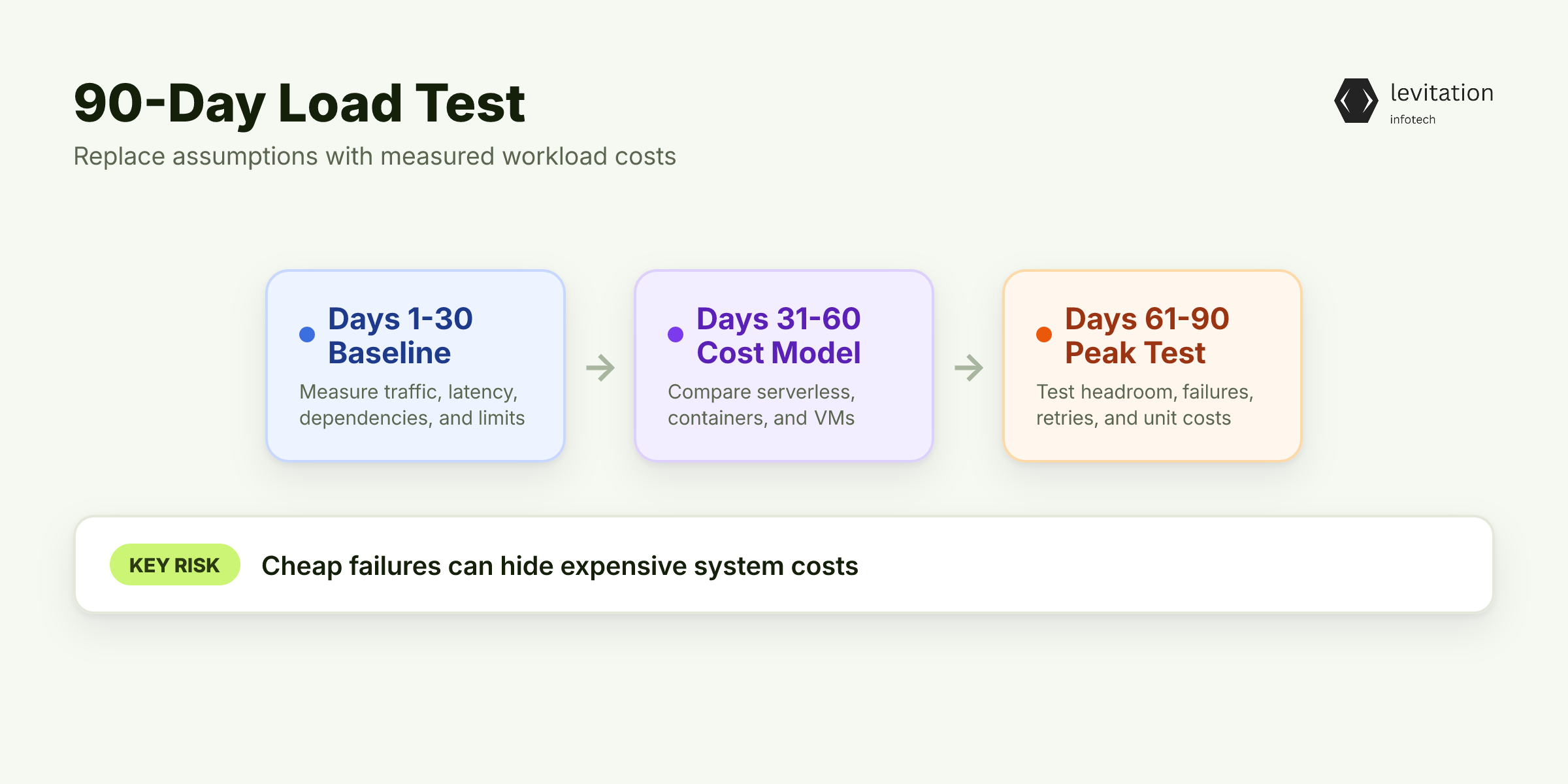
A spreadsheet can be wrong with great precision. The 90-day test turns assumptions into measurements.
Days 1-30: Establish the baseline
Collect the traffic and dependency signals that affect both latency and billing. - Request counts, concurrent sessions, p95 latency, and p99 latency - Function duration, scheduled jobs, egress, retries, and error rates - Database load, connection pressure, and downstream service limits
Days 31-60: Build the cost model
Enter the baseline into the three workload profiles. Obtain current provider rates and service quotas. Compare serverless, container, and VM candidates across a 12-24-month horizon.
Days 61-90: Execute the peak test
Test the agreed peak with the agreed headroom. A basic `k6` scenario can make the run repeatable:
1import http from "k6/http";2import { check } from "k6";34function required(name) {5 const value = __ENV[name];6 if (!value) throw new Error(`Missing ${name}`);7 return value;8}910const baseURL = required("BASE_URL");11const testPath = required("TEST_PATH");12const targetVUs =13 Number(required("PEAK_VUS")) + Number(required("HEADROOM_VUS"));1415export const options = {16 scenarios: {17 peak: {18 executor: "ramping-vus",19 startVUs: 0,20 stages: [21 { duration: required("WARMUP"), target: Number(__ENV.PEAK_VUS) },22 { duration: required("PEAK_DURATION"), target: targetVUs },23 ],24 gracefulRampDown: "30s",25 },26 },27 thresholds: {28 http_req_failed: [`rate<${required("ERROR_RATE_THRESHOLD")}`],29 http_req_duration: [`p(95)<${required("P95_MS")}`],30 },31};3233export default function () {34 const response = http.get(`${baseURL}${testPath}`);35 check(response, { "status is 200": (result) => result.status === 200 });36}
Export the required variables from the test plan, then run `k6 run peak.js`. Separate runs should exercise cold starts, autoscaling, downstream saturation, retry storms, provider throttling, and failover behavior.
Record cost per request and cost per successful business transaction. Cheap failed executions must not disguise an expensive system.
Attach every assumption to the report. Include traffic shape, region, memory settings, dependency limits, retention, and expected growth. Then produce one recommendation with baseline cost, peak cost, quotas, overage exposure, and a migration trigger.
Finally, run an operational drill. Name who responds to throttling, dependency saturation, unexpected log growth, and support escalation. This evidence should update the custom software development cost in India case.
A load test identifies the cheaper technical path. The commercial decision still has to decide which components to build, buy, and own. Which parts of the stack should the team own rather than rent?
Build vs Buy Changes When the Peak Becomes Expensive
Build-versus-buy is often asked at the wrong level. Apply it to each workload, then choose the runtime separately.
1workload_decisions:2 authentication: buy3 billing: buy4 standard_observability: buy5 differentiated_workflow: build6 domain_data_model: build7 usage_metering: build89runtime_decisions:10 bursty_event_paths: functions11 sustained_hot_paths: containers_or_vms12 persistent_managed_services: managed_services
A custom SaaS backend can use serverless for part of its traffic while managed services sit behind a persistent service. Runtime choice does not dictate product ownership.
Every commercial proposal should include these items: - Itemized engineering, third-party licenses, and cloud fees - On-call ownership and support-tier costs - Peak overage exposure and a 12-24-month TCO - Cloud account ownership, rate card at signing, and service quotas - Overage approval, price-change notice, and support response targets - Intellectual-property rights, data export, and exit responsibilities
This separation exposes the hidden costs described in why crossing the build-vs-buy line can hide build expenses.
When evaluating top custom software development companies in India, look for production longevity, regulated-industry experience, security credibility, and references covering comparable workloads.
Separating build, buy, and runtime choices lets the vendor quote one testable commercial envelope instead of a moving monthly estimate. What must that envelope lock down before anyone signs?
What a Decision-Ready SaaS Quote Must Lock Down
A monthly estimate is not a decision artifact. The final deliverable should be a short memo that another leader can review without calling the vendor.
1decision_memo:2 workload_baseline: null3 selected_architecture: null4 baseline_monthly_cost_usd: null5 peak_monthly_cost_usd: null6 dependency_costs: null7 quotas: null8 support_level: null9 decision_owner: null10 review_date: null1112 scaling_trigger:13 sustained_concurrency: null14 request_volume: null15 latency: null16 unit_cost: null
Treat every null field as a reason to block approval. Define the trigger that moves a function or hot path to containers or provisioned infrastructure.
Give finance a base budget plus an approved peak-cost envelope. Give the product team a clear usage metric for forecasting demand.
Rerun the model after material traffic changes, new integrations, pricing changes, or a major revision to the SaaS development and cloud estimate. This keeps the model tied to current decisions.
The operating payoff is concrete: fewer surprise serverless overages, clearer build scope, and fewer emergency architecture changes. Teams can mix managed and custom components without rewriting the product.
A scoped architecture assessment, load-test plan, and itemized build-versus-buy proposal should support any monthly infrastructure figure. The testable question is simple: which architecture still fits inside the approved peak-cost envelope?
Frequently Asked Questions
Q: Is serverless cheaper for an Indian SaaS product?
A: Not always. Serverless fits small, low-usage, or bursty products because it avoids paying for idle capacity.
For predictable, sustained high request rates, provisioned VMs or dedicated capacity cost less for the required performance. The correct answer comes from the peak-and-growth model, not the entry invoice.
Q: Does serverless reduce SaaS development cost?
A: Only partially. Serverless lowers infrastructure and server-management costs.
Multi-tenant isolation, integrations, metering, observability, and peak-load testing remain in the build scope. Evaluate the one-time build budget and recurring run rate separately.
Q: How much does SaaS development cost in India?
A: A reliable estimate depends on scope, team assumptions, cloud and third-party costs, support, and the expected peak workload. A commercial proposal should itemize those assumptions. It should compare the one-time build budget with the recurring run rate over the expected growth horizon.
Q: Should an Indian SaaS company build or buy its backend?
A: Buy standard components such as authentication, billing, and standard monitoring. Build the workflows, data model, and metering logic that shape the product. A hybrid architecture combines managed services with custom code. Choose the runtime separately for each workload.
Q: When should a SaaS product move from serverless to containers or VMs?
A: Move when sustained high traffic makes provisioned compute more economical after database, gateway, egress, observability, and operations costs are included. Follow a measured peak test and use a trigger set in advance rather than waiting for a surprise invoice.
Before anyone signs a fixed monthly figure, ask whether the quote can survive the peak test that matches customer traffic.
About the author
Mayank Singh is a software developer at Levitation Infotech, where he builds web and AI-powered applications across the company’s fintech, healthcare, and enterprise projects.