


TL;DR: Sharding cuts infrastructure spend. You replace one large database with several smaller nodes. But each new shard adds its own access controls, logs, encryption keys, and retention policies. The audit surface grows with shard count, not data volume. Infrastructure savings can quietly multiply the compliance workload. The trade-off only pays when your team has the engineering hours to absorb per-shard overhead.
Key Takeaways: - Infrastructure savings from sharding are well-modeled. Audit surface expansion is not, and it scales with shard count rather than data growth. - Every shard is a separate compliance perimeter with its own access controls, logging, and key management. - The three audit vectors sharding creates (access control sprawl, query trail fragmentation, and data residency drift) compound faster than infra savings as audit cycles lengthen. - Managed sharding platforms compress two of the three vectors but do not eliminate them. - Teams that get this right model infra savings and audit overhead in the same currency: engineering hours.
The Sharding Bill Your CFO Doesn't See
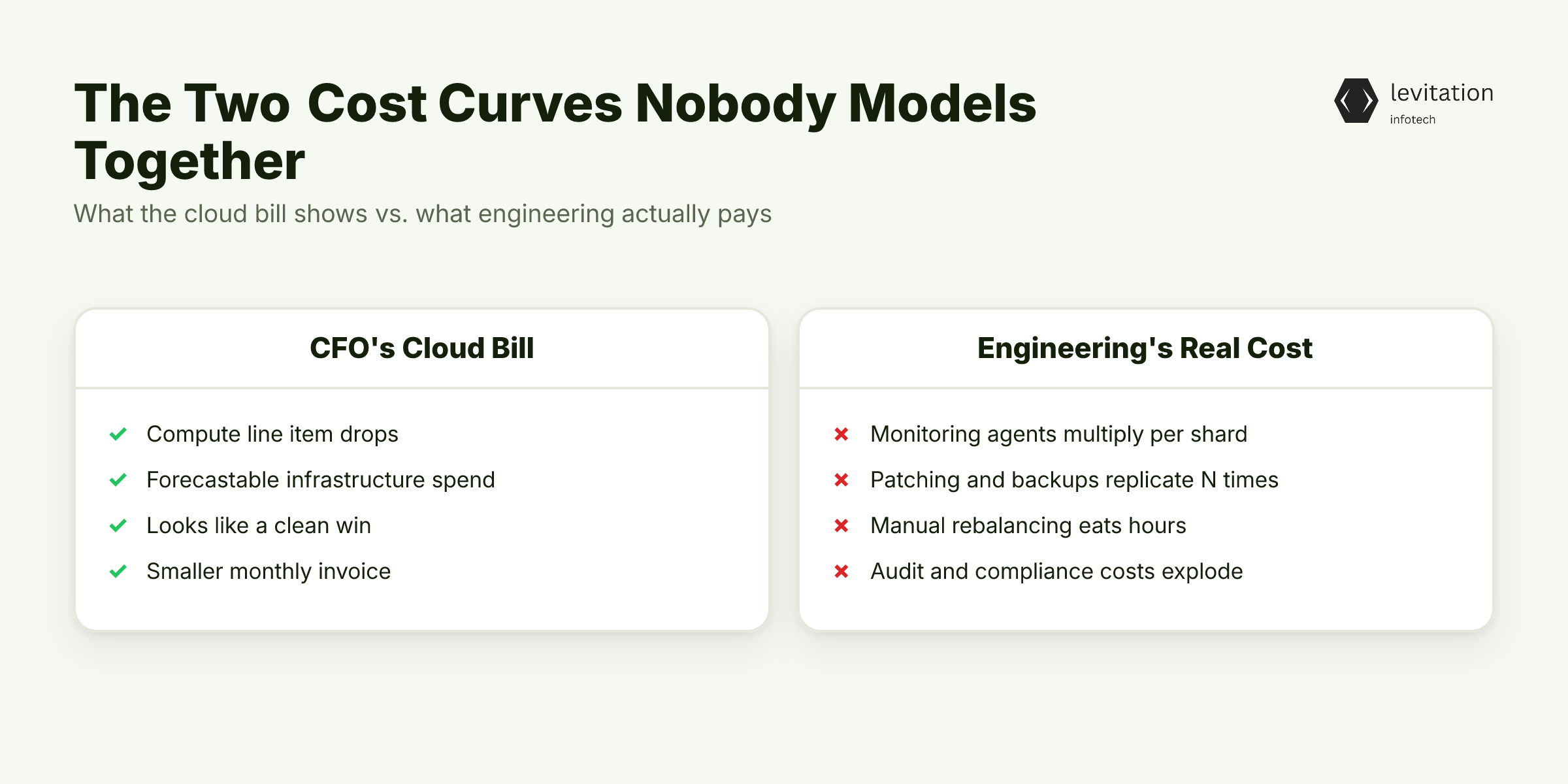
Every CTO who shards celebrates the infra savings, then watches their compliance workload expand in ways the cloud invoice never captured. The infrastructure cost curve goes down. The audit cost curve goes up just as fast, and almost nobody models both on the same graph.
Sharding replaces one large machine with many smaller ones. The compute line item drops, and the cloud bill starts to look like a victory. However, only the compute line item drops.
Operational overhead grows per shard. Monitoring agents multiply. Patching cycles now touch every node. Backups, failover drills, and schema migrations all replicate with shard count. The savings from splitting one big box into many small ones are real. However, they get diluted by the per-shard work that compounds with each new node.
The real spend shifts from infrastructure to engineering hours. Cloud bills are forecastable. Engineering hours spent on per-shard maintenance, manual rebalancing, and custom migration scripts are not.
As database architect Cao has observed, "sharding means accepting that there's a built-in limit on your development speed, which adds cost and risk to the business." The CFO sees the smaller cloud invoice. Engineering sees a slower release cadence.
The infrastructure cost curve is well understood. The second curve is the one nobody models. It shows up during your first post-sharding audit.
For a deeper look at the trade-offs in scaling out versus scaling up, see horizontal scaling tradeoffs. How those costs break down by workload is covered in database sharding cost.
Why Every Shard Is a Separate Compliance Perimeter
Shared-nothing architecture is the design pattern most sharded systems follow. Each node owns its data, its access controls, its logs, and its failure modes independently. That independence is exactly what makes sharding scale. It is also exactly what makes sharding audit badly.
What was one access control list becomes N. Every reviewer must walk each one.
Schema changes, encryption rotations, and retention policies must propagate to every shard. Auditors will check each propagation. A single missed node is a finding.
For regulated workloads, the per-shard perimeter multiplies the evidence you must produce. The per-node compliance overhead is where timelines slip. The same controls now live across multiple nodes. Each must be checked separately. What was one audit exercise becomes an exercise repeated at every node.
This is where "audit surface" stops being a metaphor. It starts being a line item. For specifics on what auditors examine, sharding audit compliance walks through the evidence pattern. Compliance review in distributed databases is covered in distributed database audit.
The Three Audit Vectors Sharding Creates
Knowing the three vectors is useful. Knowing whether you can absorb them is the real question.
Vector 1, access control sprawl. Every shard needs its own role definitions, its own grant reviews, and its own access recertification cycle. A user promoted to a senior role in January must be granted access on every shard that holds data they need.
A user who leaves the company must be revoked from every shard, on the same day. Otherwise the audit flags a stale permission. The work is mechanical, but it scales with shard count and headcount.
Vector 2, query trail fragmentation. Cross-shard queries leave logs on multiple nodes. Reconstructing a single user action requires stitching logs from each shard that served the request.
If your logging pipeline does not aggregate by correlation ID, this becomes a manual investigation. Auditors will ask for a single user's data access trail across the system. If you cannot produce it without manual correlation, you have a finding.
Vector 3, data residency and key management. Encryption keys, data classification, and residency rules must be enforced per shard. Any drift between shards is an audit finding waiting to happen.
One shard with a 90-day retention policy when the rest use 60 days is a violation. A key rotation that fails on one node creates an exposure gap. The auditor will not ignore it.
For a detailed look at how these vectors play out under HIPAA, HIPAA database compliance covers the access and encryption requirements in depth. Staying audit-ready as shard count grows is in sharding audit compliance.
When the Trade-Off Makes Sense, and When It Bankrupts You in Audit Hours
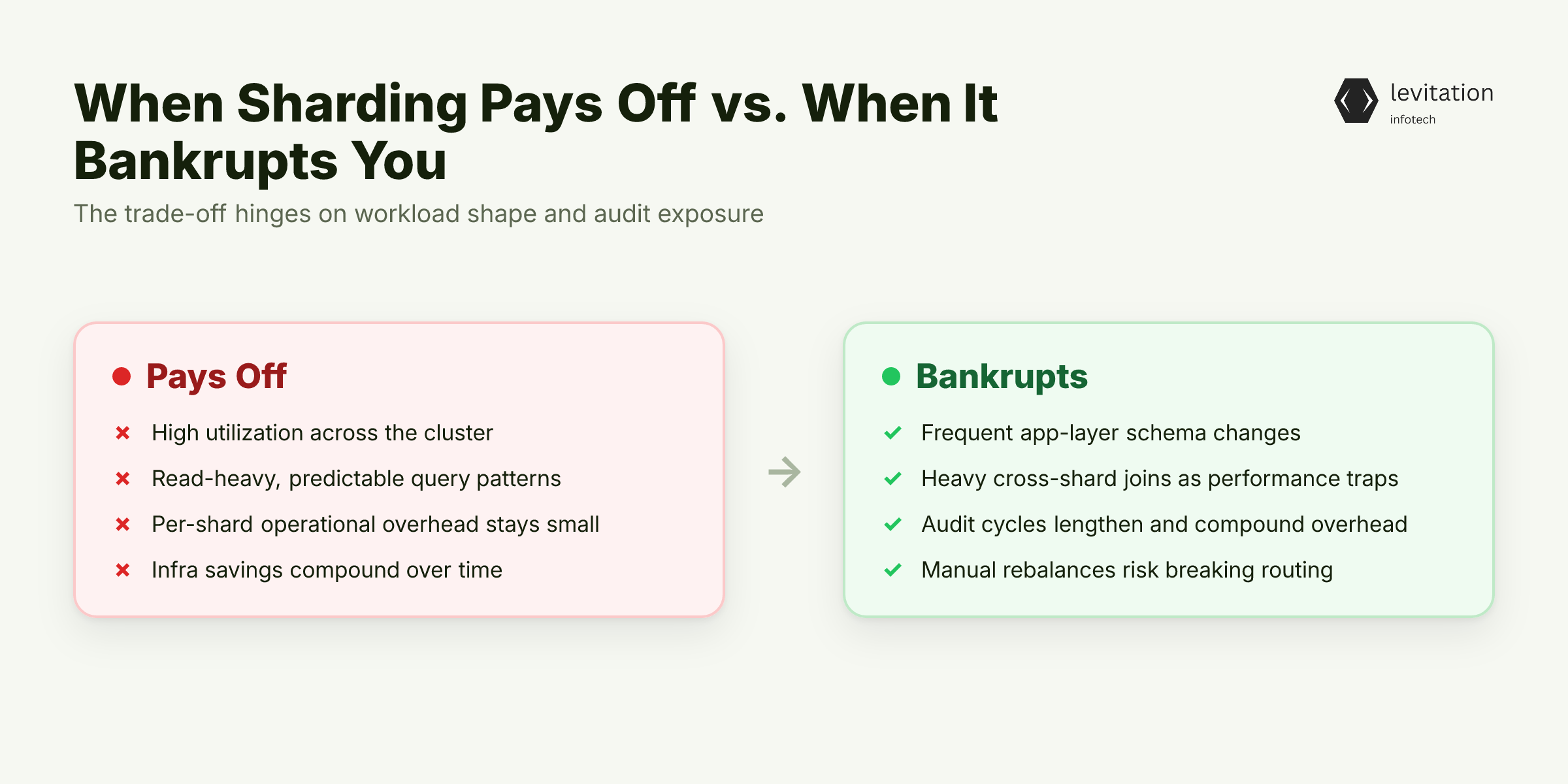
Sharding pays off when use is genuinely high across the cluster. It also helps when the workload is read-heavy with predictable query patterns. Under those conditions, the operational overhead per shard stays small, and the infra savings compound.
Sharding fails when the application layer needs frequent schema changes. It also fails with heavy cross-shard joins, or rapid feature iteration. As Cao puts it, manual sharding imposes a "speed and agility cost." Every schema change means touching application code. Every rebalance risks breaking routing. Every cross-shard join is a performance trap.
For regulated industries, the rule is this. As audit cycles lengthen, the sharding overhead compounds faster than the infra savings. Each cycle touches more shards, more keys, and more access lists.
Manual sharding amplifies every problem. Managed sharding (CockroachDB, Vitess, MongoDB Atlas) absorbs some, but not all, of the audit surface expansion. Vendor-managed key rotation and schema propagation help. Vendor-managed does not mean audit-ready.
The build-versus-buy question is sharp here. Managed sharding platforms with audit-readiness features can compress part of the per-shard work. However, the audit clock starts ticking long before the last shard is online.
How to choose between these paths is in managed vs self-hosted sharding. A closer look at how the cost curves diverge is in database sharding cost.
The Decision Framework: Five Questions Before You Cut a Shard
A framework is only useful if it changes outcomes. Run these five questions before you commit to a sharding plan. The answer will usually be clearer than the architecture diagrams suggest. - What is your current audit cycle length, and how much engineering time does it use per cycle? This is your baseline. Every shard you add will multiply that work. - How many cross-shard queries does your application issue, and can you measure that today? If you cannot measure it, you cannot control it. Auditors will find the untracked queries. - Who owns schema migrations, and how many environments must they touch? If the answer is more than one database, you are already paying a hidden tax. - Can you centralize access logging across all nodes, or will it require custom aggregation? Centralized logging compresses one of the three audit vectors. Custom aggregation does not scale. - What is your realistic cost-per-shard for monitoring, backup, patching, and key rotation? If the number is fuzzy, the sharding decision is premature.
The five-question checklist in full is at sharding decision framework. For the broader scaling context that frames these questions, see horizontal scaling tradeoffs.
What Teams Who Get This Right Actually Do Differently
Teams that have navigated this trade-off well share four habits.
They model infrastructure savings and audit overhead in the same spreadsheet. They use the same currency: engineering hours. The infra line and the compliance line get added together before any shard is cut.
They adopt managed sharding platforms when audit surface is a concern. Vendor-managed key rotation, schema propagation, and access logging compress two of the three vectors. They treat the platform as a force multiplier for a small compliance team, not a replacement for it.
They treat schema migrations as a first-class operational concern. They use tooling that propagates to all shards at the same time. A migration that succeeds on seven of eight nodes is a partial outage. The audit findings write themselves.
They retain a partner who has shipped the pattern before. The gap between a team that has navigated sharding-and-compliance and one that hasn't shows up most clearly during the window when the cluster is half-built. Audit findings arrive in proportion to that gap.
If you are evaluating a build-versus-partner decision on sharded, regulated workloads, see managed sharding platforms for how to build it. The audit mechanics are in distributed database audit.
A useful comparison: teams that adopt multi-model AI infrastructure face a similar expansion of audit surface. We measured this in Multi-Model AI Cuts GPU Costs 40%. It Doubles Your Audit Surface. The pattern repeats across infrastructure decisions. Every lever that cuts compute cost adds a control surface you have to govern.
Frequently Asked Questions
Does sharding actually reduce database cost?
Sharding can reduce infrastructure cost by replacing one large machine with several smaller ones. Savings are most pronounced at high use across the cluster. However, it does not reduce total cost of ownership. Operational and audit overhead scales with shard count. Net savings depend on workload shape and per-shard maintenance hours.
What does "audit surface" mean in a sharded database?
Audit surface is the total set of access points, log streams, and configuration boundaries a compliance reviewer must examine. In a sharded system, every shard becomes its own perimeter. Each has its own access controls, logs, encryption keys, and retention policies. The surface area scales with shard count, not data volume.
Is sharding compatible with HIPAA compliance?
Yes, but each shard must independently satisfy HIPAA's access control, audit logging, and encryption requirements. In practice this means per-shard key management and per-shard access reviews. You also need the ability to rebuild a user's data access trail across all shards that served a request. Many teams underestimate this overhead at the architecture stage. A similar pattern shows up in dynamic scaling: Karpenter's 90-Second Scaling Breaks HIPAA Audit Trails shows how a node-lifecycle decision can break audit continuity in the same way.
Can managed sharding platforms reduce audit overhead?
Partially. Managed platforms like Vitess, CockroachDB, and MongoDB Atlas handle shard rebalancing, schema propagation, and some logging centrally. This compresses two of the three audit vectors. They do not eliminate the per-shard access control perimeter. Vendor-managed does not mean audit-ready. You still own the configuration review.
What is the alternative to sharding for cost reduction?
Before sharding, most teams should evaluate other options. Try vertical scaling to the largest reasonable instance. Add read replicas for read-heavy workloads. Move cold data to object storage. Improve queries. Each of these avoids the audit surface expansion that sharding introduces. Sharding should be the last lever pulled, not the first.
About the author
Mayank Singh is a software developer at Levitation Infotech, where he builds web and AI-powered applications across the company’s fintech, healthcare, and enterprise projects.