


TL;DR: Treat the catalog as a shortlist, not proof of eligibility. Require lifecycle metadata that machines can verify before execution. At the gateway, enforce policy based on the task.
Key Takeaways: - Similarity search can rank an endpoint. However, it cannot prove that the endpoint is current or correct in production. - Discovery, eligibility, and execution need separate controls. These controls need lifecycle metadata and runtime policy. - Measure catalog health through agent outcomes. Do not rely on endpoint counts or docs coverage.
A Stale Catalog Becomes an Agent Failure Mode
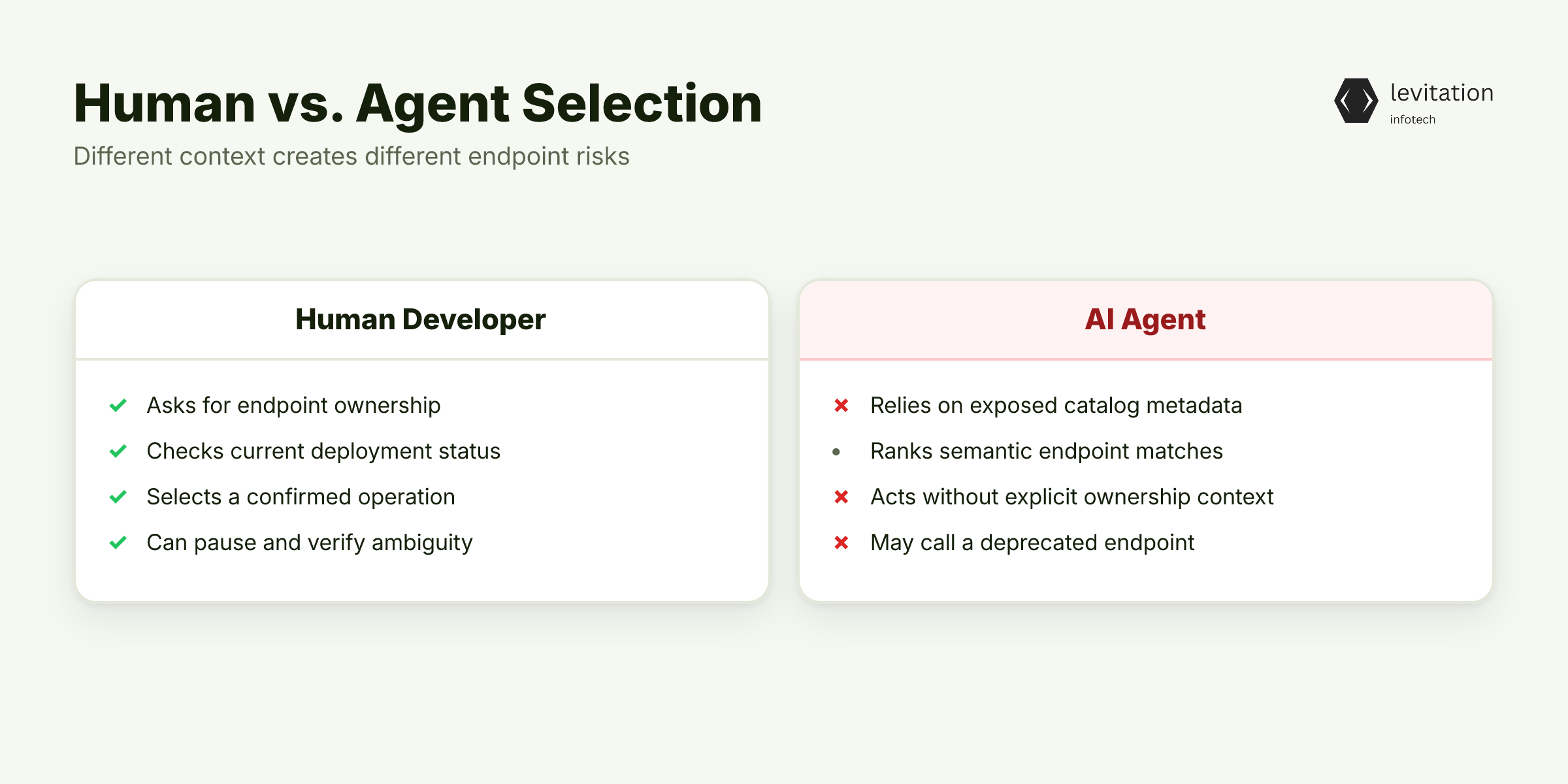
Treating AI API governance as docs creates live-system risk. An AI agent cannot ask which team owns a deprecated route. Stale metadata can look like valid context for an action. Then the wrong endpoint can run with confidence in production.
A human developer can pause, ask who owns an endpoint, or inspect a service registry. An agent uses the context it can access. It fills in the rest from names, descriptions, schemas, and similarity. - Human path: Ask for ownership, check deployment status, then select an operation. - Agent path: Read exposed metadata, rank semantic matches, then act on the available context.
Without explicit team context, agents can choose the most plausible endpoint instead of the correct one.
A stale catalog can be worse than no catalog
Without a catalog, an agent can abstain or rely on a direct tool binding. With stale metadata that machines can read, it gets a strong reason to act.
Consider a stale `v1` schema next to a current `v2` operation. The old schema can look simpler or more robust.
This leads to zombie API usage. Agents keep calling deprecated or unintended endpoints. The failure looks like an API error. It does not look like a mismatch between the catalog and production.
For teams investing in custom software development, inventory control now affects live-system behavior. Updating the catalog on a docs schedule is no longer enough.
If the danger is semantic selection, why doesn't publishing better documentation solve it?
Why Better Docs Do Not Expose Production Drift
Better docs can make intent clearer. They cannot show that live systems still match the artifact.
The catalog records intent; production determines reality
API catalog drift appears when published details differ from live systems. This can affect operations, schemas, scopes, versions, and lifecycle states. The catalog records intended use. Live systems show what is actually available.
They drift because they change on different schedules.
Common drift signals include: - A deployed operation is missing from the specification. - A catalog operation has been retired but remains deployed. - Request or response schemas changed without a catalog update. - Required scopes or lifecycle states differ between systems. - Ownership and expiration records no longer reflect reality.
These are mismatches in the control system, not typos in a description. The issue extends agentic API reliability into discovery itself.
How can freshness be verified before a mismatch becomes a runtime failure?
Static governance cannot establish freshness
Static controls still matter. Gateways can enforce authentication, rate limits, and request formats. But a static rule cannot decide whether a machine-readable description is current.
Broader discussions of AI governance often cover access control, model risk, explanations, and compliance. Those controls matter, but they do not stop an agent from confidently picking the wrong operation.
A gateway can enforce only the state it receives. It cannot learn live truth from stale text.
How can you block stale metadata before an agent acts?
The lifecycle breaks at the handoff
The break is structural. Deployments change scopes and versions. Deprecations, replacements, and ownership changes often move through a separate docs process.
That delay turns a normal release into stale context for live use. This is why API lifecycle management for custom software must link deployment events to the metadata used for discovery.
Discovery, eligibility, and execution must be separate decisions. Finding an operation, weighing it, and being allowed to call it are different states.
The answer isn't a prettier catalog. Every listed operation must show that it is current, has the right scopes, and is safe to call. Which control should carry that proof?
Separate Discovery, Eligibility, and Execution
Discovery should find possible choices, not grant access. This missing boundary makes most catalog controls ineffective.
Discovery returns candidates
Agents should use structured metadata, schemas, a clear hierarchy, and intent. These help them find possible operations. Similarity ranks the choices. It cannot approve them.
A flat search index encourages agents to treat a close semantic match as live truth. Hierarchy improves ranking, but still cannot prove deployment status.
How can a platform cut that list without confusing a good match with approval?
Eligibility is machine-verifiable
An operation is eligible only when it lists its lifecycle state and owner. It must also list required scopes, schema version, replacement, and last verification time. Those fields let a platform reject stale or unclear context before it picks an operation.
A minimal OpenAPI extension set can carry those controls:
1openapi: 3.1.02info:3 title: Payments API4 version: "2026-11-01"5paths:6 /payments/{paymentId}:7 get:8 operationId: getPayment9 summary: Fetch a payment10 parameters: - name: paymentId11 in: path12 required: true13 schema:14 type: string15 responses:16 "200":17 description: Payment returned18 x-lifecycle-status: generally-available19 x-owner: payments-platform20 x-schema-version: "2026-11-01"21 x-replacement-operation: null22 x-required-scopes: - payments:read23 x-verified-at: "2026-11-25T09:00:00Z"
If verification is missing or expired under the freshness window set by policy, exclude the operation. It should not appear in default discovery. Never use confidence in a semantic match to override missing proof.
Hierarchy and intent labels must keep standard operations separate from aliases and legacy routes. These extensions should support bespoke software development. They must not make every agent its own policy engine.
What should happen when one of those signals is missing or conflicts with runtime state?
Execution is a runtime decision
The gateway evaluates the chosen operation against agent identity, task intent, and token scopes. It also considers data sensitivity, risk level, and current policy.
Context that machines can read gives agents a clear path to act. If live truth is missing, that path must close. The catalog path must fail closed when eligibility cannot be proven.
This control model is useful only if it survives normal schema changes, deployments, and deprecations. Can a documentation pipeline do that?
Build a Closed-Loop API Lifecycle Pipeline
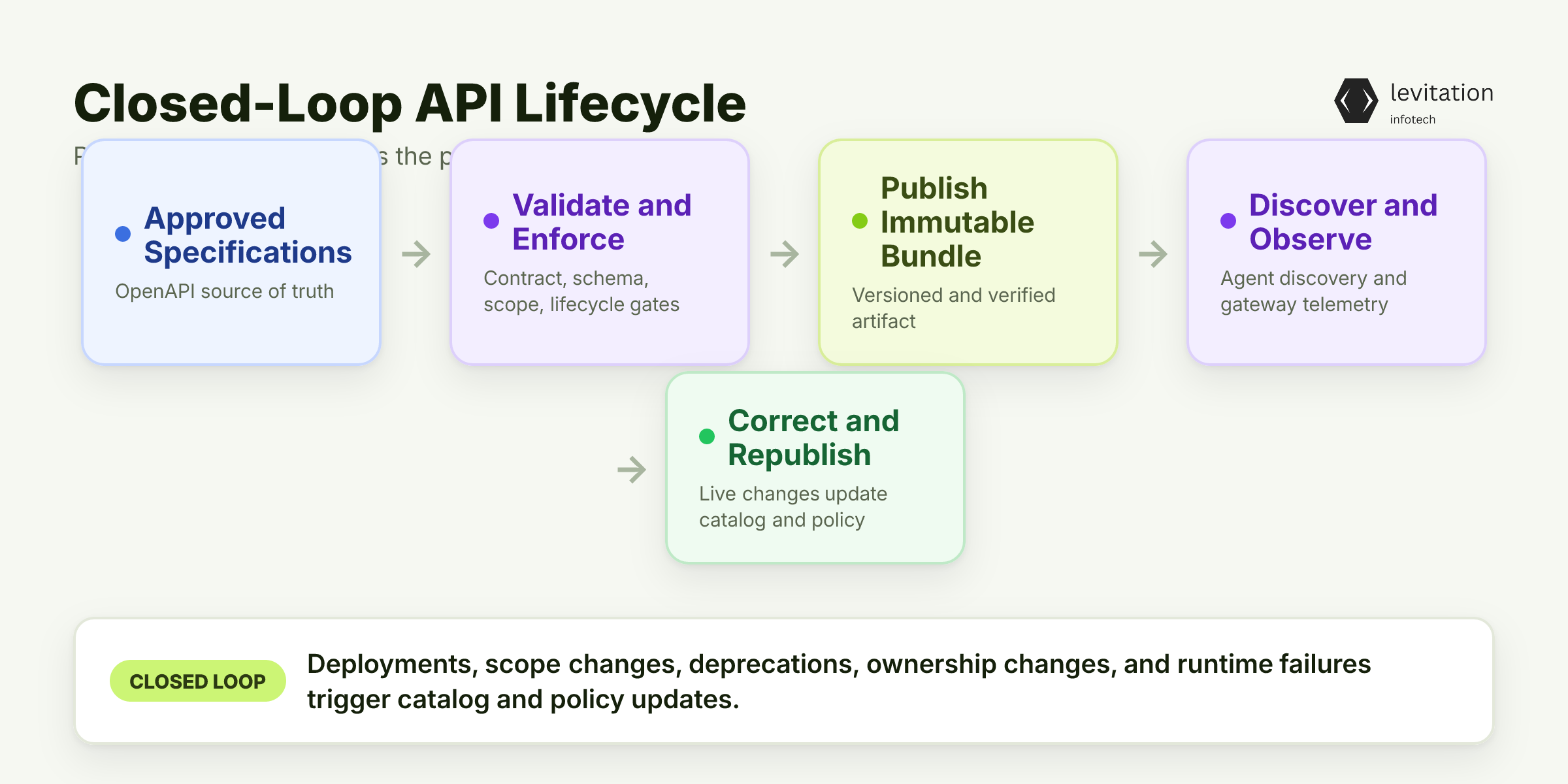
A catalog becomes trustworthy only when production can correct it. Publication starts the lifecycle. It cannot finish it.
Establish the Source of Truth
Make approved OpenAPI definitions the source of truth for the published catalog. Then align that source with deployment and policy events. Each operation needs one owner, lifecycle state, scope requirement, schema version, and replacement path.
Unclear ownership is not a docs detail. It is a live-system risk with no owner.
Who resolves that ambiguity before an agent can discover the operation?
Validate before publishing
Run contract linting, schema checks, scope checks, duplicate detection, and checks that link deprecations to replacements in CI.
1set -euo pipefail2mkdir -p build3redocly lint openapi.yaml4redocly bundle openapi.yaml -o build/agent-catalog.yaml5sha256sum build/agent-catalog.yaml > build/agent-catalog.yaml.sha256
Redocly is one gate. Repo policy checks must enforce team ownership, scope, and lifecycle rules.
Which check becomes the final gate before agents receive the artifact?
Publish an immutable artifact
Publish a versioned bundle only after every gate passes. Never overwrite a released artifact. Give agents and gateways its version and verification timestamp.
The lifecycle then runs in both directions: - Forward flow: Specifications move through validation, catalog generation, policy updates, agent discovery, and gateway telemetry. - Reverse flow: Deployments, scope changes, deprecations, ownership changes, and runtime failures trigger catalog and policy updates.
Production changes must trigger updates at once. Do not wait for a docs cycle. The published artifact should show current live state before agents can find it.
How can deployment events correct the published bundle without creating a race between discovery and policy updates?
Make deprecation actionable
Give each deprecated operation a replacement that machines can read, plus an expiration date. Do not remove it from a menu without guidance. Return a clear error that names the current replacement.
Never silently send writes to another route. A semantically similar match can change side effects.
Maintain an exception list for operations that cannot meet the standard. Record an owner, reason, expiration date, and restricted discovery policy.
Delivery credentials and timelines help with buying, but they do not prove catalog accuracy. They show delivery capacity, not live truth. A delivery partner must still support production systems, phased rollouts, and long-term operations.
How will you know that the published replacement reflects the route now running in production?
Enforce Task-Aware Policy at the Gateway
The gateway must judge the call, not trust the catalog. Gateway approval cannot fix bad discovery, as data-gateway decisions also show.
Evaluate intent, identity, and operation together
Combine the requested task, agent identity, target operation, token scopes, lifecycle state, and data risk. Evaluate these signals together. Identity without intent is incomplete.
A deny-by-default policy can separate read access from higher-risk writes:
1package agentapi.authz23import rego.v145default allow := false67base_conditions if {8 input.operation.lifecycle_status == "generally-available"9 input.task.allowed_intents[_] == input.operation.intent10 input.operation.data_risk != "prohibited"11 every required_scope in input.operation.required_scopes {12 required_scope in input.token.scopes13 }14}1516allow if {17 base_conditions18 input.operation.risk_level == "read"19}2021allow if {22 base_conditions23 input.operation.risk_level == "write"24 input.approval.approved == true25}
Reads pass with narrow scopes. Writes can require stronger scopes, tighter limits, or explicit approval. This example requires approval.
What evidence should trigger additional review when a task could change production state?
Handle deprecated operations explicitly
Return a structured error for deprecated operations. Include the current replacement.
1{2 "error": "deprecated_operation",3 "operation_id": "getPaymentV1",4 "replacement_operation_id": "getPaymentV2",5 "catalog_version": "2026.11.25.1"6}
Do not silently substitute another route. The agent must review inputs, permissions, and execution intent before retrying.
How will the agent confirm that the replacement preserves the task's intended effect?
Separate read and write permissions
Agent tools should expose narrow read operations separately from mutations. Reads can retrieve information for a task. Writes change production state and deserve stronger controls.
This separation also makes policy decisions easier to explain. The gateway can state which permission, approval, or risk rule blocked the operation.
Which signals should an agent receive before it commits to a write?
Require abstention
Provide an abstention path. If no operation meets policy, report that the agent lacks the needed capability. Do not let the agent guess a nearby endpoint and make up a request.
Abstention is a controlled outcome. A guessed request is not.
How will the agent distinguish a missing capability from a temporary policy denial?
Log the complete decision
Record agent identity, task context, selected operation, catalog version, access decision, policy reason, and result. Include refusals and abstentions.
Without that record, tool-call audit trails become guesswork. Operators need evidence of what the system knew and why it acted.
Build a regression suite from sample agent tasks. Run each task against candidate catalog versions and policy revisions before release. Check the selected operation, access result, and expected abstention.
Controls now exist. Do they produce evidence that agents chose and executed the right endpoint?
Measure Catalog Health Through Agent Outcomes
Catalog completeness cannot tell you whether the agent chose correctly. A catalog with full docs can still send every task to the wrong place.
Replace catalog-coverage metrics with outcome metrics: - Wrong-endpoint selection rate - Deprecated-operation call count - First-pass tool-call success - Reasons for policy denials - Use of replacement operations - Time from production change to catalog and policy refresh
Counts alone need context. Segment them by task, agent, domain, and catalog version.
Track denials too, but interpret them by cause. A rising denial count can show that policy is blocking unsafe behavior. It can also expose metadata and task-design defects.
Review failures across ownership boundaries
Review failures with platform, security, API, and agent owners. Classify each mismatch by cause: metadata, policy, delivery, or task design.
That classification points to the right fix rather than another catalog cleanup. Metadata defects return to the contract pipeline. Policy defects return to the gateway. Task-design defects return to agent design.
With this loop, agents receive one approved interface, abstain when eligibility is uncertain, and recover through explicit replacements. Every decision leaves an audit trail, including refusals.
AI API governance is not a one-time catalog cleanup. It is a feedback loop where live behavior corrects discovery.
The practical questions are concrete. How do you detect drift? Which metadata can you trust? Where is access enforced? When should an endpoint disappear?
Frequently Asked Questions
What is API catalog drift, and why is it dangerous for AI agents?
API catalog drift is the gap between published API docs and what runs in production. This gap can cover operations, schemas, permissions, and lifecycle states. It is especially dangerous for agents because they cannot ask for team context.
Agents can treat old metadata as official. This creates zombie API usage. It also leads to confident calls to deprecated endpoints. This is why API governance for bespoke software must treat metadata as live-system context, not a periodic document refresh.
How do you detect and prevent API catalog drift?
Compare approved specifications with deployment, deprecation, scope, ownership, and gateway policy events. Prevent drift by validating contracts in CI and publishing versioned artifacts. Keep catalog artifacts and gateway policy synchronized with production state.
Do not wait for a periodic documentation review. Production changes must trigger catalog and policy updates.
What metadata should an AI agent use for API tool discovery?
Provide structured schemas, hierarchical tags, intent labels, lifecycle state, required scopes, ownership, last verification time, and replacement guidance. Human summaries can support ranking. They must not replace machine-checkable eligibility signals.
Can an API gateway solve API catalog drift?
No, not by itself. A gateway can enforce the lifecycle state and policy it receives. Stale source data can still drive a wrong decision.
Prevent drift upstream by syncing deployment, contract, and policy events. Can gateway logs then prove why the agent chose each route?
About the author
Mayank Singh is a software developer at Levitation Infotech, where he builds web and AI-powered applications across the company’s fintech, healthcare, and enterprise projects.