


TL;DR: A data gateway can approve every record an AI agent reads. It can still miss the task, entity, state, or action that makes the decision unsafe.
Govern live workflows with three runtime gates: retrieval, reasoning, and action. Back these with decision contracts, governed agent identities, complete lineage, and failure-path testing.
Key Takeaways: - Read-only access and gateway approval protect systems, but they don’t establish decision authority. - A runtime decision contract must bind every decision to its task, entity, state, evidence, policy, and action limits. - Expand autonomy only when negative tests and decision telemetry show controls stop unsafe actions.
The Approval-Decision Gap Starts at the Gateway
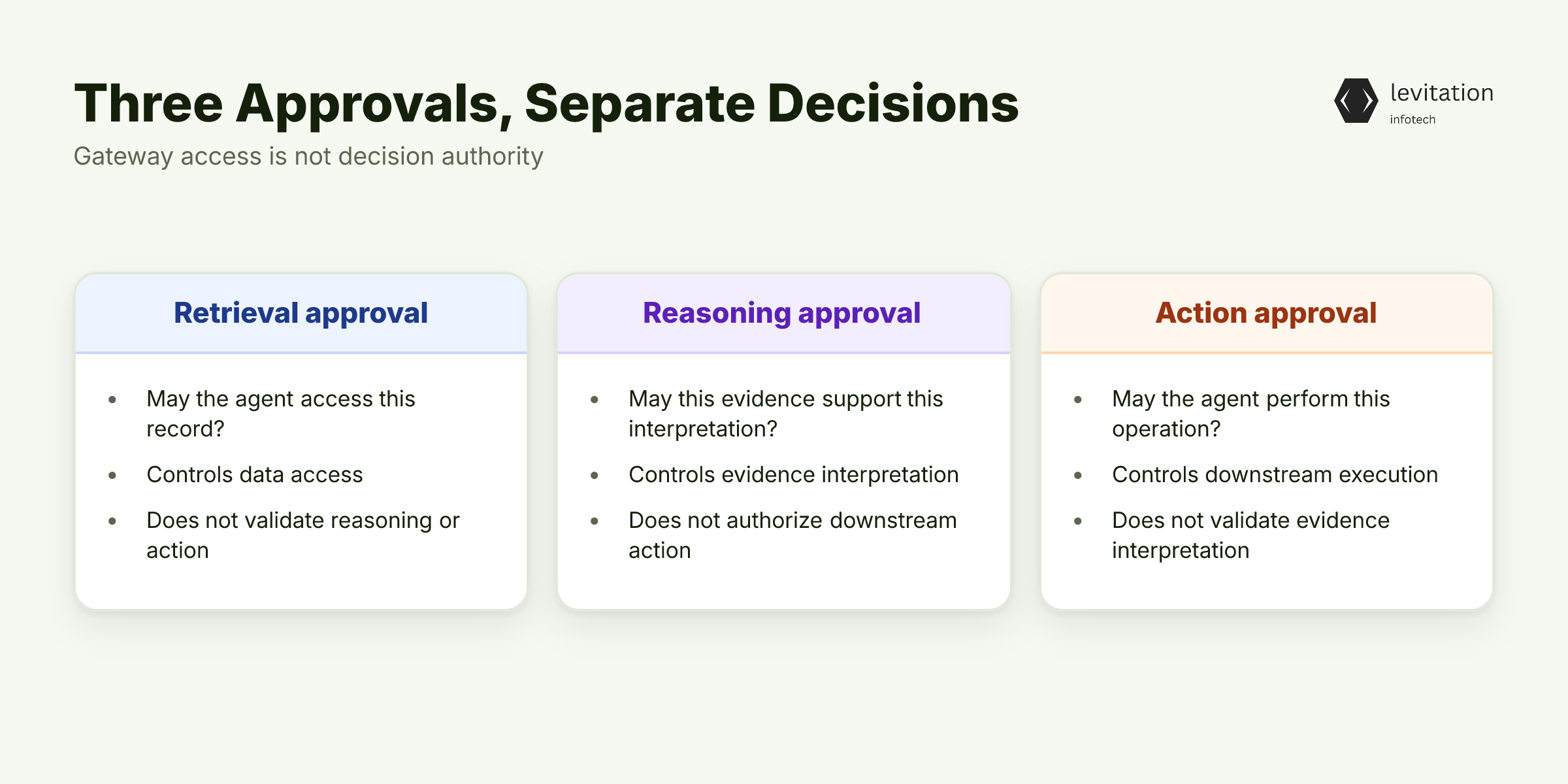
A query can satisfy every gateway rule and return only approved records. It can still lead an agent to the wrong conclusion or next action. Gateway rules govern access, not decision authority.
The False Equivalence
An allow response from the gateway shows that retrieval is allowed. It says nothing about whether the agent will choose relevant evidence, interpret it correctly, or select a suitable action.
Three approvals must remain separate: - Retrieval approval: May the agent access this record? - Reasoning approval: May this evidence support this interpretation? - Action approval: May the agent perform this downstream operation?
Microsoft Fabric Data Agents show the boundary clearly. They are strictly read-only, respect Microsoft Purview policies, and can generate SELECT-style queries. They cannot create, update, or delete data.
Read-only access prevents changes to source systems, but it does not make the downstream decision safe. Even so, a read-only agent can shape a decision with real consequences. Its output can trigger a notice, approval, customer call, or another agent’s action.
For enterprise AI solutions, the design task changes. You must govern how evidence becomes a decision, not only which datasets were approved.
This distinction also underlies RAG Won Retrieval. The Real Enterprise AI Problem Is Decisions.. Agentic data governance must cover what gets assembled, interpreted, and acted on during execution. If the gateway isn’t wrong, where does control actually break?
Why Approved Data Can Be the Wrong Data
The same approved dataset can suit one task, customer, and moment. It can become irrelevant or risky for another. An open-ticket history supports renewal reviews but can distract an agent handling collections.
Context Changes Admissibility
Consider an account dataset approved for renewal analysis. It contains product support records from an unrelated product line. Every record is authorized, but the extra context dilutes the signal.
More context can reduce reliability. It adds noise, exposure, and cost without adding a relevant fact.
That changes how AI agents should be governed. The target isn’t maximal access. It’s precise access for a defined decision.
What changes when approved data starts moving?
Data in Motion Creates New Risk
Sensitive information can also emerge during execution: - APIs move fragments between services. - Context windows combine records from different sources. - Temporary memory retains them beyond the original request. - Agent-to-agent exchanges spread them across workflows.
Individually acceptable fragments can become sensitive when assembled at machine speed. A ticket summary can be harmless alone. Combined with identity and medical details, it becomes a new sensitive record.
Classification must therefore change as data comes together. Controls that stop at classifying data at rest miss the point at which exposure changes.
Agents also create a non-human identity gap. Ownership, recurring access reviews, and automated offboarding matter when software consumes data and acts faster than periodic human review cycles. This echoes the principle in AI Agents Don’t Need Bigger Context. They Need Better Memory..
The answer isn’t to block every dataset. It’s to govern each live decision. Where should that decision begin?
Separate Retrieval, Reasoning, and Action
Control breaks because one broad approval gets stretched across three different questions. Retrieval success gets treated as permission to reason, interpret, and act.
The Retrieval Gate
Before data enters the working context, confirm: - The agent’s identity. - The source system. - The permitted fields and records. - The declared purpose.
This gate confirms that access is allowed. It doesn’t guarantee that every returned record belongs in the context. Does access approval prove relevance?
The Reasoning Gate
Before interpretation begins, bind the request to five things: - Task scope. - Entity scope. - Current state. - Data scope. - An explicit policy version.
Then reject irrelevant, excessive, or stale context. Freshness matters because approved evidence can become wrong after a policy update, account change, or system event. Does sound reasoning authorize every action?
The Action Gate
Restrict the tools, systems, and records the agent can use. Limit how many actions it can take. Set human approval thresholds for high-impact operations.
The minimum runtime decision contract has seven dimensions: - Task scope: What decision is being made? - Entity scope: Which customer, account, asset, or process is involved? - Current state: Which trusted moment governs the decision? - Data scope: Which records and fields may enter the context? - Policy controls: Which rules and policy version apply? - Traceability: Can the decision be reconstructed later? - Action limits: Which tools, records, and operations remain permitted?
Gateway approval is only the first gate. Read-only enforcement addresses only part of the action gate. The missing control is decision lineage, linking evidence to interpretation, proposed action, approval, and outcome.
Once the three gates are explicit, they can become runtime code instead of a policy PDF. The practical question is where those controls should run.
Build a Runtime Decision-Control Plane
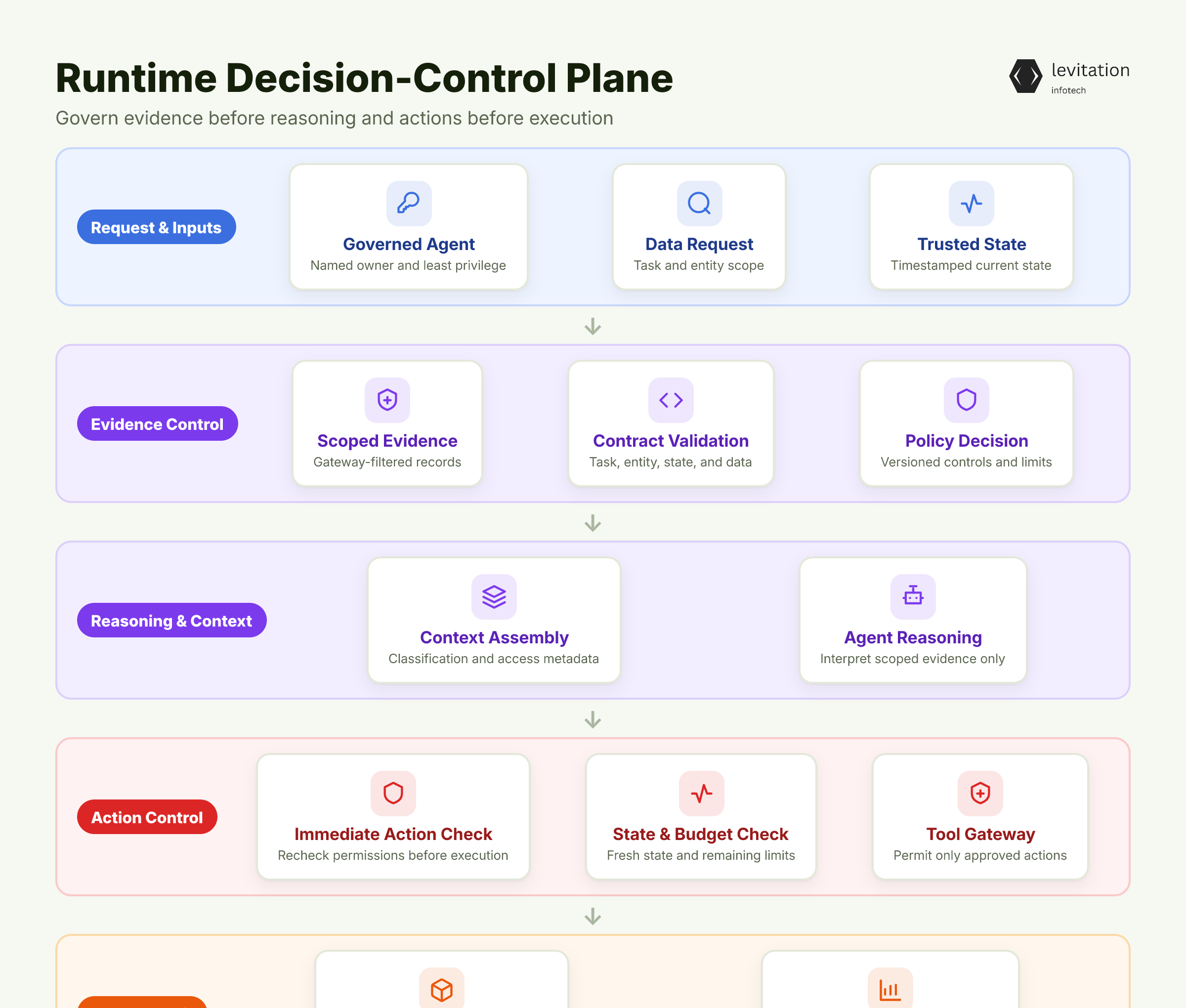
A control plane must sit between data access and model reasoning. It must also sit between the model and every tool that changes the outside world.
Define the Contract
Illustrative only: A renewal-risk review for account `A-1042` carries these fields: - Task scope: `renewal-risk-review`. - Entity scope: Account `A-1042`. - Current state: As of a timestamp from a trusted source. - Data scope: Allow `account_status` and `open_tickets`; deny `unrelated_customer_records`. - Policy controls: A locked policy version and its decision rules. - Traceability: Required evidence, interpretation, decision, and action references. - Action limits: `draft_summary` is the only permitted action, with approved limits for records and tool calls.
The exact values come from your policy, but the structure remains consistent across workflows and agent frameworks. How do you enforce it before reasoning starts?
Enforce Before Reasoning
Have the gateway return scoped evidence. Validate task, entity, state, and data scope against the contract before the agent interprets anything.
This catches a subtle failure: the record was readable but did not belong in the working context. What happens when the agent calls a tool?
Gate Every Tool Call
Check the proposed action against current permissions immediately before execution. Do not trust instructions written into the original prompt.
A prompt can drift, a policy can change, and current state can become stale. The execution gate must check identity, contract, policy version, state, and remaining action budget again. Who owns the agent while those checks run?
Govern Identity and Data in Motion
Every agent needs a governed non-human identity. It must also have: - A named owner. - Least-privilege permissions. - Recurring access reviews. - Automated credential revocation when ownership or policy changes.
Data controls must follow each fragment. Carry classification, access conditions, and audit metadata through retrieval, context assembly, temporary memory, and downstream tool use.
Record complete decision lineage at each stage. Capture agent identity, task, entity, trusted timestamp, evidence references, policy version, interpretation, proposed action, approval state, and outcome.
Build discipline is part of the product. Delivery claims associated with AI development services are not measured outcomes from this control model.
A control plane still fails if teams test only intended flows. Which failures must pass first?
Test Failure Paths Before Expanding Autonomy
Agent demos often prove only that the intended path works. Production risk lives in every path the contract did not anticipate.
Build a Test Matrix for Failures
Test these cases before granting broader autonomy: - Wrong entity: Deny or narrow the request. - Wrong task: Deny the request or require a valid task contract. - Stale current state: Deny and request fresh state. - Excessive record volume: Narrow the evidence. - Prohibited data class: Deny or escalate under an explicit policy. - Changed policy version: Stop and re-evaluate. - Disallowed tool: Deny the call. - Offboarded agent: Stop execution and revoke access. - Incomplete decision lineage: Stop before action.
For high-impact operations, the policy can require human approval. Successful execution alone is not a sufficient test criterion. Verify the control decision and the state change that follows.
How should autonomy expand after those checks pass?
Roll Out in Stages
Use a clear sequence: - Begin with read-only execution and complete lineage logging. - Observe proposed decisions in shadow mode. - Release one limited workflow to a small group. - Expand autonomy only when control outcomes remain consistent.
Make identity reviews and offboarding part of release management. An ownership change should trigger credential review before another agent ships.
The governance model must be tested on its own. Service signals such as retention or client trust are not evidence that it works.
Can the team respond quickly when a governed workflow fails?
Make Incident Response Executable
Your runbook must let responders disable tools and revoke credentials. It must also expose decision lineage, support policy rollback, and identify every downstream action affected.
Keep the kill switch outside the agent, as explained in Your AI Agent Kill Switch Must Live Outside the Agent.. A runaway agent shouldn’t also control its own shutdown path.
Once live, the CTO needs metrics that expose weak decisions before users or auditors do. Which metric catches the failure before an action lands?
Measure Decision Risk, Not Just Query Traffic
A busy query log can hide a dangerous system. It proves calls happened, not that evidence fit the task or actions remained safe.
Add Decision Telemetry
Track signals such as: - Out-of-scope evidence requests. - Stale-context failures. - Policy denials, separated by control. - Attempted unauthorized actions. - Incomplete decision lineage. - Cases sent for human review. - Time required to revoke agent access.
Measure both sides of the system: - The percentage of permitted decisions with complete lineage. - The percentage of denied or suspicious decisions that stopped before action.
Where should the first baselines come from?
Establish Baselines from Real Workflows
Create baselines from the first controlled workflow. Don’t invent universal thresholds before seeing the actual distribution.
The observed pattern should reveal which controls work, which fail, and which permit wider autonomy. A stable dashboard alone proves little. Stable control outcomes matter.
Can one contract carry these controls across workflows?
Make the Contract a Release Gate
The same decision contract can govern multiple enterprise AI agents. This reduces repeated control design and makes decisions explainable and reversible.
For enterprise AI solutions, that creates a practical benefit for the CTO. Build the control once, apply it consistently, and improve it from observed failures.
Every governed decision should answer five questions: - What may be retrieved? - What may enter the context? - What decision is being made? - Which action is permitted? - Is the decision reconstructable after the fact?
Reconstruction is not optional. If the evidence is missing, autonomy is premature. The next controlled release will show whether the contract remains complete under live conditions.
Frequently Asked Questions
What Is Agentic Data Governance?
Agentic data governance governs data at runtime. It constrains what an AI agent assembles and how it interprets that data. It also sets action limits and preserves the records needed to reconstruct a decision.
It extends traditional data governance rather than replacing design-time access, quality, and lineage controls.
How Is Agentic Data Governance Different from Traditional Data Governance?
Traditional governance establishes whether data is trustworthy, classified, and accessible. It usually relies on design-time controls and periodic reviews.
Agentic governance adds live controls because agents combine data and act at machine speed. It covers task scope, entity scope, current state, data scope, policy controls, traceability, and action limits.
Does Data Gateway Security Cover AI Decision Controls?
No. A data gateway can enforce retrieval authorization, while AI decision controls govern context selection, interpretation, tool use, and action.
Read-only Microsoft Fabric Data Agents show the boundary. They prevent write operations, but an agent can still select or frame information poorly for the task.
Which Runtime Controls Should a CTO Require for Enterprise AI Agents?
Require a runtime decision contract covering task scope, entity scope, current state, data scope, policy controls, traceability, and action limits.
Also require governed agent identities, recurring access reviews, and automated offboarding. Track data as it moves through retrieval, context assembly, temporary memory, and downstream tool use, and verify that lineage remains complete at every handoff.
The harder test is operational: can the team revoke one agent, trace every affected decision, and explain the resulting actions?
About the author
Mayank Singh is a software developer at Levitation Infotech, where he builds web and AI-powered applications across the company’s fintech, healthcare, and enterprise projects.