


TL;DR: An agentic API can fail without a model change. Tools, identities, state, and retries create another failure surface. Model the execution path as a failure-domain graph, enforce executable contracts, bound each task, and roll back dependencies independently.
Key Takeaways: - An empty model diff rarely identifies the dependency that actually broke. - Tool and MCP contracts need versions, manifests, and executable compatibility tests. - Capability-based canaries and independent rollback keep one failure from becoming a platform outage.
The 2 A.M. Failure Has No Model Diff
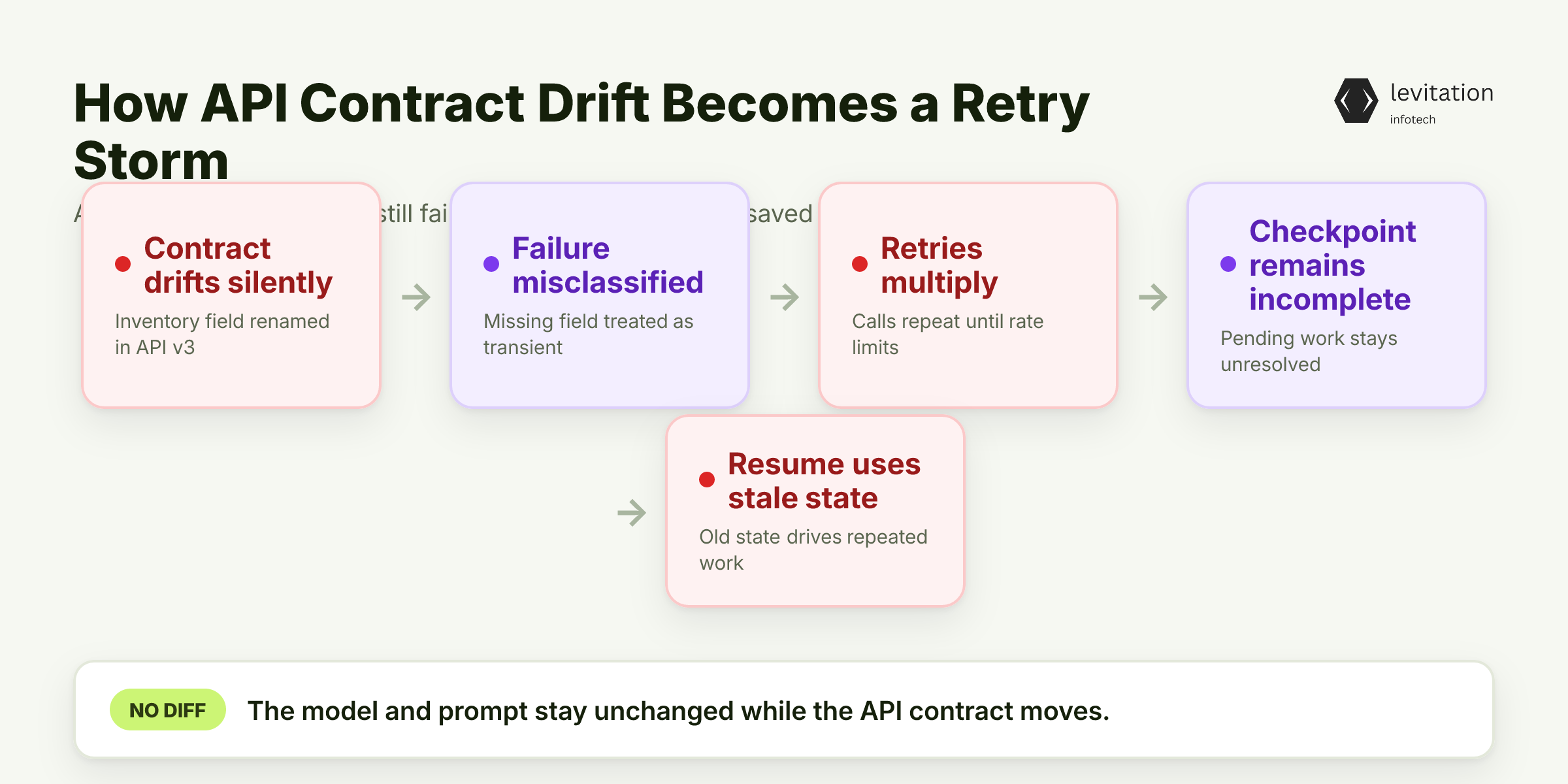
The empty model diff
At 2 A.M., the model diff is empty, yet the workflow is failing.
Imagine a scheduled inventory reconciliation agent resuming from a checkpoint. The model and prompt haven't changed. A tool provider renames one response field without sending a version signal.
1Model and prompt Unchanged2Tool response Field renamed in inventory API v33Adapter Treats missing field as transient4Retry path Repeats calls until rate limits appear5Stored checkpoint Marks the original step as incomplete6Result Work resumes with stale state
This is an illustrative sequence, not a reported case.
The retry storm starts when a response contract moves under a workflow expecting the old contract. The resumed checkpoint then amplifies the problem because the agent repeats work it believes is pending.
Together, contract drift and stale state turn one parsing failure into repeated execution. The tool can work while the agent can no longer interpret its response safely. Which other surfaces can change without touching the model?
Five surfaces change independently
Teams building AI agents often monitor one surface too closely. Agent workflows can depend on five surfaces that change separately: - The model and prompt. - Tool and API schemas. - The MCP server and its capabilities. - Agent identity, credentials, and authorization. - Memory, checkpoints, and workflow state.
One agent request can trigger planning, memory reads, policy checks, several tool calls, and asynchronous callbacks.
That breaks the old assumption that one request produces one bounded response. Each child call can fail, retry, wait, or resume independently.
Endpoint monitoring can't explain the resulting execution path. Which dependencies should the first incident questions cover?
The first five incident questions
When an agent workflow fails, ask: - Was the tool schema compatible with the agent's contract? - Was the agent still authorized for the requested action? - Was stored state valid for resumption? - Were retries bounded and idempotent? - Did a rate limit, policy, or cost threshold change?
The model can decide what action to take. The surrounding execution system determines whether that action completes safely.
If the model diff is empty, which dependency boundary did the incident actually cross?
The Model May Be the Least Likely Trigger
Decision failure and execution failure are different problems
A model can select a sensible action, but execution can still fail when a tool is unavailable, incompatible, unauthorized, or unparsable.
1decision:2 action: inventory.adjust3 model_version: unchanged45execution:6 expected_contract: inventory.v27 actual_contract: inventory.v38 result: rejected9 reason: incompatible_schema
The decision remains valid. The execution boundary rejects it.
This distinction matters because decision-focused model evaluations won't catch an expired credential or a changed error shape. Production-grade custom software development must test both sides of that boundary.
Which operational layers can change while the model stays still?
The volatile operational layers
Agent systems also shift through layers that model monitoring rarely sees: - Memory state becomes stale or incompatible. - Concurrent requests amplify one failed dependency. - Agent identities lose scopes or trust. - A shared tool creates a wide blast radius. - Logs lose the context needed to reconstruct causation. - Rate limits or pricing change the viable execution path.
A provider can also alter rate limits, pricing, response behavior, or core interfaces without changing the model. A provider-level redesign can force a broad integration rewrite.
Standardized endpoints help. They don't define failure containment, state compatibility, retry behavior, or when an agent must stop acting. API governance alone can't provide those guarantees.
What changes can bypass model monitoring and destabilize execution?
Four failure classes
Classify every incident into one of four buckets: - Contract drift: A tool, schema, MCP server, or error format changed. - State incompatibility: Stored memory or workflow state no longer matches the current system. - Load or cost amplification: Retries, concurrency, or long tasks exceed operational limits. - Unsafe execution: A trusted system accepts an action that policy should reject.
Policy failure needs special attention. The model didn't malfunction. The authorization or policy system failed to enforce its boundary.
The execution system must reject unreasonable actions. When AI agents can act, allowing the action is a separate engineering decision.
Once these failure classes are separated, the architecture starts to reveal the right containment unit. Which unit should own each failure?
Treat Every Agent Request as a Failure-Domain Graph
Draw the execution path
Every agent request should become an explicit execution graph.
1Request2 ├── Planner ── Model3 ├── Memory store4 ├── Policy and identity5 └── Tool adapter ── MCP server ── Downstream API6 └── Event or callback path
Assign failure domains to every node and edge. Each edge needs an owner, timeout, retry policy, compatibility state, and blast-radius boundary.
One generic timeout across the workflow hides the actual fault. A fast model can hide a slow tool. A broad task timeout can combine several safe operations into one failed task.
The graph should show which component can pause, retry, compensate, or terminate the task. That makes containment design possible. Where should the task budget sit?
Budget the task, not just the model
A task budget converts runaway amplification into controlled termination.
1task_budget:2 max_tool_calls: 103 max_retries_per_edge: 24 max_elapsed_seconds: 605 max_concurrency: 36 max_spend_usd: 0.50
This sample shows a policy shape, not a universal threshold. Derive limits from task risk and expected action cost.
Include maximum tool calls, retries, elapsed time, concurrency, and spend. These limits belong to the task because one request can fan out into many actions.
Use idempotency keys for side-effecting operations. Persist the key across retries and deduplicate at the service boundary. Without deduplication, a retry can repeat an irreversible action.
Use circuit breakers when a tool returns repeated malformed or incompatible responses. Without a breaker, one failed tool can consume the entire retry budget.
How can operators see which boundary failed?
Build causal observability
Pass one trace identifier through the agent, adapters, MCP calls, downstream APIs, policy checks, and asynchronous continuations.
Record: - Tool and schema versions. - Attempt counts and retry reasons. - Rate-limit signals. - Policy denials. - Idempotency decisions. - The model version, when available.
The model version is optional because execution contracts can change independently. Tool contract versions aren't.
This changes custom software development for agent platforms from prompt engineering into execution-graph engineering. The same principle behind API budgets, not just rate limits applies to every dependency.
A graph exposes failure domains, but it still cannot make an incompatible tool schema safe.
Turn Tool Schema Versioning and MCP Compatibility into Executable Contracts
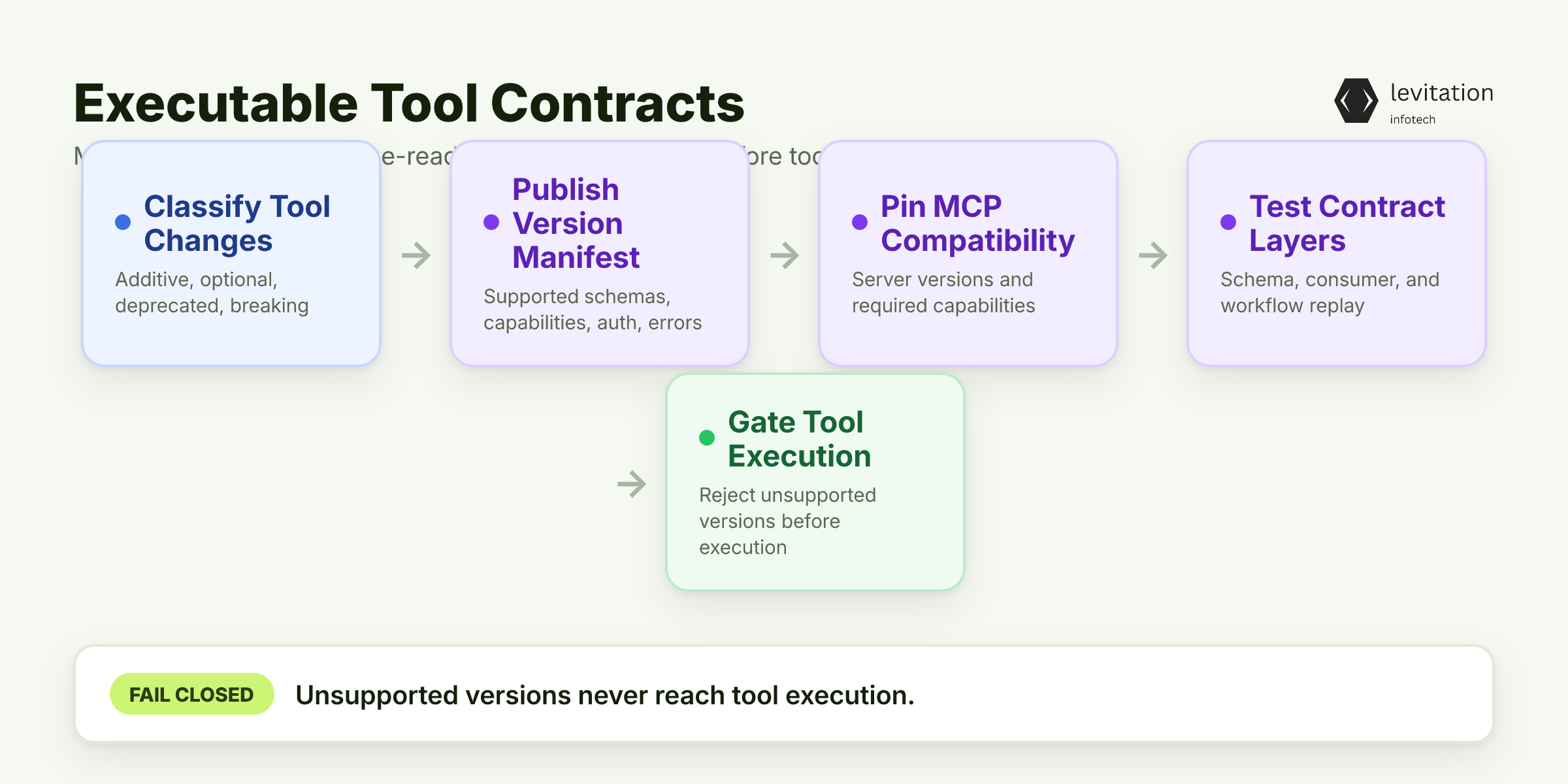
Version tools independently
Each tool needs its own version, separate from the model and prompt. Publish a compatibility matrix that classifies changes consistently: - Additive: Existing valid requests remain valid. - Optional: New behavior doesn't require immediate consumer changes. - Deprecated: The old version remains temporarily supported. - Breaking: Existing requests, responses, or errors change meaning.
Informal release notes can't enforce this classification. Store the supported relationship in a machine-readable manifest.
1tool: inventory.adjust2schema_version: "3.1"3supported_schema_versions: - "2.0" - "3.0" - "3.1"4mcp_server_version: "1.8.0"5required_capabilities: - inventory.adjust.dry_run6auth_scopes: - inventory:adjust7error_contract: "errors/v2"
The agent validates this manifest before selecting the tool. If the requested version isn't supported, execution fails closed.
This prevents a feature-contract failure from becoming an agent outage. But how does the agent know that a server still honors the contract?
Define MCP compatibility operationally
MCP compatibility means the agent can safely use the expected server and tool capabilities. Pin supported server and tool versions. Test them before release.
Negotiate required capabilities explicitly. A successful MCP connection doesn't prove that inputs, outputs, pagination, or errors remain compatible.
Critical behavior must also be machine-readable: - Stable error codes. - Idempotency behavior. - Rate-limit signals. - Authentication scopes. - Request and response examples. - Timeout and retry expectations.
Documentation can't safely enforce these rules at runtime. The contract must travel with the executable artifact. Can a runtime gate catch every mismatch before a tool acts?
Test the contract at three levels
Add three distinct test layers: - Schema-diff checks: Detect unsupported input, output, and error changes. - Consumer contract tests: Exercise every tool version the agent supports. - Workflow replay tests: Replay real agent-to-tool interactions and state transitions.
Side-effecting tools also need dry-run or simulation support. A new contract must prove its behavior before it can write, transfer, delete, or notify.
The migration path should remain explicit:
- Publish the new version.
- Support both versions temporarily.
- Track current usage.
- Migrate consumers.
- Enforce a removal deadline.
- Retire the old contract after compatibility evidence is complete.
Production discipline depends on evidence after launch, not assumptions made during deployment, because a sound contract only protects the release if risky changes reach agents gradually.
Which agents should receive the change first?
Canary by Agent Capability, Not Endpoint
Segment exposure by authority
A URL canary tests a route. It doesn't test authority.
Separate agents by capability and tool risk: - Read-only retrieval. - Internal state changes. - External writes. - Financial transactions. - Communications and notifications. - Actions that trigger another system.
The same endpoint can serve several of these paths. A release that tracks capabilities can isolate the risky one. How should that exposure grow safely?
Stage every change with exit conditions
A safe release path looks like this: - Compatibility checks: Pinned versions and contract tests pass. - Sandbox dry run: The agent completes the workflow without external side effects. - Shadow evaluation: A constrained cohort exercises the new contract safely. - Limited canary: Only selected capabilities receive the changed version. - Progressive expansion: Exposure grows while contract-specific metrics remain within policy. - Full promotion: The change becomes the supported default with rollback still available.
Every stage needs an exit condition. “The canary looks healthy” isn't enough if health doesn't include schema mismatches, denials, retries, task completion, and cost.
How can each stage prove that agents still behave correctly?
Roll back the dependency, not the model
The tool, schema, MCP server, or adapter must roll back independently. A tool rollback shouldn't require a model deployment or a new prompt.
1capability_control:2 agent: inventory-reconciler3 disabled_tools: - inventory.adjust4 max_concurrency: 05 tool_budget: 06 rollback_contract: inventory.v27 quarantine_state: reconciliation-checkpoints
This pattern reflects the rule that a kill switch must live outside the agent. The platform must disable a capability without asking the agent to stop itself.
Track error rates, schema mismatches, retry volume, rate-limit responses, policy denials, task completion, and cost per completed task.
The runbook must identify the failing contract version, affected capabilities, available rollback version, and whether stored state needs quarantine.
Keep the tool contract behind an adapter or gateway. That separates model or provider changes from downstream integration rewrites.
With staged exposure and fast rollback in place, reliability becomes a promise the platform can keep. Can the platform contain a failure without touching the model?
Make Agentic API Reliability an Architectural Property
Reliability isn't zero failures. It's contained failure.
An incompatible change should be detected before exposure. One failed tool shouldn't consume the whole platform. Rollback shouldn't depend on a model deployment. Incidents should identify the contract that changed.
The operating model fits in one line:
Model the execution graph, version every external contract, fail closed on incompatibility, bound every action, and release by capability.
For teams building AI agents, reliability becomes an architectural property. For custom software development, that property belongs in the platform rather than each agent prompt.
The test is simple. Can an operator name the changed contract, disable its capability, and preserve unaffected workflows without a new model deployment? If not, reliability remains a dashboard promise.
The practical failure point is often the first check an operator cannot run under pressure.
Frequently Asked Questions
Can an agentic API really break without a model change?
Yes. A tool can change its schema, or an MCP server can alter behavior. An authorization scope can expire. Stored agent state can also become incompatible while the model remains unchanged.
Because one request can fan out into many downstream calls, these changes can still produce a cascading outage for AI agents.
How should teams version tool schemas for AI agents?
Version each tool independently and publish a compatibility matrix. Distinguish additive fields from breaking input, output, and error changes.
Test each supported version with contract tests from the consumer side and an internal compatibility manifest. Unsupported versions must fail closed before reaching production.
This discipline is part of reliable custom software development for AI integrations.
What does MCP compatibility mean for production agents?
MCP compatibility means the agent can safely use the expected server and tool capabilities. Inputs, output shapes, and error semantics must also match.
Pin the supported versions, negotiate required capabilities, and run contract tests. A successful MCP connection alone doesn't prove that tool behavior remains unchanged.
How do you stop retries from turning one bad tool call into an outage?
Use bounded retries with jitter, per-task tool-call budgets, circuit breakers, concurrency limits, idempotency keys, and a capability kill switch.
These controls prevent repeated failures from consuming downstream capacity or duplicating irreversible actions.
What belongs in an agentic API reliability test suite?
Test schema compatibility, authentication and scopes, stable errors, rate-limit signaling, idempotency, state recovery, dry-run behavior, and rollback paths.
Then replay real agent-to-tool interactions and state transitions. The next question is which of these checks can enforce a release gate automatically rather than merely reveal failure after deployment.
About the author
Mayank Singh is a software developer at Levitation Infotech, where he builds web and AI-powered applications across the company’s fintech, healthcare, and enterprise projects.