


TL;DR: The "senior" label on a resume no longer predicts competence in India's developer market, and salary confirms nothing. The real fix is shifting from hiring individual bodies to buying a structured, accountable pod, and applying five verifications before you sign anything.
Key Takeaways: - A title and a salary band tell you almost nothing about an engineer's actual judgment in 2026. - Hidden costs of a mislabeled senior (rework, mentorship overhead, delayed launches) compound through each quarter and routinely exceed the headline salary. - A genuine dedicated team is a vetted pod with enforced seniority, not a stack of resumes. - Five targeted verifications separate a real senior from an 18-month impostor in under a week. - Lock the seniority mix and tie fees to delivery metrics, and pricing stops being a bait-and-switch.
You posted a job for a senior developer at ₹2.4 lakh per month, got fifty resumes, and shipped nothing for six months. The problem isn't the Indian talent market. The real problem is that "senior" in 2026 has become a title, not a skill level. Most outsourcing partners won't tell you the difference.
The "Senior" Label Has Collapsed as a Signal
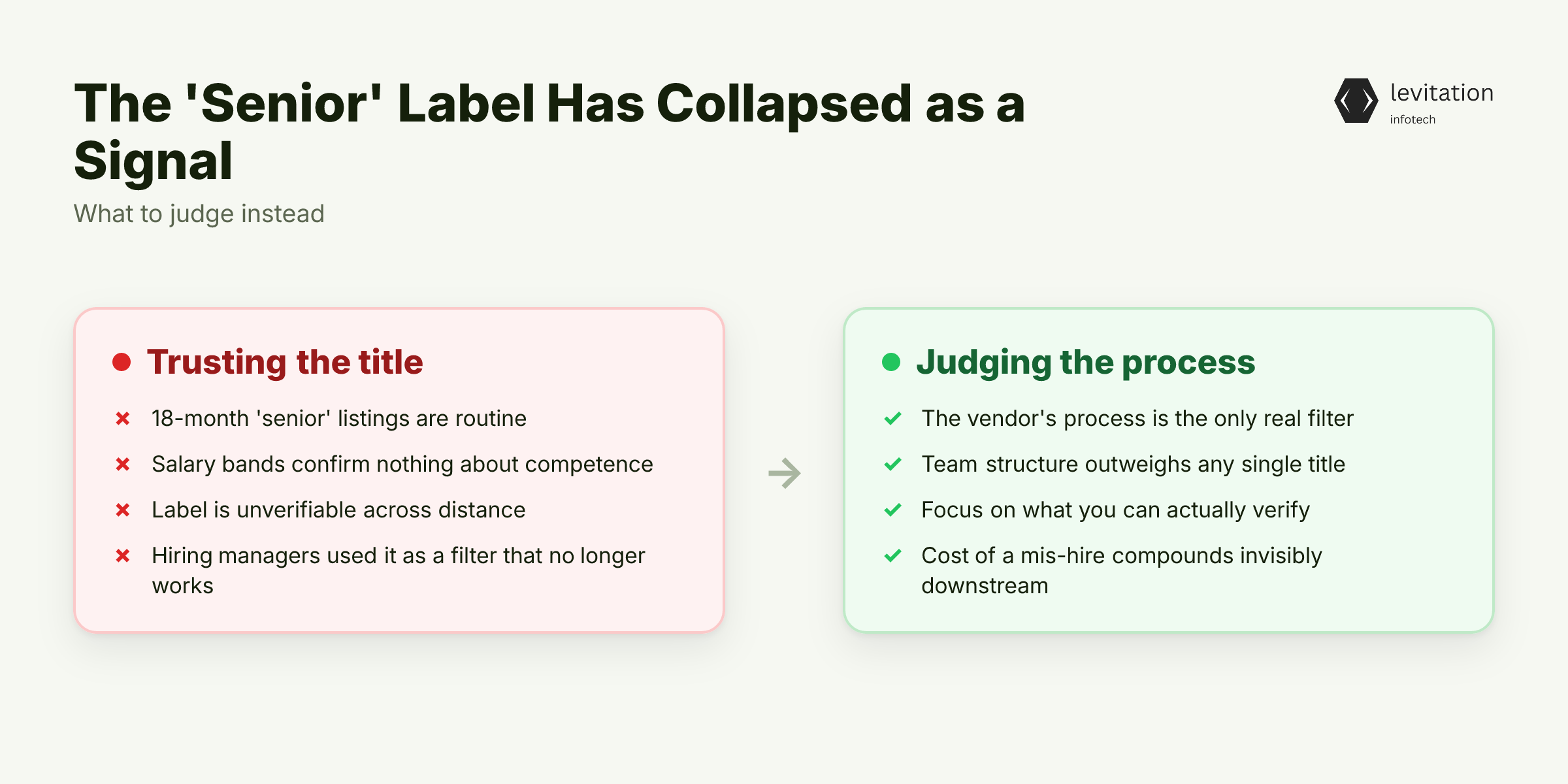
Salary used to be a proxy. Today, S&P Global pays its Software Development Engineer 3 in Noida between ₹2.3L and ₹2.4L per month. That band is the mid-level senior-equivalent for large product companies operating in the same city as your vendor. The number alone confirms nothing about competence.
Walk through Noida job portals and you'll see the pattern. An "18-month senior" is now a routine search result. Bootcamps compressed learning cycles, and recent industry contraction pushed mid-level engineers into title inflation to stay visible.
Hiring managers, drowning in applications, used the senior label as a filter. The label stopped meaning what it used to. This collapse matters more for a CEO hiring a dedicated team than for a company hiring locally. You are buying a label you can't verify in person, on a candidate you may never sit beside.
The label carries less signal than the team structure behind that developer. The vendor's process is the only thing standing between you and a mis-hire. The painful part isn't that ₹2.4 lakh is too high for 18 months of experience. It's that the downstream cost compounds invisibly for months, and shows up where you aren't looking.
Why a Cheap "Senior" Actually Costs You More Than the Salary
On paper, the math looks great. Outsourcing rates in India run $28 to $55 per hour, and a senior at the top of that band is roughly a quarter of the $120K to $200K a US or EU senior commands per year.
The savings show up instantly on a procurement spreadsheet. That is why this model still wins board approvals. What the spreadsheet doesn't show is rework. When a mislabeled senior makes the wrong call on a microservice boundary, an API contract, or a data model, the cleanup lands in your quarterly burn, not on the vendor's invoice.
Mentorship overhead shows up too. Your real seniors, if you have any, end up teaching instead of building. So does delayed product-market fit, since the architecture keeps needing revisions.
Each of these costs is invisible until it isn't. A wrong API contract can take a sprint to discover and a quarter to unwind. A mentor diverted from the core product is a feature your competitor shipped instead.
The total cost of a cheap senior compounds invisibly. It routinely exceeds the headline salary by the time the project should be shipping. That is why custom software development cost in India discussions that start with hourly rates miss the real question.
If the salary and the rate aren't the problem, your vetting process must be. And that's where most CEOs, even experienced ones, get filtered out of the real conversation.
Why Resume Screening and Portfolio Reviews Don't Catch This
The standard hiring funnel is broken at the first step. The 18-month senior usually has a polished GitHub graph, two bootcamp certificates, and one production deployment they inherited from a teammate.
None of that is fraud. None of it proves the judgment a senior is actually paid for. Standard technical interviews don't catch it either. They test algorithms, not the calls a senior makes daily: when to ship, when to refactor, when to push back on a product requirement.
An 18-month engineer can grind LeetCode for a few weeks and pass any FAANG-style screen. The interview rewards the wrong skill. Then there's the vendor incentive. Staff-augmentation shops profit from placement volume, so the faster they fill a seat, the more seats they bill. They have no structural reason to flag a mislabeled candidate to the client.
The client only finds out six months later, by which time the vendor has billed for two renewals. This isn't malice. It's a misalignment of incentives baked into the model.
It's the same pattern we covered in your "dedicated" team serving three clients. The model quietly rewards what hurts you.
So if resumes, portfolios, and vendors all fail the same test, the only signal left is the model itself. The question is whether you're buying a body or buying a delivery unit.
What a Genuine Dedicated Development Team Actually Looks Like
A real dedicated development team is a long-term, client-owned delivery unit. Not a group of contractors, not a body shop. The pod has an architect, senior engineers, QA, and a delivery lead working as one team on one product.
They share your sprint cadence, your tools, and your code review process. They sit in your standups, even if they sit 1,500 kilometers away. The architectural lead inside that pod carries the production experience your architecture decisions require. They sit on your sprint reviews, and they own backend, frontend, and API decisions end-to-end.
They sign off on the architecture before code gets written. That's the seniority your product needs, and it comes from the pod's structure, not from a LinkedIn title. The senior label inside the pod is enforced by the vendor's own career ladder, not by what the candidate wrote on their resume. Seniority gets verified before the client interview.
The vendor enforces it through code reviews on internal projects, code wars, and architecture walkthroughs with a tech board. This is why a software development company in Noida running a real pod model produces the structural outcomes that regulated industries depend on. The track record doesn't come from loose hiring. It comes from structural enforcement of seniority.
Once you know what the real model looks like, the question shifts from "who do I hire?" to "how do I verify the pod before I sign anything?"
Five Verifications That Expose the 18-Month "Senior"
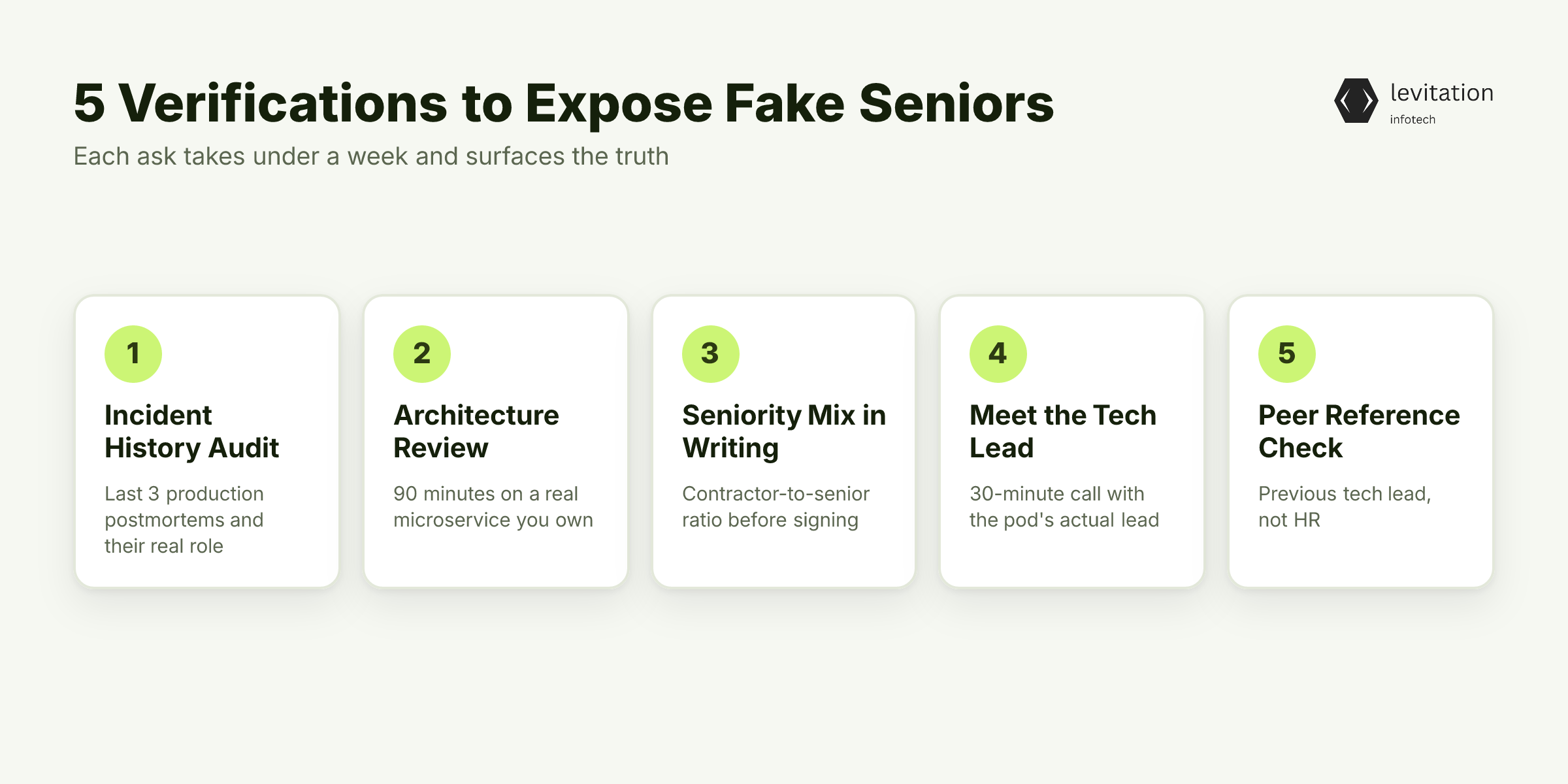
Verification doesn't have to take a month. Five targeted asks, most under a week, will surface the truth. - Ask for the engineer's last three production incidents and their actual role. A real senior wrote the postmortem; an 18-month impostor only attended someone else's. No postmortem document means no proof of seniority. - Request a 90-minute architecture review of a real microservice you own. A senior questions the API contract and data model before touching the code. A junior starts refactoring. Watch which one shows up. - Demand the vendor share the seniority mix upfront. The ratio should weight architects and senior engineers over junior contractors. If the vendor hands you five contractors all titled senior, you are buying exactly that problem. A real custom software development partner gives you the mix in writing before the contract. - Ask for the tech lead's resume and a 30-minute call with them. The lead is the spine of the pod. If the vendor won't let you talk to them, the pod doesn't exist as described. Then request a reference check with the candidate's previous tech lead, not HR. HR confirms attendance. A tech lead describes architectural decisions, and that difference is the entire conversation.
Verification is half the battle. The other half is pricing, because the dedicated team model has a very different cost shape than staff augmentation. The wrong pricing structure creates the same misalignment.
Pricing a Dedicated Team Without the Bait-and-Switch
Real dedicated team pricing in India lands between $28 and $55 per hour per developer. That range is honest. The trap is the margin layered on top.
A bait-and-switch vendor quotes a flat monthly retainer that bundles vendor margin, "project management," and "tooling" into one opaque number. You stop seeing what you're paying for, which is exactly when the seniority starts drifting.
Three clauses turn the pricing into something you can trust: - Lock the seniority mix in the contract. If the vendor swaps your architect for a mid-level mid-project, the rate must adjust. This is the single clause most CEOs forget to negotiate. It prevents the slow erosion of your pod's quality. The pattern matches what we measured in 6 hidden costs in Noida software quotes; the headline number hides the swap. - Separate vendor margin from developer cost. The margin should be transparent and capped, not buried in a retainer. When you can see it, you can negotiate it. The vendor has less room to drift on the actual people they put on your pod. - Connect a defined portion of the monthly fee to a delivery metric you actually care about. Pick one: cycle time, defect escape rate, or production uptime. Write it into the contract, and the vendor's incentives match yours. The conversation stops being about hours billed and becomes about what shipped. This is the same shift we covered in cycle time, not salary, being the real cost.
When the model, the vetting, and the pricing are all aligned, the conversation stops being about cost-per-head and starts being about what the team ships.
What Changes When You Hire the Pod, Not the Person
The shift from person to pod changes three things that show up in your quarterly review.
Architecture decisions stop needing your review. The architect on the pod has the seniority your product needs, signs off on the design, and absorbs the technical risk. You stop being the de facto architect because no one else on the pod will make the call. That frees your time, which is the resource you can't bill back.
Your internal team stops absorbing mentorship overhead. They go back to building the part of the product that makes you money: the core differentiator, the moat, the thing your competitor can't copy. Every hour your real senior spends teaching a mislabeled vendor developer is an hour not spent on that. Long-term retention of the pod creates a knowledge base that compounds. The same engineers who shipped v1 are the ones shipping v4.
They know the schema, the edge cases, the deployment history, and the customer's last-minute pivots. Retention is a leading indicator that the pod's knowledge isn't walking out the door every six months. This is why vendors running structured pods in Noida maintain the institutional knowledge that regulated industries require. It is also why top software development companies in Noida that enforce seniority structurally see their pod's knowledge compound across product versions.
You stop paying senior salaries for junior output. The product ships. The architecture holds. The board stops asking why engineering is the line item that keeps growing.
Ready to swap resume theater for a verified pod? Start the conversation.
Frequently Asked Questions
What is the average salary of a senior software developer in Noida in 2026?
Senior developers at large product companies in Noida earn between ₹2.3L and ₹2.4L per month at the mid-band. This is based on current S&P Global compensation data. At top-tier product firms, seniors with deep production experience command premium compensation. That is why salary alone is a weak signal of seniority.
How do you verify a developer's actual years of experience?
Ask for production incident reports they authored. Then add a live architecture review of a system you own, plus reference checks with their previous tech lead, not HR. A real senior has postmortem documents, RFCs, and a tech lead who describes their specific architectural decisions, not just confirms they "worked on the project."
What is the difference between a dedicated development team and staff augmentation?
Staff augmentation sells you individual bodies billed hourly. The vendor has no stake in delivery outcomes. A dedicated development team is a full pod: architect, seniors, QA, and a delivery lead, contracted as a unit with shared accountability for shipping the product. That shared accountability is why the model works for high-complexity builds.
How much does a dedicated development team cost in India?
Dedicated team rates in India range from $28 to $55 per hour per developer. The exact rate depends on seniority mix and domain complexity. The structural savings versus a comparable US or EU team come from the difference in local labor markets, not from cutting corners on pod quality.
When should a CEO outsource to India versus hire locally?
Outsource to India when your product needs a sustained build and your domain is well-defined. You also need to verify the pod's seniority before signing. Hire locally when the engagement is short, the domain is highly ambiguous, or you lack the engineering leadership to manage a remote pod. The time-zone and context-switching cost overwhelms the savings on brief engagements.
Sources
Research and references cited in this article:
- Software Developer Job Description Updated for 2026
- Hire a Dedicated Development Team in 2026
- Senior Software Developer Role & Responsibilities- Glider AI
- Senior Software Developer Job Description | HiringGo
- Software Development Team: Essential Roles in 2026 | South
- Cost of outsourced software development by country 2026
- Software Development Outsourcing Cost in 2026: Full Guide - IdeaSoft
- The Complete Guide to Software Outsourcing: Models, Costs, and How Not to Get Burned (2026)
- 2026 Software Development Price Guide & Hourly Rate
- Software Development Outsourcing Costs: How Much Should You Pay in 2026? - The Rocky Mountain Collegian
- 50 Senior Developer Hiring Statistics 2026: Costs, Timelines, and Success Rates | Second Talent
- Developer Hiring Trends in 2026: The Five Forces Reshaping How You Build a Team
About the author
Mayank Singh is a software developer at Levitation Infotech, where he builds web and AI-powered applications across the company’s fintech, healthcare, and enterprise projects.