


TL;DR: Most custom software contracts in India transfer legal title to the client but retain practical control with the vendor through shared toolkits, undocumented logic, and restrictive licenses. True ownership costs 20-50% more upfront but protects the ₹20 lakh from becoming a permanent dependency. Five specific contract clauses - broad assignment, source escrow, third-party component restrictions, knowledge transfer warranties, and exit support - separate real ownership from a paper title.
Key Takeaways: - Legal ownership and practical control are different things. Your contract may give you the first while quietly stripping away the second. - Shared vendor toolkits (auth modules, admin panels, deployment scripts) are the real lock-in mechanism, not the assignment clause. - Demanding full IP transfer adds a 20-50% premium. That premium is cheaper than the long-term cost of vendor lock-in. - Five contract clauses close the ownership gap. Vendors that resist them are signaling their intent to retain control. - Firms comfortable with full IP transfer build retention through performance, not lock-in.
The Clause That Voids Your ₹20 Lakh Investment
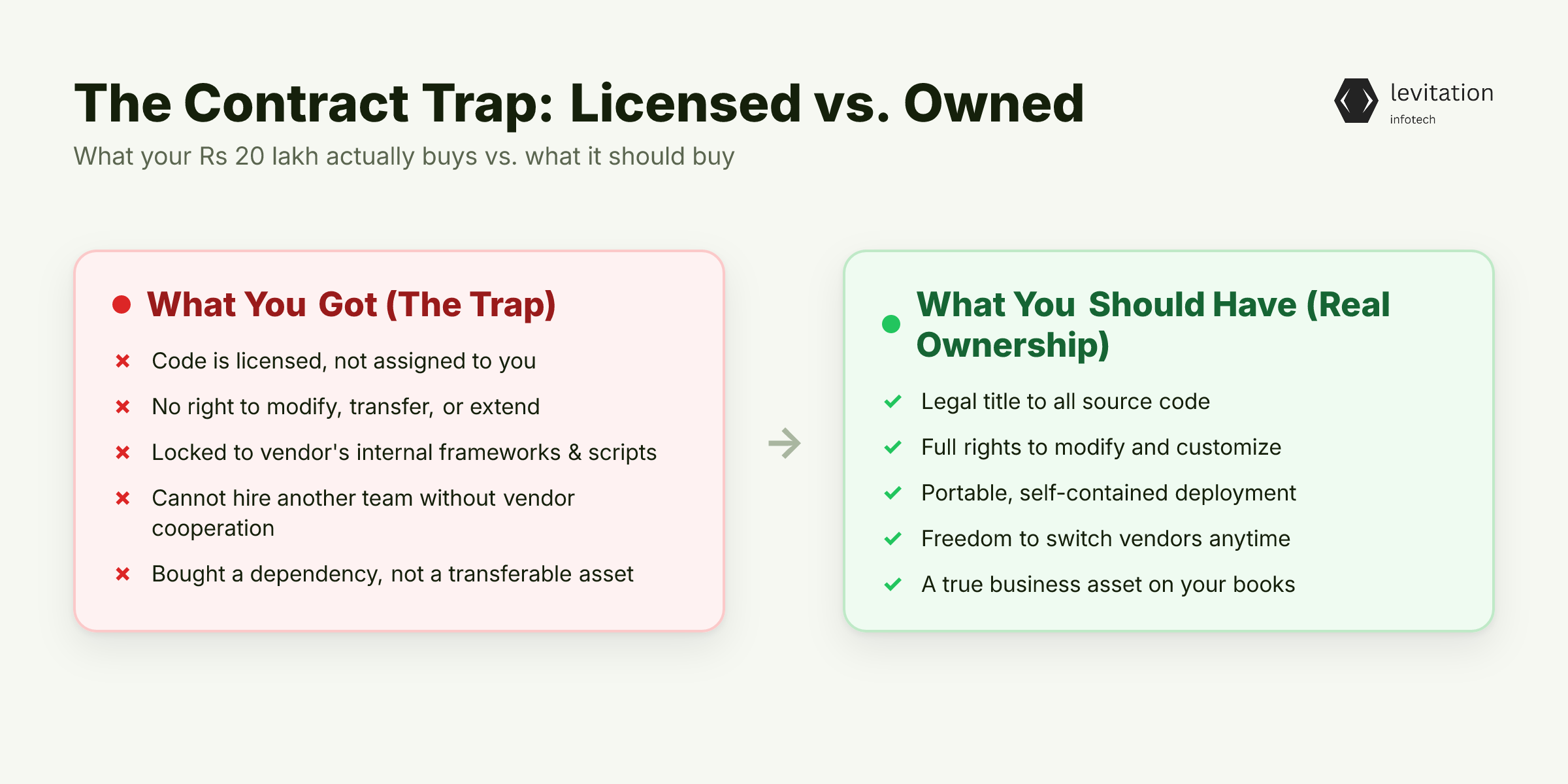
You paid ₹20 lakh. The vendor deployed the software. And then you discovered the contract you signed gives you a license to use the code - not the right to modify it, transfer it, or hire another team to touch it. This is not an edge case. It's the default for most custom software development contracts in India.
Here's the trap. Most founders read "work made for hire" or "all code assigned to client" and assume the deal is clean. The vendor nods, the lawyer signs off, and the project ships. Six months later, when the in-house team tries to take over maintenance, they hit a wall. The authentication module is licensed, not assigned. The admin panel uses a framework the vendor built for a dozen other clients. The deployment scripts reference internal tooling nobody outside the vendor's office can access.
Two concepts matter here. Formal ownership means you have legal title to the code. Practical control means you can run, modify, and transfer the software without the vendor's cooperation. A contract can hand you the first while denying the second, and most top software development companies in Noida structure deals exactly this way. The client gets a deliverable, not a transferable asset.
The moment you try to switch vendors, you discover the code is not portable. Your ₹20 lakh bought a dependency, not an asset. And the worst part? You signed for this on page one.
If the contract explicitly says "client owns the code," how does the vendor still control it? The answer is buried in clauses most founders never read past the first page.
How Work-for-Hire Clauses Actually Work in Noida
Work-for-hire and assignment provisions sound protective. They use words like "all rights, title, and interest" and "perpetual, irrevocable assignment." Founders read these phrases and breathe easy. The trouble starts when you ask: assignment of what, exactly?
Indian custom software development contracts typically assign only what the vendor creates from scratch for your project. That's the visible part of the iceberg. The hidden part is the vendor's pre-existing toolkit - the authentication framework, the admin templates, the deployment harness, the shared utility libraries they reuse across every client engagement. These components are the vendor's pre-existing IP, and the contract carves them out of the assignment.
Here's where it gets ugly. These retained components are often load-bearing. Remove them and the application stops working. The auth module handles session management across the entire product. The admin panel renders every internal tool. The deployment scripts provision the production environment. A new team inheriting the codebase can't just maintain the application; they have to reverse-engineer what these shared pieces do, rewrite them from scratch, or negotiate a separate license with the original vendor.
This is custom software contracting in Noida at scale. The vendor assigns "the code" while quietly retaining the parts that actually make the code run. On paper, you own the house. In practice, the vendor owns the foundation.
Even when the assignment clause is clean, there's a second mechanism that locks clients in, and it has nothing to do with the words on the page.
The Shared IP Trap: Owning Code You Can't Use
The mechanics of vendor lock-in live inside the codebase itself, not the contract. Many top custom software development companies in India license internal toolkits across multiple client projects. The auth module serving your fintech app also serves a healthcare SaaS three floors down. The admin panel powering your dashboard also powers a logistics platform in the same building. These shared components are the vendor's amortized R&D, built once and billed many times.
When a new team inherits your codebase, they discover these components aren't "your" code. They're the vendor's IP, licensed only for use as deployed. The license doesn't transfer. The source isn't included. The new team must either rewrite the shared portions or negotiate a separate license with the original vendor.
This is the real cost. Rewriting the shared portions requires reconstructing foundational components without the original vendor's documentation, and the work can approach the cost of the original build. Licensing them from the original vendor gives them ongoing leverage over your roadmap. Either way, your custom software development company partner has just turned a one-time sale into an annuity.
This is vendor lock-in by design. You own the application surface. The vendor owns the machinery underneath. And the machinery is what makes the surface run.
So what's the actual fix? It turns out there is one, but almost no startup founder knows what it costs upfront, which is why most don't ask.
True Ownership Costs 20-50% More - Here's Why That's Worth It
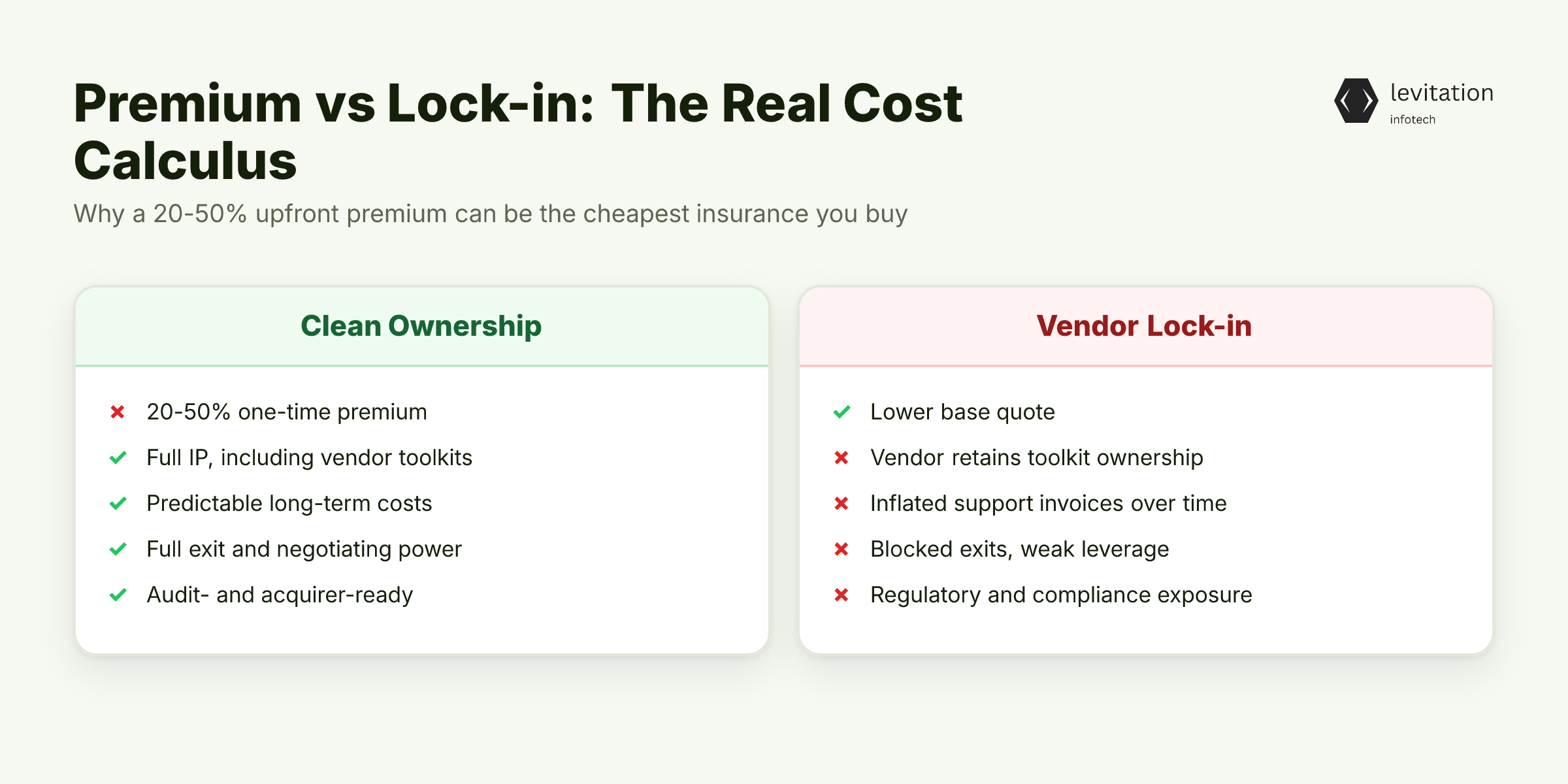
Full source-code ownership, including every component, not just project-specific code, carries a premium. Most Noida-based vendors quote 20% to 50% above the base software development cost for clean IP transfer. The variance depends on how much of the vendor's toolkit your project depends on.
Why the premium? Two reasons. First, the vendor loses the ability to amortize their toolkit across future clients. That internal admin panel was built once and billed to ten engagements; now it has to be built bespoke for yours. Second, ongoing maintenance costs rise. The vendor can no longer reuse battle-tested shared modules. They have to maintain your unique stack separately, and that work shows up in support invoices.
The trade-off is asymmetric. The 20-50% premium is a one-time bump. Vendor lock-in can cost multiples of that over the software's lifetime through inflated support rates, blocked exits, and reduced negotiating power when the relationship sours. If you're investing in bespoke software for a long-horizon product, the premium is the cheapest insurance you'll ever buy.
For application development projects that touch healthcare data, financial transactions, or anything with regulatory exposure, the calculation is even simpler. Auditors and acquirors do not accept "the vendor owns the auth module" as an answer. Clean ownership is the price of doing business with serious counterparties.
The premium is the easy part to calculate. The hard part is getting the contract language right so the vendor can't quietly re-introduce the same lock-in through a different clause.
Five Contract Clauses That Lock Down Your IP
Contract language is where ownership actually lives. Five clauses matter more than any other. If a software company in Noida resists any of these, they are telling you they plan to retain control.
Clause 1: Broad assignment of all work product. Replace "code developed for this project" with "all code, components, scripts, configurations, and derivative works delivered under this SOW." This closes the shared-IP loophole by assigning everything, not just the new parts.
Clause 2: Source code escrow. Require a third-party escrow service with release triggers tied to vendor bankruptcy, abandonment, or material breach. Escrow is your seatbelt for the day the vendor stops responding to emails.
Clause 3: Prohibition on embedded pre-existing components. Forbid the vendor from embedding their pre-existing toolkit without a written, itemized license that survives contract termination. If they want to use their auth module, they have to list it, price it, and license it to you in writing.
Clause 4: Knowledge transfer warranty. Require the vendor to warrant that a competent third-party team can maintain the codebase using only the delivered documentation. No "dark logic" that requires vendor cooperation to understand. This clause is your protection against undocumented dependencies.
Clause 5: Exit and transition support. Negotiate 30-60 days of handover support with the successor team, billable at a pre-agreed rate, not market rate. Without this clause, transition help becomes a hostage negotiation.
These five terms separate firms that treat IP transfer as standard from those who treat it as a concession. The top custom software development companies in India, the ones comfortable with full IP transfer, agree to these clauses without drama. They retain clients through performance, not through lock-in. Clients stay because the work is good, not because they're trapped.
If you're evaluating a best software development company candidate and they flinch at any of these five clauses, walk away. The relationship will not improve after you sign.
What Changes When You Actually Own the Code
Real ownership changes the entire dynamic. Negotiating leverage shifts first. A vendor that knows you can leave retains you through performance, not through lock-in. This is why firms comfortable with full IP transfer don't need lock-in mechanisms. They don't need to trap clients. They earn the relationship every renewal cycle.
Feature velocity increases. Your in-house team or replacement vendor ships changes without waiting for the original developer's release cycle. No more "we'll add that to the next sprint" delays because the original team is busy with three other clients.
M&A and fundraising become simpler. Acquirors and investors can audit the codebase, confirm clean ownership, and factor it into valuation. Locked-in code often gets written down or excluded from the deal entirely. Clean IP is a line item on the balance sheet, not a liability footnote.
The ₹20 lakh you spent becomes a real asset. It depreciates predictably, it transfers cleanly, and it doesn't generate recurring support invoices you can't control. Working with a software development company Noida that treats IP transfer as standard is the difference between buying software and buying a subscription to someone else's architecture.
This is the kind of contract posture that turns a custom build into a strategic asset, and it's the lens any serious IT company Noida evaluation should start from.
For teams structuring these deals for the first time, the Noida quote gap analysis we published earlier shows how the same SOW can vary widely across vendors, and ownership terms are where most of that variance hides. The hidden costs in Noida software quotes breakdown covers six more line items that compound the lock-in problem.
Frequently Asked Questions
Q: Who owns the source code in a custom software development project in India?
By default, the developer owns the code unless the contract explicitly assigns it to the client via a work-for-hire or assignment clause. Even then, pre-existing components and shared toolkits are often carved out. The only way to secure full ownership is to negotiate specific language covering all deliverables, not just project-specific code.
Q: How much extra does full source code ownership cost in India?
Most Noida-based vendors charge a 20% to 50% premium on the base development cost for full IP transfer, depending on project complexity. The premium covers the vendor's loss of amortizing shared components across future clients and the cost of building bespoke equivalents for your project.
Q: What is vendor lock-in in custom software and how do I prevent it?
Vendor lock-in happens when the original developer retains practical control over the codebase, through shared IP, undocumented logic, or restricted licenses, even after the client has formal ownership. Prevention requires source code escrow, knowledge transfer warranties, and explicit clauses forbidding the use of pre-existing vendor toolkits without a written license.
Q: Can I get the source code after the project ends if I didn't secure it upfront?
Sometimes, but at a significant cost. The original vendor typically charges for retroactive IP transfer, and any shared components must be licensed separately or rewritten. This is why the negotiation must happen before signing the SOW. Once the project is delivered, the vendor holds all the leverage and has little incentive to accept unfavourable terms.
Q: What contract clauses should a startup demand for IP protection in custom software?
Five clauses matter most: (1) broad assignment of all work product, not just project-specific code; (2) third-party source code escrow with release triggers; (3) prohibition on embedding pre-existing vendor toolkits without a written license; (4) a knowledge transfer warranty; and (5) a defined exit and transition support period. Any vendor resisting these is signaling long-term lock-in intent.
Sources
Research and references cited in this article:
- Who Owns the Code in Custom Software Development? - Comidor
- Software Development Agreement Template: Scope, IP Ownership & Free Sample (2026)
- Essential IP and Ownership Clauses in Software Development and Services Agreements | GenieAI Blog
- Who owns your software development code? - IT Contracting
- Intellectual property in IT: Who owns the code? Discuss t | Blog ARDURA Consulting
- Software Source Code Ownership: A UK Buyer's Guide
- Who owns source code? And why it should be you
- Who Owns The Code? | ASP Historical Archive
- Ownership of Source Code in Software Agreements|Oziel Law
- Software Contract Negotiation: 2026 Guide to Save 10-30%
- US Buyer’s Guide: How to Choose a Custom Software Development Partner (2026)
- Custom Software vs Low-Code in 2026: Which Approach Drives Real Business Value? - Reproto Techologies
About the author
Mayank Singh is a software developer at Levitation Infotech, where he builds web and AI-powered applications across the company’s fintech, healthcare, and enterprise projects.