


TL;DR: ERP quotes price the license and the first wave of implementation, not the five-year cost of running the system. The real number lands at roughly three times the year-one sticker, hidden across migration, customization, integration, training, and maintenance. A forensic review of the quote before signing is the single highest-ROI hour a founder can spend.
Key Takeaways: - The ₹8 lakh figure is license + initial implementation, not total cost of ownership, and vendors are usually quoting a different scope, not being dishonest. - Five cost categories compound after go-live: data migration, customization creep, integration tax, training gaps, and ongoing maintenance. - A balanced cost-distribution check and three "year questions" will predict the real five-year number before you sign anything.
The ₹24 Lakh Reality No One Quotes You
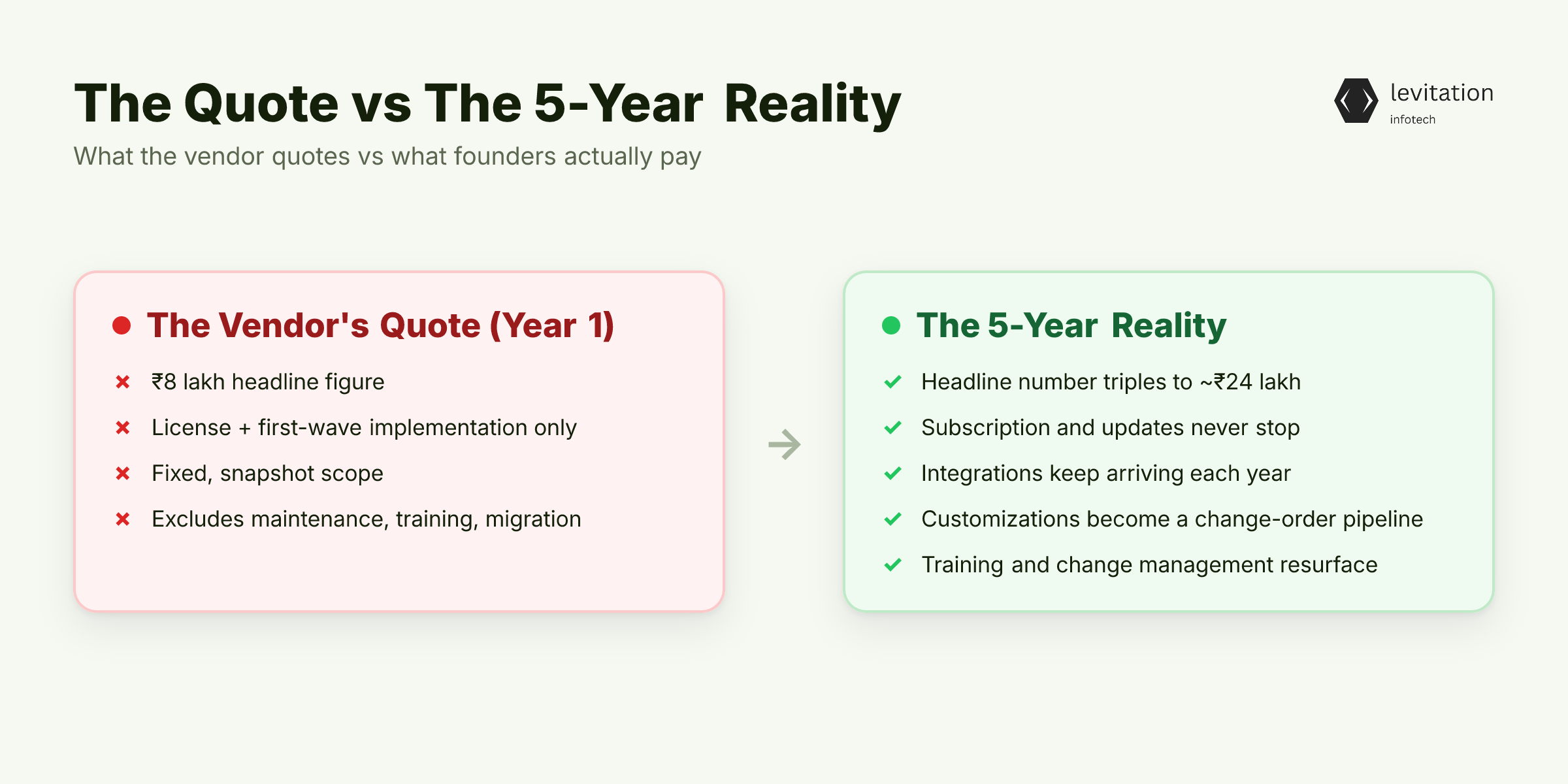
The vendor's quote is a photograph. The cost is a five-year film, and almost no founder reads the script before signing.
The ₹8 lakh figure on a vendor's deck usually covers two things. The bundle is the software license plus the first wave of implementation services. It almost never covers the work that decides whether the system survives year two.
Indian ERP implementation cost varies wildly because most quotes omit the same line items. Founders don't know to ask for them. Vendors are not hiding the number. They are quoting a different scope.
The reason the headline number triples over five years is structural. Maintenance, updates, and scaling are ongoing costs. The year-one quote never captures them.
The subscription does not stop. The integrations keep arriving. The upgrade cycles keep coming.
The customization work that was never scoped in year one becomes a change-order pipeline in year two. Indian vendors routinely exclude migration, integration, training, and change management from the headline number.
None of this is dishonest. The vendor quoted a different scope. The founder who compares the two numbers and signs anyway is buying a year-one product with a year-five invoice.
Enterprise-scale budgeting follows the same logic at a different size. The structure of the trap does not change. For a deeper look at how the same dynamics play out in custom builds, see our notes on ERP software development.
The quote you received is a snapshot. The real cost is a five-year film, and the sequel is where the budget actually breaks.
The Five Cost Bombs Hidden Inside Every ERP Quote
Most ERP quotes fail at the same five points. These are not surprises. They are the structural reasons every year-one number turns into a year-five story.
Data migration. Legacy spreadsheets, Tally exports, and inconsistent master data can expand the quoted effort. If your customer database has three formats, the migration line item will explode. If your inventory codes were last cleaned in 2019, it was never itemized.
The full scope of hidden ERP costs sits here, in the work nobody wants to scope before the deal closes.
Customization creep. Every "small change" request after go-live triggers a change order. Vendors price these at premium rates because they break the project plan.
A field rename is light work. A new approval workflow is a sprint-scale effort. The math compounds, and most of the ERP implementation effort after month three is customization the original scope never mentioned.
Integration tax. Connecting ERP to payment gateways, CRMs, e-commerce platforms, and tax software is almost never in the base scope. Each connector is a small project. Together they are a medium project, one that arrives in year one and finishes in year two.
Training and change management. User adoption is the single biggest reason ERP projects fail, and it is the first line item cut when budgets tighten. Teams that skip training end up running two systems in parallel. The cost of that parallel run is invisible until the audit.
Ongoing maintenance and upgrades. Cloud subscriptions look cheap per user but compound relentlessly with headcount and feature growth. Year-three invoices routinely bear no resemblance to year-one quotes because the subscription base has grown, the upgrade cycles have hit, and integration drift has accumulated. The projects that survive year two are the ones where all five of these categories were priced in from day one.
So if every quote systematically underestimates, why do so many founders still chase the lowest year-one number?
Why 'Cheap Now' Always Compounds to 3x by Year Two
Because the lowest year-one number is a familiar, comfortable, boardroom-defensible number. The five-year film is not. Here is what the compounding math actually looks like across the three real options.
Off-the-shelf platforms like Odoo or ERPNext carry a license and implementation cost. The cost varies by scope and headcount. Then the per-user monthly fees begin.
Those fees scale linearly with headcount, and they do not stop. The math is simple. Every additional month of subscription, every upgrade cycle, every integration connector adds to a total that compounds year over year.
A full custom ERP for a mid-sized company carries a high entry cost. The marginal cost per workflow is lower once the core system is built. This is the build vs buy ERP trade that most founders misread, because they compare year-one license to year-one custom and stop counting.
On-premise looks expensive upfront but caps your spend. Cloud looks cheap upfront but turns into an annual tax that grows with the business. Neither is wrong. Both are math.
The same cost-compounding problem applies in regulated industries where retrofits are dramatically more expensive. That is why so many Indian hospitals and pharma plants end up buying ERP twice. We explored this in most Indian manufacturers buy ERP twice.
The compounding effect is mechanical. A ₹8 lakh cloud quote becomes ₹24 lakh, not because of fraud, but because of three years of subscription. Add integration drift and three upgrade cycles. The compounding math tells you what to choose. The decision tree tells you when.
The Founder's Build vs Buy Decision Tree
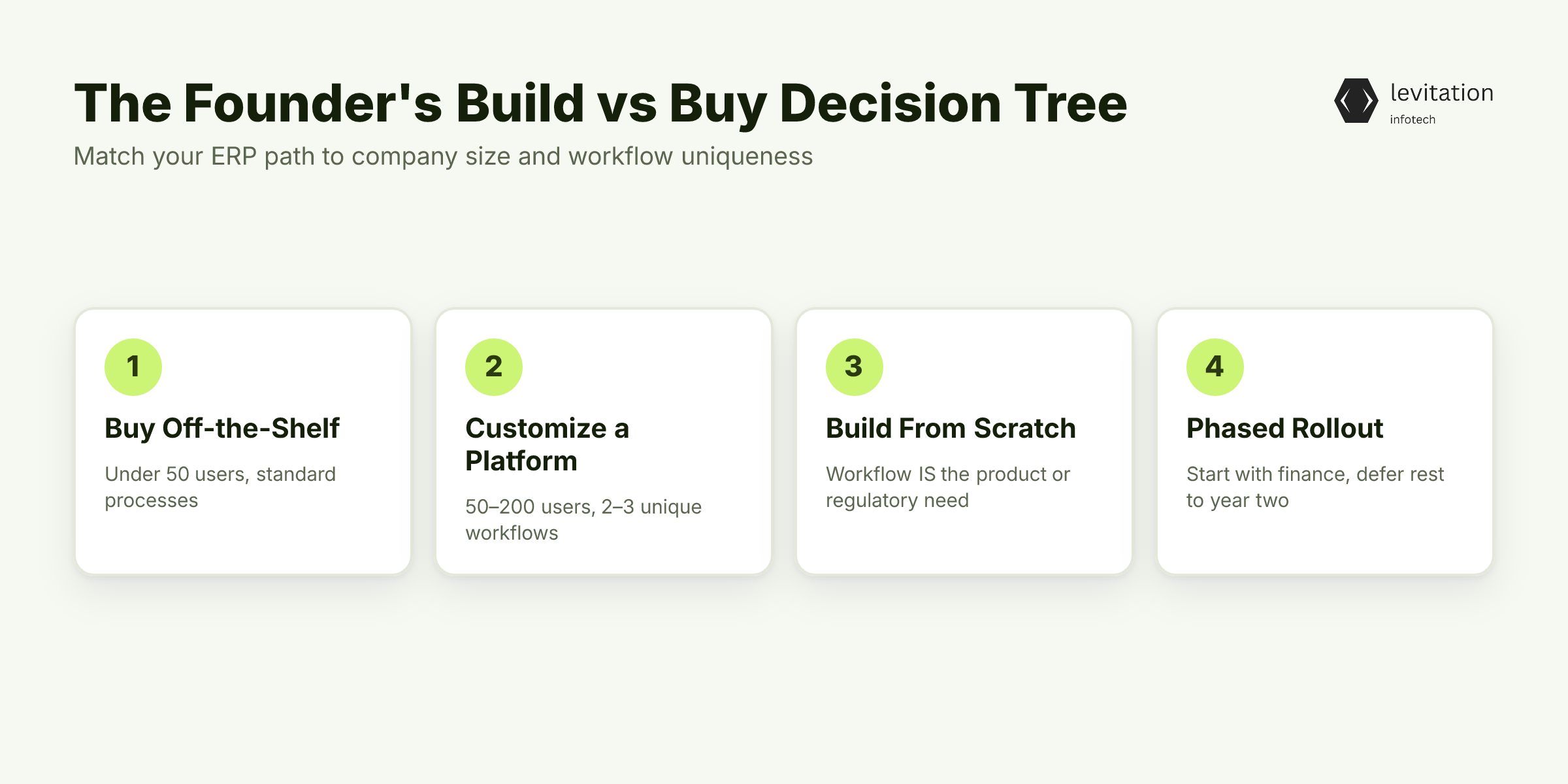
Most founders frame ERP as a binary: build or buy. That framing is wrong. The right frame is a four-way decision, and the fourth option is the one almost no vendor pitches.
Buy off-the-shelf (ERPNext, Odoo Community) when: you are under 50 users and your processes are standard. Your regulatory load is low, and you can tolerate most-but-not-all fit. The remaining gap is where most of these projects die.
For a 20-person services company with clean books, off-the-shelf is often the right answer. The full custom ERP cost in India comparison is in the practice notes.
Customize a platform (Odoo Enterprise, SAP Business One) when: you have 50 to 200 users, and two or three workflows are genuinely unique. You need vendor support without taking on full custom risk. This is the highest-volume middle path.
The ERP development work here is mostly configuration plus targeted extensions. The per-user math starts to break down as headcount climbs. That is why ERP vendor lock-in at scale becomes a real, documented pattern.
Build from scratch when: your workflow IS the product, like a marketplace, logistics network, or hospital chain. Your regulatory requirements force it, or you have hit the ceiling of two prior platforms. The custom path only wins when you have a five-year horizon and a real reason to own the code.
See our notes on custom ERP outperforming large platforms for mid-market firms.
The hidden fourth option: phased rollout. Start with finance and sales on a platform. Defer manufacturing or HR to year two when revenue funds it. Most founders sign a year-one contract for a five-year scope.
The phased approach reverses that. The contract grows with the business, not against it.
How to Read an ERP Quote Like a Forensic Accountant
A quote is a financial document, not a sales document. Read it like one.
Demand four line items every quote must contain: license, implementation services, data migration, and year-one support. If any are missing, the quote is a teaser. Compare this to a SAP vs Odoo pricing breakdown. The structure should be identical regardless of vendor.
Apply a cost-distribution check. The bulk of a healthy quote covers license. A comparable portion covers implementation services. A meaningful share goes to everything else: migration, training, integration, contingency.
If the quote shows most of the cost in license alone, the vendor is hiding cost in scope cuts. If services dominate, the change-order pipeline is open. This single check catches most year-two bombs.
A solid Odoo implementation quote follows a balanced distribution across these categories.
Ask the three year-questions. What does year two cost? What triggers a change order? What is included in the annual maintenance fee?
If the vendor cannot answer all three in writing, the answer is "more than you think."
Red flag: any quote that does not itemize customization hours separately. This is where vendors recover margin on supposedly fixed-price projects. Fixed price without itemized hours is not fixed price. It is a blank check.
Get the quote right, and the next question every founder asks is: when does the system actually pay for itself?
What a Predictable ERP Cost Structure Actually Looks Like
A well-scoped mid-market ERP in India requires a realistic total budget that reflects three years of license, implementation, migration, and maintenance, not the year-one sticker price alone. The difference is not vendor quality. It is design discipline.
Three design choices drive predictability. First, a fixed-scope phase one with a written definition of done. Second, a clear change-order rate in writing, negotiated before the contract is signed.
Third, a cap on annual maintenance tied to the license value rather than left open-ended. With these three in place, the ERP cost India conversation becomes a planning conversation, not a surprise conversation.
When the cost is predictable, the payback math becomes straightforward. Most Indian mid-market ERPs pay back through inventory, collections, and compliance savings, not through revenue growth. The full enterprise resource planning discipline at mid-market size mirrors what enterprise teams do at ten times the budget, where predictable cost is the precondition for any honest business case. Levitation's ERP implementation practice operates on that same principle.
The most expensive questions show up in year two, and most of them were buried in the year-one quote.
Frequently Asked Questions
How much does ERP implementation actually cost for a small business in India?
For a 10 to 25 user company on a cloud platform like Odoo or ERPNext, the realistic three-year cost runs well above the year-one quote. The subscription, implementation services, and integration work all stack.
The year-one subscription alone is a major cost component. Implementation services typically match the license cost. Plan for a multiplier of several times the headline number, not a 1x.
Detailed ERPNext cost breakdowns are in the practice notes.
Is a custom ERP cheaper than buying Odoo or SAP in the long run?
Only if you have genuinely unique workflows and plan to stay on the system for five or more years. Custom ERP development for a mid-sized Indian company requires a high upfront investment, but marginal cost per new workflow is low once the core system is built.
Odoo or ERPNext starts cheaper but compounds through per-user fees. The break-even calculus depends on how many users you add and how unique your workflows really are. See the Odoo development path for the realistic mid-market numbers.
What are the most common hidden costs in ERP projects?
The four that derail budgets most often are data migration from legacy systems like Tally, Excel, or multiple ERPs. The next is third-party integrations with payment gateways, e-commerce, or tax APIs. Then come change-order charges for post-go-live customizations.
The fourth is the productivity dip during the first months of user adoption. Each can add a meaningful share to the quoted project cost. Many of these match the patterns in hidden costs in Noida software quotes.
Why do ERP projects go over budget so frequently?
Three structural reasons explain the pattern. First, vendors quote the license to win the deal and recover margin on change orders. Second, founders sign fixed-price contracts without itemizing customization hours.
Third, scope creep after go-live is treated as a new project rather than a planned phase. The fix is a forensic quote review before signing, not a better vendor.
Adoption failure is the silent killer behind most blow-ups. See why Indian ERP implementations fail at adoption for the documented patterns.
About the author
Mayank Singh is a software developer at Levitation Infotech, where he builds web and AI-powered applications across the company’s fintech, healthcare, and enterprise projects.