


TL;DR: AI compliance is a perception problem before it is a technology problem. Engineers manage one AI platform. Auditors evaluate three independent layers (data, model, deployment) with separate evidence requirements. They also check a fourth layer most teams miss: vector databases. The fix is a unified audit surface. It makes evidence machine-verifiable rather than narrative.
Key Takeaways: - Auditors see data, model, and deployment as three separate systems. They have different owners, lifecycles, and evidence requirements. - Documentation without a reproducible structure is narrative. It is not evidence and cannot be certified. - Vector databases are the fourth compliance blind spot. Most governance programs ignore it until audit. - A unified audit surface automates evidence collection at the pipeline level. It is the only architecture that survives external review.
The One-Platform Illusion: Why Your AI Database Is Three Systems to an Auditor
The most dangerous gap in AI governance isn't technical. It's perceptual. Your engineering team manages one AI database. Your auditor sees three separate systems. The mismatch is where compliance failures hide.
Engineers reason about a unified platform. The data lake, the training pipeline, the model registry, and the inference service all sit inside one architecture diagram.
From the inside, governance looks like a documentation problem. From the outside, it's something else entirely.
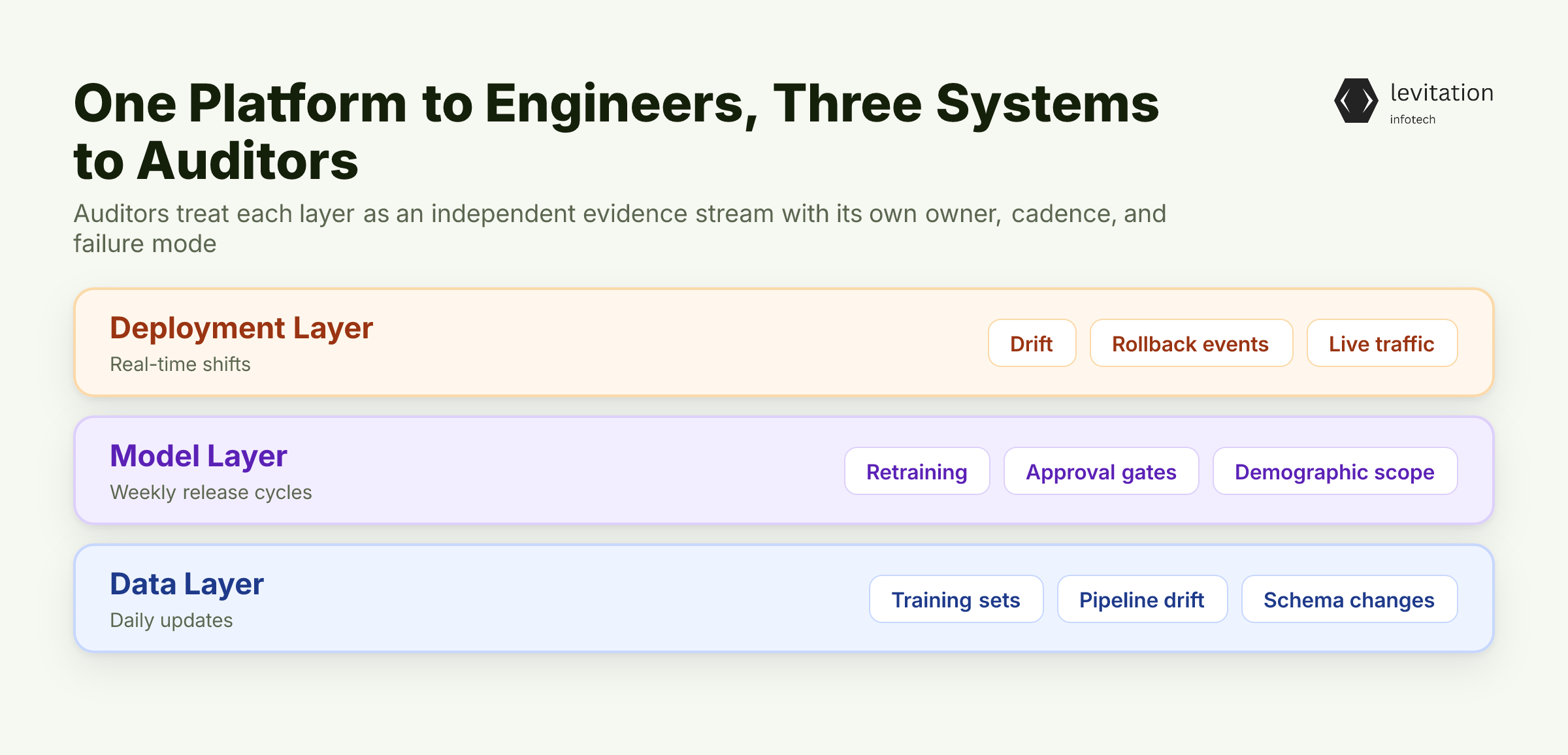
Auditors reason about layers. Each layer has different owners, different update cadences, and different failure modes. They treat data, model, and deployment as independent systems for that reason.
The data layer changes daily as new training sets land. The model layer moves on release cycles measured in weeks. The deployment layer shifts in real time as traffic, drift, and rollback events accumulate.
Across enterprise deployments in regulated industries, one pattern repeats. Governance gaps surface only when a production AI system faces its first external audit.
The seams between the three layers are where findings live. They are not the center of any single layer. Teams that passed internal review with the same controls routinely fail external review. The ISO 27001 audit your buyer wants will miss 11 AI-specific controls. This happens unless the architecture treats them as separate evidence streams.
The AI Incident Database has logged $2.9 billion in losses. Most failures trace to those seams. A data pipeline drifts but doesn't trigger a model retraining. A model approved for one demographic ships to another. A deployment rolls back without preserving the evidence of what went wrong.
CTOs who treat compliance as a documentation exercise miss the point. The three layers don't share a lifecycle. They don't share an owner. They don't fail in the same way.
Treating them as one system in a shared Confluence page is the most expensive assumption in enterprise AI platform governance today.
The fix feels obvious: just document everything in one place. Here's why that approach fails every audit cycle.
Why "Just Document Everything" Doesn't Work
Documentation without a reproducible structure is narrative, not evidence. Auditors cannot certify a narrative.
They can verify a hash. They can replay a lineage graph. They can validate an access matrix. The distinction is the entire game.
Here's why a shared wiki breaks. The three audit dimensions update on different cadences. Data lineage shifts with every pipeline run. Model versions rotate on training cycles.
Deployment telemetry changes by the minute. A document that tries to cover all three in prose drifts out of sync. It often drifts within weeks, sometimes within days.
The result is predictable. Engineers write a full governance page during audit prep. Three months later, the model registry has built up versions the document never mentions. The data team swapped feature stores.
The deployment logs reference a system nobody can find. The auditor asks for current evidence. The team hands over a page that describes a system that no longer exists.
Manual evidence collection is the single largest source of audit delays. Teams spend weeks rebuilding lineage from logs, screenshots, and tribal knowledge.
What should be a focused evidence review stretches into a multi-month engineering project. Every hour spent on reconstruction is an hour stolen from roadmap work.
What auditors need is not more prose. They need machine-verifiable artifacts. These include signed data hashes, reproducible lineage graphs, versioned model cards, and queryable access control matrices.
Evidence that can be rebuilt from the system of record on demand. Not evidence someone wrote down once and forgot.
Most AI systems in production today already have the raw material for these artifacts. Training pipelines emit metrics. Model registries track versions. Deployment logs capture traffic.
The problem is that the material stays scattered across systems that don't talk to each other. No one built the control plane that joins them.
So if dumping more documentation into a wiki fails, what does an auditor actually need to see?
The Three Audit Dimensions: Data, Model, and Deployment
The three layers auditors evaluate are well defined. The evidence they expect from each is specific. Treating them as one artifact is the mistake that keeps repeating across industries.
The data dimension covers lineage from source to feature store. Auditors want to see where training data originated. They want to see how it was changed. They want to see who accessed it. They want to see what retention policies govern it.
PII handling is a recurring focus. Auditors ask which fields were masked. They ask which were excluded. They ask which were inferred from joining external sources. An access control matrix for the data layer is non-negotiable.
The model dimension covers training data snapshots, evaluation results across demographic slices, version history, and approval workflows. Auditors ask which model version was deployed when. They ask who approved it. They ask what evidence supported the approval.
Bias testing results belong here, along with the evaluation harness that produced them. Model rollback is evidence deletion when the rollback discards the artifacts the auditor needs. The auditor needs them to verify what was in production.
The deployment dimension covers inference logs, drift metrics, rollback procedures, and incident response records. Auditors want to see the system as it ran, not as it was designed.
Drift thresholds, alert settings, and on-call response records are all in scope. Explainable AI that passes internal review still fails its first external audit. This happens when the deployment telemetry cannot reproduce the decision path.
ISO/IEC 42001 codifies this expectation. The standard requires that organizations keep records of AI system performance and decision-making across the full lifecycle. It puts weight on transparency, governance, and accountability.
The same expectation is converging across regional frameworks. Procurement teams now treat it as table stakes.
An audit-ready repository contains six artifacts by name. They include a model inventory, data flow diagrams, and an access control matrix. They also include risk assessments, bias testing results, and incident response procedures. These are not suggestions. They are the minimum set that external auditors expect to find.
They span all three dimensions.
The three-dimension model is what mature regulated-industry deployments converge on. The data, model, and deployment layers are governed independently. Shared identifiers let auditors join evidence across them.
The architecture looks redundant from the inside. From the outside, it's the only thing that passes review.
Those three layers are well understood. The fourth one is where most CTOs are flying blind.
Vector Databases: The Compliance Blind Spot Nobody Talks About
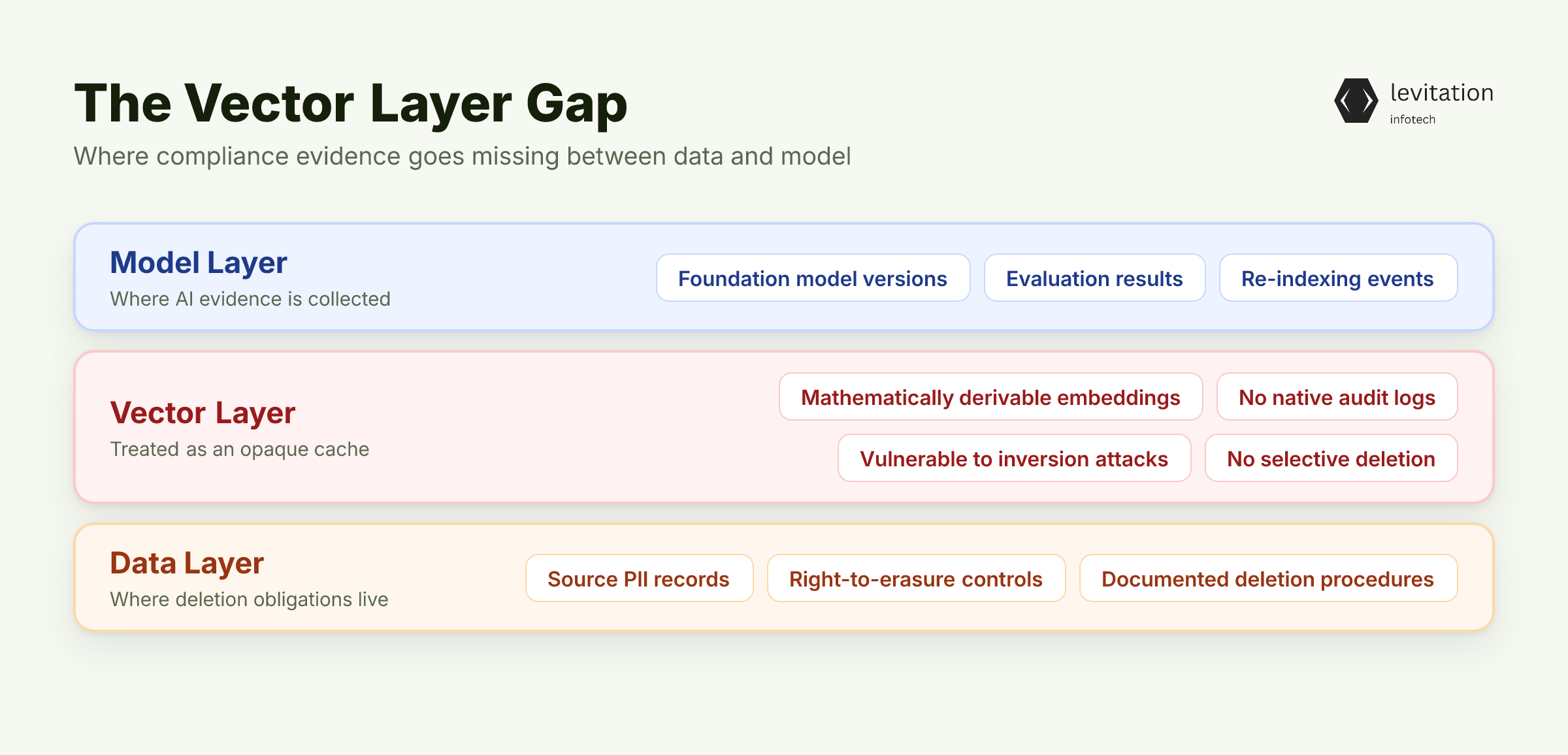
Vector stores hold embeddings that are often mathematically derivable from source PII. Most vector databases ship without native audit logs. That gap is starting to show up in audit findings across every regulated sector.
The risk is not theoretical. Embedding inversion attacks can rebuild original text from embeddings with surprising accuracy. Cross-tenant leakage in multi-tenant vector indexes is a recognized concern in security research.
Auditors are increasingly asking for embedding lineage. They ask where these vectors came from. They ask when they were generated. They ask who can access them.
The right-to-erasure obligation under privacy frameworks conflicts with most production vector indexes. You cannot selectively delete a single vector without re-indexing the whole collection. This is often too expensive at scale.
Teams that documented deletion procedures in the data layer discover during their first privacy audit that the vector layer cannot honor them.
Foundation model and genai governance programs are also struggling here. Embedding model versions, evaluation results, and re-indexing events all generate evidence that has nowhere to live.
The vector database is treated as an opaque cache rather than a regulated system. The evidence gaps are visible to anyone who looks.
The blind spot in your AI stack that external auditors find first is almost always the vector layer. It is the part nobody documents because it does not fit neatly into either the data dimension or the model dimension.
It lives between them, and the evidence gaps are visible.
Vector database governance is the bridge between your data-layer controls and your model-layer evidence. Closing it requires deliberate architecture, not an afterthought.
Closing one blind spot helps. Closing all of them at the same time requires a different architecture.
Building a Unified Audit Surface: What Actually Works
The architecture that survives external audit is not a documentation system. It is a control plane that emits evidence as a first-class pipeline output. Here is what actually works in regulated production environments.
Automate evidence collection at the pipeline level. Every training run emits a signed artifact bundle. The bundle includes the data hash, the model hash, the evaluation results, and the approver ID.
Every deployment emits a release record. It links back to the model version, the data snapshot, and the approval trail. Evidence is a build artifact, not a postmortem.
Wire the three layers into a single queryable index. A control plane joins data lineage, model registry metadata, and deployment telemetry. It uses shared identifiers: a model version, a dataset hash, a release tag.
When an auditor asks for everything related to a specific deployment, the answer is a query. Not a week of reconstruction.
Replace narrative documentation with evidence APIs. Auditors query the control plane and receive reproducible results. The query returns the same answer every time because the underlying evidence is signed and versioned.
The shift from shared drive to queryable surface changes the relationship between teams. The audit team and the engineering team now work differently.
Embed the six required artifacts as first-class pipeline outputs. Model inventory, data flow diagrams, and access control matrices all flow from the same control plane. Risk assessments, bias testing results, and incident response procedures also flow from the same control plane.
They are not written after the fact. They are generated as the system runs.
Integrate with existing GRC tooling. ServiceNow GRC and Archer expect evidence in specific formats. A control plane that exports to these systems gives compliance teams and engineers the same source of truth.
The handoff stops being a manual translation exercise that loses fidelity every time.
The same architecture supports AI implementation for production governance that auditors can read in real time. Event-driven AI systems that auditors can read in real time replace the old batch-reconstruction model.
Controls are evaluated on every commit, not annually. Findings surface in CI, not in audit reports six months later.
Teams that build evidence generation into the pipeline reach a unified audit surface far faster. They are faster than teams that bolt governance on afterward.
When this works, the relationship between your engineering team and your auditor changes in a basic way.
What Changes When Auditors and Engineers Speak the Same Language
The payoff shows up in three places. They are audit cycle time, vocabulary, and the long-term value of the systems you build.
Audit cycles compress. Weeks of evidence reconstruction shrink to days of query review. Engineers stop pulling sprint capacity to compile screenshots. Auditors stop waiting on tribal knowledge.
Both sides work from the same signed artifacts and the same versioned identifiers.
The vocabulary converges. Automated testing, systematic evaluation, documented evidence, reproducible processes. These are the same words engineers use for CI and auditors use for control testing.
The shared language is what makes continuous compliance possible.
Long-lived production AI and genai systems become a competitive moat. Governance compounds rather than erodes. Systems still running in production five years after deployment are the ones whose original controls keep working. They work without rework.
Long-term partnership depends on governance that holds up across multiple regulatory cycles, not just the first one.
Frequently Asked Questions
What is AI database compliance?
It is the practice of making sure AI systems meet regulatory and internal standards across three distinct layers. They are data, model, and deployment. Each layer must produce auditable, reproducible evidence. Treating the AI database as a single system to govern is the most common CTO mistake. Auditors find it first.
How do you audit a vector database?
By capturing embedding lineage, access logs, tenant isolation evidence, and selective-deletion capabilities. Most vector databases ship without native audit features. So governance must be layered on top.
The evidence includes which embedding model version produced each vector. It includes when vectors were re-indexed. It includes how cross-tenant boundaries are enforced.
What does an AI auditor actually look for?
Six artifacts by name. They are a model inventory, data flow diagrams, and an access control matrix. The list continues with risk assessments, bias testing results, and incident response procedures. ISO/IEC 42001 codifies these as the baseline for AI system records.
Auditors expect to query these artifacts, not read prose about them.
What is ISO/IEC 42001?
An international standard that requires organizations to keep records of AI system performance and decision-making. It puts weight on transparency, governance, and accountability across the full AI lifecycle.
It is the first AI management system standard with global recognition. It is becoming the baseline expectation for regulated procurement.
How long does an AI compliance audit take?
About the author
Mayank Singh is a software developer at Levitation Infotech, where he builds web and AI-powered applications across the company’s fintech, healthcare, and enterprise projects.