


TL;DR: AI spending needs one accountable owner. It does not need one owner for every decision. The CTO should own the enterprise AI portfolio and its guardrails. Finance, business, platform, data, and risk leaders share clear mandates. Connect every material investment to four owners, four investment gates, full lifecycle cost, and a scale-or-stop date.
Key Takeaways: - Double-digit AI budgets make unclear decision rights an expensive operating-model defect. - The CTO owns the portfolio, while other executives own economics, outcomes, and controls. - Every material AI investment must pass four gates and produce a one-page decision record.
Enterprise AI Spending Is Scaling Faster Than Ownership
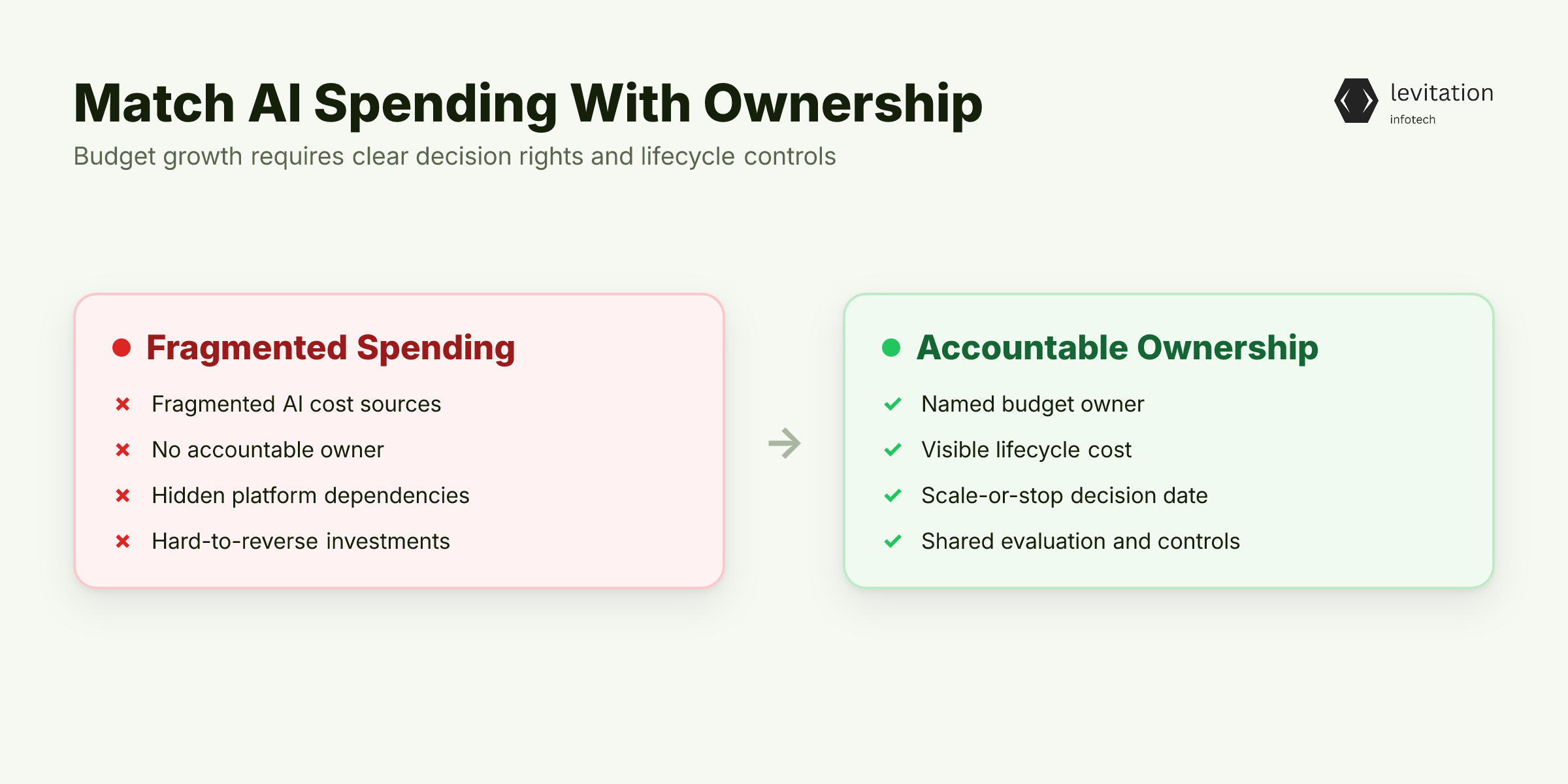
West Monroe reports that 74% of enterprises will commit more than 10% of IT budgets to AI. Yet the available research identifies no clear owner for that spending.
That gap turns every unclear decision into a larger, harder-to-reverse investment. When AI consumes double-digit IT budgets, ambiguous decision rights become an expensive operating-model defect.
Budget pressure does not reveal who owns the decision. AI costs can arrive through several sources. These include direct model and API consumption, bundled SaaS, cloud and inference infrastructure, agentic workloads, and unmanaged shadow AI. When those costs sit in different systems, the budget can grow while accountability remains fragmented.
Budget growth can expose an ownership gap before any governance model exists. As enterprise AI services expand, new spending can appear in several forms. These include model access, integration work, and operating dependencies. This happens instead of appearing as one visible budget line. Company-level adoption can therefore rise while responsibility for each purchase remains unclear.
Shared foundation-model providers and horizontal applications can create dependence. This happens when coding assistants, chatbots, or other common capabilities become embedded in workflows. Once embedded, switching becomes an integration, evaluation, and institutional-knowledge problem rather than a simple procurement choice.
More money is buying deeper dependence on shared platforms and horizontal capabilities. The executive question is no longer simply, “Can we buy AI?” It is, “Can we govern what the purchase changes?”
The test for any enterprise AI solutions portfolio is simple. Every material investment needs: - A named accountable owner - A visible lifecycle cost - An explicit scale-or-stop decision date
Imagine a coding assistant bought for one team becoming a shared platform. It then needs shared evaluation, access controls, and cost ownership, even though its original buyer has moved on.
If any answer is missing, the budget is growing faster than the controls around it. The obvious answer is to appoint one AI budget owner, but that answer is incomplete and potentially dangerous.
Why AI Budget Ownership Cannot Sit in One Role
The False Abstraction: One Owner Is Not Enough
One “AI budget owner” sounds decisive. It is often a category error.
Take a customer-service assistant. The CFO may fund it, the business leader owns service quality, and the platform leader owns reliability. No single role can settle every question that follows.
That is why ownership of enterprise AI systems must split across four decisions: - Funding: Is the money sufficient, and does the funding model survive production use? - Business outcome: Which result will justify continuing the investment? - Platform and risk control: Can the system operate securely, reliably, and within policy? - Institutional knowledge: Who preserves the process context needed to operate and improve it?
Each decision needs an accountable party. Otherwise, approval becomes a signature without accountability.
Enterprise spending also resists simple tracking. Costs can sit in direct model and API consumption. Costs sit in AI bundled in existing SaaS, cloud and inference infrastructure, agentic workloads, or unmanaged shadow AI. A missing invoice can therefore be a missing owner.
The research describes enterprises as renting cognitive infrastructure. Forbes warns that this can cede institutional knowledge to AI platforms the company doesn't own. A Forbes contributor reported that Schneider Electric and Siemens are embedding AI-native capabilities into their own platforms.
That contrast matters. Owning every model isn't the goal. Retaining the ability to evaluate, integrate, observe, and exit is.
Use this diagnostic for each major program. Draw lines from the funding source to the economic and outcome owners. Also connect it to the production platform owner, risk approver, and data and process-knowledge owner. Any missing line is an ownership gap.
Centralizing approval may reduce committee friction while leaving underlying decisions dispersed. Simply moving money under the CTO doesn't create governance.
The better answer separates ownership by decision and makes one executive accountable for the entire portfolio. The unresolved question is how to do that without creating a new bottleneck.
One Accountable CTO, Four Shared Ownership Mandates
Across the research, enterprise AI adoption is widespread, but no ownership model is clear. The evidence also flags reliance on rented cognitive infrastructure. It also notes the related risk of losing control over institutional knowledge.
The recommended answer is direct. The CTO should be singularly accountable for the enterprise AI portfolio and its cross-company investment guardrails. Execution remains distributed.
Portfolio Mandate
The CTO owns investment sequencing, reusable technical capabilities, architecture standards, production-readiness criteria, and unresolved escalations.
The role is portfolio editor, not purchase-order approver. Consider a coding assistant used by many teams. The CTO governs its shared evaluation and access. Business leaders own adoption, while platform leaders own production controls.
Economics Mandate
The CFO owns funding adequacy, total-cost assumptions, procurement power, and realized benefits.
Finance contributes economics to the decision, but it doesn't decide technical suitability. A cheap service can still create an expensive operating burden.
Outcome Mandate
Each business leader owns workflow change, adoption, the operating metric, and the business result. That leader also decides when to scale or retire the use case.
The system isn't the outcome. The changed decision or workflow is.
Control Mandate
The CIO, CDO, data, security, and risk leaders own the production platform. They also own data contracts, access controls, evaluation requirements, observability, and production assurance.
This is AI portfolio governance, not a universal organizational chart. Create a compact owner record for every approved investment: - Economic owner: Funding and lifecycle economics - Outcome owner: Workflow change, adoption, and business result - Platform and risk owner: Production, data, security, evaluation, and assurance - Institutional-knowledge owner: Process context, exceptions, and continuity
A program without all four cannot pass the next gate.
Ownership isn't vertical integration. Own decision rights, evaluation harnesses, integration layers, observability, data contracts, and exit logic where knowledge is strategic. Rent underlying model or compute capacity where that preserves control.
Enterprise AI is judged on integration, not the model. That's the strategic layer the enterprise must control.
The title may change by company, but one CTO-level executive must remain singularly accountable. Distributed mandates only work if every proposal follows the same gates. Otherwise, the portfolio becomes a queue of exceptions. The next test is whether those mandates can process real proposals. It must not turn the CTO's office into a new bottleneck.
Four Gates for Defensible AI Investment Decisions
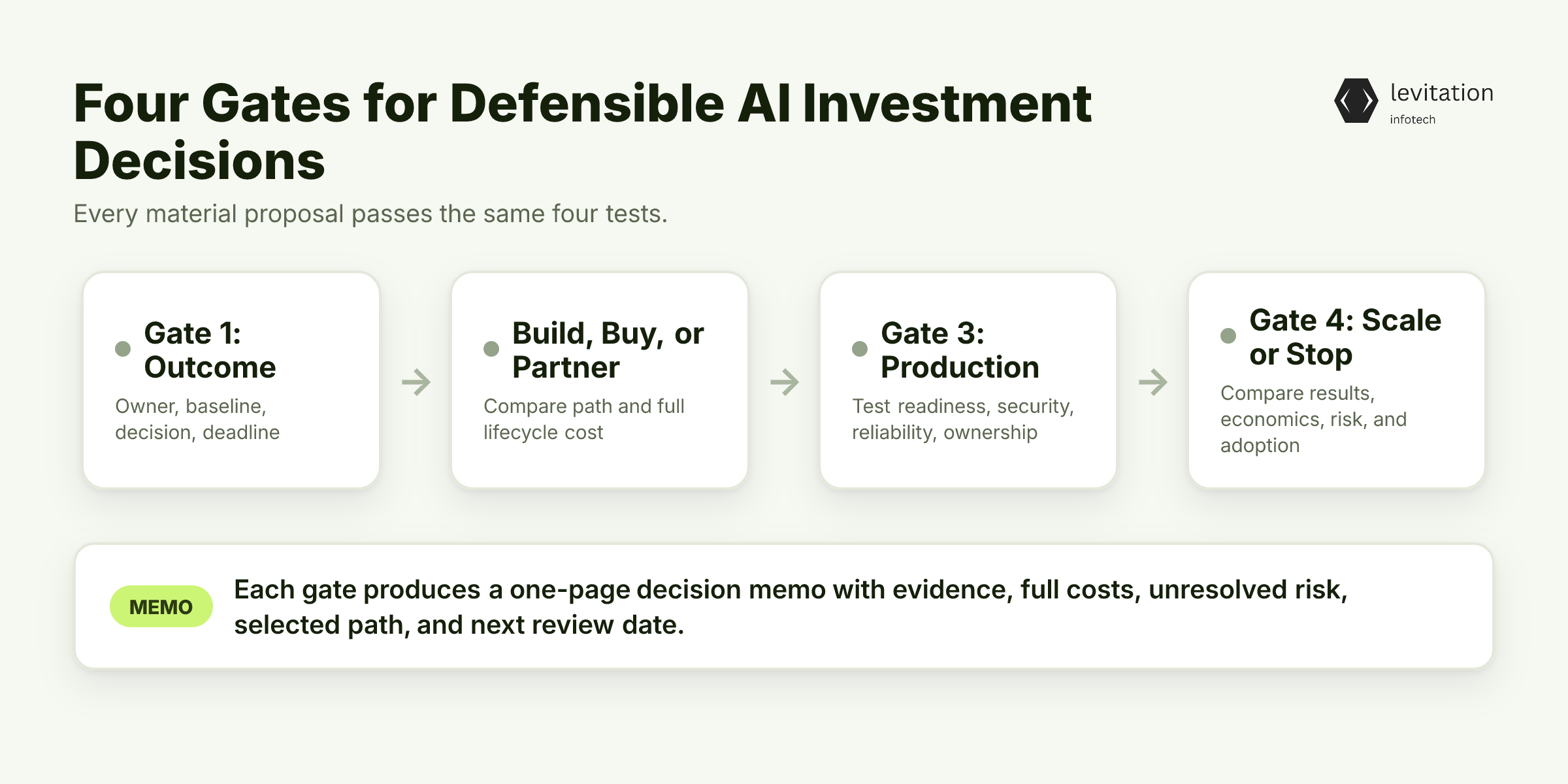
Without gates, shared mandates become meeting invitations. Every material proposal should pass the same four tests.
Gate 1: Outcome
Require a named business owner and the problem being funded. Also require a measurable baseline, the decision this system will support, and a deadline for judging continuation.
An approval assistant isn't an outcome. Faster approval of eligible requests is.
Gate 2: Build, Buy, or Partner
Assess strategic differentiation, proprietary workflow or data context, time to production, control, switching costs, and full lifecycle cost.
Select the delivery path after the comparison, not before it. This makes AI investment decisions auditable and keeps a popular demo from becoming an expensive default.
Gate 3: Production
Test data readiness, integration, security, reliability, evaluation, observability, human oversight, and operating ownership.
A successful prototype can't pass without a production plan. A model demo doesn't show whether the workflow can run when inputs, permissions, and failures change.
Gate 4: Scale or Stop
Compare observed adoption and outcomes with the baseline. Inspect unit economics, operating cost, and unresolved risk.
Then choose scale, redesign, hold, or retire. Each choice needs evidence and a next review date.
Apply the full cost taxonomy at every gate: - Direct model and API spend - AI bundled inside existing SaaS - Cloud and inference infrastructure - Agentic workloads - Unmanaged shadow AI
Tag each cost as a use-case, shared-platform capability, run expense, or change-management investment.
Shared capabilities such as coding assistants and chatbots can become horizontal dependencies. Govern them once where possible, or risk redundant business-unit purchasing.
Every gate produces a one-page decision memo containing: - The decision owner - Evidence reviewed - The complete cost view - Unresolved risk - The selected path - The next review date
Govern exceptions too. Expensive requests often bypass planning because they feel urgent, strategic, or sensitive.
An urgent agent request should enter an exception queue, not escape review. Give exceptions a named approver, expiry date, and the same evidence requirement.
These gates will stay theoretical unless budget data, owners, and evidence are reviewed in one operating cadence.
A 90-Day AI Portfolio Governance Reset
A 90-day reset turns policy into operating control. It doesn't wait for every platform contract to end.
Days 0-30: Inventory the Portfolio
Reconcile procurement, SaaS, cloud, API, and infrastructure records. Identify shadow AI and separate pilots from production systems.
Map each material investment to its business owner, platform owner, cost, and current stage. This is the visibility layer behind reliable production AI implementation.
A missing system isn't a minor data-cleaning task if it already consumes budget.
Days 31-60: Install Decision Rights
Publish the CTO's portfolio mandate, four shared mandates, four gates, escalation rules, and one-page investment memo.
Assign every live initiative to the governance model, including pilots without a production plan. Use one owner record so approval, outcome, platform control, and knowledge retention travel together.
Days 61-90: Reconnect Money to Decisions
Hold the first portfolio review. Classify every initiative as scale, redesign, hold, or stop.
Apply funding changes in the next budget cycle. Intent shouldn't outlive the evidence.
Install a simple operating cadence: - Weekly: Review exceptions and unresolved risks - Monthly: Review the complete AI portfolio - Quarterly: Review strategy, budget, and portfolio direction
Monthly reviews compare value, adoption, cost, production health, reuse, risk, and portability across initiatives. That comparison can reveal per-use-case ROI can become a system-level loss.
Add contract-level controls for outsourced capabilities. Require data rights, service levels, auditability, evaluation access, observability, incident responsibilities, and an executable exit or transition path.
These controls turn hidden vendor lock-in into a managed transition choice rather than a surprise.
Create a central AI control plane for identity, access, approved models and providers, evaluations, logs, and deployment status. Route exceptions through it while business accountability stays with the use-case owner.
This is how teams escape the spreadsheet control plane trap without creating a new approval maze.
Measure the reset with operational evidence: - Percentage of spend visible - Percentage of pilots with production plans - Percentage of investments with named owners - Ambiguous escalations reaching the executive portfolio forum
A governance reset is only credible if it protects the enterprise after the launch team disbands.
Ownership That Outlasts the Pilot
The first payoff is traceability. Every material AI investment has an accountable owner, visible lifecycle cost, production stage, and scheduled scale-or-stop decision.
That makes the enterprise AI portfolio an operating system for decisions, not a list of experiments.
Control doesn't require owning every model. Imagine a foundation-model vendor changing its pricing or commercial terms. The enterprise should preserve its evaluations, integrations, institutional knowledge, and exit options.
Shared platforms and horizontal capabilities can be governed once. That reduces repeated procurement and operating effort across business units.
Change the definition of success. A demo isn't complete. A maintained production capability includes operating ownership, observability, adoption, and retirement planning.
The CTO shouldn't own every AI product. The CTO should own portfolio integrity and the mechanisms connecting investment, control, risk, and outcomes.
The test comes when the launch team leaves. Can the enterprise still scale, redesign, or stop each system with evidence?
Frequently Asked Questions
Who should own enterprise AI spending?
The CTO should be accountable for the enterprise AI portfolio, its investment guardrails, and reusable technical capabilities. The CFO, business leaders, and data or platform leaders remain responsible within their mandates. They cover funding, outcomes, and controls.
Should AI funding sit with the CIO or each business unit?
Use a centrally governed portfolio with shared financial accountability. Central governance defines platforms, controls, and investment gates. Business units fund use cases and own adoption and results.
What is AI portfolio governance?
AI portfolio governance is the system used to manage AI investments across the enterprise. It selects, funds, operates, scales, and retires those investments. It combines decision rights, lifecycle cost visibility, shared technical capabilities, risk controls, and outcome reviews.
How should a CTO decide between build, buy, and partner for AI?
Compare strategic differentiation, proprietary data and workflow context, time to production, control, full lifecycle cost, and switching costs.
Buy for mature commodity capabilities. Build when the capability creates proprietary advantage, and use a partner when the boundary can be contractually controlled.
How can an enterprise prevent shadow AI?
Reconcile AI costs across procurement, SaaS, cloud, API, and infrastructure records. Then route unapproved spending through the same ownership and review process.
About the author
Mayank Singh is a software developer at Levitation Infotech, where he builds web and AI-powered applications across the company’s fintech, healthcare, and enterprise projects.