


TL;DR: Continuous agent execution does not remove human dependency; it creates an overnight decision queue. AI agent escalation should operate as a context-complete control plane, not a support transfer button. Controlled autonomy means fewer avoidable pages, explicit authority, and measured human involvement.
Key Takeaways: - An always-on agent can stay available without having authority over every consequence. - Escalation must follow consequence, authority, and reversibility, not confidence alone. - Good handoffs preserve context, ownership, urgency, and an auditable decision trail.
At 3 a.m., an always-on AI agent can generate decisions that your overnight team cannot safely adjudicate. The uncomfortable truth is simple: continuous execution does not produce continuous autonomy. It produces a queue.
Every insight needs validation. Every recommendation needs strategic context. Every risky action needs authority. AI agent escalation isn't a customer-support escape hatch. It's the control system that makes always-on AI operable.
The 3 A.M. Work Queue Is the Hidden Failure Mode
The always-on contradiction
An always-on agent can sleep until work arrives, then wake to process its inbox. Availability isn't judgment. The system can run while nobody reviews its reasoning, permissions, or consequences.
Consider an agent monitoring failed payments. It can retry a safe operation at 3 a.m. It shouldn't decide that a customer deserves a broad refund without authority.
Both actions can occur in the same hour. Their risk doesn't. Teams building AI agents need a third clock: accountable decision coverage.
Automation multiplies decisions
Agent-generated work creates more decisions, not fewer. Policy can absorb routine decisions, but when exceptions reach people, the overnight review burden can grow.
The two-clock test
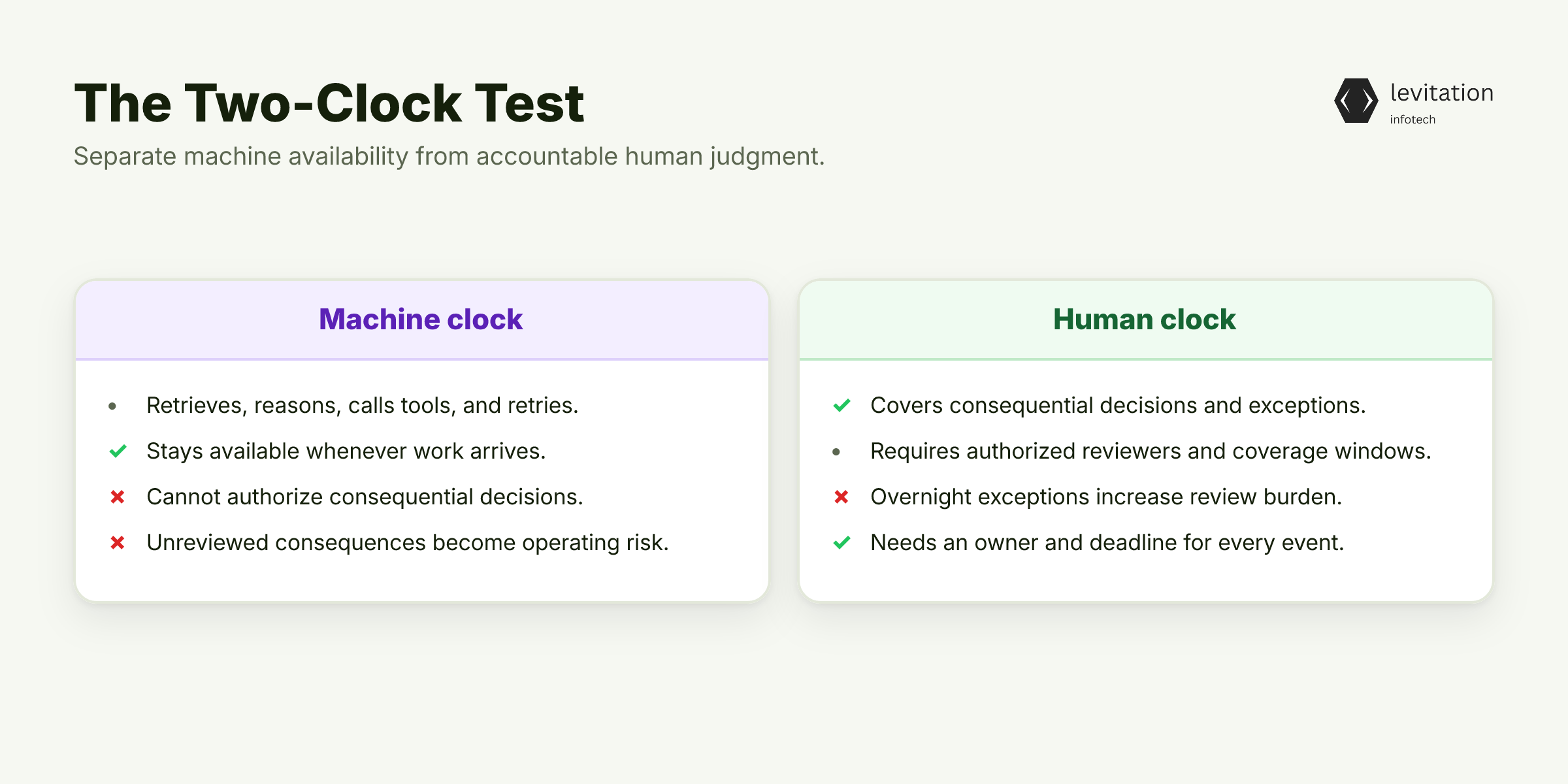
Separate two clocks: - Machine clock: When the agent can retrieve, reason, call tools, and retry. - Human clock: When authorized people are available to make consequential decisions.
Map every consequential overnight event to an owner, coverage window, and deadline. If an event lacks an accountable owner, throughput gains become operating risk.
If overnight volume is only the symptom, why do escalation policies still reflect daytime support traffic instead of consequential overnight work?
Why Confidence Thresholds Break in Overnight Operations
Confidence is not consequence
A confidence score says how certain the model is. It doesn't describe business risk, operating conditions, or delegated authority.
A low-confidence draft can be discarded. A high-confidence account closure can be hard to reverse.
The first question isn't whether the agent feels certain. It's what happens if the agent is wrong.
Overnight conditions compound uncertainty
Overnight failures rarely arrive as one clean fault. They stack: - Stale retrieval evidence. - Conflicting sources. - Missing tools or permissions. - Partial failures spread across many records by batch execution. - No available person to clarify the task. - Audit records without reliable timestamps.
These conditions don't merely reduce confidence. They change the cost of acting, waiting, and asking for help.
Fail open or fail closed
Fail closed for high-consequence writes. Let reversible work continue. - Stop and escalate sensitive writes when context, identity, permission, or source verification is missing. - Retry transient, low-risk actions because waiting adds no value. - Ask the user to clarify ordinary ambiguity if the task can continue safely. - Defer safe work with an explicit deadline and owner.
A single confidence score can't encode all of this. So what exactly should an escalation system control?
AI Agent Escalation Is an Operations Control Plane
Calling escalation a transfer button is an architectural mistake. It moves the conversation without managing the decision.
A complete escalation control plane covers: - Trigger detection: Recognizes a condition that needs attention. - Policy evaluation: Applies rules for consequence, authority, and reversibility. - Ownership routing: Finds the person allowed and available to decide. - Context packaging: Preserves the evidence required for a sound decision. - Service levels: Defines when action is urgent, deferred, or scheduled. - Auditability: Records what happened, who decided, and under which policy.
Data access approval doesn't replace this layer. As Your Data Gateway Approves Data. Agents Still Make the Decisions argues, the agent still needs a decision rights system.
Three escalation outcomes - Approval: A person authorizes one defined action, then the agent continues. - Handoff: Responsibility for the work or conversation transfers to a person. - Deferral: The work enters a staffed queue with a stated deadline.
Suppose an agent finds a disputed account change. Approval means a person authorizes the action before execution. Handoff transfers the customer relationship.
Deferral keeps the case pending until the next staffed shift. These outcomes need different queues, expectations, and audit records. Treating them as one ticket type destroys that distinction.
Explicit agent states
Model the agent's operating state clearly: - Autonomous: The agent can act within its policy. - Constrained: The agent can act, but with reduced permissions or scope. - Awaiting approval: A defined decision is blocking progress. - Handed off: Responsibility now belongs to a person. - Deferred: The task is safely queued for a later decision.
An awaiting-approval state isn't a failed state. Operators must distinguish deliberate pauses from crashes, silent stalls, or repeated retries.
Human involvement shifts from answering every anomaly to setting boundaries, owning exceptions, and improving escalation rules over time. Which conditions should move work out of autonomous mode?
Trigger on Consequence, Authority, and Reversibility
Confidence is convenient. It isn't a safety boundary.
The three-axis policy
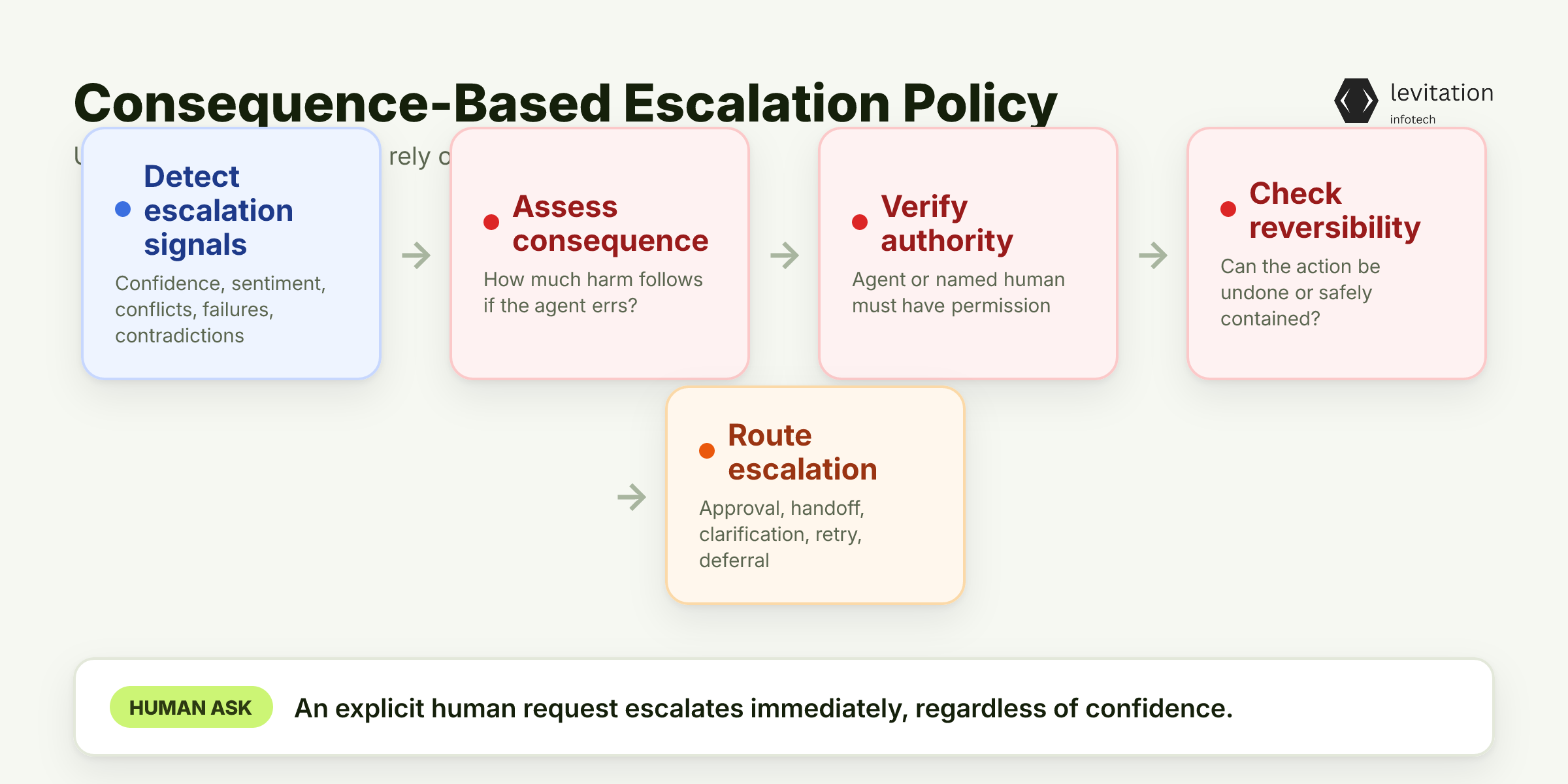
Evaluate every escalation candidate against three axes: - Consequence: How much harm follows if the agent acts or answers incorrectly? - Authority: Does the agent, or a named human, have permission to decide now? - Reversibility: Can the action be undone, compensated, or safely contained?
These axes change the answer. A low-confidence draft needs no human. A high-confidence security change needs one.
Signal hierarchy
Confidence, sentiment, policy conflicts, missing evidence, tool failures, and contradictory outputs all feed policy evaluation. None should stand alone as the rule.
An explicit request for a human triggers escalation immediately and unconditionally. No confidence score should override it. Distress or frustration should trigger earlier attention, but it shouldn't be the sole decision rule.
High-impact or irreversible actions include sensitive account changes, policy exceptions, financial actions, security changes, and production modifications. The same authority problem appears in The Risk in Autonomous CI/CD Isn't the Code You Ship.
Ordinary ambiguity should return to the user when clarification is safe and proportionate.
Build distinct decision paths - Approval: A defined action needs authorization before the agent continues. - Handoff: Responsibility must move to a person now. - Clarification: The user can safely resolve the ambiguity. - Retry: The failure is transient, and the action is low-risk. - Deferral: The work can wait safely with an owner and deadline.
A policy that says only "escalate when confidence is low" creates two failures. It wakes people for harmless ambiguity and misses high-confidence actions with severe consequences. For enterprise AI solutions, escalation needs business policy, not another model threshold.
A precise trigger can still create a poor handoff if its context is incomplete. The human needs evidence, authority, and a clear next step to decide. What must accompany the trigger so the human can decide without reconstructing the case?
Build a Context-Complete, Fail-Closed Handoff
At 3:07 a.m., imagine a security-change request arriving without verified approval. The receiving engineer shouldn't reconstruct the incident from chat fragments. The agent must package the decision context before handing over ownership.
Minimum context packet
Include: - The user's intent and desired outcome. - Relevant conversation history. - Source evidence and timestamps. - Actions already taken. - Identity and verification status. - Permission checks. - Conflicting evidence and remaining uncertainty. - Proposed next actions. - The policy rule that triggered escalation.
The packet should preserve uncertainty, not hide it behind a clean summary. A human needs to know what the agent knows, what it doesn't, and why it stopped.
Route by authority and coverage
Select the human queue using required expertise, decision rights, current availability, and workload. Use an availability-aware route rather than notifying an unavailable person by default.
Ownership without coverage isn't coverage. If no authorized person is awake, the work needs a defined on-call path or a safe deferral.
Fail closed on incomplete context
Don't approve a sensitive action when identity, source data, or authorization can't be verified. Preserve the pending task and its audit trail instead.
Apply least privilege to the handoff. Redact unnecessary sensitive data while retaining enough evidence for an auditable decision. The receiver should see what they need, not everything the agent can access.
The warm-handoff principle is simple: the person should begin with a complete understanding of the task. They shouldn't ask the user to repeat the problem.
Production systems that must survive years of change need durable ownership and records. They can't depend on chat history and memory.
A complete packet solves only the receiving end. Without defined ownership, urgency, and coverage, the queue can still wake someone overnight. What operating rules must fill that gap?
Operate Escalation as an Enterprise AI Reliability Service
A queue without service levels is just a delayed page. Always-on telemetry isn't enough, as Why AI Agent MLOps Breaks When Agents Never Stop explains. The escalation queue also needs operating rules.
Measure quality, not volume
Track: - Escalation rate by trigger and task. - Context-packet completeness. - Time to assignment and decision. - Oldest queue age. - Recurring escalation reasons. - Human override rate. - Rollback rate.
Track them together. A falling escalation rate hides two possible causes: fewer risks or hidden deferral. Quality measures reveal which one applies.
Severity-based service levels
Define separate expectations for: - Urgent overnight risk. - Approval requests. - Routine handoffs. - Deferred work.
One global escalation service level will either wake too many people or promise support the queue cannot deliver.
Design the coverage model
Choose deliberately among: - Follow-the-sun staffing. - An on-call rotation. - A deferred queue. - Scheduled review.
Customer-facing commitments must match the coverage schedule. An instant human promise without instant coverage creates a broken service promise.
Create a runbook for each escalation class. Name the queue owner, backup owner, expected action, audit location, and recovery path.
Recurring escalation reasons are policy feedback. Expand autonomy only when the same boundary produces safe, repeatable outcomes. Narrow or roll back permissions when evidence shows the boundary is wrong.
Once the queue becomes measurable, the goal changes from maximizing autonomous volume to minimizing avoidable human attention without surrendering control. Can each avoidable page be traced to a policy defect?
Controlled Autonomy Changes the Human Role
Controlled autonomy changes what people do, not whether they exist. For AI agents, humans move from improvising exceptions to governing explicit boundaries. - They set authority and consequence boundaries. - They resolve genuinely consequential work. - They improve escalation policies using recurring evidence.
For enterprise AI solutions, ownership becomes part of product design. The result isn't a human-free enterprise. It's predictable involvement, fewer ad hoc pages, complete audit trails, and controlled expansion of autonomy.
That operating model depends on every pending decision having an owner, a deadline, and enough context to act. Which of the five common questions below exposes the gaps in your design?
Frequently Asked Questions
When should an AI agent escalate to a human?
Escalate when a request exceeds the agent's authority, a wrong action would be materially harmful and not safely reversible, or required data or tools are unavailable. An explicit request for a human triggers an immediate, unconditional handoff.
Confidence and sentiment are policy inputs, not the entire policy.
Does AI agent escalation increase handle time?
Broad rules or context-poor handoffs increase handle time. A decision-ready packet reduces repetition because the human receives intent, evidence, prior actions, verification, permissions, and next steps.
Selective routing also prevents the human queue from becoming the new bottleneck.
What information should an AI agent include in a human handoff?
Include the requested outcome and relevant conversation history. Add source data, timestamps, actions already taken, identity and verification status, and permission checks.
Record conflicting evidence, uncertainty, the escalation reason, and proposed next steps. The human should decide without asking the user to reconstruct the interaction.
How should a CTO measure escalation quality?
Measure more than escalation rate. Track context completeness, assignment and decision time, oldest queue age, recurring triggers, human overrides, rollbacks, and cases that can be safely automated later.
These measures show whether the boundary is improving or merely transferring work to people.
How do you handle human escalation outside business hours?
Treat overnight work as a separate coverage state. Set severity-based service levels and name a queue owner.
Route urgent cases to an on-call or follow-the-sun team. Defer routine work to a staffed queue.
Never promise immediate human handoff unless coverage supports it.
If any answer depends on an improvised judgment at 3 a.m., the operating model isn't finished. Can yours answer all five without relying on that improvisation?
About the author
Mayank Singh is a software developer at Levitation Infotech, where he builds web and AI-powered applications across the company’s fintech, healthcare, and enterprise projects.