


TL;DR: An ₹18-lakh quote is rational when its scope and assumptions are clear. AgentCore targets runtime friction, but it does not erase the build, integration, evaluation, or ownership work behind the price. Separate the four cost ledgers, then require one scope, one workload, and one set of acceptance tests.
Key Takeaways: - An ₹18-lakh quote is rational when scope, assumptions, and acceptance tests are clear. AgentCore has no documented quote-reduction guarantee. - Build, readiness, run, and change costs must be normalized before vendors are compared. - The buying decision belongs in acceptance tests, monthly run assumptions, and exit terms, not cloud branding.
The ₹18-Lakh Quote Is Not an AWS Billing Problem
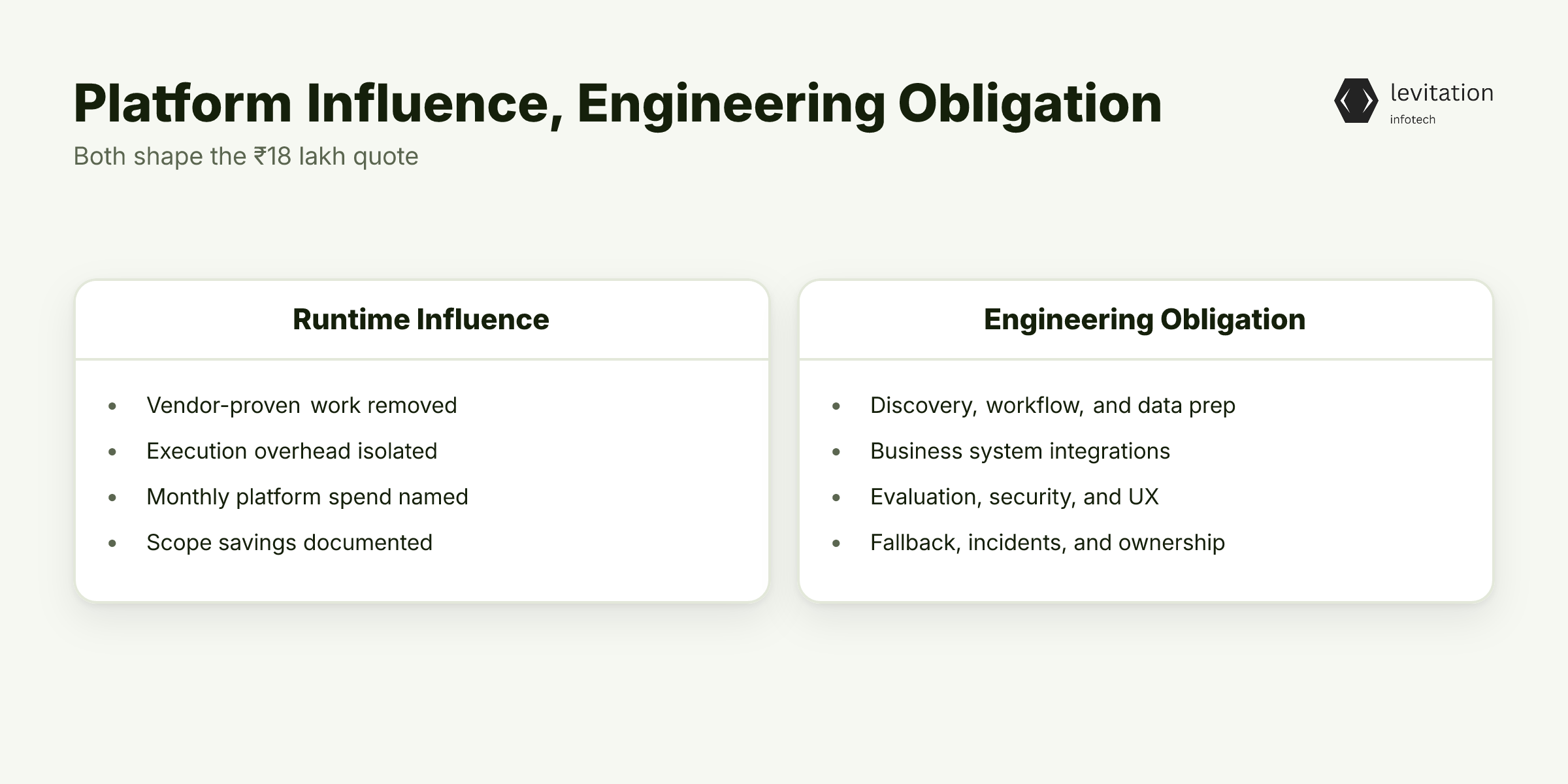
An ₹18-lakh AI quote is not an AWS billing problem. AWS's launch of AgentCore does not turn it into an ₹8-lakh quote. Lower runtime friction also does not settle the build, integration, evaluation, and ownership work.
The evidence is narrower than the sales conversation. The linked Coverage of AgentCore's preview presents it as a response to India's AI-agent quality-control crisis. It gives no documented reduction for the quote in question.
The closest published benchmark comes from CodeNicely Studio. It estimates ₹8 lakh to ₹80 lakh for an AI support agent serving an Indian B2B SaaS or consumer-app startup that clears 500 tickets daily.
₹18 lakh falls within that range. Range membership does not validate scope, assumptions, or commercial terms. This is where why Indian AI quotes often miss project cost becomes relevant.
Before comparing vendors, the founder must answer six practical questions. - Which workflow must work from first release? - How many users, tickets, or requests will it handle? - Which business systems must it access? - What service level must it sustain? - When must a human take over? - Who owns production operation after launch?
Separate platform influence from engineering obligation.
Runtime areas to test against AgentCore: - Runtime work the vendor proves it removes. - Operational overhead tied directly to agent execution. - A named portion of monthly platform spending.
Engineering work that remains unless mapped to a saving: - Discovery, workflow design, and data preparation. - Integrations, evaluation, security, UX, and documentation. - Human fallback, incident response, and production ownership.
Treat the first AI development services proposal as a scope document to challenge. Expose what the ₹18 lakh actually buys, including which expenses are one-time, recurring, or hidden?
Unbundle AI Development Cost Into Four Ledgers
A single quote hides four different kinds of risk. When founders compare top generative AI companies in India, vendors often use the same headline for different promises.
One-time build and integration
An AI development cost guide frames the categories that drive an estimate. Benchmark ranges are not quotes. A proof of concept, a standalone feature, and a production application carry different integration, evaluation, and reliability work.
The build ledger should identify workflow design, model orchestration, integrations, user interface work, testing, and release engineering.
The build ledger shows what the project delivers. Which readiness work must happen before it can run safely?
Data, evaluation, and release readiness
Low engineering estimates often leave out the work required to make the system dependable. Ask what the quote includes for: - Cleaning and labeling usable business data. - Building representative evaluation cases. - Testing security, permissions, and failure paths. - Creating monitoring, audit logs, and release controls. - Documenting operation and incident procedures.
A cheap build hides the cost of an expensive launch. Excluded work returns later as a change order unless the quote prices it up front.
These controls still leave one cost unpriced. What does the system consume each month once it is live?
Recurring run and model operations
Post-deployment operations cover recurring infrastructure, model usage, monitoring, and updates. Retraining adds another recurring workstream when the product requires it. The estimate depends on workload assumptions, not only software features.
Ticket volume, context size, model choice, escalation patterns, and monitoring depth all change consumption. Each vendor must state which assumptions drive its estimate.
The monthly bill is only one side. Which people and process changes will the launch also require?
Change management and risk reserve
Change management adds a separate program cost through training, workflow redesign, and organizational adoption. It covers the work required to make people use the system.
A founder-ready comparison sheet should contain six items. - Committed build price. - One-time data, integration, and release work. - Monthly infrastructure and model usage. - Retraining and support assumptions. - Change-management effort. - Contingency linked to named unresolved assumptions.
Normalize currency, taxes, usage assumptions, and included support periods before comparing any quote. Once separated into ledgers, test each proposed AgentCore saving against the relevant ledger without hand-waving.
Which parts of the quote does AgentCore actually change?
Where AgentCore Can and Cannot Change the Quote
The dangerous claim is that AgentCore removes most of the quote. The cited coverage places its preview within a $100 billion effort addressing India's AI-agent quality-control crisis. That number is context, not a savings promise for your quote.
The useful split is project economics versus runtime economics. - Project economics cover discovery, data preparation, integrations, evaluation, security, UX, and documentation. - Runtime economics cover work and expense directly tied to executing and operating the agent.
Any credible AgentCore savings case sits in the second group. The first group remains unless a proposal maps a specific reduction.
Foundation models reduce the need for custom training in enterprise AI solutions. Production integration and quality control still remain.
Require a line-item bridge from each vendor that identifies every affected estimate and shows the before-and-after monthly assumption. Reject any answer that treats the entire build estimate as cloud consumption.
The source material also links a 13-hour AWS outage to erroneous AI-agent actions. That incident does not prove AgentCore will fail. It shows why evaluation, observability, escalation, and incident response need named owners and prices.
What AgentCore Can Affect - Runtime configuration work that the vendor shows it removes. - A corresponding part of monthly operations. - Build tasks only when the proposal maps them to removed work.
Any savings claim applies only to the named runtime work. Which engineering costs remain outside that boundary?
What AgentCore Cannot Remove - Business discovery and workflow design. - Data cleanup and source integration. - Evaluation, security, and user experience. - Documentation, human fallback, and incident ownership.
This boundary should shape the contract. Which costs must every bidder price under the same assumptions?
Require an architecture diagram, affected line items, workload assumptions, and the proposed quality controls. If the stack includes Kubernetes, also review why Kubernetes costs can erase AI budget gains.
Reject architecture claims sold by slogan. Accept the architecture only when the operating assumptions change. Price the build and the run separately.
How do you turn that split into a contract that gives vendors one price basis?
Turn the Estimate Into a Scope Contract
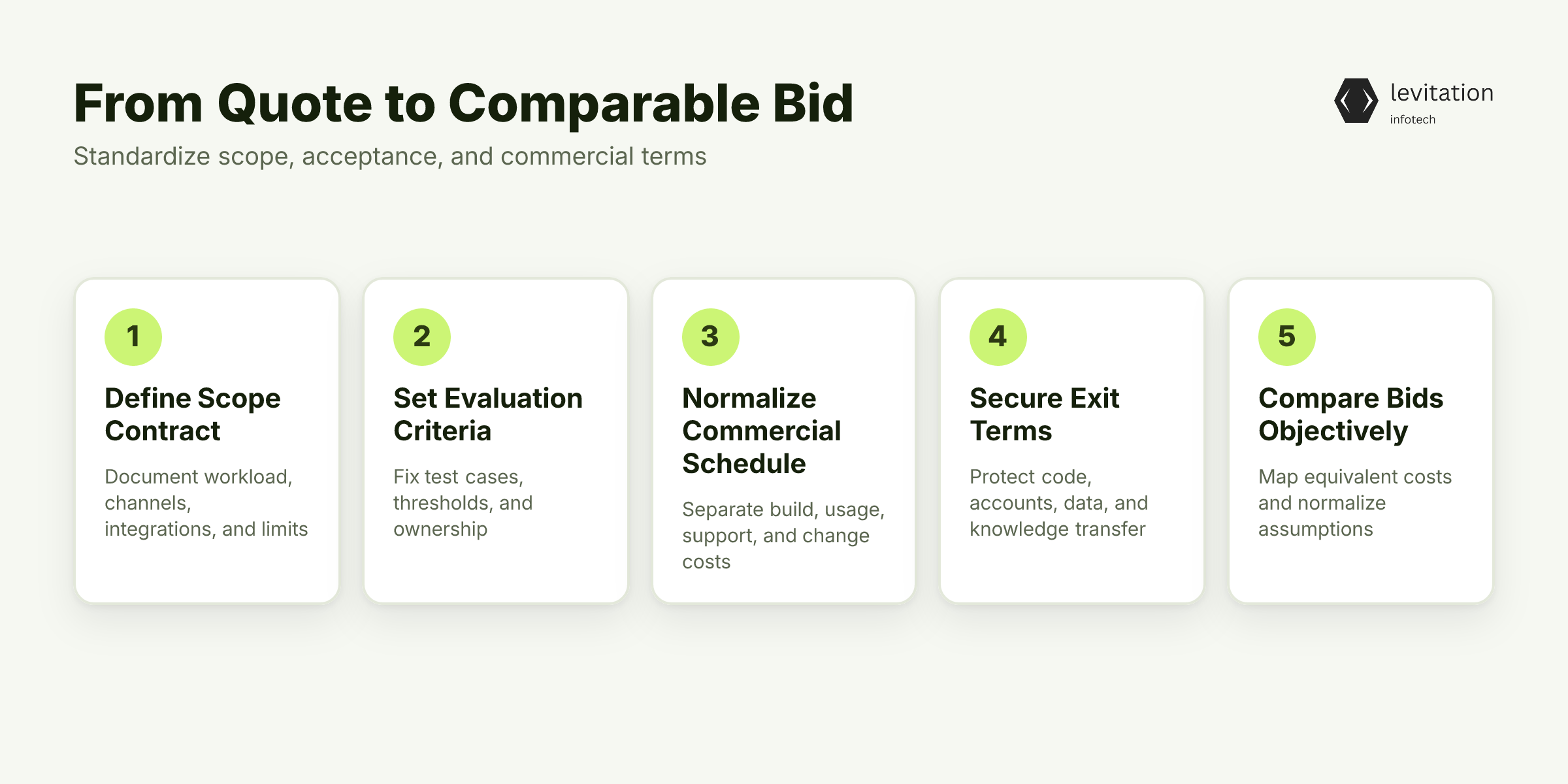
Most AI quotes become disputes before code arrives. Make vendors quote the same product before asking them to lower their price.
Scope Contract
A useful scope contract defines the operating reality. - The complete user journey and supported channels. - Expected request or ticket volume. - Languages and content types. - Permitted data sources. - Required business-system integrations. - Latency and availability expectations. - The human-escalation path. - Actions the agent is allowed and forbidden to take.
“AI support agent” is not a scope. In practice, one quote covers ticket classification, while another covers complete resolution across several systems.
The contract now gives bidders a target. Which tests will prove the target is met?
Evaluation and Acceptance
Quality claims without a test corpus are opinions. The proposal should include measurable workflow outcomes, representative test cases, known failure modes, and explicit quality thresholds.
The final test set must have a named owner. If the vendor alone selects the cases, acceptance becomes negotiable. This is the problem described in why LLM evaluations approve failing models.
Once the tests are fixed, which commercial terms will make the bids comparable?
Commercial Schedule
A commercial schedule should separate: - Build fees and milestone payments. - Monthly infrastructure and model usage. - Retraining, monitoring, and support. - Change-management work. - Assumptions that trigger a change order.
Require every bidder to use the same scenario. If the project resembles the 500-tickets-a-day support-agent benchmark, apply that volume across all bids. Reject assumptions that quietly change the workload.
Exit terms determine whether the build becomes an owned asset or a dependency. - Source code and system prompts. - Architecture and operating documentation. - Cloud and model-account ownership. - Data export and deletion terms. - Acceptance testing and knowledge transfer. - A rate card for work outside scope.
Use a structured process to keep the comparison objective. First, collect proposals and classify equivalent line items. Next, map build, readiness, run, retraining, support, and change costs.
Finally, list contradictions and send one written clarification round to every bidder.
Give everyone the same deadline. This is not another sales negotiation. With scope normalized, the founder compares delivery models instead of polished proposals.
Which operating model should the founder own after launch?
Hire AI Developers or Buy a Fixed-Scope AI Team?
Compare the full operating model, not the lowest first invoice. When founders shortlist top generative AI companies in India, they should compare three paths. - Fixed-scope services: Best for bounded delivery, specialist depth, and faster launch. Watch scope creep, dependency, and post-launch rates. - In-house AI developers: Best for continuous product ownership and changing workloads. Watch hiring time, retention, and the long operational runway. - Hybrid foundation-model build: Uses managed infrastructure and orchestration while retaining core product ownership. It balances speed with control.
Annual cost comparisons provide orientation, not quotes. A comparison of in-house and outsourcing economics must account for team composition, duration, and ownership. An annual headline alone cannot settle the choice.
Those factors decide the comparison once normalized. This is why hidden build-versus-buy costs matter more than the first invoice.
Existing foundation models reduce the upfront cost of custom training. That saving disappears when the estimate omits data cleanup, integrations, and evaluation. The product then looks cheaper but becomes harder to operate.
AgentCore belongs in the decision only when three conditions hold. The workload must be genuinely agentic, runtime cost must be material, and the architecture must show measurable operational value.
Score vendors on architecture quality, fixed-price discipline, evaluation ownership, security, communication cadence, relevant references, and post-launch support.
Make project-specific references and acceptance criteria part of that scorecard. The comparison only creates value if it ends in a decision sequence, not another spreadsheet.
What sequence should lead from that shortlist to a signed scope?
A Quote Reset Before You Sign
A structured reset turns an ₹18-lakh quote into a decision-ready package. - Define the business outcome, non-goals, users, volume, and required result. - Inventory data, integrations, constraints, and the human process the AI must support. - Request alternative architecture options from shortlisted providers offering AI development services. Ask how each design changes under different runtime, evaluation, and integration assumptions. - Define acceptance tests, failure handling, escalation, and the minimum release worth expanding. - Normalize build, run, retraining, support, change-management, and contingency costs. - Choose a path, document rejected assumptions, and set milestone acceptance and exit terms. Record a no-go decision when evidence supports it.
Frame enterprise AI solutions around the operating outcome, not the model. This is also the discipline behind Levitation: judge production AI by owned outcomes, not platform novelty.
₹18 lakh becomes defensible only when it specifies defined outcomes and a measurable monthly run cost. The quote must also list unresolved risks. The purchase order must answer one final question: can the business still own the result after the vendor leaves?
Frequently Asked Questions
Most post-quote questions return to one issue: what is actually being bought?
What does AI development cost for an Indian startup?
No single number is defensible without a defined workflow, expected volume, required integrations, data readiness, and launch target. If the product is a support agent clearing 500 tickets a day, the published range is ₹8 lakh to ₹80 lakh. ₹18 lakh falls within it, but that does not prove the scope or price is right.
Can AWS AgentCore reduce an ₹18-lakh AI development quote?
AgentCore targets specific runtime and agent-operations line items. The research does not establish a reduction for this quote. Data preparation, integrations, evaluation, security, human fallback, and ongoing ownership must be assessed separately.
Is a generative AI MVP cheaper when built on an existing foundation model?
Existing foundation models reduce the upfront cost of custom model training. That apparent saving disappears when the project needs extensive data cleanup, complex integrations, strict evaluation, or high-volume inference.
Should a startup hire AI developers or outsource to AI development services?
Hire when the product will keep evolving and the startup has capacity for a long-term team. Outsource when speed, bounded scope, and specialist delivery matter more than daily control. Annual comparisons must include team composition, duration, and ownership.
The deciding factor is how much daily control the founding team can sustain after launch.
What should an AI development quote include?
Separate the one-time build, data and integration readiness, monthly usage, retraining, monitoring, support, and change management. State acceptance criteria, usage assumptions, ownership, and the conditions that trigger additional cost.
Comparing AI development services is more useful than challenging cloud pricing when the problem is scope and execution. Challenge the cloud architecture when runtime assumptions are wrong. Would you sign the current quote while its scope, run rate, and exit terms remain unwritten?
About the author
Mayank Singh is a software developer at Levitation Infotech, where he builds web and AI-powered applications across the company’s fintech, healthcare, and enterprise projects.