


TL;DR: A modest India AI quote doesn't balloon to several times its original because the vendor is dishonest. It balloons because the quote covers engineering hours, not inference, compliance, or scope drift. Fix the engagement model upfront and the same project ships in months rather than over a year, beating in-house teams on time-to-market by a wide margin.
Key Takeaways: - The wide cost range in most AI cost guides is the quote, not the project. Conflating them is the root cause of every budget blowout. - Three multipliers nobody warns you about: scope creep, monthly inference bills, and compliance overhead. - Fixed price fails in AI because requirements only become clear after the model is trained on real data. - An in-house AI team carries high fixed cost and long ramp time. A structured vendor engagement ships in a fraction of the timeline. - A 5-step engagement framework (time-boxed discovery, metric-based scope, capped inference, pre-priced change orders, phased kill points) is the only way to keep the quote honest.
The Quote That Balloons in Four Months
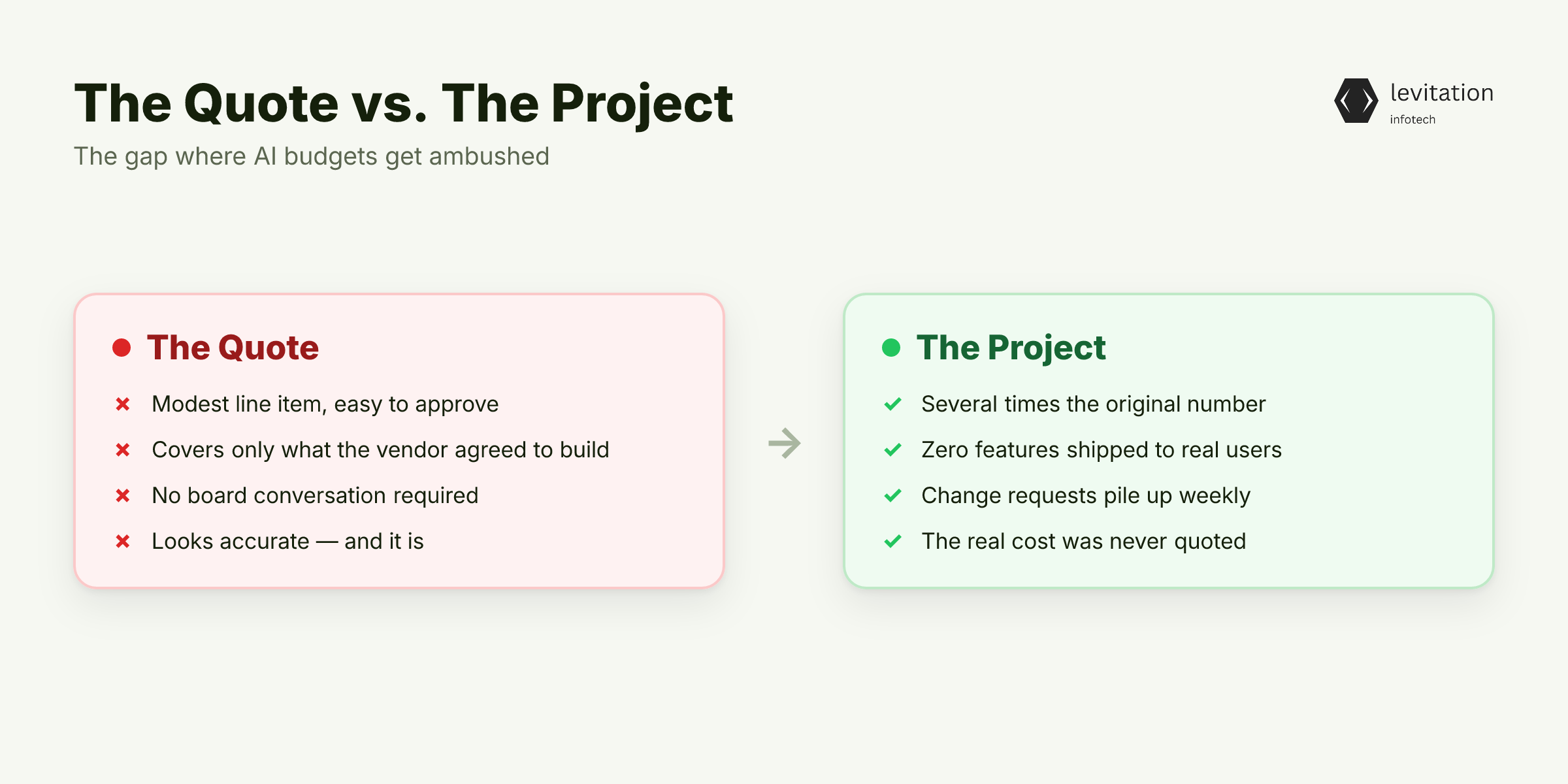
You got a quote from an India AI vendor. Four months later, the same project is on track to cost several times the original number, and you still haven't shipped a single feature to a real user. The vendor isn't dishonest. The quote was accurate. It just wasn't covering what you thought it was.
This is the pattern we see in almost every AI development services engagement that goes sideways. The founder signs fast because the line item looks good. The vendor starts work. Within weeks, the change requests start: "while you're in there, can you also add user authentication," "we forgot to mention the system needs to handle 10x traffic," "our compliance team needs audit logs." Each request feels small. The bill grows.
Here's the trap most cost guides set. They publish a range: a modest sum for a basic proof of concept, a large sum for enterprise platforms. Founders read that range as the project cost. It isn't. That range is the quote, the narrow thing the vendor agreed to build. The project is what you actually need to ship to a real user, and the gap between quote and project is where founders get ambushed.
Startup founders are uniquely vulnerable to this. You're optimizing for the line item because runway is short. A modest quote is something you can approve this week. A large quote requires a board conversation. So you sign the cheap one, plan to manage the rest yourself, and discover too late that "manage" was always the most expensive word in the contract.
Why 'Fixed Price' Is Fiction in AI Development
AI projects are research and development, not construction. A builder can quote your kitchen renovation because walls, cabinets, and countertops don't change behavior during installation. A vendor can't quote an LLM-powered system the same way, because the system's behavior shifts the moment the underlying model is updated, the data drifts, or the evaluation harness gets tightened.
A traditional CRUD app can be fixed-priced because inputs and outputs are stable. Form submits, database writes, response renders. Every input maps to a known output, and that contract holds for years. An AI system has no such contract. You specify "summarize this contract" and discover in week three that "summarize" means different things to legal, to sales, and to your end users. The vendor is now rebuilding functionality that wasn't in the original scope, and you're paying for it.
This is why even reputable enterprise AI solutions vendors rarely offer true fixed price for anything beyond a proof of concept. They'll quote a fixed price for a short discovery sprint, or a fixed price for a defined PoC with narrow success criteria. But production-grade AI development is time-and-materials, or a phased model with kill points, because no one on either side of the table knows the full scope until the model is trained on your data.
The implication is uncomfortable. Fixed price feels safe because the number is known. In AI, fixed price is fiction, and the only thing that feels worse than an open-ended budget is a fixed budget that produces a system nobody uses.
If fixed price doesn't work, what actually drives the multiplier? Three specific line items, and none of them are in the original quote.
The Three Cost Multipliers Nobody Warns You About
The gap between original quote and final project isn't padding. It's three distinct cost categories, each of which the original quote silently excluded.
Scope creep. Every time a founder says "while you're in there, can you also..." the vendor either absorbs the cost or sends a change order. Most absorb it, because the alternative is an awkward conversation with the customer. They absorb it until they can't, then the change order arrives and the founder feels ambushed. The change order isn't dishonest. It's the vendor finally surfacing work that should have been quoted separately two months ago.
Inference costs. Development is the upfront check. Inference is the monthly subscription you can't cancel. Inference spend scales with request volume and model size, and the bill compounds the moment a system goes to production. Most startups forget to budget for this because the dev phase is front of mind and the production bill is abstract. It isn't abstract when it lands on month three.
Compliance overhead. A compliant system for a regulated industry isn't just the model and the UI. It includes audit trails, data residency controls, handling procedures for sensitive data, and penetration testing. None of which appear in a development quote, and all of which add material cost when regulated verticals are the target. The same shape of overhead shows up across regulated industries, where audit requirements silently inflate project scope once the system has to survive a real review.
These three multipliers are why a "cheap" quote almost always becomes a much larger project once you account for what top generative AI companies in India actually have to build to ship something production-ready. The ballooning isn't a scam. It's the difference between a demo and a system a regulated business can put in front of a real customer.
But here's the part most cost guides miss: the multiplier isn't actually the problem. The problem is whether you get a shipped product at the end of it.
The Real Cost Comparison: India Vendor vs. In-House AI Team
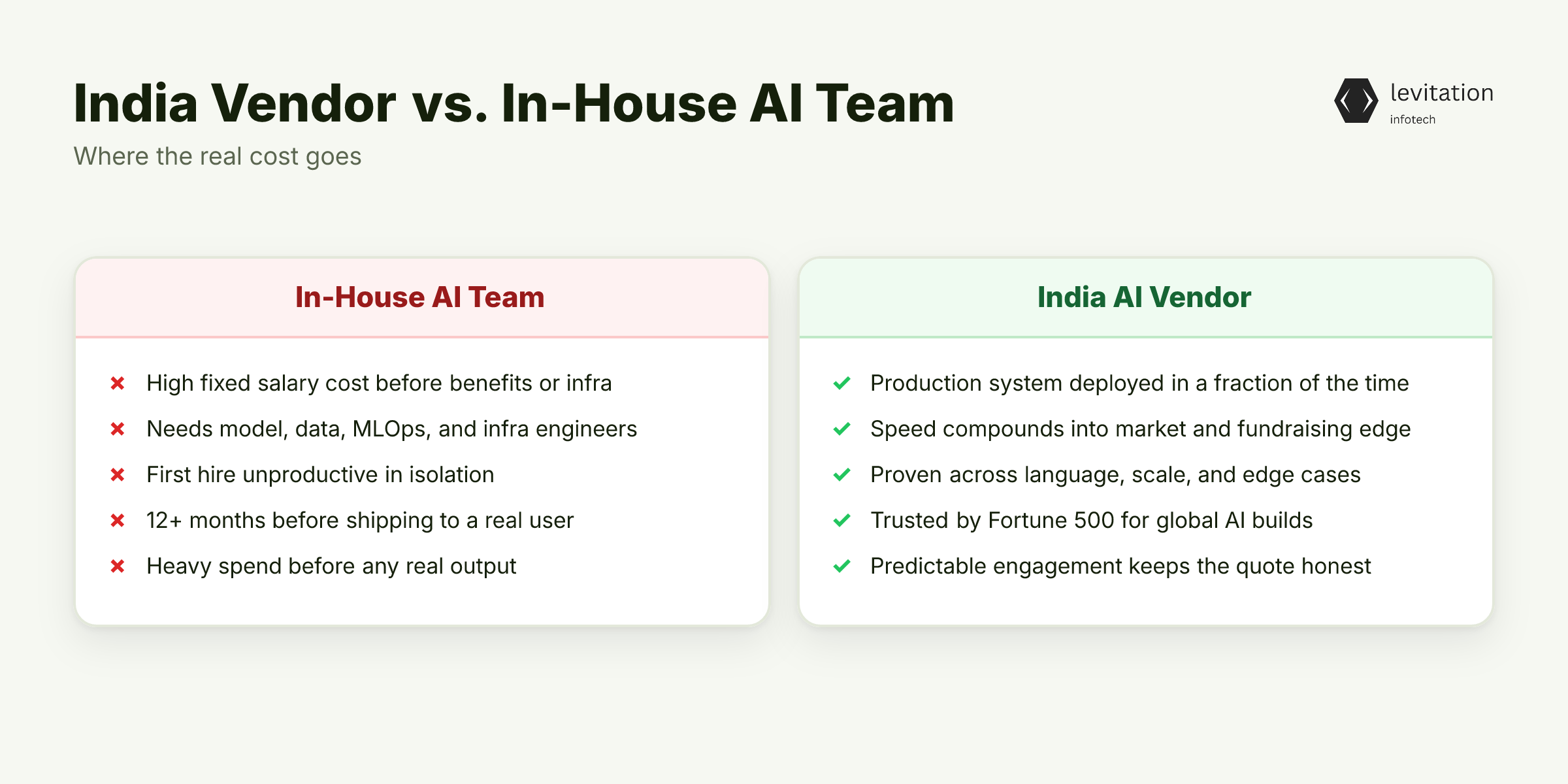
When the quote balloons, founders ask an obvious question: should we just hire in-house? The math is unforgiving.
An in-house AI team carries high fixed cost in salaries alone, before benefits, office space, and infrastructure. The first hire is rarely productive in isolation. You need multiple engineers to cover model development, data engineering, MLOps, and infrastructure. By the time they're hired, ramped, and aligned, well over a year has passed. In most cases, you've spent heavily before shipping anything to a real user.
An AI development services vendor in India can deploy a production system in a fraction of that time, which is a speed advantage that compounds into market positioning, fundraising, and revenue. The shorter timeline isn't just convenience. It's the difference between launching in this funding cycle and launching after your competitors have already captured the same accounts. The same logic shows up in why founders pay 35 lakh for a 12 lakh app: the gap between quote and build reflects what's actually needed to ship, not vendor markup.
India is also becoming a proving ground for AI products intended for global markets. If a system can perform reliably for Indian users across language, scale, and edge cases, it can handle most global markets. That's why Fortune 500 brands trust enterprise AI systems built here, and why 7 of 10 Indian AI builds quietly double in cost by day 90 when engagement models are loose.
The question isn't whether to use India. It's how to structure the engagement so the quote actually holds.
How to Lock In Your Quote: A 5-Step Engagement Framework
The founders who don't get ambushed by ballooning quotes all do five things before signing.
Step 1: Time-box a short discovery phase with a fixed ceiling. This forces the vendor to surface unknowns before the main quote, not during it. The discovery deliverable is a written scope document, an evaluation plan, and a refined quote. If the vendor refuses to do discovery on a fixed ceiling, they don't understand AI work well enough to be your vendor.
Step 2: Define scope by user stories and evaluation metrics, not features. An AI system that "summarizes contracts" has ten versions, depending on who you ask. One that "extracts parties, dates, and obligations with measurable accuracy on a test set of contracts" has one. Metric-driven scope is the only way to keep an AI project from becoming an endless negotiation about what "done" means.
Step 3: Cap inference budget in the contract. Set a monthly API spend limit with explicit cost-sharing when usage exceeds it. The cap is your safety net. The cost-sharing clause is the vendor's incentive to architect for efficiency, not to bill you for runaway token usage.
Step 4: Pre-define a change order process with rates, not estimates. If every change costs a defined amount, the founder thinks twice before adding "just one more thing." If every change is "we'll figure it out," the founder adds five of them, and the vendor absorbs the cost until something breaks.
Step 5: Phase the build with kill points. Pay for a working PoC. Evaluate. Then fund production. This is how serious enterprise AI solutions engagements are structured, and it's the only way to keep a quote from drifting. Kill points also protect you from the trap of your 5 lakh AI pilot won't reach production for 32 lakh, because you see the gap before you sign the next check.
The same framework shows up in why India's software is still cheap but your bill isn't: the low sticker price assumes a scope that doesn't exist in production, and the difference shows up later unless you write it down upfront.
This is the framework that turns a modest quote into a predictable project, and it only works if both sides agree to it before a single line of code is written.
What Changes When You Get the Engagement Model Right
Predictable cost. The quote you signed is the quote you pay, within a defined tolerance band, because the discovery phase surfaced the unknowns and the change order process priced the rest.
Predictable timeline. Faster deployment instead of a year-plus in-house build. You ship before competitors who started hiring the same quarter you did, and the hidden costs that triple AI development cost in India stop being hidden because they were priced upfront.
Vendor accountability. When scope is clear and changes are priced, the vendor has incentive to deliver, not to bill hours. That dynamic produces healthcare-grade and enterprise-grade AI systems rather than demo-ware. The contract makes success visible to both sides, which is why top generative AI companies in India build trust at scale.
The real takeaway: a ballooning quote isn't a scam. It's a symptom of an unframed engagement. The founders who learn to frame the engagement first are the ones who actually ship, and they're the same founders who turn India into a speed advantage rather than a cost trap. That's why 7 of 10 Indian AI builds quietly double in cost by day 90: the doubling isn't a vendor trick, it's a scope trick.
If you're evaluating top generative AI companies in India and want a partner who builds the engagement model before building the system, the conversation to have isn't about price. It's about scope clarity, inference budgets, and kill points. That's where the predictable cost lives. Teams that get this right often work with a partner like Levitation, where the engagement model is the first deliverable, not an afterthought. The quote you sign is the quote that ships.
Frequently Asked Questions
How much does AI development cost from India in 2026?
A basic AI feature or chatbot from an India vendor typically costs in the low tens of thousands, while a custom generative AI application runs into the high five to six figures. These figures cover engineering only. Inference, data preparation, and compliance add a significant percentage to total program cost over the first year, depending on volume and regulatory exposure.
Why do India AI quotes increase after signing?
Quotes increase because the original scope didn't account for inference costs, compliance overhead, and the scope creep that AI projects naturally produce. Fixed-price quotes assume known requirements, but AI systems iterate as the model, data, and evaluation criteria evolve, making the original quote accurate only for the narrow thing it described.
Is it cheaper to build AI in-house or outsource to India?
An in-house AI team carries heavy fixed cost and a long ramp time before shipping. An India vendor can deploy in months at a fraction of upfront cost. The honest math favors outsourcing when you factor in time-to-market, but only if the engagement is structured to prevent scope drift.
How long does an India AI vendor take to deploy a production system?
Typical deployment runs in months for a production-ready AI system, compared to well over a year for an in-house team. This speed advantage often matters more than the cost difference, because it determines when you can start generating revenue or proving product-market fit.
How do I prevent scope creep in an AI development project?
Define scope by evaluation metrics and user stories, not features. Pre-price change orders in the contract, cap inference budgets with explicit cost-sharing, and structure payment around phase gates with kill points. These three mechanisms force both sides to surface unknowns before they become unbudgeted work.
About the author
Mayank Singh is a software developer at Levitation Infotech, where he builds web and AI-powered applications across the company’s fintech, healthcare, and enterprise projects.