


TL;DR: A hospital CRM quote is not a total by itself. Recurring fees, setup work, readiness work, and future workflow changes must be priced separately. Normalize each bid against the same patient workflows. Then, price the next workflow and use a controlled 90-day trial before signing.
Key Takeaways: - A lower quote can reflect fewer interfaces, migration tasks, training obligations, security controls, and support services. - Separate recurring access, one-time setup, readiness work, and a named workflow-change reserve. - A controlled 90-day trial replaces assumed change costs with measured effort and support demand.
A Hospital CRM Quote Is a Scope Promise, Not a Total
On paper, a Noida hospital CRM quote can look complete. In practice, research puts ongoing changes for similar healthcare deployments at ₹1 lakh to ₹8 lakh. This cost tends to appear during months 3 through 9. The cause is simple: a workflow nobody modeled arrives after go-live.
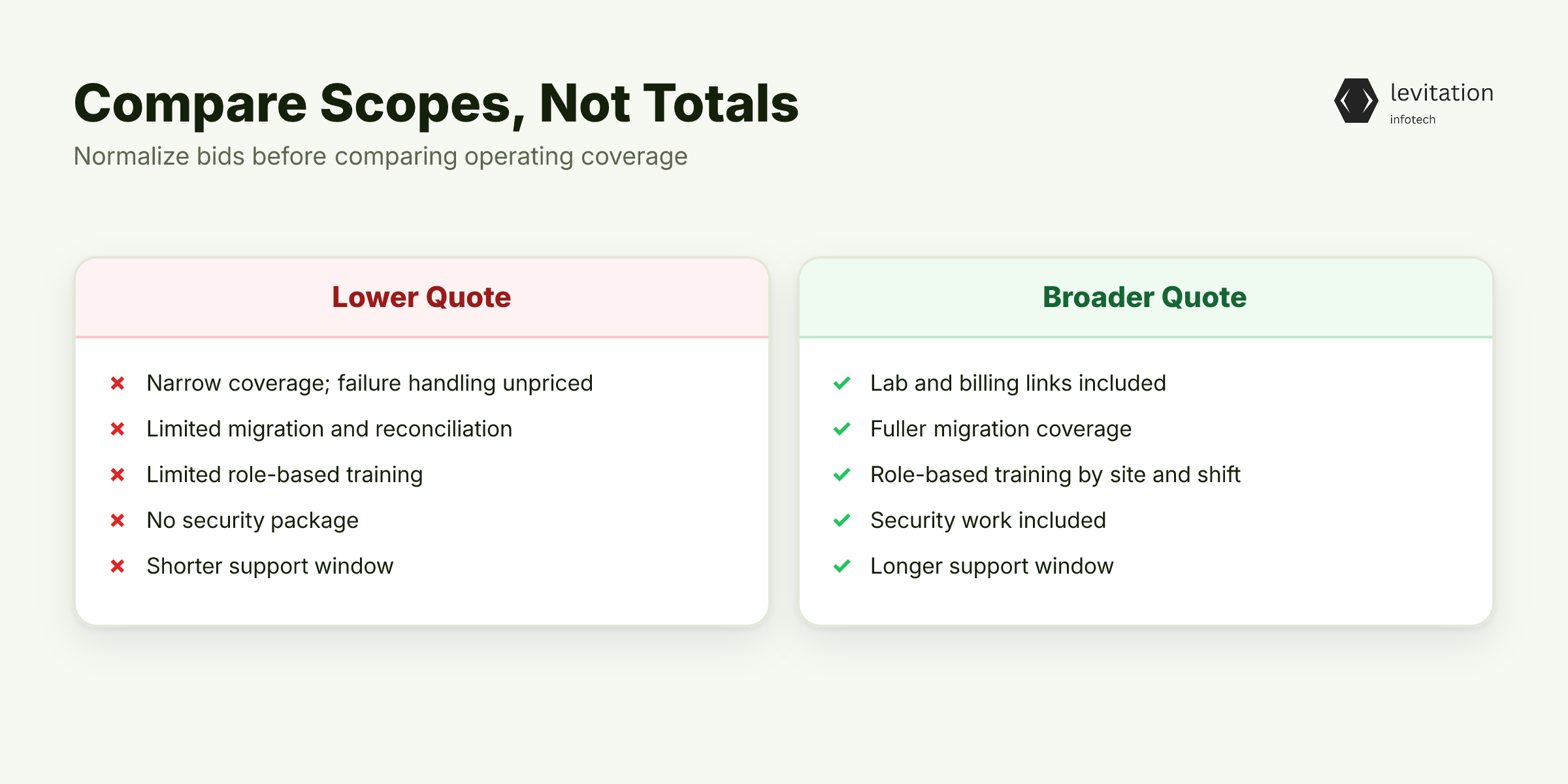
Imagine two bids that both list a hospital CRM, named users, setup work, and first-year support. One includes narrow interface coverage, limited migration, limited training, and no security package. The other includes lab and billing links, fuller migration, role-based training, security work, and a longer support window.
That makes the lower quote weaker, not cheaper. Each vendor has priced a different hospital.
No public Noida Hospital CRM price was available in the research. So, this article offers a comparison method for real bids. Two external hospital-management-system reference points offer context. One is about $40,000 in year-one costs for a small facility using SaaS. The other is a reference cost of about $150,000 for a mid-size hospital using a configured platform.
Their scopes are not directly comparable, so neither figure sets a Noida price.
Normalize Before Comparing
Require every bid to identify: - The same patient workflows, user groups, and role-specific access - Interfaces, including source systems, data direction, and failure handling - Data migration scope, including source quality and reconciliation - Training coverage by site, role, and shift - Security work, support period, and acceptance criteria
Compare workflow coverage, not license count. A hospital pays for a dependable operating workflow, not access to CRM screens.
That makes healthcare technology evaluation a business question, not a feature-count exercise.
The first crack appears after go-live, when an unpriced workflow reaches operations. Which omissions are most likely to trigger that call?
Why Hospital CRM Cost in India Spikes After Go-Live
The first costly discovery arrives when the CRM works well enough to show the hospital's real process. Ongoing changes in similar healthcare deployments tend to surface in months 3 through 9.
Use that window as a planning signal, not a guaranteed Noida price. Ask operations heads which anticipated and unanticipated workflows the estimate covers.
Scope gaps hide in six places: - Patient-route variations, such as emergency, scheduled, and referral paths - Exception handling for cancellations, delayed tests, and disputed steps - Ownership changes when departments, shifts, or escalation paths differ - Interface dependencies on labs, billing, scheduling, or other systems - Reporting differences across roles, departments, and audit needs - Staff workarounds that were invisible during initial discovery
These are operating realities, not missing CRM screens. A configurable workflow covers the expected path while leaving the exception outside the system.
For buyers calculating hospital CRM cost in India, keep subscription costs separate from setup costs. Similar healthcare-vertical CRM pricing in India is about ₹1,500 to ₹4,000 per user per month.
One market estimate puts setup at one to three months of annual license value. Verify both figures with each vendor. These are market reference points, not quotations.
This is the same budgeting discipline behind healthcare AI's year-two cost cliff, even though the workloads differ.
A quote audit should expose five common omissions: - Interfaces and data migration - Training coverage - Security work - Support terms - Rules for pricing future changes
Use the CRM development cost in India comparison before accepting any headline monthly or year-one figure.
A single total still conceals the mechanics. Which costs recur, which land once, and which fund the workflow nobody has described?
Split the Quote Into Cost Pools Before Comparing It
Two vendors can quote the same total while accepting very different future duties. A single number cannot tell whether two quotes carry the same risk.
Four Cost Pools
Separate the quote into four pools: - Recurring platform access: subscriptions, hosted capacity, and usage-linked charges - One-time setup: configuration, custom changes, interfaces, and data migration - Operational readiness: training, security work, and the support period - Future workflow-change reserve: named capacity for changes after acceptance
Then calculate decision exposure, not a polished sales total:
Decision exposure = recurring access + one-time setup + readiness work + named change reserve + explicitly excluded work.
An excluded item without a value stays visible as unpriced exposure. It never becomes free.
Label every line with one of four conditions: - Fixed: committed by contract - Usage-based: rises with defined consumption - Estimated: bounded by the vendor - Unpriced: no commitment yet
This classification exposes the business consequence. A configurable product handles routine workflows with settings and rules. A custom CRM earns its keep only when repeated exceptions justify the build, ownership, and maintenance burden.
For every proposed change, require the vendor to classify it: - Existing configuration - New CRM development - An interface dependency - A continuing manual workaround
Use the CRM development guide to test three areas. Check whether the product, custom changes, and connection work are opaque or separate.
The worksheet is the control. A cheaper quote is credible only when recurring, one-time, and future-change duties are visible.
Once those duties are visible, one question matters: what will the next patient workflow actually cost to add?
Give One More Patient Workflow a Price Card
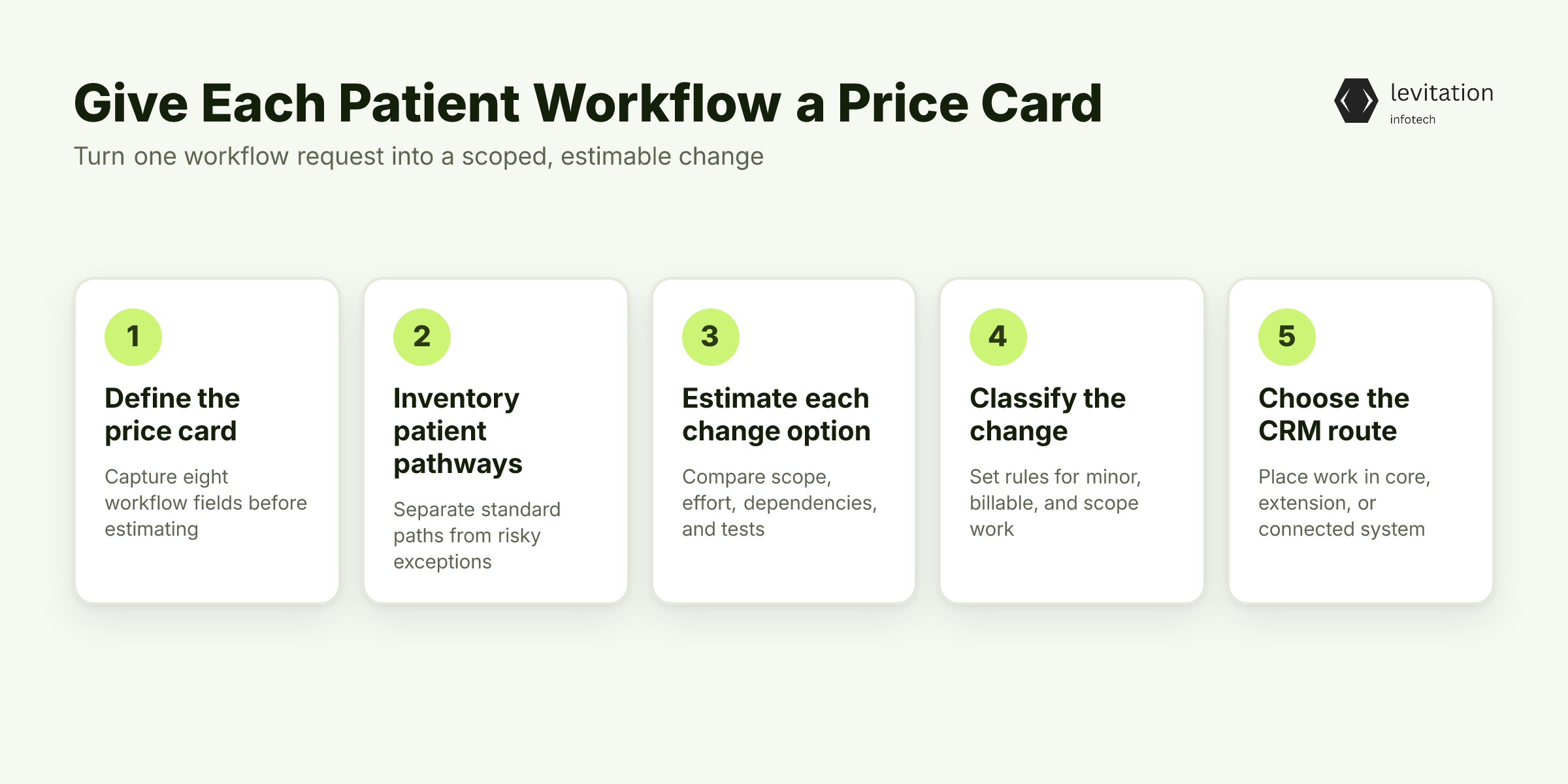
Consider a discharge follow-up request. It looks like one feature. It triggers a new task, data field, handoff, report, and external update.
Build a price card before asking for a change estimate. It must capture eight fields: - Trigger: What starts the workflow? - Responsible role: Who owns the next action? - Required data: Which records and fields does it need? - Decisions and exceptions: Where can the process vary? - Handoffs: Which team or person receives it next? - External touchpoints: Which systems or outside parties take part? - Reporting and audit needs: What must be recorded, reviewed, or exported? - Acceptance criteria: How will the hospital confirm correct operation?
Build the Inventory
List every current patient pathway, then mark the variants the CRM must support. Separate them into: - High-volume standard paths that justify fast, consistent execution - Low-volume exceptions that carry clinical or financial risk
Do not build every variant because it exists. Price importance, not mere presence. With importance set, the next step is to estimate each route.
Estimate the Change
For each missing workflow, compare at least four routes: - Leave it outside the CRM - Configure an existing capability - Extend the custom CRM - Support it through an integration or controlled manual process
Attach an effort estimate, vendor rate, elapsed-time assumption, dependency list, and acceptance test to every option. Keep recurring license effects separate from one-time build and migration effort.
Define three change classes: - Minor configuration adjustment: a pre-agreed field, setting, or rule inside an existing capability - Billable change request: a new workflow, interface, report, or rule requiring analysis, build, and test - Scope revision: a new user group, patient journey, system of record, or control obligation. It changes the core design
Without these definitions, a small wording difference becomes a post-signing dispute.
Use the custom CRM decision path. Decide whether the workflow belongs in the core product, an extension, or a connected system. Require the vendor to price that routing explicitly.
A workflow price only protects the budget if the contract explains what happens after acceptance. What rules will govern that change?
Make Every Hospital CRM Quote Change-Controlled
A price card still fails if the contract treats every workflow change as a dispute. The hospital needs a process that turns requests into decisions.
Contract Language
Attach these controls to the agreement: - A versioned workflow catalogue identifying included and excluded pathways - Defined change-request classes with response ownership and itemization rules - Written approval before any work begins - Payment or release tied to objective acceptance criteria
The catalogue should carry workflow version, owner, supporting interfaces, acceptance status, and change history. That shared record becomes the first input for the bid scorecard.
Bid Scorecard
Put these categories side by side in one scorecard: - Base fee - Setup fee - Interface and migration cost - Training - Security work - Support - Workflow reserve - Exclusions
Keep the catalogue and acceptance model beside the price, not buried in another proposal. This prevents a broad total from hiding weak operating commitments. Each exposed gap now points to a specific piece of vendor evidence.
Vendor Due Diligence
Ask for regulated-industry references and security documentation. Also ask for the name of the person who leads setup and a sample change-order estimate. A general CRM portfolio does not prove vendor pricing for hospital exceptions.
A vendor that loses the person who leads setup erases the benefit of a low quote. The Noida CRM staffing risk article shows this risk.
Give every shortlisted vendor the same question:
What happens operationally and financially when the hospital adds one workflow that was not present at signing?
Use the top CRM development companies in India shortlist to compare delivery evidence. Then use the CRM development cost in India worksheet to compare the resulting proposals.
Commercial fit without evidence is only reassurance.
Contract language sets expectations. However, only a controlled trial shows whether the workflow and its cost assumptions survive daily operations. Will they?
Run Ninety Days as a Controlled Workflow Trial
A contract cannot reveal a problem that daily operations has not exposed. A focused trial can.
Days 0-30
Baseline the current patient workflow before changing it. Record: - Manual touches and duplicate entries - Handoffs and unresolved exceptions - Support requests - Time staff spend working around the CRM
This baseline gives the quote something real to test. Once the baseline is fixed, the next phase can test one live workflow.
Days 31-60
Pilot one additional workflow with a named owner, trained users, acceptance criteria, support path, and change log. Keep unapproved scope changes visible. Do not absorb them into the trial.
With the pilot running, the final phase can compare promised effort with actual demand.
Days 61-90
Compare actual effort and support demand with the quote. Accept or reject the workflow against predefined criteria.
Update the catalogue. Then revise the change reserves for the next twelve months.
Add a security and data governance gate before expansion. The hospital's own review remains decisive.
The trial should produce four decisions: - A normalized first-year cost - An evidence-based workflow-change reserve - A controlled request queue - A signed decision on whether additional workflows belong in the custom CRM
Failures teach more than polished demos. The same discipline behind why hospital AI pilots fail in year one applies here.
If the assumptions fail, keep them out of the contract. Which assumptions will fail under real patient volume before the hospital has to absorb the cost?
Frequently Asked Questions
How much does a custom CRM cost for a hospital in India?
No public Noida Hospital CRM price appeared in the researched sources. Treat any local figure as a vendor estimate.
Similar healthcare-vertical CRM pricing in India is about ₹1,500 to ₹4,000 per user per month. Setup work is often worth one to three months of annual license value.
Verify both through the CRM development cost in India process.
Why do hospital CRM quotes change after go-live?
Similar healthcare deployments show the largest hidden cost during months 3 through 9. During this period, unexpected workflow changes add an indicative ₹1 lakh to ₹8 lakh.
A workflow catalogue, clear acceptance criteria, and priced change-request rules keep those discoveries from becoming unplanned emergencies.
What should a hospital CRM quote include in India?
It should separate subscription fees, setup, custom changes, interfaces, data migration, training, security work, support, and future workflow-change capacity. It should also identify exclusions and define who approves and prices extra work.
The answer is complete only when the buyer can see who owns each future change.
Is a custom CRM cheaper than a configurable hospital CRM?
Not automatically. A configurable platform is the low-cost starting point for standard workflows. Custom CRM development makes sense when repeated exceptions or integrations justify dedicated ownership and maintenance.
The deciding factor is exception volume, not the label on the quote.
How should operations teams compare two CRM development quotes?
Normalize both bids against the same workflow catalogue, acceptance model, and interfaces. Also normalize migration scope, training, security work, and support period. Then compare the base cost, one-time cost, change reserve, and exclusions side by side. Do not compare only the headline totals.
Otherwise, the cheapest quote does not prevent the largest change order.
Ask each vendor for a line-item quote, a named change reserve, and a 90-day acceptance plan. Also ask for proof that it meets healthcare technology evaluation criteria. The remaining uncertainty is the workflow neither vendor has priced yet.
About the author
Mayank Singh is a software developer at Levitation Infotech, where he builds web and AI-powered applications across the company’s fintech, healthcare, and enterprise projects.