


TL;DR: A $7-per-user Bigin plan can be the wrong Zoho CRM alternative before the festive rush begins. It has no email sequences, a fixed 1 GB storage limit, and add-ons that obscure the final bill. The real risk is harder sales work exactly when lead volume matters.
Key Takeaways: - Bigin is a lightweight product, not a feature-equivalent Zoho CRM replacement. - A peak can break the sales operating model without crashing the software. - Decide with a 12-month cost model, a workload test, and a 30-day readiness plan.
Bigin's $7 Promise Hides the Festive-Sale Risk
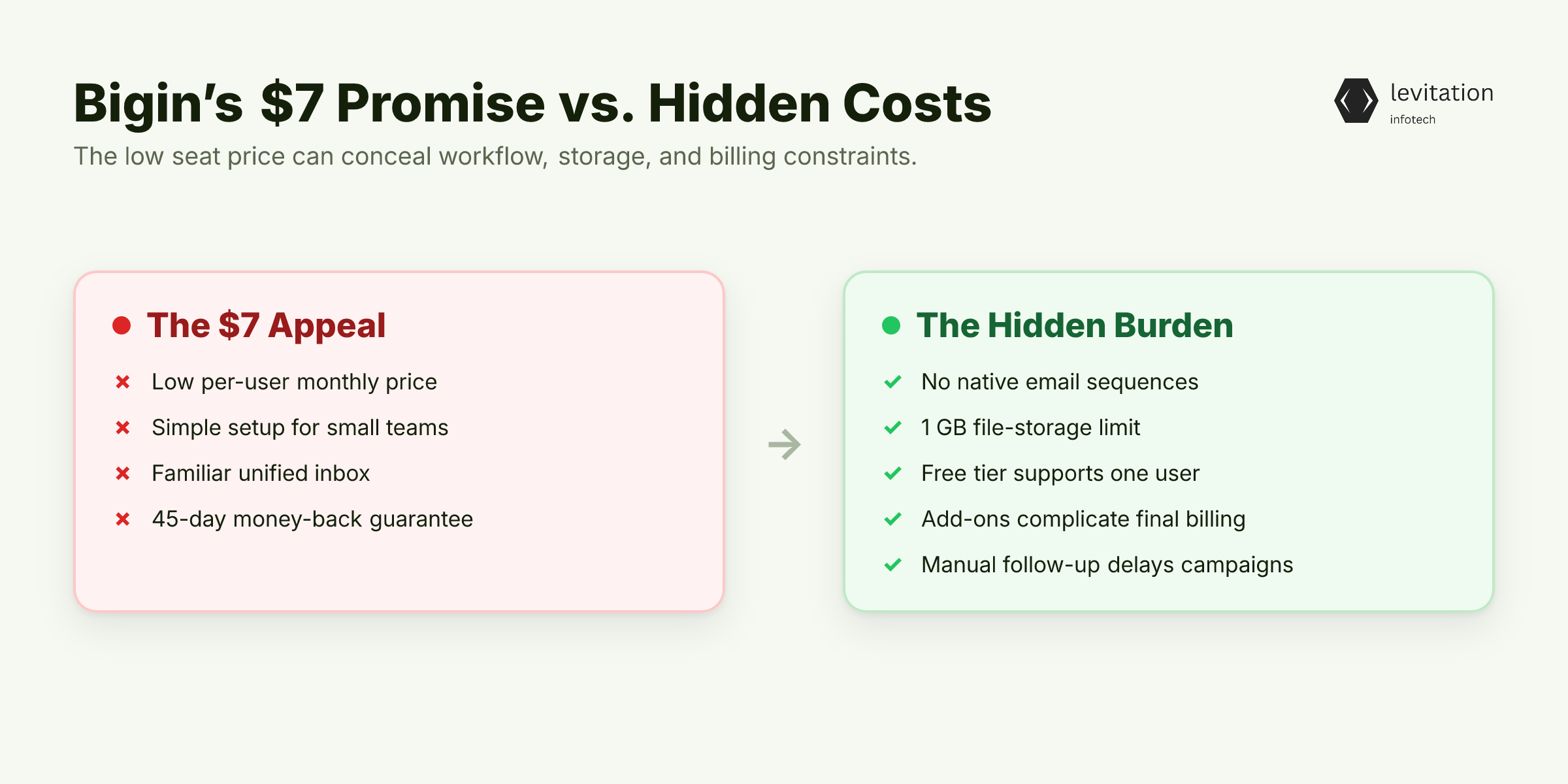
Bigin ranks among the cheapest CRMs. Its $7 per-user monthly price looks attractive right up to a festive campaign. Then the work changes shape.
The software does not need to crash for the sales operation to break. Follow-up, files, and shared leads then depend on manual work.
What $7 actually buys
Bigin suits a small sales team. It comes from the same company as Zoho CRM. It is a separate, lightweight product, not a feature-equivalent replacement.
Bigin's interface feels familiar from the first login. One inbox brings email, WhatsApp, and X together.
Paid plans have consistent support. The 45-day money-back guarantee reduces the risk of a rushed switch.
That makes Bigin worth considering when comparing CRM development cost in India. For a small team, a low-friction start can matter more than a feature checklist. The harder question is what the low price leaves unresolved.
The constraints behind the low seat price
The low price comes with clear boundaries: - Bigin has no email sequences on any plan. - Every plan has a 1 GB file-storage limit. - The free tier supports one user and 500 records. - Add-ons can make the final bill hard to predict.
The free tier can support an individual trial. It cannot prove how the product behaves for a team.
None of this proves that Bigin will fail. Instead, it identifies where the current setup needs another tool or a different operating model.
Price alone cannot tell you which constraint will hurt first.
Price is not a workload forecast
Bigin fits straightforward pipeline management. It does not automatically fit automated outbound, attachment-heavy selling, or sudden campaign-driven growth.
Imagine a festive lead spike with proposal files and repeated email follow-up. Without native sequences, someone must trigger and track every message. That becomes a sales tax paid in delayed follow-up.
Write down every workflow that must run without a workaround during your busiest sales week. Compare that list with Bigin's verified capabilities. Only then request a formal quote or run a pilot.
The visible license price explains why teams consider Bigin. The costly risks sit inside workflows that must keep running when demand changes shape. Which workflow breaks first?
Why Festive Peaks Test CRM Scalability for Sales Teams
A peak does more than add leads. It changes how many conversations, tasks, users, and files move at once. CRM scalability must measure that work, not seats.
A peak changes the shape of work
Start with your festive plan, not an industry benchmark. Estimate new records, simultaneous inbox conversations, active reps, follow-up tasks, and shared files.
Mark integration dependencies too. A campaign can create records but still fail when routing breaks.
A one-page peak-workload sheet should contain: - expected active users - new and total records - concurrent inbox conversations - expected file volume and file types - required automations - integration dependencies - maximum acceptable recovery time
Which of these loads will define your busiest week?
Lightweight becomes operationally expensive
Missing email sequences turn rep activity into manual orchestration. The 1 GB storage ceiling can force another file channel. The free plan's one-user and 500-record limits make team testing essential.
The failure mode is not a crash. It is a queue of missed follow-ups, duplicate work, and reps doing administration instead of selling.
Shared ownership makes that risk worse. Your NCR CRM demo cannot prove who owns leads applies here. A clean pipeline can still hide a failed handoff under pressure.
Which check will expose the first failure?
Six scalability checks for sales teams
Set each business threshold before testing. Otherwise, a preference can look like a product constraint. - Record creation: Create expected records and fields. Note where errors, delay, or rework becomes unacceptable. - Inbox triage: Run simultaneous email, WhatsApp, and X conversations. Observe assignment and follow-up handling. - Attachment handling: Upload and retrieve real file types. Observe access, retrieval, and storage limits. - Repeated follow-up: Execute the required sequence. Count missed actions, duplicates, and manual steps. - Multi-user access: Test reps and admins. Check permissions, ownership, and handoffs. - Bulk export or migration: Export representative data. Measure export time and whether the file can be reused.
These checks give CRM software development teams a reproducible workload. They also separate three concerns.
User count is licensing capacity. Transaction behavior is workload capacity. Workflow coverage is operating capacity.
A CRM can pass the first test while failing the other two.
Once the workload is explicit, comparing Bigin's $7 rate with a higher quote becomes easier. That comparison works only when it measures complete operating cost. What belongs in that cost?
Compare Zoho CRM Alternatives by 12-Month Cost
A $7 seat and a higher seat price can be closer than they look. The gap appears only when both quotes buy the same operating result.
Build a true total-cost worksheet
Create one worksheet for every candidate. Include each cost below: - annual license cost and mandatory add-ons - implementation and data migration - integrations and required connectors - training and support - storage and backup requirements - expected renewal changes - internal cost of manual steps
Internal work deserves a price. If a rep sends sequences manually, moves files elsewhere, or reconciles exports, count the labor and delay.
The same trap appears in Delhi-NCR's cheapest Salesforce quote can become the costliest rollout. A low quote can hide the work required to make it useful.
What will your own quote leave out?
Normalize quotes without false precision
Request current written Zoho CRM pricing in India. Ask every shortlisted alternative for an equivalent quotation.
Normalize edition, user count, billing term, currency, modules, add-ons, implementation scope, support level, and contract duration. Compare the same obligations, not advertised entry rates.
Use one CRM development cost in India worksheet for all bids. Challenge each quote against the same peak scenario. Entry-rate precision can create false confidence.
Which obligation does each quote actually cover?
Compare operating models, not logo counts
Three models deserve separate scorecards: - Lightweight buy: Bigin. Best when basic pipeline work stays simple and add-on costs remain predictable. - Configurable platform: Zoho CRM. It supports no-code, low-code, and custom deployment options. - Custom build: A purpose-built CRM. It fits distinct workflows, but carries migration, maintenance, and ownership work.
A richer logo does not equal operating fit. Nor is a heavier build strategic value by itself.
Which model matches the way your work changes at peak?
Run three business scenarios
Price the current team. Then price the festive campaign team with added records and files. Finally, price the next-stage team after the campaign.
Keep workflows, integrations, support, storage, and manual-work rules consistent. Otherwise, the spreadsheet changes the product being compared.
Choose the option with the lowest acceptable 12-month operating cost under your peak scenario. Do not choose the smallest monthly headline.
The cost model identifies what a platform should deliver. Only a representative test can reveal whether it delivers that work under pressure. Can it?
Run a Festive Load Test Before the Refund Window Closes
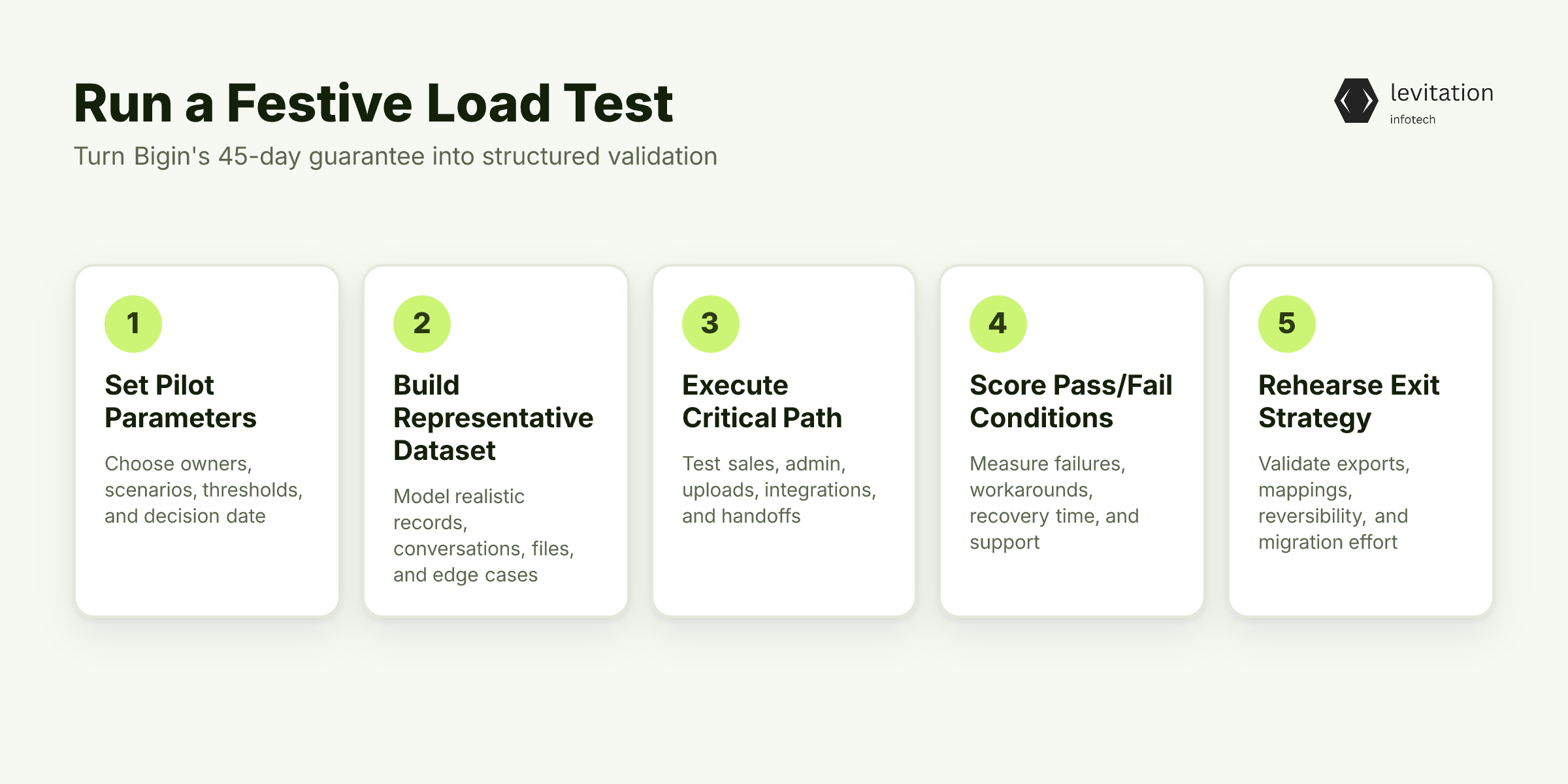
A CRM demo shows the path the vendor prepared. A festive load test shows what happens when reps, data, and files arrive together.
Use Bigin's 45-day guarantee as a structured pilot
Bigin's 45-day money-back guarantee is useful. It becomes valuable only when turned into timed validation.
Set a start date, named owners, test scenarios, and thresholds. Schedule a go, revise, or exit decision before the window closes. An unstructured trial creates stories, not evidence.
What must the test prove before the window closes?
Build a representative peak dataset
Use sanitized historical records, realistic lead segments, and representative inbox conversations. Include the file types the sales team actually uses.
Derive the workload from your festive forecast and campaign plan. Include awkward but valid cases, such as long notes, shared ownership, missing fields, and old records.
Which cases will your team meet on peak day?
Execute the critical path
The test must cover the critical operational path. Create records while handling simultaneous inbox conversations.
Upload and retrieve files, complete daily follow-up, and perform required campaign actions. Hand opportunities between users to test ownership.
The administrative path must test bulk operations, exports, and available integration paths. Record an unsupported email sequence as a gap rather than hiding it behind a workaround.
What will this path expose under real pressure?
Score observable pass and fail conditions
The scorecard must capture specific signs of system stability. Record missed follow-ups, manual workarounds, failed imports, inaccessible files, and support escalations. Document the time needed to export or recover data.
Set thresholds before the test. Document every workaround as either an acceptable operating cost or a blocking issue. Keep both comments attached to the affected workflow.
Which workaround crosses your threshold?
Rehearse exit before commitment
Export representative data and document field mappings. Identify unsupported objects. Test whether the pilot can be reversed without recreating work.
Include reverse-migration effort in any CRM software development or custom-system evaluation. Compare the same exit test against the CRM development cost in India worksheet.
Assign a commercial decision owner and a technical decision owner. Require both to sign the final scorecard. Apparent savings must not conceal workflow or recovery risk.
A successful load test still leaves a strategic question. Should the winning system be bought, configured, or built to remove the constraints testing exposed?
Buy, Configure, or Build: A CRM Decision Gate
Build-versus-buy debates fail when they compare a product with a project. CRM decisions should compare three operating models under the same workload.
Buy a lightweight CRM when the workflow stays simple
Buy when the team needs basic pipeline management and can work without email sequences. File use should remain within 1 GB, and add-on costs should be predictable.
Bigin's free-plan limits also rule out treating it as a team testbed. Bigin is not wrong. It is the wrong choice for a workflow that needs native automation or heavy shared files.
Does your peak workflow stay within those limits?
Configure a full CRM when standard modules need extending
Choose Zoho CRM or another established platform when the business needs richer sales, service, marketing, approvals, workflows, or customization.
Zoho CRM offers no-code, low-code, and custom deployment options. Verify the exact modules and extension effort in the written proposal.
Map every requirement to standard configuration, extension, integration, or build. A CRM software development partner should make that classification explicit.
Which requirements truly need custom work?
Build when the requirement is genuinely differentiating
Build when unique workflows, integrations, or data models repeatedly exceed configuration and add-on limits.
Use the same CRM development cost in India worksheet for build and buy. Include migration, maintenance, support, and ownership costs, not only initial development effort.
The year-two bill that kills custom CRMs shows why ownership after launch belongs in the first decision.
What makes your requirement worth owning?
Vet a CRM implementation partner in India as an operating partner
A thorough evaluation requires six artifacts from the partner. Request a migration runbook and a peak-workload test plan. The vendor must also supply support escalation procedures, training materials, rollback procedures, and named post-launch ownership.
A low implementation quote without these artifacts is incomplete. Treat firm-level evidence as one input, then ask how it applies to your scope.
Have legal and finance review data terms, contract terms, and the full 12-month cost. Technical fit cannot compensate for unclear renewal or ownership.
Once the model is chosen, can the team finish setup before the first campaign lead arrives?
A 30-Day Plan to Enter Peak Season Ready
Peak readiness is not a feature checklist. It is the result of decisions, tests, and ownership completed before demand changes.
Days 1-5: Baseline the business
Record pipeline stages, lead sources, follow-up actions, peak assumptions, file volume, integration dependencies, and the current cost of manual work.
Every required workflow needs an owner before the campaign begins. Who will own each one?
Days 6-12: Configure the selected operating model
Configure only the workflows proven necessary by the workload sheet. Assign owners, establish naming and stage rules, and document support and escalation paths.
Ask CRM software development teams to show which steps are automated. Document every exception and the person who can approve a change.
Which steps will be automated before launch?
Days 13-20: Test and recover
Run the representative workload. Document failures, complete a rollback rehearsal, and remediate issues that cross predeclared thresholds.
Keep those thresholds fixed during the test. Otherwise, every failure becomes negotiable after the evidence arrives.
Maintain a daily exception log. List each failed workflow, owner, deadline, and accepted workaround.
Which failure will you fix first?
Days 21-30: Freeze and brief
Freeze the configuration. Publish the peak-season runbook. Train reps on the minimum required workflow.
Confirm monitoring and backup responsibilities. Schedule a post-launch review.
Attach the workload sheet and CRM development cost in India worksheet to the final decision before the first festive lead arrives. Will that lead test a ready system, or expose one final dependency the runbook missed?
About the author
Mayank Singh is a software developer at Levitation Infotech, where he builds web and AI-powered applications across the company’s fintech, healthcare, and enterprise projects.