


TL;DR: A larger context window helps only when the right information is already present. Durable AI agent continuity requires a governed memory system that controls admission, storage, retrieval, updates, and forgetting.
Key Takeaways: - Failures across sessions point to memory architecture, not model context capacity. - Vector search finds candidates, but cannot decide authority, scope, freshness, or lifecycle. - Production memory needs explicit records, unaltered provenance, task-aware retrieval, evaluation, and rollback.
The Failure Hidden Behind a Bigger Context Window
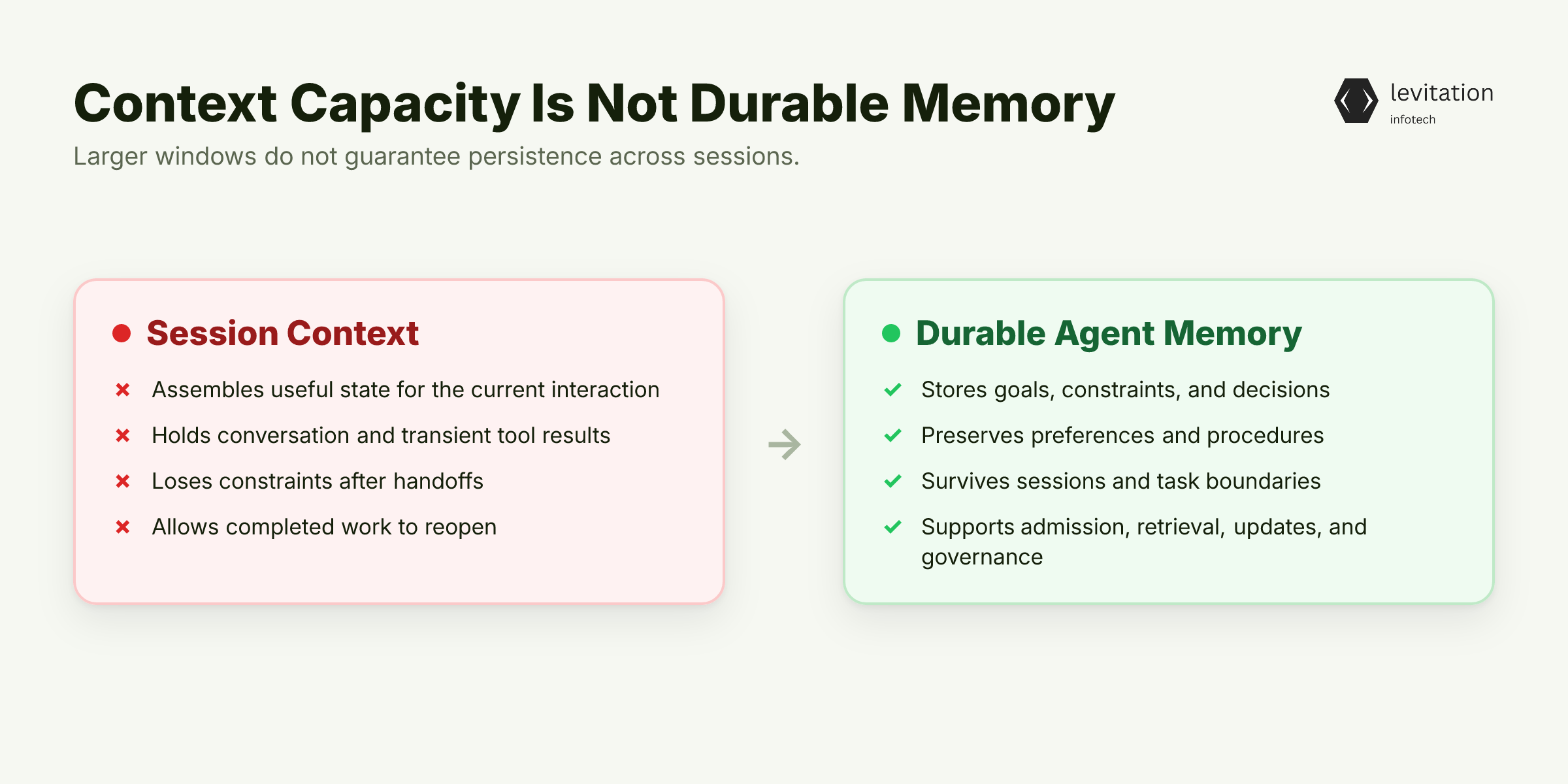
An AI agent can fit an entire conversation into a larger context window. It can still forget the constraint that mattered in the next session. That is the tell.
The bottleneck isn't how much the model can see. It's whether the system can write, retain, retrieve, update, and govern AI agent memory.
Three patterns should make any CTO uneasy: - A "no external email" rule works in one session, then disappears after a handoff. - Completed work reopens because closure never became durable state. - A tool result vanishes when a task boundary splits the workflow.
These are diagnostic patterns, not isolated model errors. None requires a bad model.
The distinction matters: session state is tied to the current interaction, while durable memory governs goals, constraints, decisions, preferences, and procedures that must survive an interaction.
Context engineering assembles useful current state. AI agent memory controls the durable state behind it.
For AI agents, start by locating where the failure occurs: - Within one session: inspect context construction, tool-state handling, and orchestration. - Across sessions or tasks: inspect memory admission, scope, retrieval, and update paths.
Within-session failures concern state delivery; cross-session failures concern state preservation.
A larger context window only delays the problem. Context capacity decides what can be present now. It does not decide what will persist, remain current, or obey access policy later.
If a larger context window only makes the failure visible, ask a different question. Where does durable state enter the system, and why does it fail there?
Why Retrieval Cannot Repair a Broken Memory System
Retrieval looks like the fix. It isn't.
Vector similarity can find related text. It cannot establish which record is authoritative, current, permitted, active, or complete.
Common failures include: - Duplicate recollections: the same preference exists under several identities. - Stale constraints: an old rule outranks a newer replacement. - Conflicting records: two sources disagree, with no lifecycle deciding the winner. - Wrong-scope recall: one user's state reaches another user's workflow. - Lost qualifiers: a summary removes the exception that made a decision valid.
Semantic search treats similarity as relevance. Memory governance asks harder questions: Who approved this? Does it still apply? Which tenant owns it? What supersedes it?
A user changes a delivery preference. The old and new records remain semantically close. Vector search can surface both with nearly equal scores. Only version, authority, and status reveal which one belongs in the current task.
Raw transcripts make this worse. They mix constraints, guesses, tool errors, and temporary observations. Retrieving several similar passages can increase verbosity without restoring correctness.
Task-aware compression takes a different approach. It selects state for the current job, then preserves what the next action depends on: - Exact constraints and exclusions - Decisions and their rationale - Unresolved blockers and dependencies - Required evidence and recent tool outcomes - Lower-priority preferences, procedures, and background
Generic summarization makes text shorter. Task-aware compression protects action-critical state, which is why careless compression can break an audit trail.
This changes what enterprise AI solutions require. They need policies for what may be remembered, for whom, under which authority, and for how long.
That leaves a harder question: what deserves to become durable state in the first place?
Memory Must Be a Governed State Machine
Durable state should enter through a gate, not a chat log.
Lifecycle: Candidate → admission policy → canonical record → task retrieval → compression → context assembly → outcome-driven update.
Start with candidate events such as user statements, tool results, decisions, and workflow transitions. Most should never become durable memory.
A candidate should pass four tests: - Permitted: policy allows this type of information to be retained. - Traceable: its source, owner, and authority are known. - Long-term value: it matters beyond the current interaction. - Structured form: it can become a governed record, not an orphaned chat fragment.
Separate append-only history from canonical state. The event log records how memory changed. The canonical store answers what is true now.
That separation enables audit, supersession, correction, and rollback. It also prevents contradictory observations from accumulating as equal truths.
A minimum record model should include: - Identity: memory ID, memory type, version - Scope: tenant, user, subject, and workflow scope - Meaning: content, source, provenance, and authority - Lifecycle: status, creation time, expiry, and dependencies - Control: access policy and retention class
Retrieval must start with hard filters. Apply authorization, scope, lifecycle, and freshness rules first. Only then rank the remaining records by task relevance, authority, and recency.
Similarity supports discovery. It must not decide inclusion.
Forgetting also needs explicit operations. Support expiry, supersession, deletion, and auditable correction. Contradictory records should not survive simply because the system lacks a policy for ending them.
A lifecycle is only a diagram until storage, retrieval, and update paths enforce it. How do you turn that lifecycle into a production architecture that enforces every transition?
Build a Minimum Viable Memory Plane
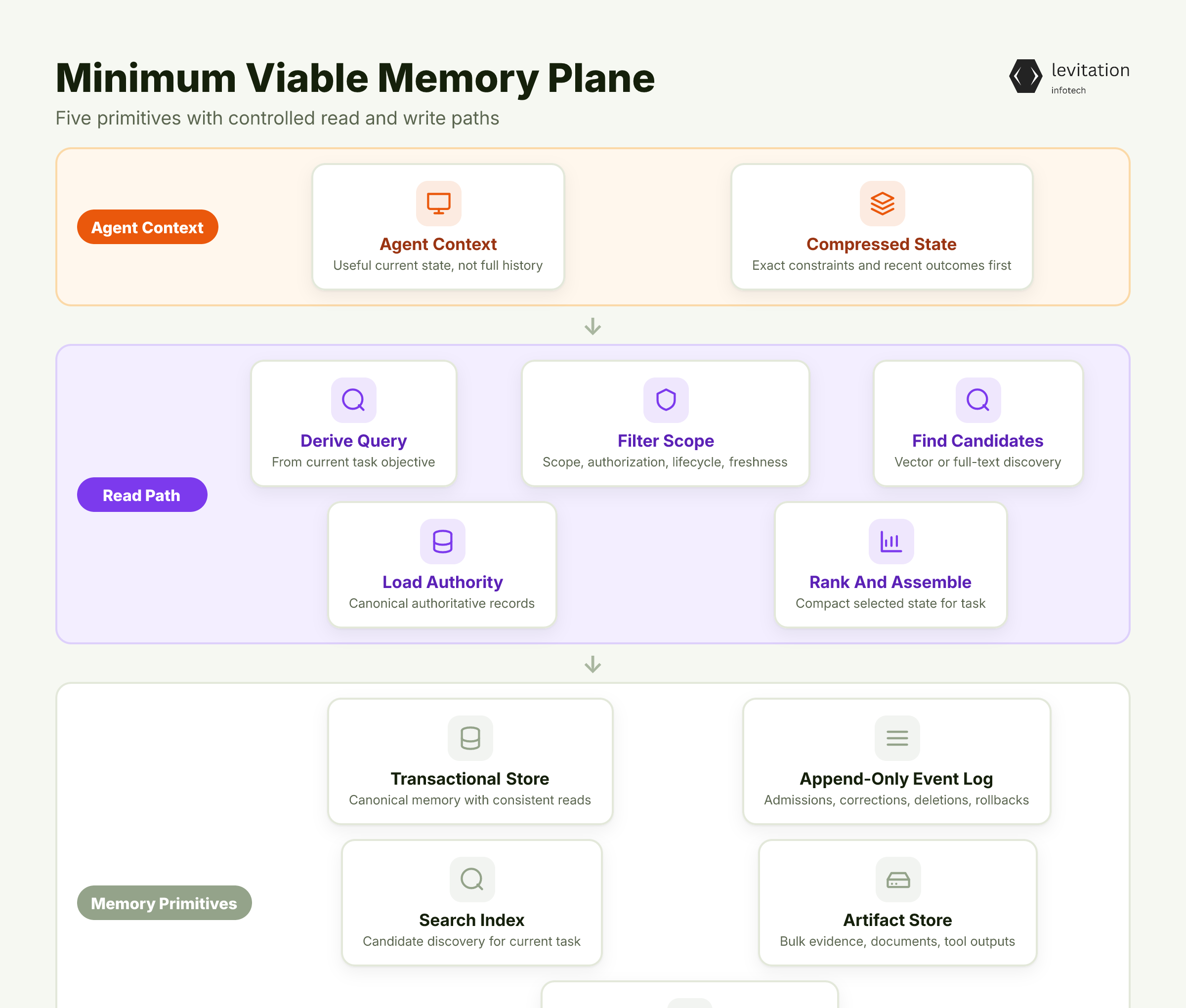
A production memory plane has five primitives. With fewer primitives, persistence becomes a liability. - Transactional store: Holds canonical memory and supports consistent reads, updates, and version changes. - Append-only event log: Records provenance, admissions, supersessions, corrections, deletions, and rollbacks. - Search index: Finds candidates through vector or full-text discovery. - Artifact store: Holds bulk evidence, documents, and tool outputs outside the prompt. - Task-context assembler: Selects and compacts authorized state for the current task.
A practical schema can group the fields by purpose: - `memory_id`, `memory_type`, and `version` identify the record. - `subject_scope`, `workflow_scope`, and `access_policy` define where it applies. - `content`, `source_uri`, and `authority` establish meaning and source. - `status`, `created_at`, `expires_at`, and `dependencies` govern its lifecycle.
The write path should be deliberate:
- Extract candidate state from user statements, tool outputs, and decisions.
- Check admission, permission, and retention policies.
- Normalize the candidate into the canonical structure.
- Resolve duplicates and supersession relationships.
- Update or insert the canonical record and append its provenance event.
The read path should be equally deliberate:
- Derive a task-specific query from the current objective.
- Apply scope, authorization, lifecycle, and freshness filters.
- Search for candidate records.
- Load authoritative records from the canonical store.
- Rank candidates for the task.
- Compress the selected state and assemble the current context.
That final step completes context engineering. The agent receives useful current state, not a replay of every historical interaction.
Compression should preserve exact constraints, decisions, blockers, dependencies, and recent tool outcomes first. Preferences, procedures, and background summaries come later.
The same architecture also needs operational controls inside the memory plane itself: - Tenant isolation and record-level access checks - Retention, expiry, and deletion workflows - Provenance linking each record to its source - Human correction and auditable rollback - Logs for every admission, retrieval, and update - Protection against agent access beyond the audit boundary
A model-generated summary must never become the sole source of truth. It is a derived view over governed records.
For enterprise AI solutions, this plane turns memory from a model feature into a controlled data system. For AI agents, it creates continuity without surrendering authority to the model.
A memory plane can pass a demo and still fail on stale, conflicting, or unauthorized state. If recall is only one measure, what else must teams test before trusting the system?
Test Recall, Authority, Scope, and Forgetting
Recall is the easy metric. It also hides the failures that matter.
Build an evaluation set from representative multi-session task sequences. Label four things for every sequence: - What should become durable state - What should be ignored - What must appear in the next task - What must never be recalled
Measure more than hit rate: - Write precision: How many admitted memories were correct and appropriate? - Retrieval recall and precision: Did the system find required state without adding noise? - Constraint persistence: Did commitments survive the next session? - Contradiction handling: Did newer authority replace older state? - Scope isolation: Did one tenant or workflow affect another? - Expiry enforcement: Did expired memory remain unavailable? - Compression fidelity: Did summaries preserve exact qualifiers and blockers? - Operational cost and latency: What did each successful task consume?
Include adversarial cases: - A changed preference - An expired memory - A newly superseded decision - Conflicting evidence - An irrelevant but semantically similar record - Cross-tenant contamination - A task that needs no history
Compare three baselines under the same labels and task budget: - Replaying the full transcript - Searching stored chats with vector search - Using the governed, task-aware memory pipeline
Do not declare a winner from a demo. Compare failures that change business outcomes.
Instrument every memory decision. Trace candidate creation, admission, rejection, ranking, selection, compression, and included memory IDs.
That trace turns unseen AI failures into inspectable system behavior. It also shows when agent failures weren't model failures.
Roll out progressively:
- Run in shadow mode without affecting live actions.
- Enable one low-risk workflow.
- Expand through controlled cohorts.
- Broaden only after correction and rollback paths are proven.
Maintain human correction, rollback, and a kill switch for every write path.
Once memory is observable, reversible, and measurable, it can be governed like any other critical enterprise dependency. The next step is deciding what becomes possible when memory becomes infrastructure.
What Changes When Memory Becomes Infrastructure
Memory changes the unit of work. The agent no longer starts from zero. It starts from governed state. - Goals and constraints persist across task boundaries. - Decisions remain connected to their rationale and dependencies. - Procedures survive without replaying entire conversations. - Retrieval replaces indiscriminate history with task-relevant state.
This memory layer does not replace context engineering, tools, permissions, or orchestration. It also does not automatically turn stored interactions into model training.
The strategic question is no longer whether an agent can remember. It is who can change what it remembers, and how every change can be explained, reversed, and forgotten.
What must a team verify before trusting this shift?
Frequently Asked Questions
Does a bigger context window solve AI agent memory?
No. A context window controls information available during one model interaction. AI agent memory governs information that persists across sessions and tasks.
A larger window only postpones the failure. It does not decide what to store, retrieve, update, or forget.
What is the difference between context engineering and AI agent memory?
Context engineering assembles the smallest useful view for the current task. AI agent memory manages the durable state that view depends on, including admission, scope, retrieval, update, compression, and deletion.
Is vector search enough for enterprise AI agent memory?
No. Vector search can surface semantically similar candidates. It cannot by itself enforce authority, freshness, tenant scope, supersession, or task relevance.
It should operate as a discovery layer over governed records, not as the memory system.
What is task-aware compression?
Task-aware compression selects state for the current job and compacts it while preserving constraints, decisions, unresolved dependencies, and required evidence. It is safer than generic summarization.
That is because it optimizes for what the next action must know, not for making the transcript shorter.
What should a CTO evaluate before deploying AI agent memory?
Test cross-session recall, write precision, contradiction handling, scope isolation, expiry, compression fidelity, and auditability under realistic multi-step workflows. Require traceable writes and retrievals, rollback controls, and clear ownership of durable state before expanding beyond a pilot.
The real test is simple: can the business prove why the agent remembered what it remembered, and prove that it can forget?
About the author
Mayank Singh is a software developer at Levitation Infotech, where he builds web and AI-powered applications across the company’s fintech, healthcare, and enterprise projects.