


TL;DR: Indian SMEs can ship a production generative AI system in 90 days, but only if they pick use cases where the data is already in their ERP or CRM and the team already makes the decision it informs. The three that work fastest: customer service on WhatsApp, SKU-level demand forecasting, and custom quote generation. The wrong paths are off-the-shelf SaaS chatbots and 9-month custom builds that deliver a model, not a workflow.
Key Takeaways: - The 18 to 24 month in-house timeline fails because CEOs treat AI like a software build instead of a use case. - Build-vs-buy is the wrong axis. The right question is which use case can ship in 90 days with data you already have. - Customer service AI, demand forecasting, and quote generation rank ahead of chatbots and knowledge bases because the data is structured, the loop is short, and the human stays in control.
Why Most Generative AI Projects for Indian SMEs Never Ship
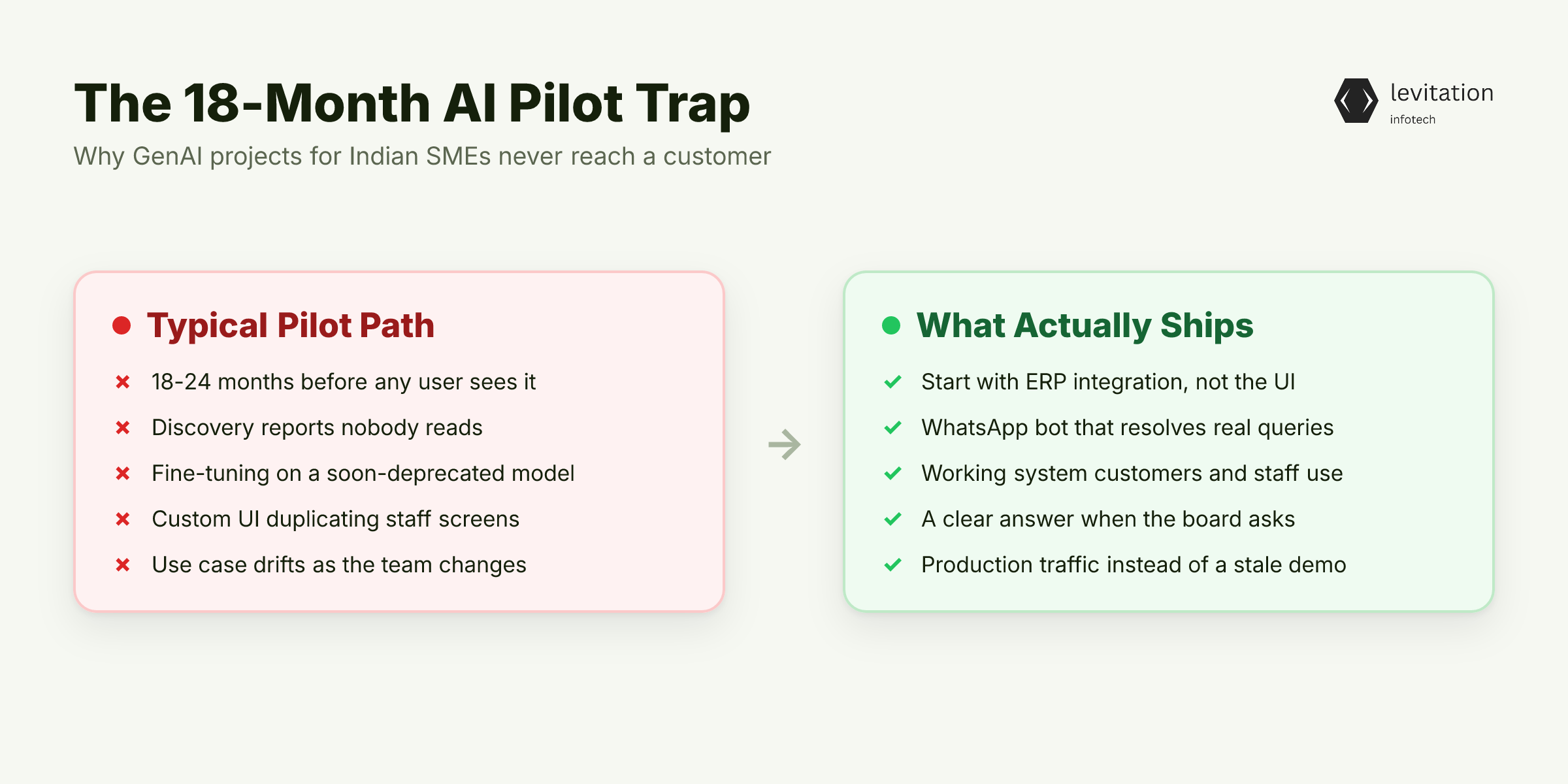
Indian SMEs burn 18 to 24 months on generative AI pilots that never reach a single customer. The pattern repeats across industries.
Discovery expands into a report nobody reads. The build phase becomes a fine-tuning exercise on a model version that will be deprecated before the project ships. Custom UIs duplicate screens staff already use. Launches miss the season they were scoped for.
By the time anyone notices, the team has changed and the original use case has drifted. This is the failure pattern most GenAI projects follow, and Indian SMEs are not exempt from it.
The CEO's actual constraint is a working system that customers or staff use, not a proof of concept. When a board member asks what the AI does for the business, a working answer is a WhatsApp bot. It resolves a meaningful share of order-status queries without escalation.
A demo is a slide that goes stale. The difference is production traffic. So which path actually gets you there?
"Build a chatbot" is the most over-promised and under-shipped phrase in Indian AI pitches. Vendors sell it because the demo is easy. Buyers ask for it because the word is familiar.
Both miss that a chatbot without ERP integration is a wall decoration. It cannot tell a customer their order status. The order data lives in Tally, Zoho Books, or a custom database the bot cannot reach.
enterprise AI programs that ship to production start with the integration, not the interface.
Most CEOs assume the fix is either cheaper SaaS or a bigger consulting team. Both routes are how the 18-month clock starts.
The cheaper SaaS route hides integration debt. The bigger team route hides a use case that was never defined clearly enough to staff against.
The Two Paths That Both Lead to Dead Ends
There are two default paths Indian SMEs take on generative AI. Both look reasonable on paper. Both end with no production traffic.
The first path is plug-and-play SaaS chatbots. Sign up, embed on the website, answer customer questions. The problem shows up in week three.
A Hindi-speaking customer asks about a return in their dialect. The bot falls back to English. A WhatsApp inquiry references an order number the bot cannot query.
The bot does not know your pricing tiers or return policy because the knowledge base was never loaded. The tool works in the demo. It dies in production, ignored by staff within a month.
The second path is the 9-month custom build with a top-tier partner. The proposal looks credible. A fine-tuned model, a custom UI, a phased rollout.
Six months in, the deliverable is a model that performs well on the test set. Nine months in, the deliverable is still a model. The team that needs to maintain it cannot.
The deliverable is a model card, not a workflow. Top generative AI companies in India win proposals this way. They lose the renewal because the customer cannot operate what was built.
The build-vs-buy framing is the wrong axis. The right question is: what use case can your existing data and team support in 90 days? The 4 to 9 month industry timeline only applies once use case and data are locked.
During discovery, the timeline is open-ended. The 4-9 month range assumes you have skipped the model selection debate and are already building the integration. So which three use cases make the cut?
The partners who ship these projects skip model selection entirely. They start with the workflow, and the team keeps ownership of the final decision.
The Three Generative AI Use Cases That Ship in 90 Days
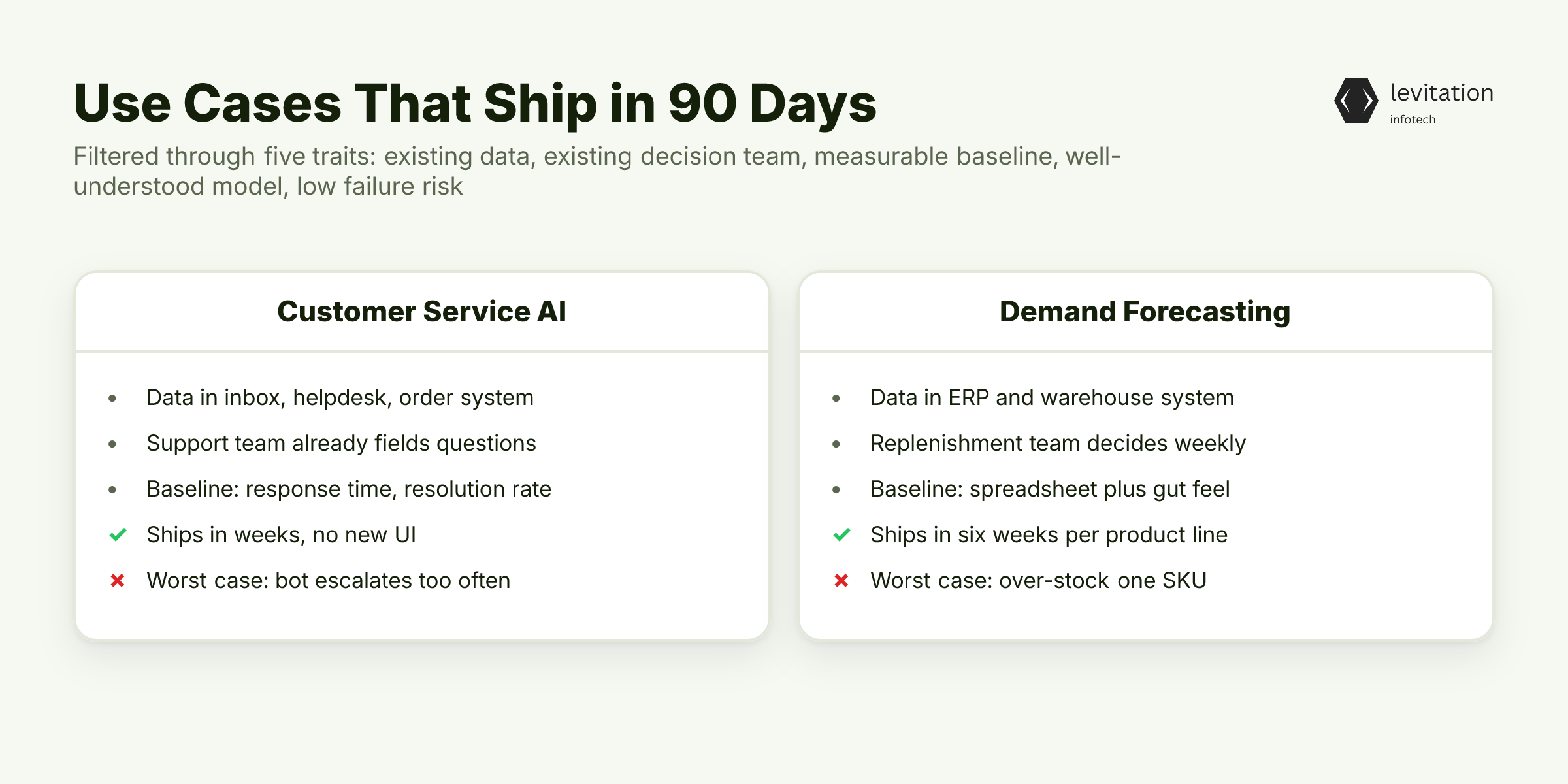
The use cases that ship in 90 days share five traits: data already in your systems, a team that already makes the decision, measurable baseline, well-understood model, and low risk of embarrassing failure.
Filter your use case list through these five traits and the short list is shorter than you expect.
Customer service AI on WhatsApp, email, and web chat
A single agent handles order status, returns, basic complaints, and policy questions. It escalates the rest to humans with full context attached. The data is in your inbox, your helpdesk, and your order management system.
The team already fields these questions manually. The baseline is response time and resolution rate. The model is well understood.
The worst case is the bot says "let me get a human" too often, which is fine for week one.
This pattern ships in weeks because the surface area is small. A WhatsApp Business API, an LLM API, a retrieval layer over your helpdesk transcripts, and an escalation path.
The integration is your existing ticketing system. No new UI. No new training data.
The agent improves as the helpdesk grows, because the retrieval layer pulls from the same tickets.
Indian retail businesses adopt this first because the volume justifies it. A D2C brand handling a high volume of weekly WhatsApp inquiries does not need a model.
It needs a router that deflects a meaningful share of inquiries to a knowledge base. It sends the rest to a human with the right context. The AI development work is the integration, not the AI.
Demand forecasting at SKU and store level
Your sales data is already in your ERP. Your inventory data is already in your warehouse system. The team already makes the replenishment decision every Monday.
The model is well understood. The baseline is the prior forecast method, which is usually a spreadsheet and gut feel. The worst case is the model over-forecasts and you over-stock one SKU, which you would have anyway.
Ship the forecast in six weeks. Use it to inform replenishment for one product line, one region. Measure the impact against the prior method.
Once that is working, the second product line is a copy-paste of the first. The AI development work is the data pipeline from your ERP to the forecast model.
It also needs the evaluation harness that compares each week's prediction to the actual. After 90 days, the replenishment integration replaces the manual reorder process for that product line.
Custom quote and proposal generation
A sales-ops use case where the inputs already live in your CRM. SKU lists, customer history, pricing rules, discount tiers, and contract templates are all structured data your sales team already uses.
The team already drafts these quotes manually. The baseline is quote turnaround time and win rate. The worst case is the model generates a quote that violates a pricing rule.
This is why the human stays in the loop. The model drafts. The rep approves. The system learns from every approval and rejection.
Over time, the approval rate climbs as the model internalises the pricing rules and the discount patterns. The first version of this ships within the 90-day window.
The inputs are structured, the output is structured, and the evaluation is binary: did the rep approve?
Why these three rank ahead of "build me a knowledge base" or "summarise my contracts"? The data shape is structured. The loop is short.
The human stays in control. A knowledge base bot fails because the documents are unstructured. The questions are open-ended. The failure mode is a confidently wrong answer.
A contract summariser fails because legal needs every clause reviewed, which defeats the purpose.
Picking the use case is half the answer. The other half is the 90-day clock. It covers what you build in-house, what you hand to a partner, and what you leave on the shelf for next quarter.
The 90-Day Build vs. Buy Blueprint
The blueprint below assumes a single use case, scoped to one product line, one region, or one customer segment. Multi-use-case rollouts follow the same clock per use case. - Weeks 1-2. Lock the use case. Lock the success metric. Lock the human-in-the-loop checkpoint. No model selection yet. No vendor demos. No API keys. The output of week two is a one-page document: "We are building X. Success means Y. The human approves Z." - Weeks 3-6. Data audit and prompt or retrieval scaffolding on existing systems. This is where most in-house teams stall. The model needs to read your ERP, your CRM, or your helpdesk. That integration is the majority of the work. A partner model gets this done in 3 to 6 months instead of the 18 to 24 months an in-house team takes, because the integration patterns are repeatable and the team has done it before. - Weeks 7-10. Pilot to one region, one product line, or one customer segment. Measure against the prior method, not against an ideal. If the WhatsApp bot resolves a meaningful share of inquiries without escalation, that is the success metric. If the demand forecast beats the spreadsheet on MAPE, that is the success metric. If the quote approval rate is consistent and rep edits are minor, that is the baseline to improve. - Weeks 11-13. Production rollout with guardrails, escalation paths, and a maintenance contract. The handover is the real deliverable. The team that runs the system on day 100 should be the team that owns the business function it serves, not a special AI squad. The maintenance contract covers model upgrades, integration breaks, and quarterly evaluation reviews.
What to buy off the shelf: - WhatsApp Business API - Vector database - LLM API
What to build: - The prompt layer - The ERP or CRM integration - The evaluation harness
What to outsource: - The orchestration and MLOps plumbing, which is where an AI development partner earns the fee.
The partner's value is not the model. It is the integration speed. Watch out for quote games that hide integration depth.
Run that clock once and the result is not a slide deck. It is a production system that pays for itself in the first quarter. What changes after that?
What Changes When You Ship This Quarter
The first production system becomes the data flywheel for the second and third. Once the WhatsApp bot logs every escalation, you have a labelled dataset for the next use case. Once the demand forecast model has enough predictions versus actuals, you have a baseline for the next product line.
The compounding advantage is that each new use case ships faster than the last. The integration patterns are already proven and the team already trusts the system.
The credibility unlock is the bigger shift. An enterprise AI system that handles real customer traffic changes how your board, your bank, and your enterprise customers perceive you.
A working system is evidence. A pilot is a promise. The systems still running in production share one trait. They were scoped to a use case the team understood on day one, not a model the team was excited about on day ninety.
The cost picture also clarifies. A scoped 90-day build with a partner lands cheaper than an 18-month in-house pilot that never ships. The gap widens with every quarter the longer timeline burns salary, infrastructure, and management overhead without production traffic.
The deployments that survive long term are the ones that started with a workflow, not a model card.
If your team is ready to map the data flow for one use case this quarter, Levitation can help.
Frequently Asked Questions
How long does generative AI development take for an Indian SME? A scoped, single-use-case build lands in 90 days with a partner. Industry baselines run 4-9 months, and in-house teams typically spend 18-24 months before any production traffic. The 90-day window is achievable when the use case is locked and the data already lives in your ERP, CRM, or helpdesk.
What does generative AI development cost for a small business in India? A 90-day, single-use-case deployment with a partner is cheaper than an 18-month in-house pilot that never reaches a customer. The bigger cost risk is the longer timeline itself. Salaries, infrastructure, and management overhead accumulate while production traffic remains at zero. Custom model fine-tuning or multi-region rollouts add cost beyond a single use case.
Which generative AI use cases ship fastest for Indian SMEs? Customer service AI on WhatsApp and email ships in weeks because the data is already in the inbox. Demand forecasting at SKU and store level ships in about six weeks using existing ERP sales data.
Custom quote generation from CRM data is the third fastest. All three share structured inputs, short human-in-the-loop cycles, and measurable baselines.
Should an Indian SME build or buy generative AI? Buy the infrastructure (LLM API, vector DB, WhatsApp Business API). Build the prompt layer, the ERP/CRM integration, and the evaluation harness. Outsource the orchestration plumbing to a partner unless you have a dedicated MLOps engineer.
The wrong question is "build or buy." The right question is "which layer of the stack are we staffing?" Each layer has a different answer.
About the author
Mayank Singh is a software developer at Levitation Infotech, where he builds web and AI-powered applications across the company’s fintech, healthcare, and enterprise projects.