


TL;DR: Indian SMEs pay roughly 2.5x the initial quoted price for generative AI projects. Vendors price only the build. Data prep, inference compute, and multi-year MLOps quietly add 60% to the bill. Founders who budget for the real five-year number avoid sticker shock and keep their systems running.
Key Takeaways: - A typical ₹40 lakh ($48K) generative AI quote balloons to ₹1 crore ($120K) or more. Data prep, inference compute, and multi-year MLOps drive the jump. - Roughly 60% of the real five-year cost sits in maintenance, retraining, and inference. The build is only part of the bill. - Indian SMEs pay a structural premium because only 15% of them use AI. Price pressure that exists in mature markets does not exist here.
A ₹40 lakh quote becomes a ₹1 crore reality. This is the 2.5x rule of generative AI development in India. Almost no one warns founders about it.
The 2.5x Multiplier Is Not a Sales Trick
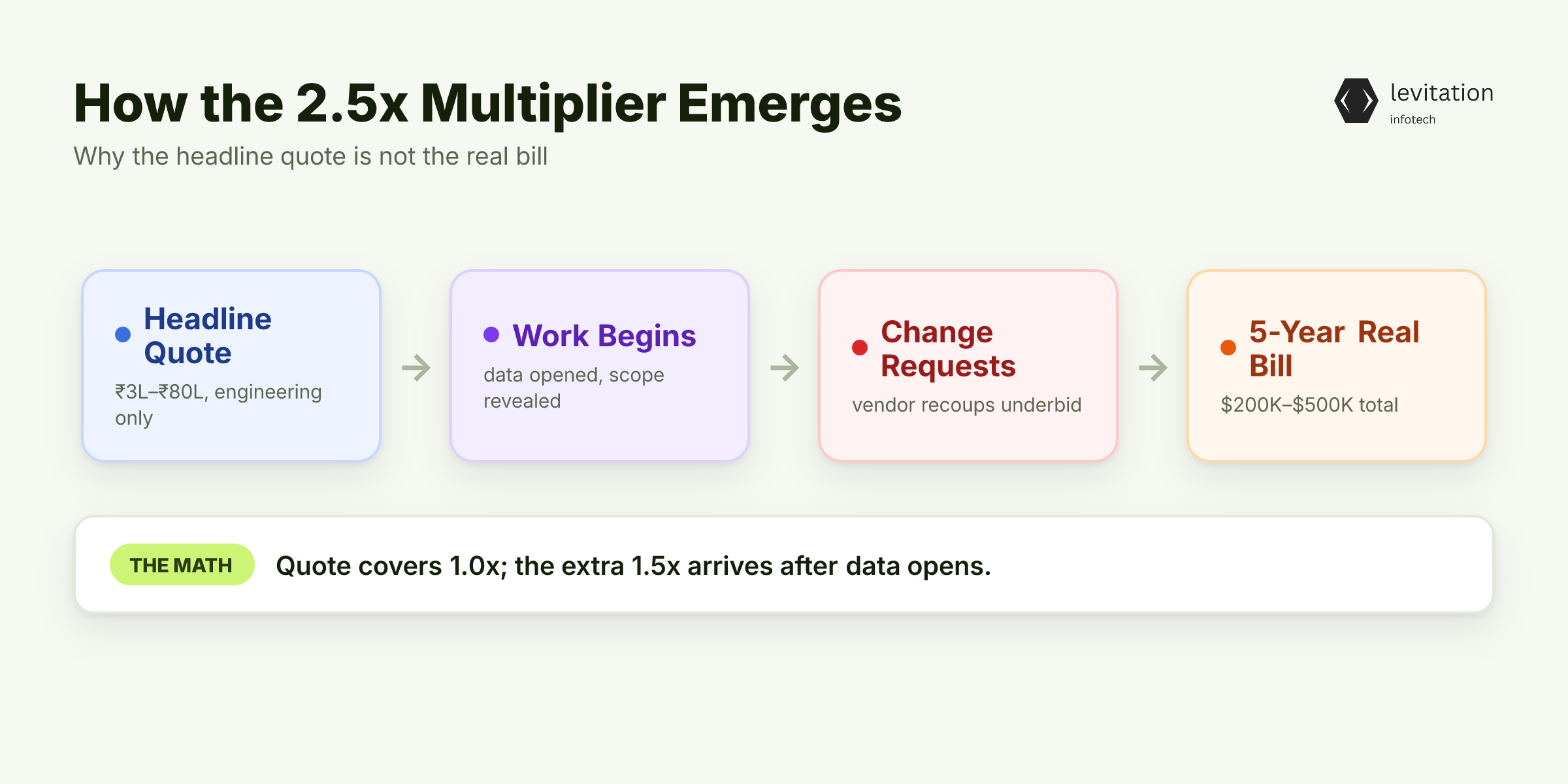
Most founders hear "2.5x" and assume the vendor is padding the bill. That instinct is wrong. The vendor is not dishonest. The vendor simply does not know the real cost upfront.
Quoting generative AI is closer to a weather forecast than a construction contract. Both sides discover the actual scope only when the work starts.
The headline ₹3 lakh to ₹80 lakh range ($18,000 to $100,000) shows up on every AI development services landing page. That range covers engineering only. It covers model training, integration, and first deployment. It does not cover the five-year real bill, which lands between $200,000 and $500,000.
The gap is structural, not opportunistic. The Indian SME market is thin. Quotes are competitive, and vendors underbid to win the deal. The overrun shows up later as "change requests" once the data is opened and production realities arrive.
This is not a one-off negotiation failure. It is the default outcome of how the Indian market quotes AI today.
The same pattern shows up in adjacent work. It shows up in ₹15 lakh software projects that quietly become ₹75 lakh and in chatbot builds that 4x within a year. The mechanic is identical.
So where does the extra 1.5x actually go? The answer is not where most founders assume.
Data Preparation Is Where Budgets Actually Die
Most founders assume the model is the expensive part. It isn't.
Data cleaning, normalization, and quality assurance often consume more resources than the model itself. For first-time AI builds, data preparation routinely exceeds model development cost in both time and money. Indian SMEs sit on the high end of that range.
The reason is simple. Internal data inside most Indian SMEs is not AI-ready. It lives in ERPs that don't talk to CRMs. It lives in spreadsheets that disagree with the database. It lives in scanned PDFs that have never been digitized.
Someone has to find the inconsistencies. Someone has to fill the gaps. Someone has to stand up a governance layer before any model can be trained. This is months of work, not weeks.
It almost never appears in the original quote. When it does appear, it shows up as a "data engineering" line buried at the bottom. Or worse, as change requests after the SOW is signed.
Vendors who lead with top generative AI companies in India lists rarely tell you this on the sales call. The first honest conversation happens during a discovery sprint. Most founders never insist on one.
A quote that excludes data engineering is a quote that will balloon the moment work begins. Treat its absence as a red flag, not a saving.
But even well-scoped data work should not push costs that high. There is a market-level reason Indian SMEs pay more than their global peers.
Why 15% Adoption Means You Pay More
Only 15% of Indian SMEs currently use AI. Worse, 78% have not deployed a single AI tool. The market is thin, and thin markets charge more.
In a saturated market like the US, an SME shopping for AI can collect five competing quotes in a week. That competition compresses margin and forces vendors to price to the local market.
In India, the same founder might struggle to get two serious proposals. The price pressure that exists elsewhere simply does not exist here.
Noida-based AI vendors are aggressively targeting global enterprise clients. They price against US and European benchmarks, not the local Indian SME market. The Indian SME is not the priority buyer. The founder is negotiating against a vendor's export pipeline rather than a local market hungry for the work.
That is the structural trap. You are buying a globally priced service from a vendor who would rather sell to a New York client. The only thing keeping your quote from being even higher is the vendor's need to keep the local pipeline warm.
This dynamic mirrors why Fintech AI costs vary three-fold across buyer segments. The math is unforgiving.
Fewer competitors, weaker negotiating position, and a vendor whose reference price is set in dollars. That is why the 2.5x is structural, not negotiable, until you change what you negotiate on.
Once you understand that, what does the full five-year bill actually look like?
The 5-Year Cost Map: Where 60% Goes
The total five-year investment for an Indian SME generative AI project runs $200,000 to $500,000. That is roughly ₹1.7 crore to ₹4.2 crore.
Sixty percent goes to maintenance, retraining, and scaling. Not to the build.
The quote you receive almost always covers the build. It covers engineering, model training, and initial deployment. It silently excludes the ongoing layer.
That layer includes GPU and cloud inference, monitoring, drift detection, and security patches. It also covers the retraining cycles that keep the model honest as your data shifts.
Inference at scale is the silent killer. A production system handling high traffic volumes can accumulate monthly inference bills that rival or exceed the original build cost. No SME quote accounts for that line item.
Vendors price the model. They do not price the electricity bill. This matches the hidden cost that catches fintech AI scaling and the CFO blind spot around GPU autoscaling we see across the industry.
Year 2 and Year 3 MLOps overhead is where budgets break. Founders who budget only Year 1 are the ones who hit the 2.5x multiplier. They discover the ongoing layer mid-flight. They scramble to fund it.
They cut scope, raise again, or quietly abandon the project. The AI development conversation founders need is not "what does it cost to build." It is "what does it cost to keep running for five years."
Those two numbers live in different universes. So how do you pressure-test a quote before signing it? The framework below separates a ₹40 lakh project from a ₹1 crore one.
A 4-Step Framework for an Honest Quote
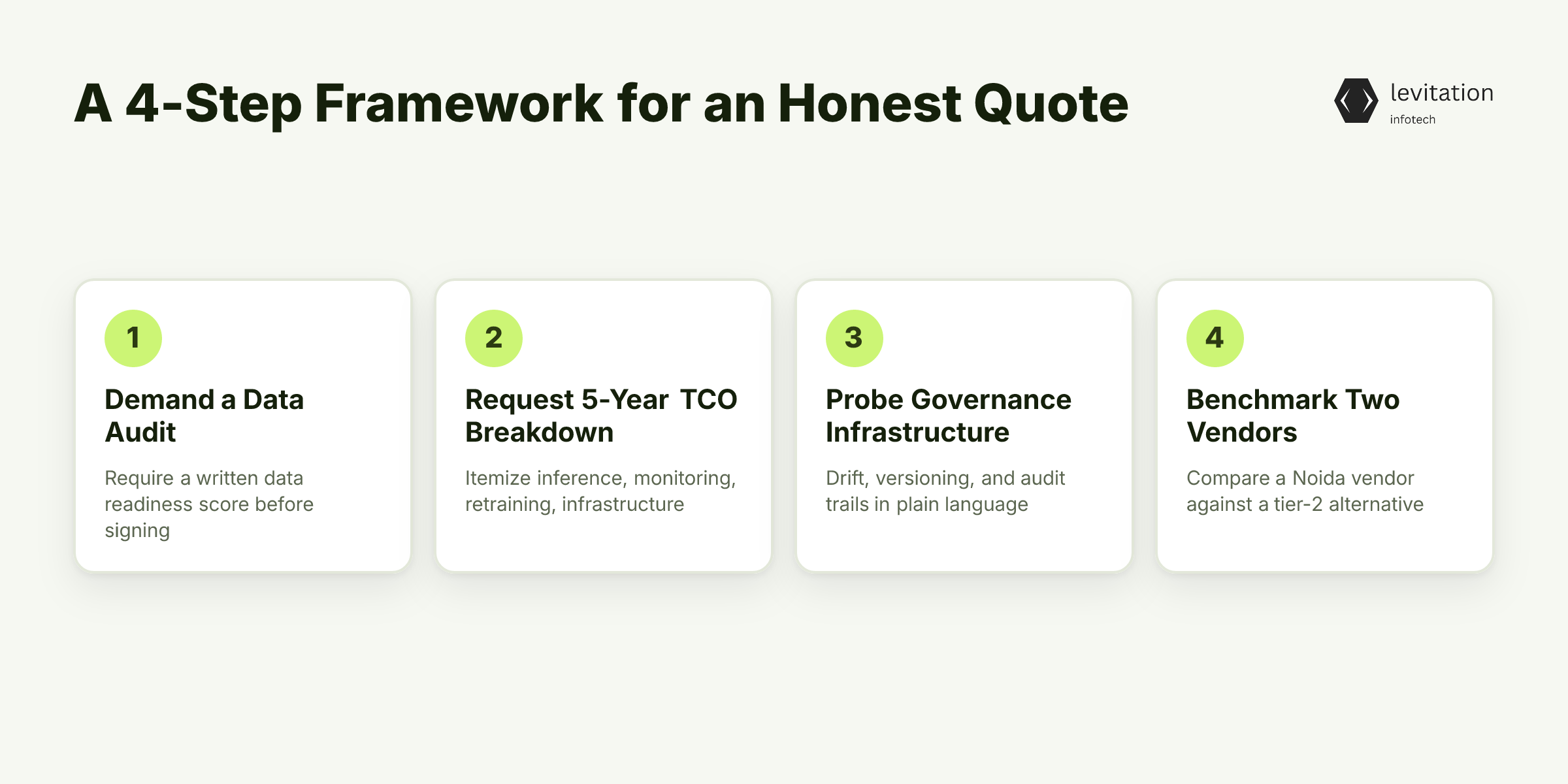
Step 1. Demand a data readiness audit before signing. The vendor should score your data quality, gaps, and governance maturity in writing.
If they skip this, the quote is fiction. A vendor who has not seen your data is pricing a demo pitch, not your project.
Step 2. Ask for a five-year TCO line-item breakdown, not a build cost. Insist on separate lines for inference, monitoring, retraining cycles, and infrastructure.
This is where the 2.5x hides. A vendor who refuses this request is telling you, in writing, that the ongoing layer is not part of the conversation.
Step 3. Probe governance infrastructure. Lack of governance is the single biggest reason Indian SME AI projects overrun. The vendor should explain, in plain language, how model drift, versioning, and audit trails will be handled.
If they cannot explain it, they will not deliver it. The mechanics of stopping inference from bleeding your budget live inside this layer.
Step 4. Benchmark against a Noida vendor and a non-Noida vendor. Noida firms are global-market priced. Smaller tier-2 vendors often compete on cost for local SME work because they need that pipeline.
A side-by-side quote comparison is the fastest way to see which vendor is pricing for you. It is also the fastest way to see which is pricing for someone else. Look for partners experienced in generative AI development with a real track record on long-running SME systems.
That fourth step deserves its own breakdown. The price sheet itself tells a story if you know how to read it.
Reading a Noida AI Vendor's Price Sheet
Red flag: a single-line quote with no data engineering line. This guarantees the 2.5x outcome because data prep gets billed as "change requests" mid-project.
The vendor knows it. You should too.
Red flag: a quote denominated in dollars but contractually locked to a USD-INR conversion. Currency clauses are how global-targeted Noida vendors protect margin when the rupee moves. Your invoice goes up the moment the exchange rate shifts in their favor.
Green flag: vendors who ask to see your data warehouse and governance maturity before quoting. They are pricing the real job, not the demo pitch.
The strongest signal is a vendor who has shipped production systems to regulated industries. That vendor understands the data foundation requirements those projects demand.
Green flag: vendors who offer a fixed-price discovery sprint before the main SOW. This is the cheapest insurance you can buy against a 2.5x overrun. The sprint surfaces the real scope.
The main quote gets written against reality rather than hope. Solid AI implementation partners will insist on this step.
Done right, what does the math actually look like? And what does it unlock for a founder?
What Changes When You Budget for the Real Number
Founders who budget ₹1 crore for a ₹40 lakh quote do not just avoid sticker shock. They build governance and data pipelines that make the system production-grade on day one.
The 60% ongoing layer is no longer a surprise. It is a planned line item with a named owner.
This is why long-term survival is so tightly correlated with honest scoping. Teams that treat custom AI development as a five-year program are the ones whose systems are still running in production five years later.
The real outcome is not a cheaper project. It is a project that survives the maintenance phase without a second funding round. Budgeting for the real number is how you avoid the cascading cost overruns that kill AI projects before they reach production maturity.
Frequently Asked Questions
How much does generative AI development cost in India for an SME?
Initial quotes range from ₹3 lakh to ₹80 lakh ($18,000 to $100,000). The real five-year TCO typically lands between $200,000 and $500,000. The build is roughly 40% of the bill. The rest is data prep, inference compute, and ongoing maintenance.
Why are AI development costs in India higher for SMEs than for large enterprises?
Only 15% of Indian SMEs use AI. There are fewer competing vendors and less price pressure. Noida and metro-based vendors price for global enterprise clients. SME founders are not the priority buyer and do not get volume-based pricing leverage.
What is the 5-year total cost of ownership for a generative AI project?
For an Indian SME, expect $200,000 to $500,000 over five years. Roughly 60% goes to maintenance, retraining, scaling, and inference compute. It does not go to the build cost vendors quote upfront.
How do Noida AI vendors price their services differently?
Noida-based AI vendors primarily target export and global enterprise clients. Their pricing is benchmarked against US and European rates, not the local Indian SME market. This is one structural reason Indian SMEs pay a premium compared to what the same vendor might charge a domestic mid-market client.
How can Indian SMEs reduce their AI development cost?
Three moves carry the most weight. First, invest in data readiness before engaging a vendor. Second, demand a five-year TCO line-item breakdown instead of a build quote. Third, run a fixed-price discovery sprint to surface hidden scope before signing the main SOW. Each one attacks a different mechanism behind the 2.5x multiplier.
Run the four steps before you sign anything. Your real five-year number is worth more than the lowest first quote.
Sources
Research and references cited in this article:
- Generative AI Development Cost in India: 2026 Guide
- Real Cost of Generative AI: What SMEs Actually Pay
- The Real Cost of AI Development in 2026: What We Charge, What Others ...
- AI Is Costing More Than The Employees It Replaced
- Cheaper AI is better: Soaring bills are reshaping how businesses choose models - The Business Times
- India's MSMEs struggle to adopt AI despite economic importance — Daily Brief, 13 July 2026
- Why Indian SMEs Are Finally Adopting AI in 2026 ? And What's Holding ...
- India's MSMEs power the economy, but most still aren't using AI
- India lags behind rest of the world in AI adoption; only 15% of SMEs use AI: BCIC - The Hindu
- Indian AI Startups Target Global Markets Amid Rising Demand, ETEnterpriseai
- Cost of Generative AI Development in India in 2026: A Complete Guide
- AI Development Cost in India: The Complete 2026 Pricing Guide
About the author
Mayank Singh is a software developer at Levitation Infotech, where he builds web and AI-powered applications across the company’s fintech, healthcare, and enterprise projects.