


A clean GSTR-1 or ERP tax report shows only that a workflow has finished. It does not show that invoices, Invoice Registration Portal (IRP) records, accounting entries, and GSTR-2B match. CFOs need document-level reconciliation, owned exceptions, and proof built into ERP acceptance criteria.
The exposure sits in document-level details. Source invoices, GSTR-1, GSTR-2B, and ERP books must match for each transaction.
Every mismatch needs an owner, tracked ageing, and saved evidence. Executives must prove the control before trusting a green status.
A Green GST Report Is Not a Green ERP Control
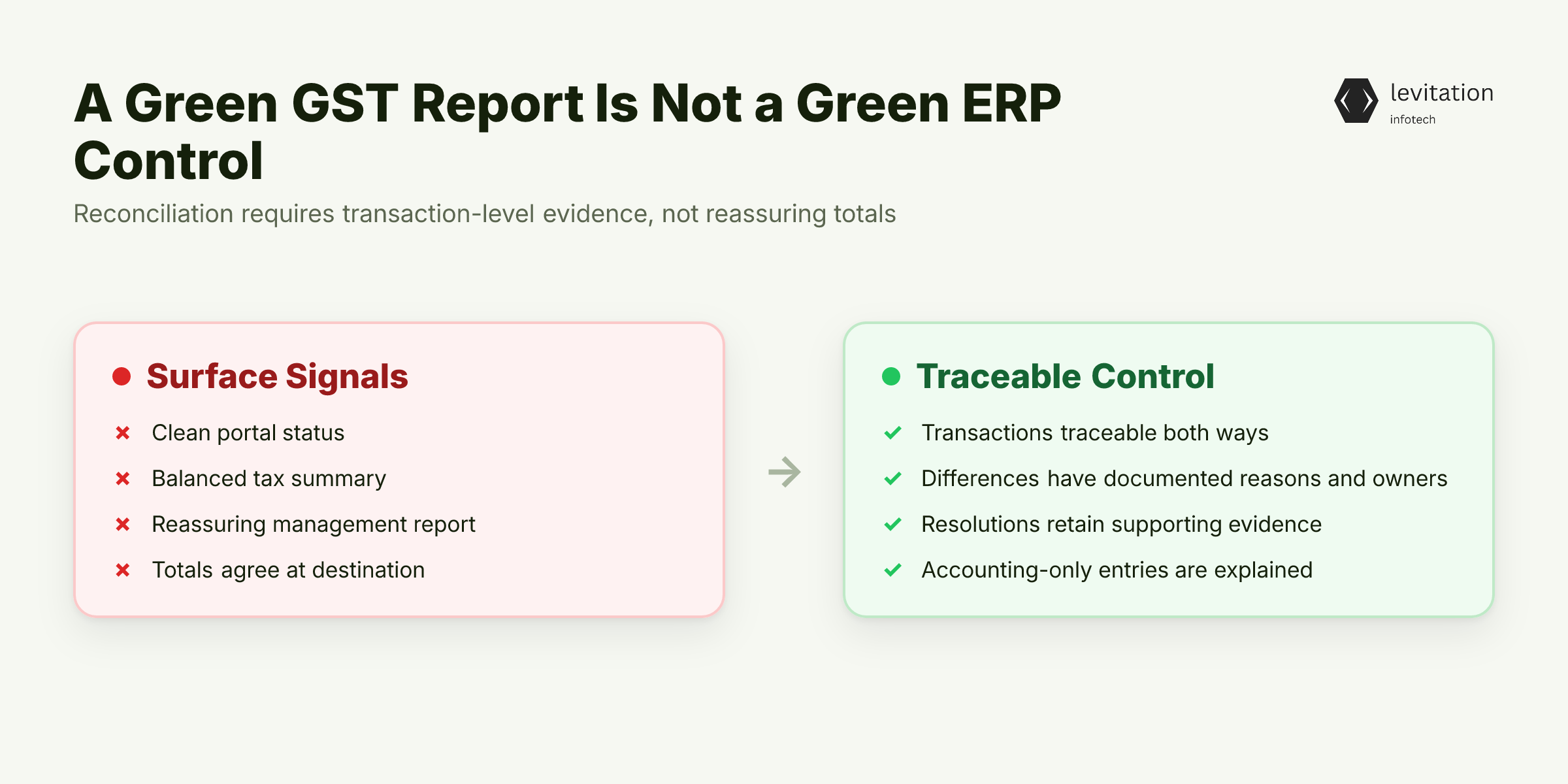
A CFO can see a clean portal status, a balanced tax summary, and a reassuring management report. The ERP still cannot trace one transaction back to its source document. That gap turns false comfort into exposure.
The same trap appears in A Green Canary Dashboard Is Not a Safe Deploy. A visible signal can hide broken paths.
The dashboard collapses four evidence sets into one green label. - Source evidence includes tax invoices and e-invoice records from the IRP. - Outward GST data tracks the invoice population reported through GSTR-1. - Inward GST data covers purchase and input-tax data compared with GSTR-2B. - Book evidence covers the sales, purchase, tax, and accounting-entry ledgers in the ERP.
A generated report or filed return shows only that data reached its intended destination. It does not show that every invoice, tax amount, accounting entry, and period agrees. Totals can agree while the underlying transactions differ.
For a CFO, reconciliation has a strict meaning. Every relevant transaction must be traceable in both directions. Each difference needs a documented reason and owner. Each resolution must also keep its evidence. Accounting-only entries must be identified and explained.
This makes reconciliation an ERP acceptance criterion, not an optional GST add-on. It changes the ERP implementation cost in India estimate. It also changes the work required from ERP software development teams.
If the portal is green, where did the books and GST records quietly diverge?
Four Failure Modes Hiding Behind a Clean Return
Manual e-invoice creation on the IRP
An invoice is generated on the IRP, but the billing workflow does not create or update the ERP invoice. GSTR-1 data also misses it. The sale now exists across source, reporting, and accounting records. However, no system holds a complete, linked version.
Parallel billing systems
A separate e-invoice portal and the billing application drift. This happens because document IDs, values, or sync status do not agree. The dashboard reports a successful sync while one side carries stale data.
Return-cutoff failures
The return closes before the invoice population does. Late invoices appear outside GSTR-1, while period-end reports look complete because the reporting date has passed. Closing a date does not close the underlying difference.
Semantic mismatches
Three cases need their own category. These are accounting entries without GST invoices, invoice values that differ from book values, and legitimate timing differences. Treating all three as generic variance destroys context and hides real errors.
The shared root cause is simple. Independent GST and accounting edits break transaction-level agreement, even when totals match. This is where ERP software development must create one lineage instead of two systems.
Use a strict diagnostic record for each mismatch. Record the failure type, source system, document, reporting period, responsible owner, and resolution status.
Classifying errors this way exposes patterns and tells finance which control failed.
These aren't four unrelated errors. They all begin when reporting data and accounting data become separate systems. Which control should break that separation first?
Reconcile Three Ledgers, Not One Green Screen
Build three linked views
Reconcile three evidence layers. - Source documents include tax invoices and e-invoice records, including IRP evidence. - GST reporting data covers GSTR-1 outward supplies and GSTR-2B inward purchase data. - ERP books contain sales, purchase, tax, and accounting-entry ledgers.
Each document needs a traceable path across all three. A totals-only screen cannot provide that path. This resembles the event-versus-batch evidence gap described in Event-Driven AI Is Real-Time. Your Auditors Read It in Batches.
Operational speed does not replace reviewable lineage.
Create one control table
Create one control table that joins the invoice ID and document number. Include the GSTIN, invoice date, and GST reporting period. The table must also store the taxable value, tax amount, accounting-entry reference, e-invoice status, and reconciliation status.
No spreadsheet should be the final record if the ERP can maintain these fields. The table makes missing links and value differences visible. It also lets a reviewer trace results without reconstructing the month from memory.
Match documents, not only totals
Require a two-way link between each invoice and its accounting entry. Separately identify accounting-only entries that legitimately have no GST invoice. A blank link is then either an error or an approved exception, never an invisible assumption.
Turn differences into owned exceptions. Record the mismatch category, financial impact, responsible person, ageing, resolution, evidence, and approval. Suppressing unresolved items inside a green dashboard destroys the control.
Operate the control
Check e-invoice and invoice completeness before GSTR-1 filing. Reconcile purchase and input-tax data against GSTR-2B regularly. Preserve digital records for six years.
Make the reconciliation trail exportable for internal review, GST scrutiny, and audit evidence. Durable ERP software development practices are part of this control. They belong in the ERP implementation cost in India estimate as an operating requirement.
Ask for delivery evidence, not demo confidence. Stable production use and a history of successful enterprise deployments indicate operating capacity. Neither proves this control works. Transaction-level testing remains decisive.
The control model is clear. Can it survive migration, month-end cutoffs, and daily transaction changes?
Build Reconciliation Inside the ERP Workflow
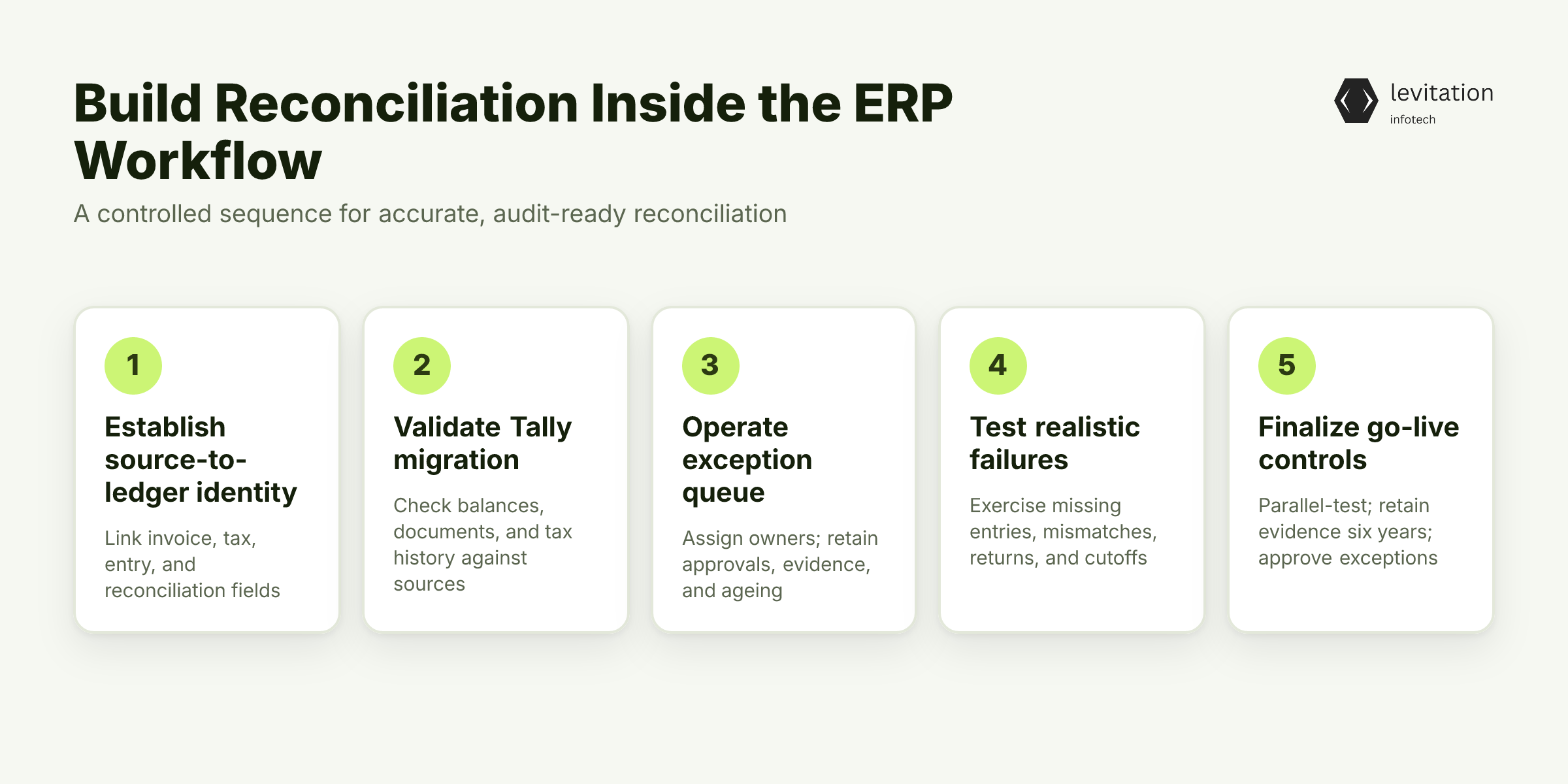
Set up source-to-ledger identity
Keep core identity fields linked throughout the workflow. Maintain the invoice number, invoice ID, accounting-entry reference, GST period, tax amount, e-invoice status, and reconciliation status together.
The link should survive retries, corrections, cancellations, and period changes. If a user can replace those fields without creating an exception, the control is decorative.
Migrate Tally data with control
Move masters, opening balances, outstanding documents, customer and supplier balances, and historical tax data. Validate each migrated value against source trial balances and outstanding-document registers.
A successful import count does not show that balances, document status, or tax history migrated correctly. This ownership problem appears in ERP Won't Save Manufacturing Costs Until Stock Agrees. Agreement between systems matters more than module activation.
Build an exception queue
Assign every failed match to an owner. Prevent unexplained variances from closing automatically. Retain the approval, evidence, and resolution history.
Expose ageing within the queue. Otherwise, old differences disappear into month-end noise.
Test realistic failure scenarios
Before go-live, test a late invoice and a manually generated IRP invoice. Cover an invoice without an accounting entry, a tax-value mismatch, and a return-period cutoff.
Use one exception report that joins invoice and accounting records by document ID. It should surface missing references, amount differences, unreconciled periods, and unmatched invoice directions. Finance can then investigate actual records instead of comparing screenshots.
Run a parallel period before go-live. Compare new ERP output with existing GST and accounting records. Document every intentional difference, then sign off on residual exceptions.
Set six-year retention, role-based approvals, exception history, and exportable evidence as explicit go-live requirements. Include this scope in any ERP implementation cost in India estimate.
Use ERP software development only where standard setup cannot preserve document lineage, exception ownership, or reporting controls. Delivery history can indicate execution breadth, but acceptance tests still decide this project.
Once the control operates inside the ERP, software choice matters less than control design and acceptance tests. Which scope deserves to enter the statement of work?
Price Reconciliation Control in India's ERP Budget
Price the work packages separately
Break the estimate into distinct work packages. These cover GST and e-invoice integration, Tally or Busy migration, and exception-workflow design. They also cover parallel-run testing, user training, process change, and post-go-live reconciliation support.
This prevents a generic GST module line from hiding the hard work. It also separates one-time implementation cost from recurring support.
Compare total cost, not licence cost
Some open-source ERPs have no licence fee. Setup, hosting, implementation, maintenance, and internal effort still carry real costs.
For paid platforms, implementation remains a major budget line. The cheapest licence does not create the cheapest compliant control.
Finance must also fund internal capacity. People must clean master data, validate sources, test workflows, resolve exceptions, and change month-end routines. Omitting this effort makes the vendor quote look complete while the control fails in operation.
Write outcomes into the statement of work
Reject vague acceptance criteria such as "GST module enabled." Instead, require invoice-to-entry traceability, clear exception ownership, and ageing. Require cutoff testing, GSTR-2B reconciliation, and retained, exportable evidence.
When evaluating ERP implementation cost in India, verify that the estimate covers this control workflow. Do not accept GST setup as included by default. The same discipline applies to ERP software development estimates.
Use a lifecycle view of licence, implementation, support, upgrades, integration maintenance, and the cost of control failures.
Assess implementation partners against production and deployment evidence as well as project-specific acceptance results.
A credible estimate becomes useful only when an acceptance test proves the control. The test must show that the control catches and resolves important differences before go-live. Can the planned proof do that?
Run a CFO Proof Before Trusting Green
A budget does not prove a control. The ERP must show failures under controlled conditions before the CFO trusts the green status. This proof belongs in ERP implementation cost in India acceptance planning and ERP software development scope.
Establish the baseline
Export the ERP trial balance with sales and purchase registers. Include tax ledgers, GSTR-1 data, GSTR-2B data, and the available e-invoice document register.
Record the extraction scope so later comparisons use the same population.
Classify every gap
Classify unmatched records into the four failure modes. Assign owners and separate genuine errors from documented timing differences.
Keep documented timing differences in their own class. Missing links and value differences need investigation before approval. The control must explain that distinction.
Correct and connect
Correct source records and set up two-way links. Make every unresolved difference visible in the exception queue. Never let a total-value match conceal the underlying exception.
Test the control
Run a parallel period and deliberately test late invoices, missing accounting entries, amount mismatches, and cutoff scenarios. Verify that each failure creates an actionable exception with an owner.
Produce the sign-off pack
The CFO pack should contain the reconciliation summary, unresolved exceptions, ageing, and financial impact. It must also detail resolutions, approvals, and exportable audit evidence.
Measure the proof using the ERP's actual results. Track transaction coverage, exception count and ageing, unmatched value, and repeat failure categories.
Do not substitute an unsupported benchmark. Compare the results with the opening baseline.
Relevant operating evidence helps choose a delivery partner. The project proof remains decisive.
The payoff is a trustworthy close and earlier visibility into tax and revenue differences. It also creates an audit trail that can stand up to review. It cuts reliance on portal colour.
Green GST reporting helps, but it is not enough. Reconciliation becomes credible only when the ERP shows the relationship continuously. Can it prove that relationship month after month?
Frequently Asked Questions
Why does a green GSTR-1 report not prove that ERP books reconcile?
A green status shows that a reporting path completed. It does not test invoice-to-accounting-entry links or e-invoice links. It also does not test return coverage or agreement between accounting entries, invoices, and tax values. Reconciliation requires document-level matching across the ERP, IRP records, GSTR-1, and GSTR-2B.
What should ERP GST reconciliation compare?
Compare sales, purchase, and tax data in the ERP with the corresponding GST records. Trace invoices to accounting entries. Check GSTR-1 against e-invoice and invoice populations, and reconcile purchase and input-tax data against GSTR-2B regularly.
Does migrating from Tally to an ERP solve GST reconciliation?
No. Moving data from Tally does not create continuous invoice-to-entry links, controlled exceptions, or correct GST cutoffs. Those controls must be set up, tested, and monitored after migration.
How much does GST reconciliation add to ERP implementation cost in India?
There is no universal addition because scope and complexity differ. Some open-source software has no licence fee, but implementation, maintenance, and internal effort still carry real costs. What will the vendor price, test, and prove before sign-off?
About the author
Mayank Singh is a software developer at Levitation Infotech, where he builds web and AI-powered applications across the company’s fintech, healthcare, and enterprise projects.