


TL;DR: Indian SMEs routinely spend ₹15 lakh on custom software that the shop floor never logs into. The real failure isn't engineering or budget. It's solving problems the business doesn't have. Six specific features (real-time inventory, shop-floor production planning, GST-ready accounting, India-specific payroll, exception alerts, and regional language support) cover the actual operational gap. Whether you buy, build, or hybrid depends on which features are standard versus proprietary, not on the technology stack.
Key Takeaways: - The WhatsApp-Excel-whiteboard stack survives because it's low-friction, language-flexible, and requires zero training. Custom software that doesn't match this speed of adoption gets abandoned. - Six features define the operational floor most Indian SMEs actually need. Everything beyond them is expensive overhead that rarely gets used. - The "build or buy" question is wrong. The right question is "which six features, and how do I get them fastest", and most SMEs land on a hybrid. - A realistic TCO for a six-feature build in India depends heavily on depth and integrations, but the quoted price rarely reflects the total cost. - The engagement model (fixed-scope project versus dedicated development team) should match the work shape, not the budget.
The ₹15 Lakh Software Nobody Logs Into
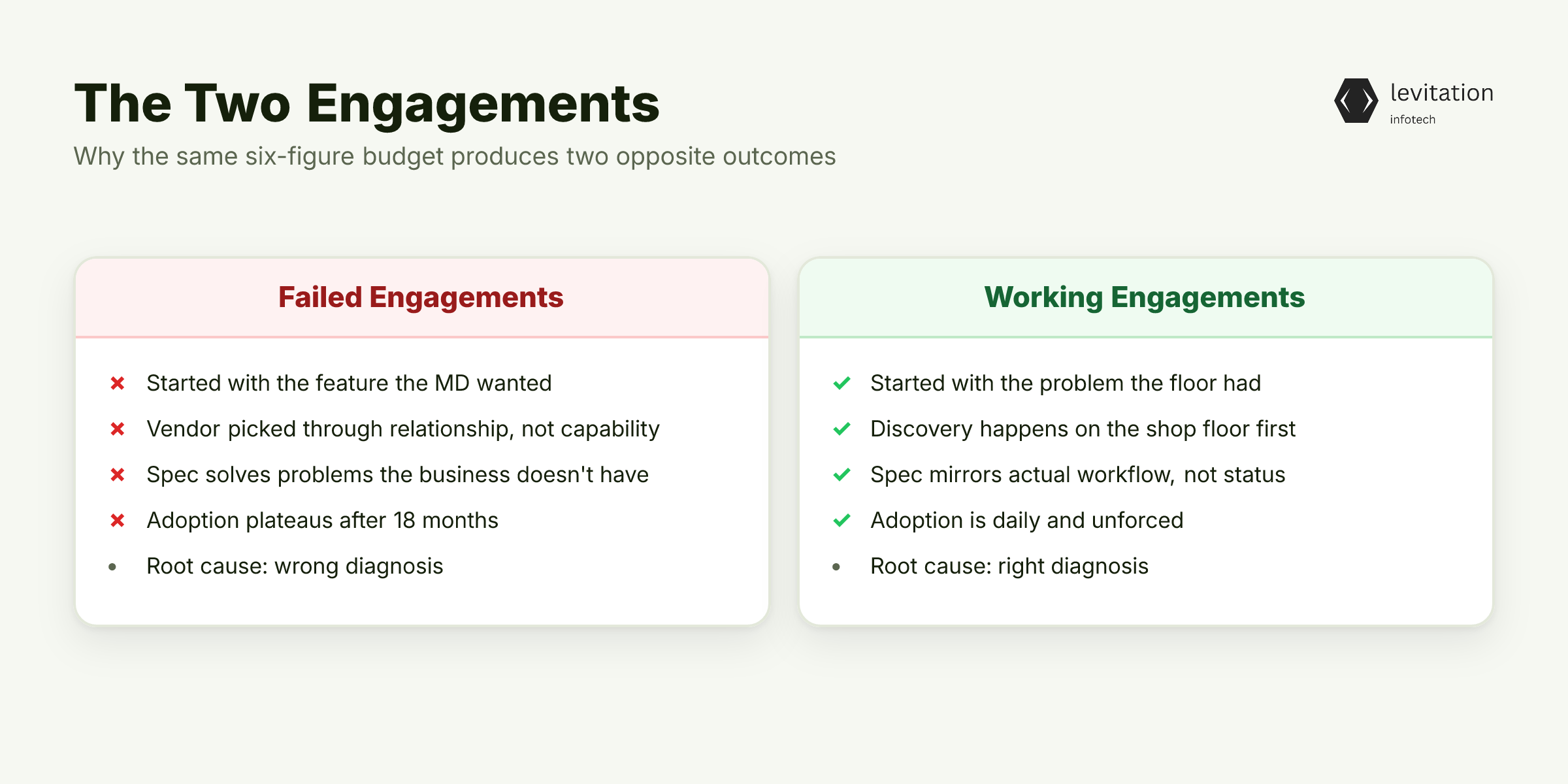
A managing director decides the business has "outgrown Excel." A vendor gets selected, often through a relationship, not a capability evaluation. A six-figure budget gets committed.
Eighteen months later, the system exists. Adoption plateaus. The MD is back to memory and phone calls.
The real failure isn't engineering. The vendor probably built what was specified. The failure is upstream: the specification solved problems the business didn't have, while ignoring the ones it did. A custom software project that's technically successful and operationally useless is more common than most CTOs will admit.
Most CEOs buy bespoke software as a status symbol, not a tool. A system that automates BOMs and routings feels modern. It signals scale. It justifies the title.
The shop floor, meanwhile, keeps doing what worked before, because what worked before was faster.
The engagements that worked shared one trait: they started with the problem the floor had, not the feature the MD wanted. The ones that didn't shared the opposite trait.
The uncomfortable truth is that the problem was never the budget. It was the diagnosis.
Why the WhatsApp-Excel-Whiteboard Stack Isn't a Bug
Walk into most Indian manufacturing SMEs. You'll see a supervisor with three apps open: WhatsApp, a shared Excel file, and memory.
Raw materials tracked in a group chat. Inventory updated in a spreadsheet the accounts team shares.
Dispatches confirmed by phone call. It's been working for years. Sometimes decades.
This isn't failure. It's a stack that earned its place. It solved real constraints: low training overhead, language flexibility, and zero infrastructure dependency.
Hindi, Marathi, and Tamil typed phonetically work fine in WhatsApp. The supervisor can teach a new worker in an afternoon.
The problem isn't that the manual stack exists. The problem is that it stops scaling past a certain size. Once complexity grows enough that the whiteboard starts dropping balls, growth stalls.
Receivables get lost. Stock-outs happen. The MD becomes the operating system, with every exception escalating to one person.
Custom software that replaces this stack without matching its speed of adoption gets quietly abandoned. If the new system requires a two-hour training session and English-only screens, the floor will keep using WhatsApp. The system sits there, half-populated, while decisions still flow through messages.
We wrote about why plant managers log line stops in WhatsApp, not ERP. The same dynamic kills adoption in any tool that ignores the floor's actual workflow.
The lesson: the existing stack survived because it earned its place. New software has to earn it too, and the bar is high.
If the manual stack isn't broken, what problem are SMEs actually trying to solve when they go custom?
The Six Features That Actually Move the P&L
Here's the shortlist. Not the feature list from a sales deck. The six features that, if they work, will change how the business runs.
1. Real-time inventory visibility. What's in stock, what's committed to a sales order, what's on the production floor, what needs to be reordered. Updated by the operator scanning a barcode, not by a clerk typing at 6pm. The MD opens a screen and sees ground truth, not last week's reconciliation.
2. Production planning a supervisor can run. BOMs, work orders, and routing that work on a tablet, not require a consultant. If a floor supervisor can't update a work order fast enough during a shift, the feature will be bypassed. This is where most "ERP" deployments fail: they optimise for the planner, not the operator.
3. GST-ready accounting. GSTR-1, GSTR-3B, E-Invoice, E-Way Bill, HSN codes, RCM, built in, not plugged in. The system should file returns with a click, not export CSVs for someone to upload manually. Indian tax law is non-negotiable; the software needs to know it natively.
4. Indian payroll complexity. PF, ESIC, LWF, contract labour, daily wages, advance management, professional tax, handled natively, not as a custom add-on. Most global payroll systems fail here. Indian labour law is its own beast.
5. Alerts and exceptions. The system tells the MD what went wrong, not what went right. If the dashboard shows green across the board, it's not working. The point of software is to surface the three things that need human attention out of a thousand things that don't.
6. Hindi and regional language support. The shop floor doesn't need to speak English to log output. If the operator has to translate "reject quantity" in their head, they'll skip the field.
Multilingual UI is not a nice-to-have. It's adoption.
These six features are the floor. A well-built system for an Indian SME, from top custom software development companies in India, should deliver all six.
Anything beyond them, including CRM, advanced analytics, AI forecasting, and mobile apps for customers, is a layer 2 problem. Solve layer 1 first.
The question is how you get these six: buy a packaged product, build bespoke, or something in between. And what that actually costs, because the software development cost in India for the same feature set varies wildly by path.
Build vs Buy: The Decision Framework Most CEOs Get Wrong
The question most CEOs ask is "build or buy?" The right question is "which features are standard, and which is my moat?" Here's a sharper framework.
Each of the six features lands in one of three buckets: - Buy when the workflow is standard. GST accounting, payroll, and basic CRM are solved problems. Vendors like Tally, Zoho, and dozens of India-focused products have done them well.
The cost of configuring is lower than the cost of building from scratch. We have a detailed breakdown of how Zoho's per-seat pricing compounds by year two. This applies to any packaged product, not just Zoho. - Build when your process IS the moat. Proprietary routing, custom BOM logic, and a manufacturing sequence no vendor will ever ship. The process is the product, so the software has to be custom.
The relevant question isn't cost. It's whether the moat survives being shared with a vendor's other customers. - Hybrid (configure-then-extend) when you need 80% standard and 20% bespoke. This is where most Indian SMEs actually land.
Buy the standard 80%: accounting, payroll, basic inventory. Build the 20% that makes your operation different.
The risk is integration debt. Every year, the gap between the product and the custom layer grows.
The reward is cost. We've seen Odoo's pricing balloon with hidden line items. Hybrid models need careful scoping to avoid that trap.
The "fastest" part of the equation matters because most Indian SMEs underestimate how long custom software takes to get right. Speed of deployment and speed of adoption are different problems.
Whichever path you pick, the cost number your vendor quotes is almost never the cost you'll pay. Here's what the real number looks like.
What Custom Software Really Costs in India (And Why the Quote Isn't the Quote)
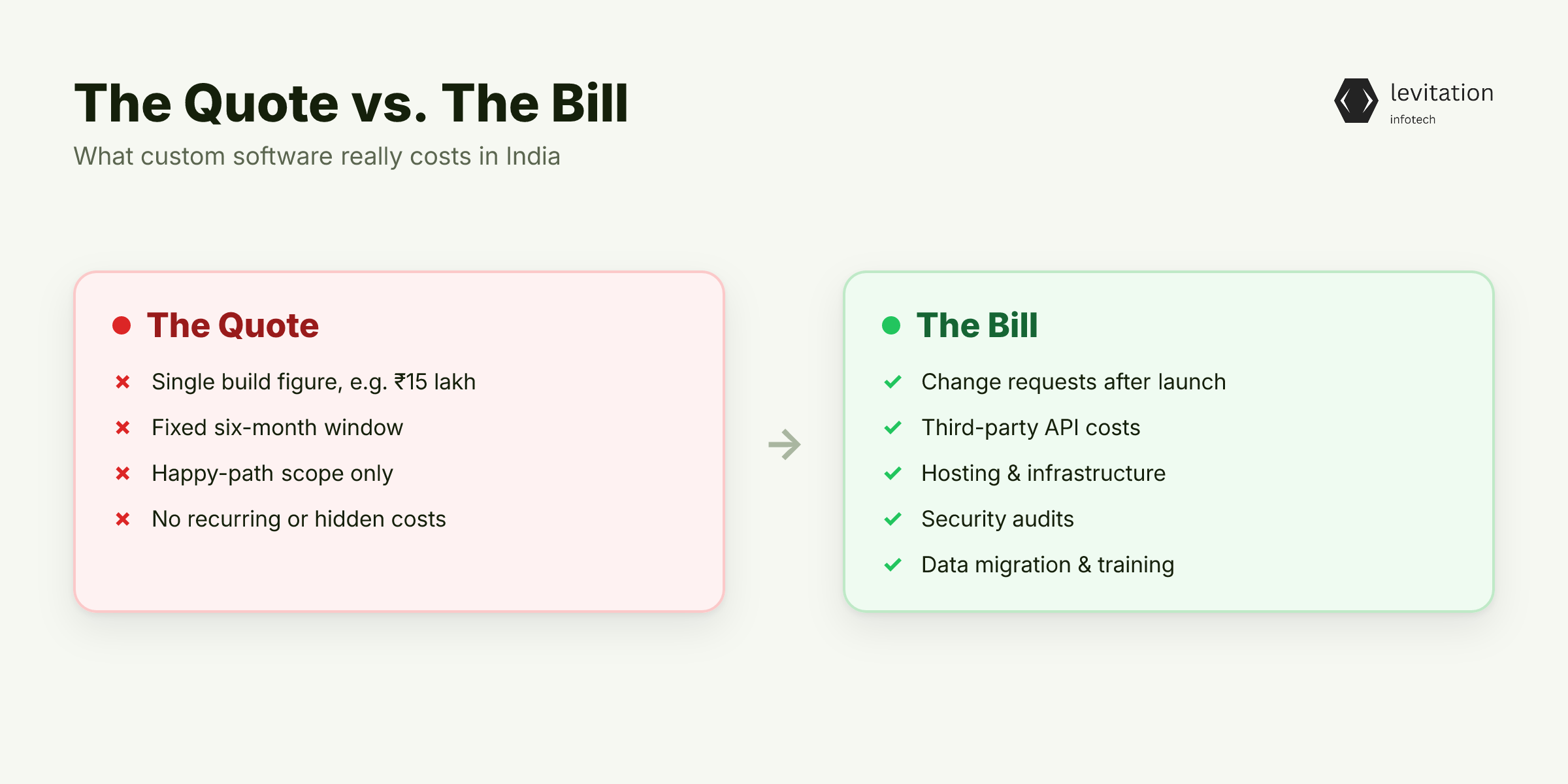
A vendor quotes ₹15 lakh. You budget ₹15 lakh. The build takes six months.
Then comes year two: change requests, hosting, security audits, third-party API costs, and data migration. The inevitable "we also need" additions follow.
The actual spend routinely exceeds the original quote. Change requests, hosting, and integration work are not in the original scope.
This is the norm, not the exception. We've seen it documented in cases ranging from a ₹15 lakh quote that balloons after deployment to the ERP surprise six months in.
The pattern is consistent. The quote covers the happy path. The bill covers reality.
Here's where the money actually goes, beyond the build: - Change requests. Every feature that wasn't in the original spec. Budget for additions. - Third-party API costs. SMS gateways, payment gateways, GST Suvidha Providers, and banking APIs charge per transaction. - Hosting and infrastructure. Cloud costs in India run lower than Western equivalents, but they're not zero. Database backups, monitoring, and uptime guarantees all cost. - Security audits. Necessary if you're touching customer data or financial records. Skipping this is a compliance risk that catches up with you later. - Data migration. Old data rarely fits the new schema. Budget for ETL work. - Training. Shop-floor training is repetitive. Each new hire is a small recurring cost.
Offshore dedicated development teams can reduce total cost by up to 60% versus in-house hiring. The catch: cost savings depend on scope discipline.
If requirements drift every two weeks, the savings evaporate. Lock scope early or accept that the discount is smaller than the brochure claims.
A realistic TCO for six core features in India varies by depth, integrations, and engagement model. That range is honest, not sales-deck.
The lower end assumes a focused MVP with a fixed-scope vendor. The upper end assumes deep integration, custom compliance, and ongoing development.
Cost clarity lets you pick the right engagement model. For some SMEs, that means a dedicated team. For others, it means a packaged product with light extension. Here's how to tell which.
When a Dedicated Development Team Actually Makes Sense
A dedicated development team is a long-term engineering squad that works exclusively on your product, usually offshore, full-time, billing monthly. It's not a project. It's ongoing capacity.
Hire dedicated when you're running multiple parallel feature streams and the work isn't a one-time build. If your roadmap extends past 12 months, and you have continuous feature requests, a dedicated team outperforms fixed-scope projects on both cost and speed. The economics work because the team learns your domain deeply over time.
Skip dedicated when your need is one product, one launch. A fixed-scope engagement is cheaper and faster for a defined deliverable. Dedicated teams shine on evolution, not initial builds.
The tell: if your MD can describe the next three months of feature work in detail, you're ready for a dedicated team. If not, you need a discovery sprint first.
Most failed engagements start with a vendor quoting a dedicated team before doing two weeks of discovery. That's selling hours, not outcomes. Red flag: any vendor who quotes headcount and monthly cost before scoping the problem.
The right sequence is discovery, fixed-scope MVP, then scale to a dedicated team. Reverse that and you'll pay for a team that doesn't know what to build.
When that sequence is followed, the operational shift shows up faster than most MDs expect.
What Changes When You Match Software to the Actual Problem
SMEs that pick the right six features and the right engagement model see real operational shifts within two quarters. The most measurable: cycle time from dispatch to invoice drops sharply, because the data is captured at the source instead of re-typed at the end of the day.
The bigger win is harder to measure but more important: the MD stops being the operating system. Decisions get made from dashboards, not from memory.
The supervisor stops escalating every exception. The floor stops relying on phone calls to confirm a dispatch.
What doesn't change: software is a tool. The discipline of updating it daily still belongs to the floor. A system nobody maintains is no different from a whiteboard nobody updates.
The shop floor culture of "we'll log it later" is the silent killer of every deployment.
The systems that survive, the ones still running in production 5+ years after deployment, share three traits: the features match actual workflows, the floor had a voice in the design, and the engagement model fit the work shape. Get those right, and the ₹15 lakh becomes an investment. Get them wrong, and it becomes a whiteboard substitute with a login screen.
Frequently Asked Questions
How much does custom software development cost in India for an SME? A six-feature build covering inventory, production planning, GST accounting, payroll, alerts, and regional language support varies in cost. Budgets depend on depth, integrations, and engagement model. Offshore dedicated teams can reduce this by up to 60% versus Western equivalents, but only if scope is locked early.
Should an Indian SME build or buy software? Buy when the workflow is standard (GST accounting, payroll, basic CRM). Build when your process is proprietary or your compliance needs are unusual. Most SMEs land on a hybrid: 80% configured product plus 20% custom extension.
The build vs buy decision should start from the six features you need, not from the technology stack.
What is a dedicated development team and when do SMEs need one? A dedicated development team is a long-term, full-time engineering squad that works exclusively on your product, usually offshore. SMEs benefit when they have multiple parallel feature streams or a roadmap extending beyond 12 months. For a single product launch, a fixed-scope project is faster and cheaper.
If the six features match your reality, start with a discovery sprint before signing anything.
Sources
Research and references cited in this article:
- Unlocking Success: 3 Essential Strategies for Indian SMBs in 2026, ETCIO
- Enhancing Innovation in Indian SMEs: Key Strategies for ...
- About SME in India | SME Chamber of India
- 8. Climate, Energy and Mobility - Research and innovation
- How Custom Software Helps Small Businesses Scale Faster in 2026
- Custom Software vs Off-the-Shelf: How to Choose in 2026 | LaunchPad Lab
- The Significance of Custom Software for Small Businesses
- Building Custom Software vs Off-the-Shelf: Advantages and Disadvantages of Each Approach - SPARK Business Works
- Custom Software vs. Off-the-Shelf: Advantages and Disadvantages
- Why Choose Dedicated Software Development Team For Scaling In 2026?
- Custom Software vs Off-the-Shelf for Indian SMBs - BlockCelerate
About the author
Mayank Singh is a software developer at Levitation Infotech, where he builds web and AI-powered applications across the company’s fintech, healthcare, and enterprise projects.