

TL;DR: The gap between Hugging Face's 2 million models and the typical enterprise ceiling of 100-200 is an architecture problem. It is not a hardware problem. Adding GPUs makes it worse. This happens because per-model overhead compounds. The fix is a multi-model inference layer built on shared pools, tiered serving, and KV-cache optimization.
The research is clear on the payoff. Snowflake hit 16x throughput gains on embedding inference. They did this by optimizing vLLM. Full optimization strategies also deliver 5x throughput increases. They also bring 70% reductions in cloud compute costs. The approach lets platforms scale well beyond 200 models. It does this without proportional cost growth.
Key Takeaways: - Most teams stall at 200 models. Each model carries its own endpoint, autoscaler, and observability overhead. This is not a GPU shortage. - "Just add more GPUs" multiplies per-model costs. Endpoints must stay warm to avoid cold-start delays that break real-time SLAs. - Continuous batching, paged attention, and INT8/FP8 quantization form the core optimization stack. They deliver major memory and throughput gains. - Shared inference pools and tiered serving cut per-model cost. Model count stops being the constraint. - Snowflake hit 16x throughput on embedding inference. Broader optimization strategies deliver 5x throughput with 70% lower compute costs.
The 2-Million-Model Gap (and Why Most Teams Stall at 200)
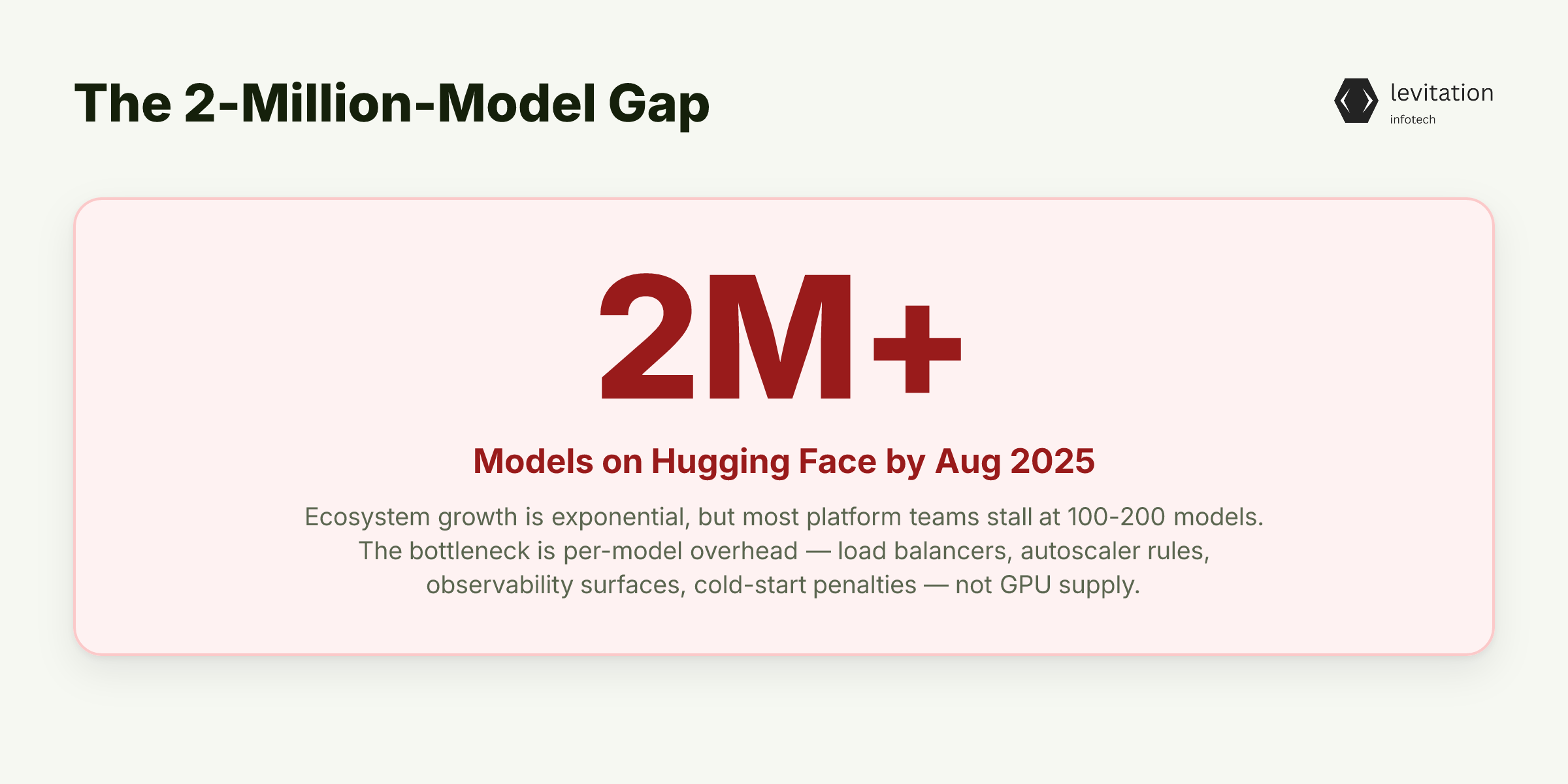
By August 2025, Hugging Face had crossed 2 million models. The number is striking. The curve is more striking. Models added in 2025 alone exceeded the total added in all of 2024.
The growth wasn't linear. It was a break in pattern. It was a sudden bend. This bend exposed how the rest of the industry builds serving infrastructure. Enterprise stacks weren't designed for that.
The turning point correlates with the rise of small fine-tuned models. Lighter, cheaper-to-train models created a customization loop. Any team could take a base model. Then they could fine-tune it on a narrow task and publish it. As a result, the ecosystem exploded.
Most platform teams hit a ceiling between 100 and 200 models. The reason isn't GPU supply. It's that each model carries its own deployment, scaling, and monitoring overhead. Each new endpoint adds a load balancer configuration. It also adds an autoscaler rule, an observability surface, and a cold-start penalty.
Past a few dozen models, the per-model glue code starts to dominate engineering time. Past a couple hundred, the bills become unanswerable.
The gap isn't about GPU count. It's about architecture. The first place it surfaces is the invoice. Understanding machine learning infrastructure at a systems level matters more than picking the right accelerator.
So where do most teams go wrong first when they try to scale?
Why "Just Add More GPUs" Is a Cost Trap
The instinctive response is to scale horizontally. Buy more GPUs. Deploy more endpoints. Serve more models. It feels like the safe choice. In fact, it is the most expensive one.
Naive horizontal scaling multiplies per-model overhead. Each new endpoint brings its own load balancer, autoscaler, observability, and cold-start cost. Doubling the model count doesn't double the spend linearly. The fixed cost of keeping an endpoint warm gets paid again and again.
Provisioned throughput pricing illustrates the trap. High-end GPU instances billed continuously represent the same risk in any cloud. Keep an endpoint "Active" to avoid spin-up delays, and you pay that rate continuously. Multiply by a few hundred models. The math stops being an engineering question. As a result, it becomes a CFO question.
We've written about this CFO blind spot on GPU autoscaling costs before. The pattern keeps repeating.
Scale-to-zero looks like the escape hatch. Spin down idle endpoints, pay nothing, spin back up on demand. In practice, large transformer models can take long enough to spin up. Then real-time inference is unusable. Teams end up paying for warm endpoints they rarely use. The alternative breaks every SLA.
The hidden cost of LLM auto-scaling is largely a function of this dynamic. The real cost driver is not peak traffic. It's the number of simultaneously warm models multiplied by their GPU memory footprint.
Reducing GPU serving costs means attacking that ratio directly. It does not mean throwing hardware at it.
If provisioning more capacity makes the problem worse, then the cost driver must be something else. What actually moves the needle?
The Four Levers That Actually Move Inference Economics
Four levers decide whether inference economics scale or collapse. These are compute flexibility, storage performance, orchestration capabilities, and operational simplicity.
Compute flexibility means matching GPU SKU to model size. A T4 handles small embedding models efficiently. An A10G covers mid-size LLMs. An A100 only earns its premium when attention layers actually demand the memory bandwidth. Running a 3B parameter model on an A100 is paying for capability you never use.
We see this misalignment in multi-node inference setups that turn tenants into roommates. It happens when workloads of different sizes share one hardware tier.
Storage performance is invisible until cold start bites. Model artifact loading time dominates the spin-up phase. NVMe-backed model registries cut cold starts from minutes to seconds. This makes scale-to-zero viable for more workloads.
Orchestration capabilities become the deciding factor past roughly 50 models. Shared inference pools with dynamic batching outperform per-model endpoints. The GPU stays busy serving requests from many models. It does not wait on one. Per-model endpoints leave capacity stranded.
Operational simplicity is the lever teams underestimate. Unified logging, routing, and quota layers eliminate the per-model glue code that compounds at scale. Teams that win at scale treat observability and routing as platform concerns. They do not treat them as per-model concerns.
A multi-model inference architecture ties these four together. Without it, the levers work against each other. With it, they compound.
These levers sound abstract. The proof is in what one team did with them.
How Snowflake Got 16x Throughput From the Same Hardware
Snowflake optimized vLLM for high-throughput embedding inference. The result: up to 16x throughput gains and major cost reductions. No new GPUs were needed. No exotic hardware was needed either. The win came from how the transformer attention mechanism was scheduled in memory.
Continuous batching and paged attention sit at the heart of that approach. Continuous batching lets requests enter and exit the batch at every forward pass. It replaces the old pattern of waiting for a full batch to finish. Paged attention manages the KV cache in non-contiguous memory. It eliminates fragmentation that wastes GPU memory on long-context inference.
Meta's AI infrastructure team has applied similar patterns. The work shows that model serving optimization is now a first-class engineering discipline. It is not an afterthought. The broader research confirms it. A full optimization strategy delivers a 5x increase in inference throughput. It also cuts cloud compute costs by 70%.
The pattern generalizes. This is not Snowflake-specific magic. It's a stack of techniques any platform team can adopt, starting with quantization. Improvements in embedding model throughput come from the same playbook. They apply this playbook to a different model class.
Quantization, Batching, and KV-Cache: The Optimization Stack
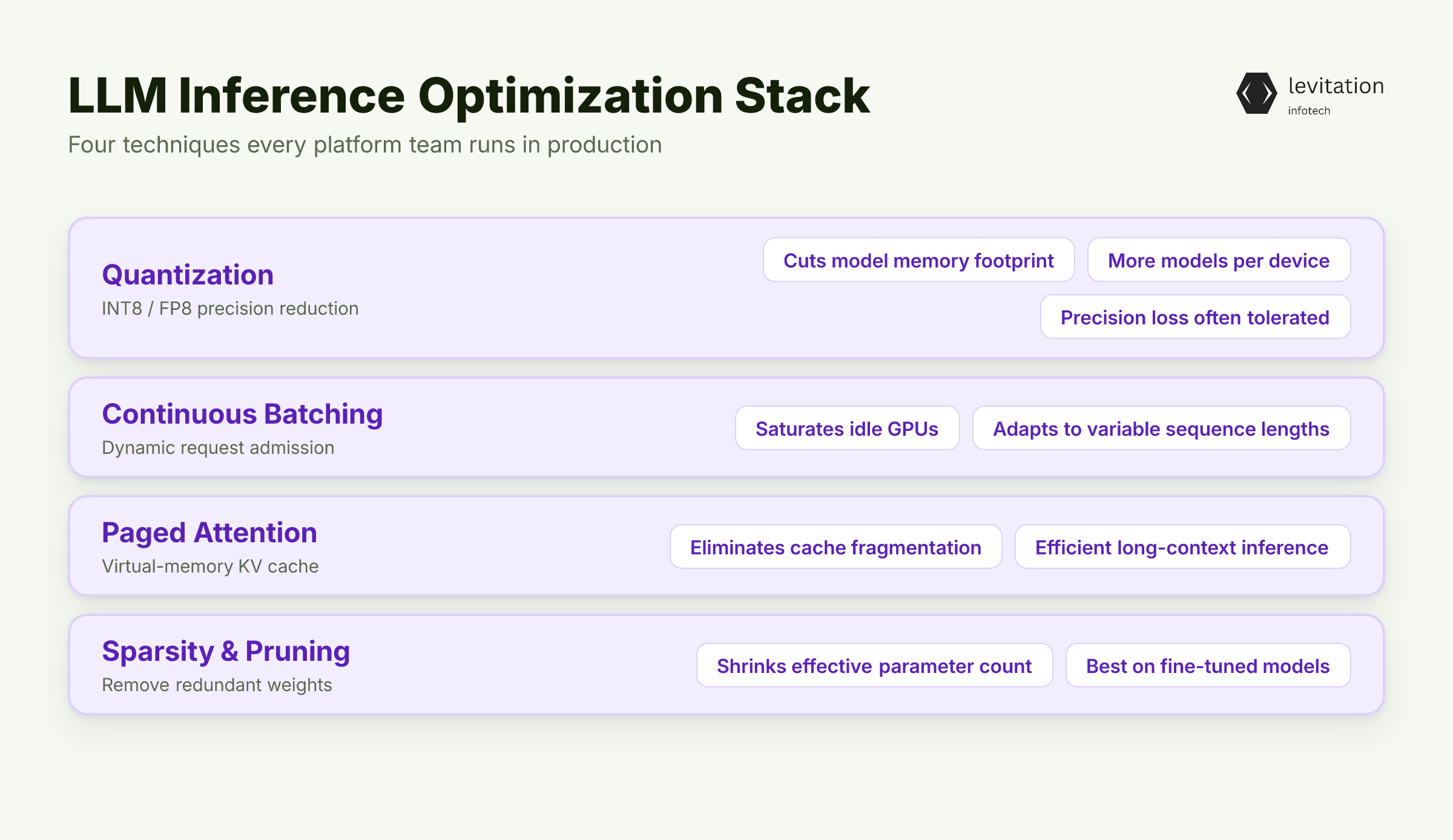
Quantization is the highest-leverage starting point. INT8 and FP8 quantization cut model memory by lowering numerical precision. Each model then fits in less GPU memory. As a result, more models share one device.
For embedding models, the gains are often larger. This is because precision loss is well-tolerated. We've covered the compliance side of quantized LLMs elsewhere. Most teams find the audit path is manageable with proper documentation.
Continuous batching is the second lever. Static batching waits for a full batch before processing. Continuous batching admits new requests. It also emits completions at every forward pass. For transformer inference with variable sequence lengths, this is the difference. Idle GPUs become saturated ones.
Paged attention solves a problem most teams don't see until they hit it. That problem is KV cache fragmentation. The key-value cache grows with sequence length and batch size. Naive allocation leaves holes. Paged attention manages the cache like virtual memory. It eliminates fragmentation. Long-context inference then uses GPU memory far more efficiently.
This is why stop bleeding money on LLM inference starts with the cache, not the model.
Sparsity and weight pruning remove redundant parameters. They work well on fine-tuned models. In those models, many weights carry task-specific signal but not general knowledge. Pruning can cut the effective parameter count of a fine-tuned model. Quality loss stays minimal, especially for narrow downstream tasks.
These four techniques form the LLM inference optimization stack. Any serious platform team builds this stack. Each one is well-documented. The hard part is operating all four in production. You have to do this without breaking observability or compliance. We see teams double their AI cost on if-checks alone. This happens when the optimization layer is missing.
These techniques optimize the model. But the bigger cost lever is how you orchestrate many models together.
Multi-Model Orchestration Patterns That Cut Costs
Optimization gets you part of the way. Orchestration is what closes the gap between 200 models and the next order of magnitude.
Shared inference pools route requests from many models to a single GPU cluster. Model-aware schedulers colocate compatible models on the same hardware. The GPU never sits idle waiting on one model's traffic pattern. This is the single biggest architectural shift teams can make.
Traffic-aware scale-to-zero keeps low-traffic models cold but warms them preemptively based on usage patterns. The naive version waits a fixed idle window. Then spin-up takes long enough that real-time traffic breaks. The smart version predicts demand and pre-warms. As a result, the penalty disappears.
Tiered serving routes embedding models (cheap, high-volume) and LLM inference (expensive, low-volume). These go through different infrastructure tiers. Each tier has its own cost model. Trying to serve both on the same hardware tier wastes money. It wastes money in both directions.
RAG-aware caching caches retrieval results at the embedding layer. This reduces redundant transformer attention calls. Many RAG queries hit the same documents. Caching the embedding stage cuts GPU time per query without changing the model.
This is where the deployment economics shift. Teams that adopt proven orchestration primitives rather than designing their own ship fastest. The cost isn't in the techniques. It's in the integration and operational discipline.
The earlier teams get the multi-model inference architecture right, the less they spend later. They spend less cleaning up the mess. For teams already over budget on GPU spend, a focused look at GPU serving costs reveals the real driver. It's orchestration, not model count.
Adopt these patterns. The numbers shift. What does scaling past 200 actually look like?
Scaling Past 200 Models: What Changes When You Get This Right
Per-model cost drops because shared infrastructure amortizes observability, routing, and warm-up overhead across the fleet. The fixed cost of running a model serving platform stays roughly constant. It stays constant as you scale from hundreds to thousands of models. The variable cost is the GPU time. That drops sharply when you stop running one endpoint per model.
Engineering velocity increases. Platform teams stop firefighting per-model deployments. They start shipping new model variants in days, not quarters. The deployment pipeline becomes a platform primitive, not a per-model project.
Long-term system stability follows. The platform persists across model and hardware refresh cycles. Architecture built on these patterns doesn't depend on any single model or GPU SKU. When a new model class emerges, you swap it in. When a GPU generation retires, you migrate the pool.
For teams building production AI systems, the shift matters. Moving from per-model plumbing to platform-level orchestration is the most consequential decision. It also pairs well with the work on KV cache and attention optimization, which compounds the savings.
The teams shipping serious AI infrastructure in 2026 aren't the ones with the most models. They're the ones whose per-model cost dropped low enough that model count stopped being a constraint. Scale follows architecture, not procurement.
Frequently Asked Questions
Q: Why does serving 200 ML models break most enterprise stacks?
A: Each model carries its own endpoint, autoscaler, load balancer, and observability surface. Past 100-200 models, the per-model overhead compounds. Teams can't engineer around it fast enough. GPU costs balloon because endpoints stay warm to avoid cold-start delays. Those delays exceed real-time SLA budgets.
Q: Does quantization actually reduce model serving costs?
A: Yes. INT8 or FP8 quantization cuts model memory by lowering numerical precision. The same GPU then hosts more concurrent models. Combined with paged attention and continuous batching, quantization drives the largest throughput-per-dollar gains.
Q: How did Snowflake achieve 16x throughput on embedding inference?
A: By optimizing vLLM with continuous batching and paged KV cache management. No new hardware was needed. The gains came from how transformer attention was scheduled in memory.
Q: What's the difference between scale-to-zero and provisioned throughput?
A: Scale-to-zero spins down endpoints after idle periods. It cuts compute charges but adds cold-start latency. Provisioned throughput keeps endpoints always-warm for predictable latency. It bills continuously. This is the right choice for production LLM inference. There, spin-up times exceed SLA requirements.
Q: How long does it take to rebuild a multi-model serving stack?
A: In-house rebuilds from scratch can stretch to a year or more. Teams must design orchestration, observability, and cost controls without proven patterns. Teams that adopt proven primitives like shared inference pools, tiered serving, and traffic-aware scale-to-zero ship in months, not years.
Want help applying these patterns to your stack? Get in touch.
Sources
Research and references cited in this article:
- What is machine learning infrastructure? | Blog — Northflank
- Scaling ML Serving to 1000s of Models
- How To Scale ML Models Efficiently?
- Machine Learning as a Service Market Size, Report by 2034
- The benefits of globally distributed infrastructure for model serving
- AI Inference Scaling: The 2026 Blueprint for Performance
- Overcoming the cost and complexity of AI inference at scale
- AI Inference at Scale: Cost Breakdown and Optimization Best
- Optimizing AI/ML Models for Serving: Proven Techniques to Reduce Inference Times
- Serving Machine Learning Models at Scale: A Guide to Inference Optimization | Sealos Blog
- The Best Model Deployment & Serving Platforms of 2026
- Model Optimization: Techniques, Trade-offs, and Best Practices - WitnessAI
About the author
Mayank Singh is a software developer at Levitation Infotech, where he builds web and AI-powered applications across the company’s fintech, healthcare, and enterprise projects.