


TL;DR: AI agents are cheaper only when their outputs are accepted without costly rework. Indian buyers should compare cost per acceptable outcome, then price every exception, review, delay, and failure before signing.
Key Takeaways: - A low token bill says nothing about rejected work, retries, or human review. - Better model accuracy cannot fix missing context, broken permissions, conflicting rules, or poor integration. - A pilot built around tail cases and an exception ledger turns a demo into a defensible operating contract.
What AI Agent Development Quotes Leave Out
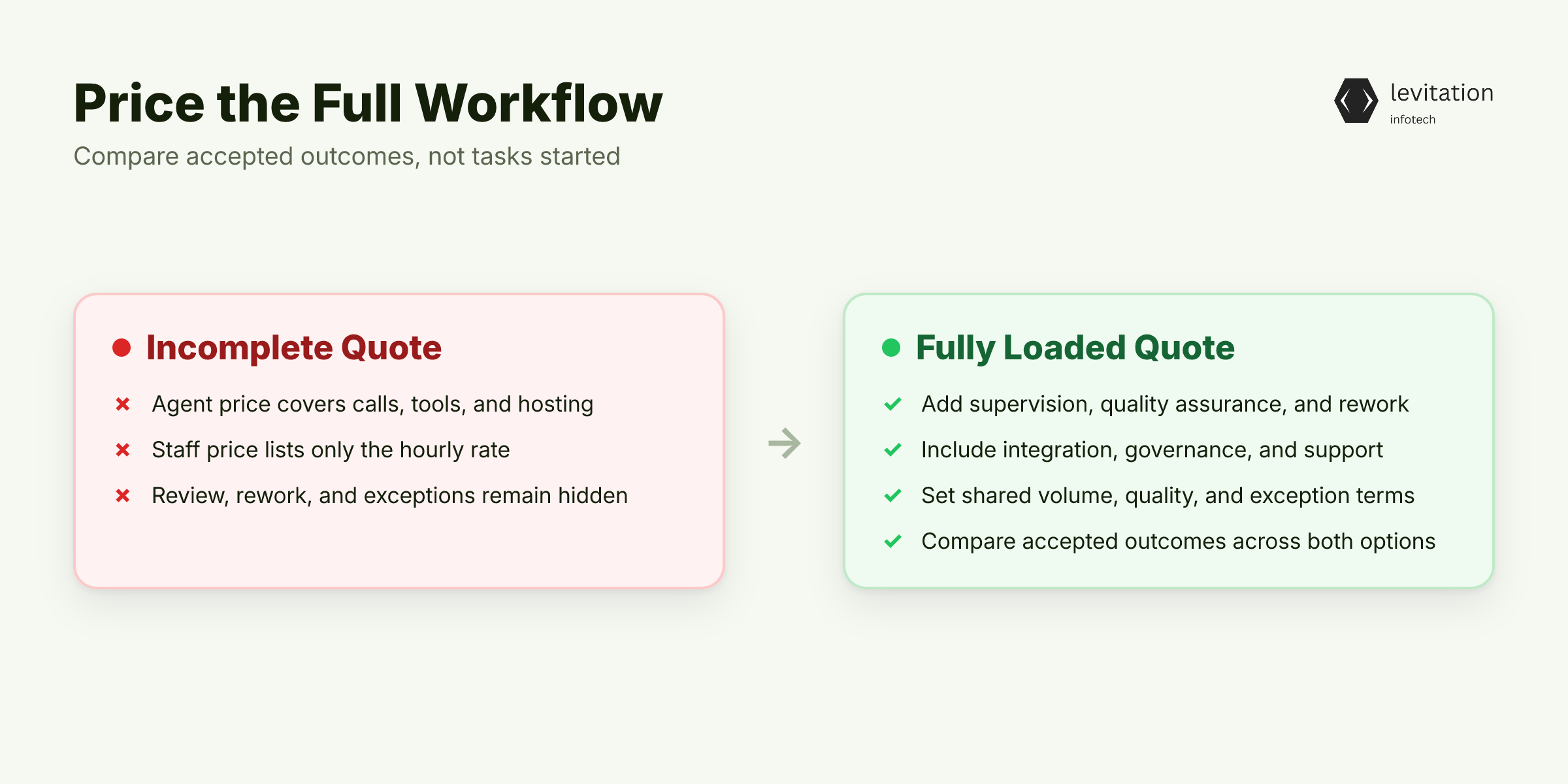
An AI agent can look cheaper than a staffed workflow on paper. The invoice tells another story once review queues, failed handoffs, and exception handling arrive.
Imagine a vendor quoting an agent to sort support cases. Its price covers model calls, tools, and hosting. A staffing quote often lists only the employee's hourly rate.
This is not a fair comparison: raw processing is being compared with work that reaches an acceptable outcome.
The economics split by task type. Agents can be cheaper for high-volume, failure-tolerant work. They can cost more for complex, multi-step knowledge work that requires precision and human checkpoints.
Many proposals omit: - Human review, escalation, and queue management - Rework and loss from unusable output - Data preparation and system integration - Observability, governance, and security controls - Ongoing support, monitoring, and change management
Indian buyers need a fully loaded human baseline, not salary alone. Add supervision, quality assurance, rework, training, and transition. Then compare accepted staff outcomes, not tasks started.
Require every shortlisted provider to quote the same: - Input volume and operating conditions - Output standard and acceptance rubric - Review policy and exception definition
Ask top generative AI companies in India to price that shared workflow. Do not rank them on token rates or model benchmarks. This follows the logic behind paying for workflows instead of demos.
Agent and staff failures carry different price tags. Which failures can the model actually prevent?
Why Better Model Accuracy Does Not Fix Exception Cost
A confident answer can still be unusable. Imagine an agent drafting a customer response. The language looks correct.
Account context can be missing. The source system can be down. The requested action can exceed the agent's permissions.
That is workflow reliability, not model accuracy. A better model can improve the sentence while leaving the business action blocked.
Model gains cannot repair the operating environment around them: - Failed integrations and stale source data - Ambiguous inputs with missing context - Conflicting systems and policies - Rules that change after deployment - Exceptions requiring judgment outside the agent's authority
These failures belong to workflow design, permissions, data access, and policy ownership. A staff member can pause and ask for missing context. An agent retries, calls another tool, retries again, then escalates.
The difference is not intelligence alone. It is the cost and speed of recovery.
Buyers should split the workflow into four operating modes: - Deterministic automation: Stable rules, complete inputs, and mechanically checked outputs - Bounded agent action: Narrow scope, explicit constraints, limited tools, and reversible actions - Agent action with a human checkpoint: A draft or recommendation reviewed before commitment - Human-led work: Ambiguous, high-impact, or outside the agent's authority
The contrarian test is simple. If the task follows stable rules and outputs can be checked mechanically, conventional software can cost less and fail less.
Ask AI development services to classify each step before proposing an agent. Reject generic proposals that start with a model and then search for a job to do. This reinforces the point in enterprise AI being judged on integration, not the model.
Pricing failures and human interventions separately makes the comparison clear. One question remains: what does an accepted outcome actually cost?
The Real AI Development Cost Is One Accepted Outcome
Two agents can carry similar token prices. One produces complete, usable records. The other creates missing fields, forcing reviewers to reopen every case.
The second workflow costs more once human labor enters. Build the total-cost view in three layers: - Variable run cost: Model usage, tool charges, orchestration, review, exception handling, and failure losses - Fixed operating cost: Monitoring, governance, security, support, and change management - Amortized build cost: Design, data preparation, integration, testing, deployment, and maintenance
Expected cost per acceptable outcome = total cost across those layers / accepted outcomes.
Run-rate costs change with each case. Fixed costs do not.
A low variable bill can still hide an expensive operating platform. This is why a cheap agent can become costly after the build fee disappears.
Exception cost must also be probability-weighted.
Expected exception cost = exception rate x (investigation + rework + escalation + delay + business loss).
A missing customer identifier looks minor on paper. In practice, it triggers several investigations and delays a business decision. The ledger must connect that trigger to its full business impact.
Review is both a capacity constraint and a cost variable.
Review cost = reviewed volume x time per review x loaded reviewer cost + quality sampling.
If review demand exceeds capacity, accepted outcomes wait. Delayed outcomes can also trigger customer churn, missed deadlines, or extra business loss.
A more capable model can reduce total cost when it prevents downstream rework. A cheaper model can increase cost when its exceptions consume more human attention. Model price matters, but only within the workflow it serves.
Define an acceptable outcome through a business-owned rubric: - Correctness - Completeness - Policy compliance - Provenance - Required formatting
Model confidence alone is not acceptance. The business owner should approve the rubric before the pilot begins.
Production economics depend on the surrounding operating system, not the agent framework alone. Successful enterprise AI solutions connect models, data, controls, people, and downstream actions.
A cost model changes a decision only when accepted outcomes and exceptions are measured consistently. Without shared definitions, two vendors can describe the same workflow and produce incomparable totals. Which exceptions will make one quote balloon?
Build the Exception Ledger Before Signing the Quote
Start with the workflow, not the quote. Walk each step and record: - The input and required context - The tools and systems involved - The decision owner - The downstream action and its reversibility - The business impact of failure
Context matters. An agent's recommendation before approval carries different risk from an action after funds are released.
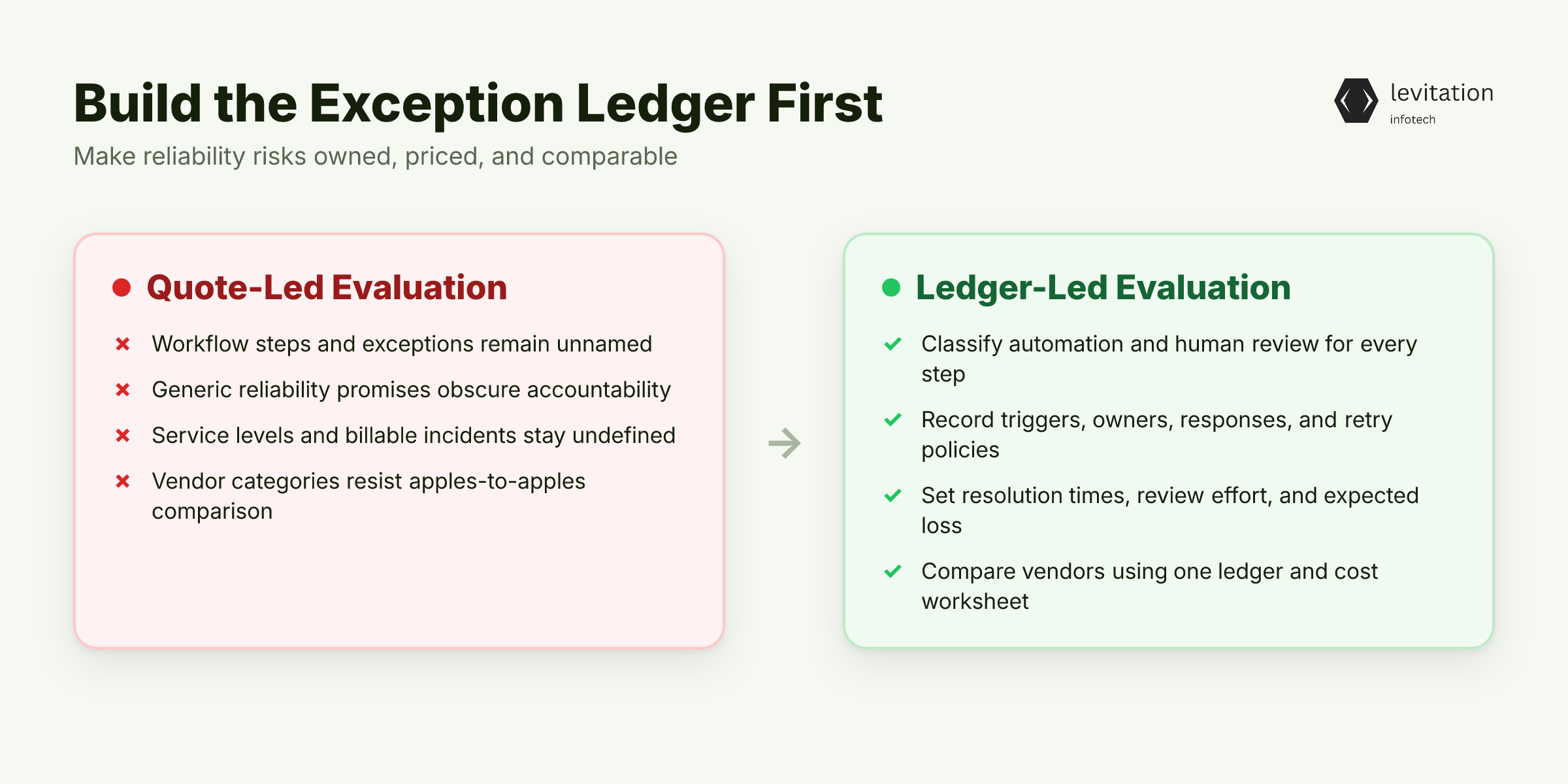
Classify every step as deterministic automation, bounded agent action, agent action with review, or human-led work. Assign an owner and service expectation to every exception category. An unnamed exception has no accountable resolver.
Create an exception ledger with these fields: - Trigger and likely cause - First response and retry policy - Escalation owner and expected resolution time - Review effort, rework cost, and expected loss
Break vendor proposals into distinct categories: - Build and data preparation - Integration and model usage - Observability and governance - Human review and support - Change management and exit costs
Then turn generic reliability promises into pricing questions: - Who responds when the agent fails? - Which service level applies to each exception? - Which incidents are billable? - How are model, prompt, and policy changes priced?
Production longevity and experience delivering in regulated industries deserve attention. Treat them as due-diligence signals, not proof that a proposed agent will meet your exception targets.
Compare AI development services and enterprise AI solutions using the same exception ledger, acceptance rubric, and total-cost worksheet. Different pricing structures become comparable only after buyers define the same work.
Once every exception has an owner and a price, the pilot will test the business case, focusing on the cases most likely to break it. Which cases deserve that scrutiny?
Pilot on Tail Cases, Not Vendor Demo Queries
Do not pilot the demo. Pilot the workflow most likely to embarrass the agent.
Select a bounded, repeatable process with historical cases and useful volume. Keep critical operations out of unnecessary risk while still exposing the workflow's tail behavior.
Build the test set from cases that reveal hidden dependencies: - Common cases and long-tail cases - Ambiguous inputs and missing context - Policy conflicts and permission failures - Tool failures and stale data - Cases requiring reversal or escalation
Run the staffed workflow and the agent workflow against the same cases. Apply the same acceptance rubric to both. Otherwise, any cost or quality comparison will mislead you.
Test a conventional automation baseline before the agent. This applies the discipline in comparing fintech agents with rule engines.
Establish a performance baseline with the most capable suitable model. Then test smaller or cheaper models to find where they still meet the required standard. This separates model value from model price.
Instrument every run with: - Model and tool cost - Retry count and review minutes - Escalation rate and resolution time - Accepted-outcome rate - Downstream correction cost
Set go, revise, and stop thresholds before reviewing results. Include maximum exception cost and minimum accepted-outcome performance. Thresholds chosen after the pilot become excuses.
When comparing top generative AI companies in India, require evidence that the proposed generative AI development removes ambiguity from the workflow. A successful prompt does not prove that the operating model works.
The pilot turns an attractive demo into the operating numbers procurement needs, including a defensible cost per accepted outcome and an explicit exception budget. Can those numbers survive a contract?
Buy an Operating Contract, Not a Cheap Demonstration
Sign the operating promise, not the demo promise. Create a scorecard covering: - Accepted-outcome rate - Exception frequency - Review effort - Resolution time - Failure loss - Security controls - Total cost per acceptable outcome
Write service levels for measurable exception categories. Do not accept promises that the agent will be accurate or available.
Separate the monthly bill into base volume, usage overages, integration work, human-review services, incident support, model changes, and change requests. Otherwise, a low renewal quote can hide the same operating problem.
Clarify audit logs, data retention, access controls, human-approval requirements, and controls for model or prompt changes. Exit terms should cover data export, knowledge transfer, and service migration.
Compare build, buy, and managed-service options through AI development services, enterprise AI solutions, and top generative AI companies in India. Frameworks have blurred the old build-versus-buy question, but they have not removed operating ownership.
The payoff is operational control. Operations gains a predictable exception budget. Procurement gains a comparable quote.
Leaders can scale only workflows that remain economically and operationally viable. Before a contract is signed, one missing line item can expose flaws in the operating model. Which line item tends to surface first?
Frequently Asked Questions
How much does AI agent development cost in India?
There is no defensible fixed price. Cost depends on workflow complexity, integrations, data readiness, model usage, review requirements, and exceptions. Ask AI development services for an itemized quote. Compare projected cost per accepted outcome, not the build fee alone.
Are AI agents cheaper than hiring staff for Indian operations teams?
They suit high-volume, failure-tolerant work. They can cost more for complex, multi-step tasks once reviews, retries, escalations, failure losses, and fixed operating costs enter the bill.
When should a business choose deterministic automation instead of AI agent development?
Choose deterministic automation when the task follows stable rules, required inputs are available, and outputs can be validated mechanically. Use an enterprise AI solution when contextual interpretation, flexible tool use, or adaptation genuinely improves the accepted outcome.
What costs are buyers usually surprised by in AI development?
Buyers should examine data preparation, integration, observability, human review, exception handling, security controls, and ongoing maintenance. A quote covering only model and infrastructure charges is incomplete. Ask AI development services to price the full operating workflow.
How should buyers compare AI development services with an in-house team?
Compare build ownership, integration effort, specialist availability, operating support, and maintainability against the vendor's total recurring cost. Also examine production longevity and regulated-industry delivery evidence. Treat these as due-diligence signals, not guarantees.
The first missing line usually reveals whether the pilot tested the real operating model. Start the next vendor request there. What will the first line item expose?
About the author
Mayank Singh is a software developer at Levitation Infotech, where he builds web and AI-powered applications across the company’s fintech, healthcare, and enterprise projects.