

TL;DR: Indian enterprises should stop paying for polished GenAI demos and start paying for governed workflows. Structure vendor agreements around validation, production integration, and operational transfer. Use objective acceptance evidence, explicit exception ownership, and clear conversion or exit criteria.
Key Takeaways: - A demo proves an output is possible, not that a live workflow can operate safely and accountably. - Define the trigger, context, action, handoff, owner, and result before selecting a model. - Release payment against production evidence, tested exceptions, and named operational owners.
The Demo Wins the Room, Then Exposes the Budget Gap
A polished GenAI demo can win an Indian enterprise pilot. It can still leave the CTO holding a system that cannot finish a live workflow.
The costly mistake is not choosing the wrong model. It is signing a contract that pays for the showcase rather than the governed business result.
The False-Confidence Handover
Consider a vendor that summarizes a supplier agreement and flags a risky clause. The room celebrates because the output looks impressive.
That proof says little about permissions, live data, downstream integrations, missing inputs, or the person accountable for a wrong recommendation. Curated demos test chosen content under controlled conditions. Production exposes what those conditions conceal.
Buyers who ask what Indian AI vendors actually failed often discover a similar pattern. The model worked. The surrounding workflow did not.
Demo, POC, and Production Are Different Purchases
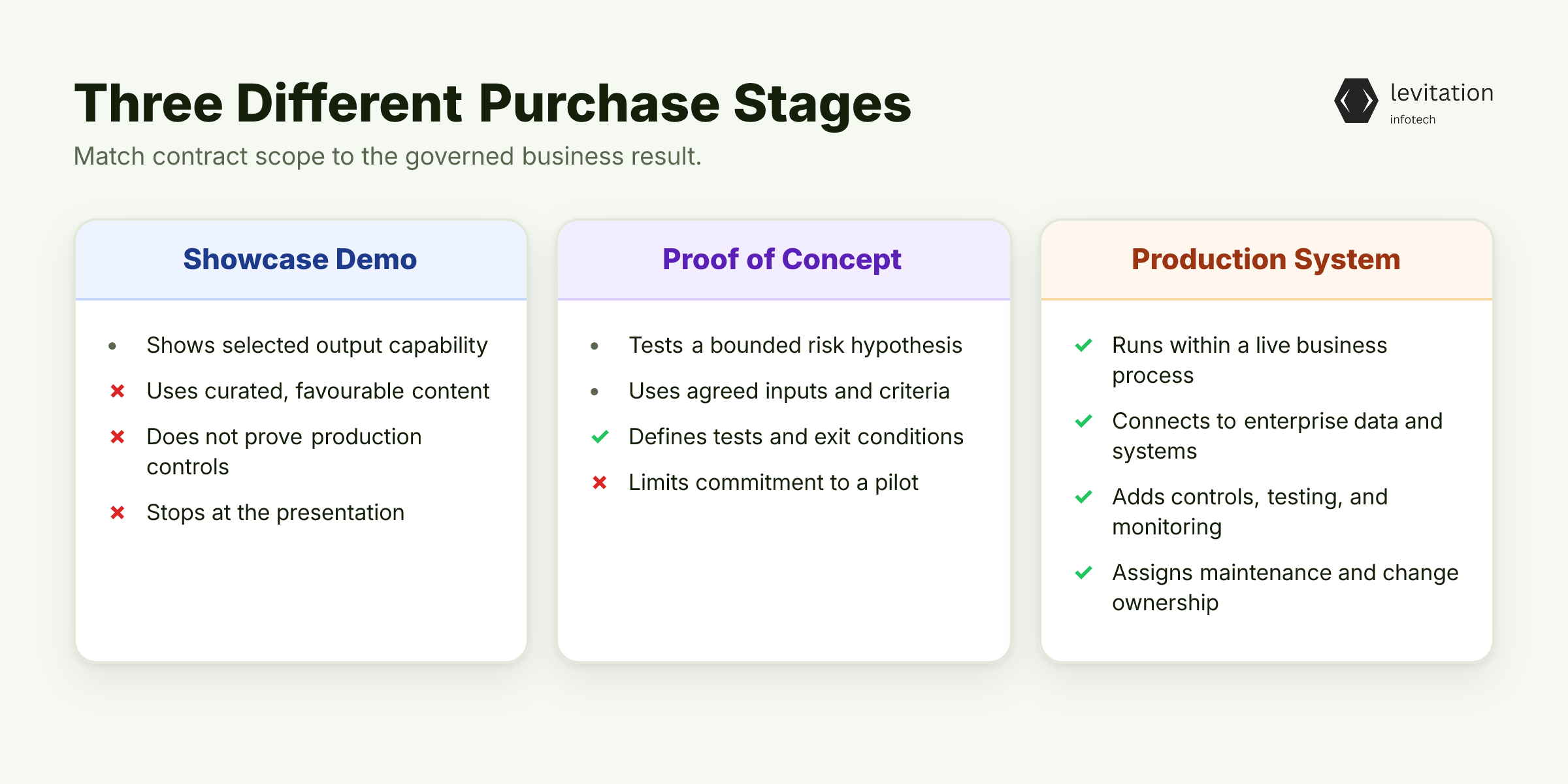
A demo illustrates capability. It shows a selected output under favourable conditions.
A POC tests a bounded risk hypothesis using agreed inputs, criteria, and exit conditions.
A production system connects to a business process through testing, controls, monitoring, maintenance, and change ownership.
An AI development services proposal can sound equally convincing at every stage. The commercial language must separate them. Confusing those stages hides the budget cliff.
The Budget Cliff
Buyers often underestimate the work that follows the launch moment: - Data preparation and access control - Enterprise integration and application development - Guardrails, security testing, and continuous evaluation - Deployment, monitoring, maintenance, and change ownership
Under a showcase-based contract, the vendor is paid for the presentation. The CTO keeps the cost and risk of making it production-ready.
A demo-only timeline also creates a mismatch. Teams still need to prepare data, integrate systems, test controls, and transfer operations.
If the demo is not the unit of value, what should be?
Define the Workflow Before Scoping the Model
The answer is a workflow map, not a model shortlist.
Resolve the Terminology Trap
A buyer-provider GenAI agreement is the commercial contract between an enterprise and its vendor. AI contract management is a category of business workflow.
These are different things, yet procurement documents often blur them. The vendor agreement should fund the governed workflow for AI contract management.
Shortlists of top generative AI companies in India often compare models, frameworks, and broad delivery claims. Such comparisons come too early when the operating problem remains vague.
Apply a Six-Part Workflow Test
Every use case should identify six elements before model discussions begin: - Trigger: What starts the workflow? - Source context: Which records, policies, and permissions inform it? - Decision or action: What does the system decide, recommend, or execute? - Handoff: Where does the work move next? - Accountable owner: Who owns each material decision? - Measurable result: What changes if the workflow performs well?
This test exposes scope gaps quickly. It also separates business ownership from technical possibility.
Make Contract Management Concrete
Contract management can connect intake, drafting, redlining, review, signing, compliance, and renewals. An intelligent workflow can surface risky clauses, speed routine decisions, and preserve accountability.
Agents should operate within the rules and commitments set by the relevant contracts. People remain responsible for decisions with legal, financial, customer, or safety consequences.
The first scoping artifact should be a workflow map. It must show decision rights, exception paths, dependencies, and outcome measures. It should not list features or rank models.
Once the workflow is explicit, milestone payments can stop rewarding slides. Which evidence should trigger each release?
Turn Workflow Value Into Acceptance-Based Milestones
Payment should follow risk reduction, proof in production, and clear operational ownership. Calendar-based milestones reward elapsed time instead.
Milestone One Validates the Riskiest Assumptions
The first paid milestone should require a production-matched path, representative inputs, and agreed evaluation criteria. It should also end with a documented decision to proceed, refine, or stop.
A model comparison cannot validate this milestone. Neither can a vendor claim that its accuracy is “good enough.” The parties need defined tests and a recorded decision.
Milestone Two Proves the Connected Workflow
The second milestone should require secure integration with enterprise data and systems. It should also prove context-aware execution, guardrails, exception handling, human escalation, and repeatable acceptance tests.
This is where the demo becomes an operating workflow. It exposes the problem described in why your LLM evals approve models that fail. Narrow evaluation can pass a system that fails in context.
Milestone Three Transfers Operational Ownership
Hold the final tranche until monitoring, retesting, incident handling, maintenance, and model or prompt changes have named owners.
The vendor behind the enterprise AI solutions must support ongoing accountability after acceptance. That includes an operating report, clear incident roles, and a path for approving system changes.
Attach Payment to Evidence
Each release should require a specific artifact: - A workflow map and approved decision rights - An integration record and repeatable test results - A guardrail report and exception test record - An operating plan with named service owners
Avoid subjective statements such as “the demo looks good” or “the model is accurate.” System acceptance should connect to business measures, such as shorter review cycles and earlier clause-risk identification.
Treat those measures as agreed targets, not guaranteed outcomes. Customer processes and data quality still influence results.
Recommendations should be transparent enough for users to understand why the system acted. The contract must identify who remains accountable for the final decision.
But measurable milestones become brittle when the workflow meets an exception. Where does that leave the contract?
Price the Exception Paths and Human Decisions
Normal paths make demos look complete. Exceptions expose the real system.
Build the Exception Inventory
Start by listing situations where automation cannot safely continue: - Missing or contradictory inputs - Low-confidence outputs - Policy edge cases - Access failures - Conflicting recommendations - Cases where no safe automated action exists
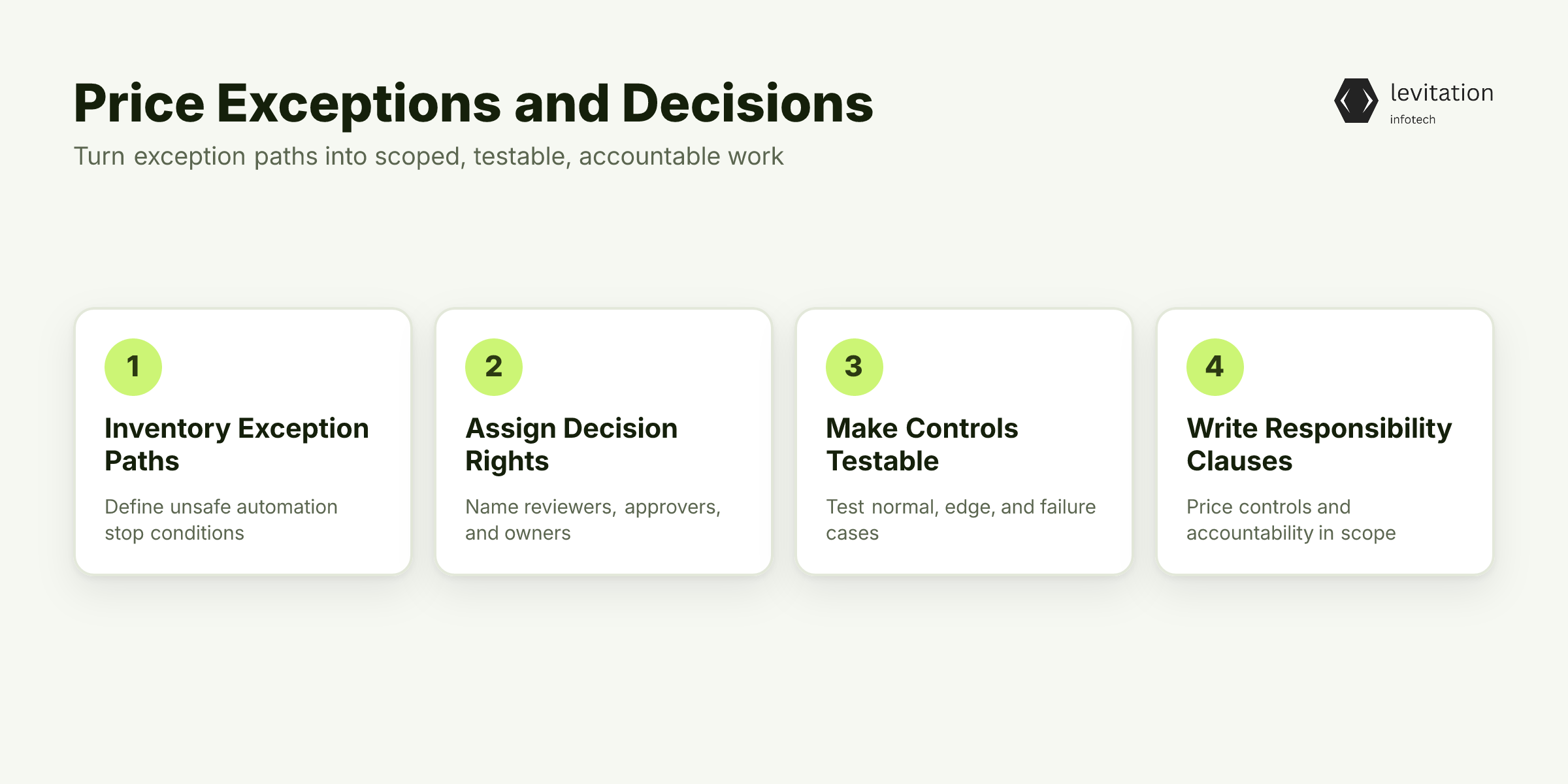
This inventory becomes part of scope, acceptance testing, and price. An exception should not become an unplanned defect after go-live.
Assign Decision Rights
Define who reviews, approves, overrides, and escalates each exception. Name the person accountable for material outcomes.
The reviewer also needs the right evidence. Include source clauses, confidence signals, retrieved context, applied rules, and the reason for escalation.
Without this context, “human in the loop” becomes a way to transfer blame rather than control risk.
Make Controls Testable
Require agreed test cases for normal, edge, and failure paths. The acceptance set should cover: - Guardrails and prohibited actions - Access controls and permission failures - Audit records and human escalation - Rollback procedures and recovery - Continuous evaluation after model or prompt changes
The AI development services scope must cover the operating controls in enterprise AI solutions, not merely an AI interface.
Write Responsibility Clauses
The vendor should remain accountable for system behaviour within the agreed scope. The customer remains responsible for source data, policies, approvals, and business decisions.
Put a red-team acceptance checklist inside the SOW. Exceptional behaviour must be tested and priced as part of production.
A defensible SOW is not delivery evidence. How can a buyer test the vendor’s claim before signing?
Build the RFP and SOW Around Production Evidence
The RFP should separate proof from persuasion.
Demand Four Production Artifacts
Require each bidder to submit these before comparing final proposals: - An annotated workflow showing decisions and handoffs - A data and integration dependency map - An evaluation and guardrail plan - An operating model with a clear RACI
That RACI must show who is responsible, accountable, consulted, and informed. Without it, “shared ownership” often means nobody owns the failure.
Build a POC-to-Production Budget
Separate the commercial stages instead of hiding them behind one POC price:
- Discovery and validation
- Data preparation
- Integration and application development
- Security, evaluation, and red-team testing
- Deployment and operational transfer
- Monitoring, maintenance, and change management
This protects buyers from the pricing confusion described in AI development cost quotes.
Separate Fixed, Transition, and Operating Costs
Fixed: Define what the POC fee buys, including its limits.
Transition: Price production conversion, its prerequisites, and the effort required from customer teams.
Operating: Define recurring support, managed services, usage charges, and service boundaries.
Also name the change trigger for model, data, policy, and integration changes. Set a base transition package. Require approval before extra work begins.
Use Ranges Without Mistaking Them for Promises
A proposal can use ranges to frame planning, but each range must match the work in its phase. Data readiness, integration complexity, evaluation scope, and operational transition can change the schedule. The proposal must explain which dependencies drive its estimate.
Weight Evidence Over Polish
Ask each bidder to walk through a relevant production workflow. Have it show its evaluation method, explain exception ownership, and present total cost.
When comparing top generative AI companies in India, treat scale claims as screening signals. Those signals help shortlist vendors. They do not prove fit with the selected workflow.
Write Enforceable Clauses
The final agreement should cover: - Precise definitions and acceptance evidence - Remediation and retest rights - Change control and security responsibilities - Service levels and support boundaries - Data and intellectual property ownership - Termination assistance, exit, and portability
Before signing, a CTO can compress the entire argument into one short accountability test. Does the contract pay for a working workflow, or only for the story that preceded it?
Use a Pre-Signing Test for Workflow Accountability
Five questions can expose whether a proposal is ready to sign.
Run the Five-Question Test
Ask the vendor:
- What exact workflow changes?
- What triggers it?
- Who owns each decision?
- What evidence proves acceptance?
- What happens when the system fails or the workflow changes?
Apply this test to each AI development services proposal. Use the same questions when assessing top generative AI companies in India.
Treat Obvious Red Flags as Disqualifying
Walk away when the proposal: - Describes a demo as final delivery - Omits POC exit criteria - Has no production transition plan - Uses vague human accountability - Leaves exception paths untested - Places no practical ceiling on operating costs
These omissions shift risk back to the buyer. They are symptoms of the same problem described in AI pilots stall on ownership, not models.
Name the Payoff
Workflow-based contracting gives the vendor a direct incentive to complete the operational path. It gives the CTO observable acceptance evidence.
It also makes AI development costs visible before the budget expands. The buyer can see what the POC buys, what production conversion requires, and who owns the system afterward.
The objective is not automation for its own sake. It is faster, more accountable decisions, earlier risk visibility, and more time for high-value human work.
The decision rule is simple. If the agreement cannot explain what the workflow will do in production, it is not ready to sign.
It must also name who will operate the system and how both parties will know it succeeded.
The remaining buyer question is harder: how can this shift be priced without creating an open-ended vendor engagement?
Frequently Asked Questions
How should an Indian enterprise structure a generative AI POC-to-production contract?
Use milestone-based scope tied to a defined workflow: paid validation, production integration, objective acceptance, and operational transfer. Include explicit stop or conversion criteria so the enterprise can change direction without paying for an open-ended AI development services engagement.
What should AI development cost include beyond the POC?
Budget for data preparation, integration, security and guardrails, evaluation, exception handling, deployment, monitoring, maintenance, and ownership transfers. A low POC fee is not a low total cost when production requirements remain undefined.
How should a CTO compare AI development services providers?
Compare production workflow walkthroughs, evidence from similar deployments, evaluation methods, ownership of operations, support terms, and total cost rather than presentation quality.
Scale claims can help shortlist providers. Workflow fit still requires direct validation.
Should a generative AI contract guarantee business outcomes?
Make system behaviour, acceptance criteria, and service levels precise. Treat outcomes such as shorter approval cycles as agreed targets where customer processes and data also influence results.
This avoids paying for claims the vendor cannot control. It also preserves accountability for the delivered workflow.
When is a POC sufficient instead of a production contract?
A POC is sufficient for bounded learning on a low-risk workflow. Apply the five-question test before signing. The key question is whether the POC has a defined stopping point before either party commits to production.
About the author
Mayank Singh is a software developer at Levitation Infotech, where he builds web and AI-powered applications across the company’s fintech, healthcare, and enterprise projects.