


TL;DR: A $1,000 project looks like a bargain until its scope meets a production quote. The cheapest credible starting point is a narrow internal workflow copilot, while a public chatbot adds data, integration, testing, and operating work. Compare scope, full ownership cost, and a production path before approval.
Key Takeaways: - The $1,000 average describes client work, not a production chatbot price. - Scope, integrations, evaluation, and support create the real cost gap. - Start with one workflow. Scale only when a business measure shows improvement.
$1,000 vs. $25,000: The Generative AI Development Price Headline Is Not a Quote
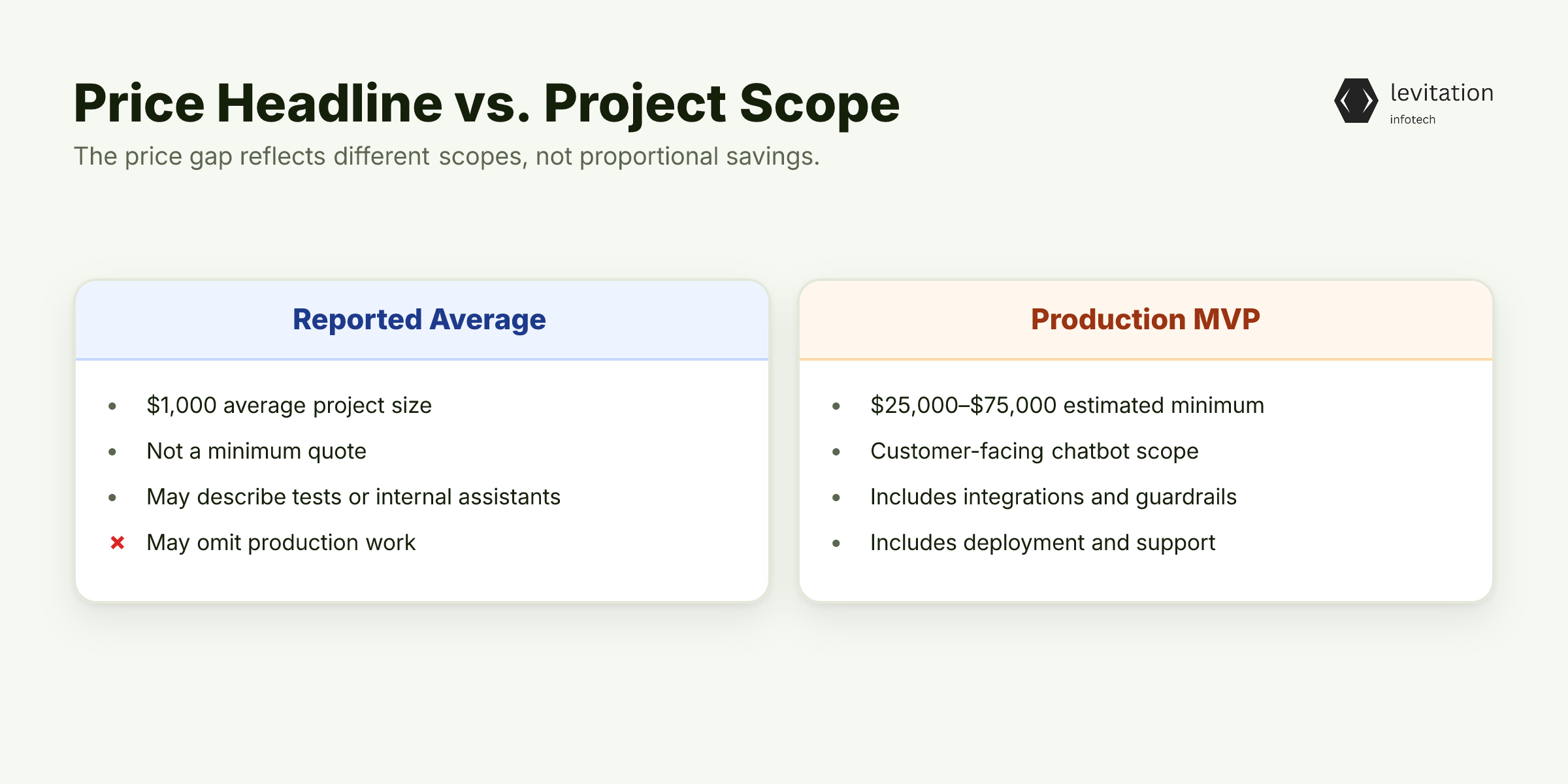
A reported $1,000 average can make a $25,000 to $75,000 chatbot MVP look absurdly cheap. But $1,000 is not a minimum quote. Treating it as the price of production AI is exactly how a CEO underbudgets the wrong thing.
UpBusiness reports that Surat-based Rain Infotech lists generative AI as a service. Its average project size is $1,000, and generative AI accounts for 20% of its services profile. The number describes average client work, not a minimum price, fixed package, or production quote.
By contrast, Craxinno estimates a minimum viable chatbot at about $25,000 to $75,000. The headline gap does not show proportional savings. It shows that the scopes differ.
Imagine one vendor pricing a document-summary test with an uploaded folder. Another covers a customer assistant connected to CRM, live documents, channels, evaluation, guardrails, deployment, and support.
Only one is a chatbot product. Vendors group experiments, internal assistants, and production customer-facing systems under the same label. Their budgets and risks differ.
Before comparing prices, ask every vendor for a one-page scope that separates: - The experiment and its data. - The pilot users and workflow. - Required integrations. - Acceptance criteria. - Ongoing support. - Production rollout.
That page prevents a contest between unlike products. It also gives your team a fair AI development services brief before anyone discusses a larger engagement.
That gap is not a bargain. It is a scope warning. The real cost sits in the work a polished demo leaves out. The practical question is which hidden work your first pilot actually requires.
Why a Chatbot Budget Hides the Real Cost Center
The visible conversation window is the cheap part. The expensive work sits behind retrieval, data access, integrations, and controls.
Published agency estimates create a useful cost ladder: - A RAG knowledge assistant: about $25,000 to $60,000. - A customer-facing assistant with CRM integration: about $60,000 to $120,000. - An enterprise platform: around $160,000 or more.
These ranges describe capability tiers, not menu prices. A chatbot estimate of $25,000 to $75,000 becomes comparable only when its quote covers the same data sources, channels, integrations, testing, and production requirements.
Ask vendors to open the estimate: - Data preparation and permissions. - Retrieval or document processing. - CRM, ERP, and internal API connections. - Third-party model and service usage. - Evaluation, hallucination guardrails, and edge-case testing. - Iteration, monitoring, and ongoing support.
These items are not polish added after the demo. They decide whether the system answers safely, connects to real work, and keeps working after launch. That is why your AI quote won't match your project cost.
The dangerous build-versus-buy mistake is simpler: compare a $1,000 experiment with an enterprise platform. That comparison misleads on both sides. Require an itemized view of enterprise AI solutions proposals across build cost, operating cost, integration cost, ownership, and exit options.
Use published benchmarks as a reference point, not a universal quote. Our AI chatbot development cost in India guide should be treated the same way. Ask shortlisted providers to state exactly what each price excludes.
The cost anatomy points to a cheaper first target than a public-facing chatbot: one internal workflow with one measurable job. Can it prove a business gain before it becomes a platform?
The $1,000 Signal Points to a Scoped Workflow Copilot
That figure points away from a broad chatbot and toward a scoped workflow copilot. It is consistent with a small test or proof of concept. It offers no basis for pricing a customer service platform.
Start with an assistant inside a CRM, ERP, or document store. It serves one operating process instead of inviting open-ended conversations. That constraint removes work: fewer channels, data sources, exception paths, and a clearer owner.
Choose one bounded task: - Summarize a defined set of documents. - Retrieve internal knowledge for a specific role. - Draft and approve a repetitive business output.
Suppose sales operations asks the system to summarize new CRM notes and draft a follow-up for manager approval. That is one workflow. "AI for sales" is not.
A minimum viable test needs five boundaries: - One user group. - One workflow. - One bounded data source. - One business measure. - Human approval for consequential outputs.
Design the test with a production exit. Preserve reusable evaluation examples, integration details, prompt or configuration records, and a clear path to replace the underlying model without rebuilding the workflow.
A cheap test that creates disposable knowledge is not cheap. That knowledge must survive a larger build.
Give each company on the top generative AI companies in India shortlist the same concrete brief. Ask each to demonstrate a live system it runs today, then compare scope, data access, integrations, and operating model. Use the same evidence standard when requesting AI development services.
Once the candidate workflow is narrow enough to test, the next decision is not which model to admire. It is which ownership model makes financial sense.
AI Build vs. Buy: Price the Full AI Development Cost
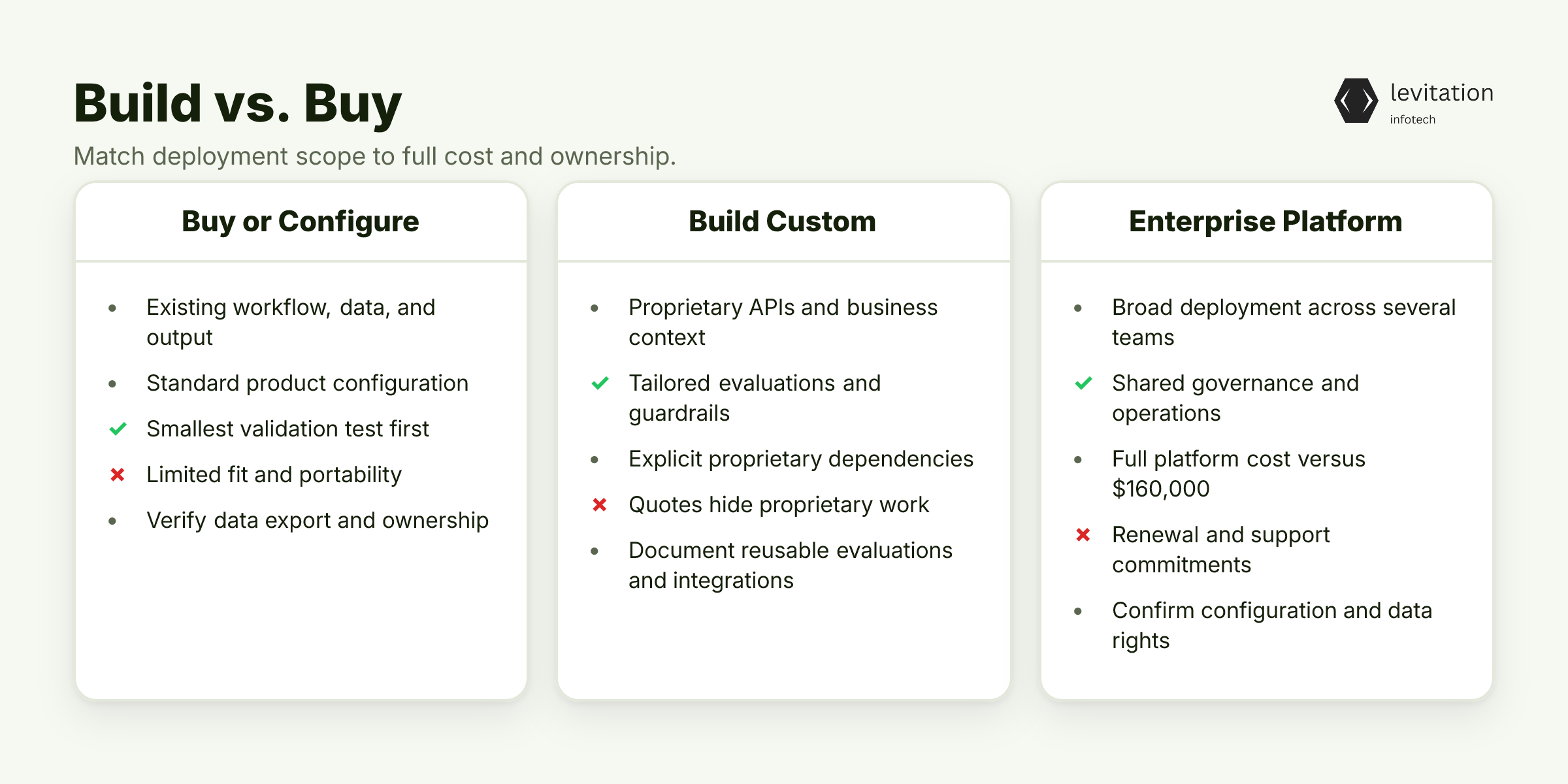
With the workflow narrowed, ownership becomes the financial question. The build-versus-buy choice follows from the workflow, data, and required control.
Buy or configure for bounded validation
Use an existing product when the workflow, data, and desired output already fit. Start with the smallest test that answers the business question without committing to a custom platform.
Build custom for proprietary workflows
Choose custom generative AI development when value depends on internal APIs or proprietary business context. You also need custom work when packaged products cannot support tailored evaluations, guardrails, or integrations.
A custom AI development services proposal must make those dependencies explicit. Otherwise, the quote hides proprietary work inside a familiar product name.
Buy an enterprise platform for broad deployment
Buy an enterprise platform when several teams need shared governance and consistent operations. When evaluating enterprise AI solutions, compare the full platform route against the $160,000 starting point cited in published estimates.
Build a decision worksheet
Place five cost categories alongside the expected timeline: - One-time development: discovery, build, test, and acceptance. - Model and infrastructure usage: test usage, production usage, and review points. - Data preparation: cleanup, permissions, and evaluation sets. - Integrations: each connected system, error handling, and retesting. - Support and iteration: monitoring, model changes, and renewal work.
Beside each line, record the expected start, end, and accountable owner. Add an exit-path test covering data export rights, configuration ownership, portable evaluations and integrations, and what a later custom build can reuse.
That test matters because AI pilots stall on ownership, not models. Keep the delivery timeline separate from the experiment. Delivery time depends on complexity, data quality, team experience, and third-party integrations.
Ownership becomes clear on paper. The harder question is whether those decisions survive contact with production.
From Discovery to Iteration: The Production Path
Production gaps appear between teams as well as inside the model. Even a narrow test fails when ownership changes at every stage.
Discovery
Define the user, workflow, current baseline, business measure, and cost of failure. State the result that would justify moving from test to production. Keep the $1,000 experiment separate from the full delivery estimate.
Data
Identify the authoritative source, permissions, document or record structure, and quality gaps. Build a representative evaluation set from real conditions. Data availability and quality are explicit schedule drivers, not administrative details.
Testing
Evaluate task completion, unsupported responses, edge cases, and human-review requirements. Add guardrails against hallucinations before connecting the system to consequential actions. A polished response is not proof of a correct workflow.
Integration
Connect the chosen CRM, ERP, document store, or internal API through the smallest useful slice. Verify permissions, latency, error handling, and fallback behavior. This reflects the principle that enterprise AI is judged on integration, not the model.
Iteration
Monitor real outputs, review failures, and refine retrieval and prompts. Update evaluations and document each change before expanding the user population. Otherwise, improvement becomes guesswork.
The production gate
A production-ready system needs an accountable owner and an operational runbook. It also needs monitored service and model costs, escalation rules, and a rollback or human-intervention path.
Choose delivery partners with operating evidence. Ask the companies on the top generative AI companies in India list for evidence of systems still running in production and how they have been maintained. A polished demo proves an interface, not long-term maintainability.
The system is live, but that does not make it a success. It must change a business measure before the budget grows. Which evidence can prove that?
What a $1,000 Test Must Prove Before a Larger Bet
A live system is not a business result. The larger budget must follow evidence that the workflow improved.
Use a CEO scorecard
Measure each result against the existing process baseline: - Completed workflow volume. - Time saved. - Review effort. - Exception and escalation rates. - Output quality. - Adoption. - Cost per completed task.
The board does not need a feature inventory. It needs evidence that work moved, risk stayed controlled, and unit economics improved.
Define the scale-or-stop gate
Set the gate before the test begins. Specify which result would justify broader access, a production integration, another data source, or a larger build budget, and which failure would end the experiment instead.
A failed test still protects the company from a larger mistake. The more useful question is whether the next budget should grow, change, or disappear.
Separate savings from learning
The immediate value of a small generative AI project is learning. It can end with a validated workflow or a rejected hypothesis, even if it produces no labor savings.
For example, if managers still rewrite every output, the test has not proven automation. But if it identifies a task that adds review effort without saving time, rejecting it prevents an expensive rollout.
Make vendor selection evidence-based
Request a live demonstration, an itemized AI development services breakdown, a realistic schedule, clear ownership terms, and proof of long-term operating experience.
Ask each company on the top generative AI companies in India list for references that describe failures and fixes, not only launch-day screenshots.
Shortlist every provider using the same scope template. Compare business outcome, production path, and total ownership cost rather than chatbot features.
The lowest headline does not decide the winner. The project's next budget must still earn approval. Which price checks matter first?
Frequently Asked Questions
Q: What is the cheapest generative AI development project in India in 2026?
A: The lowest figure in the verified research is not a guaranteed market minimum. UpBusiness reports Rain Infotech's average generative AI project size as $1,000, a figure consistent with a small test rather than a production chatbot. CEOs should request itemized scopes instead of assuming every project costs $1,000.
Q: How much does generative AI development cost in India?
A: Published agency estimates place a RAG knowledge assistant at about $25,000 to $60,000 and a customer-facing assistant with CRM integration at $60,000 to $120,000. Enterprise platforms start at about $160,000. Rain Infotech's reported $1,000 average fits a small internal test when data, integrations, and operating requirements are tightly bounded.
Q: How much does chatbot development cost in India?
A: Craxinno estimates a minimum viable chatbot at about $25,000 to $75,000. The final figure depends on the knowledge base, conversation flows, channels, and integrations. It also depends on testing, guardrails, deployment, and support.
Q: Is it cheaper to build or buy generative AI?
A: Buying or configuring an existing product is the lower-risk path for a bounded validation. A custom build earns its place when the workflow depends on proprietary data, internal APIs, or business-specific controls.
Compare total AI development costs, operating costs, integration burden, ownership, and exit options rather than comparing license and project prices in isolation.
Q: How long does a production generative AI project take?
A: Delivery timelines depend on project complexity, data availability and quality, team experience, and third-party integrations. A production schedule should be built from those dependencies rather than a generic promise.
Present a small test separately from the path to production. That distinction prevents a cheap pilot from becoming an expensive dependency. Compare itemized scopes before approving a larger budget. Which line item will your team test first?
About the author
Mayank Singh is a software developer at Levitation Infotech, where he builds web and AI-powered applications across the company’s fintech, healthcare, and enterprise projects.