


TL;DR: More seats solve a staffing constraint, not a broken patient workflow. Choose a custom CRM only when exceptions, integrations, data ownership, and access rules exceed standard tools. Compare three-year operating cost before committing.
Key Takeaways: - Treat duplicate entry, orphaned follow-ups, and spreadsheet reporting as workflow-friction signals. - Choose standard, configurable, or custom by testing exceptions, data, integrations, access, and reporting. - Price implementation, maintenance, and internal effort, not just subscription fees.
More Users Can Scale the Wrong Clinic Workflow
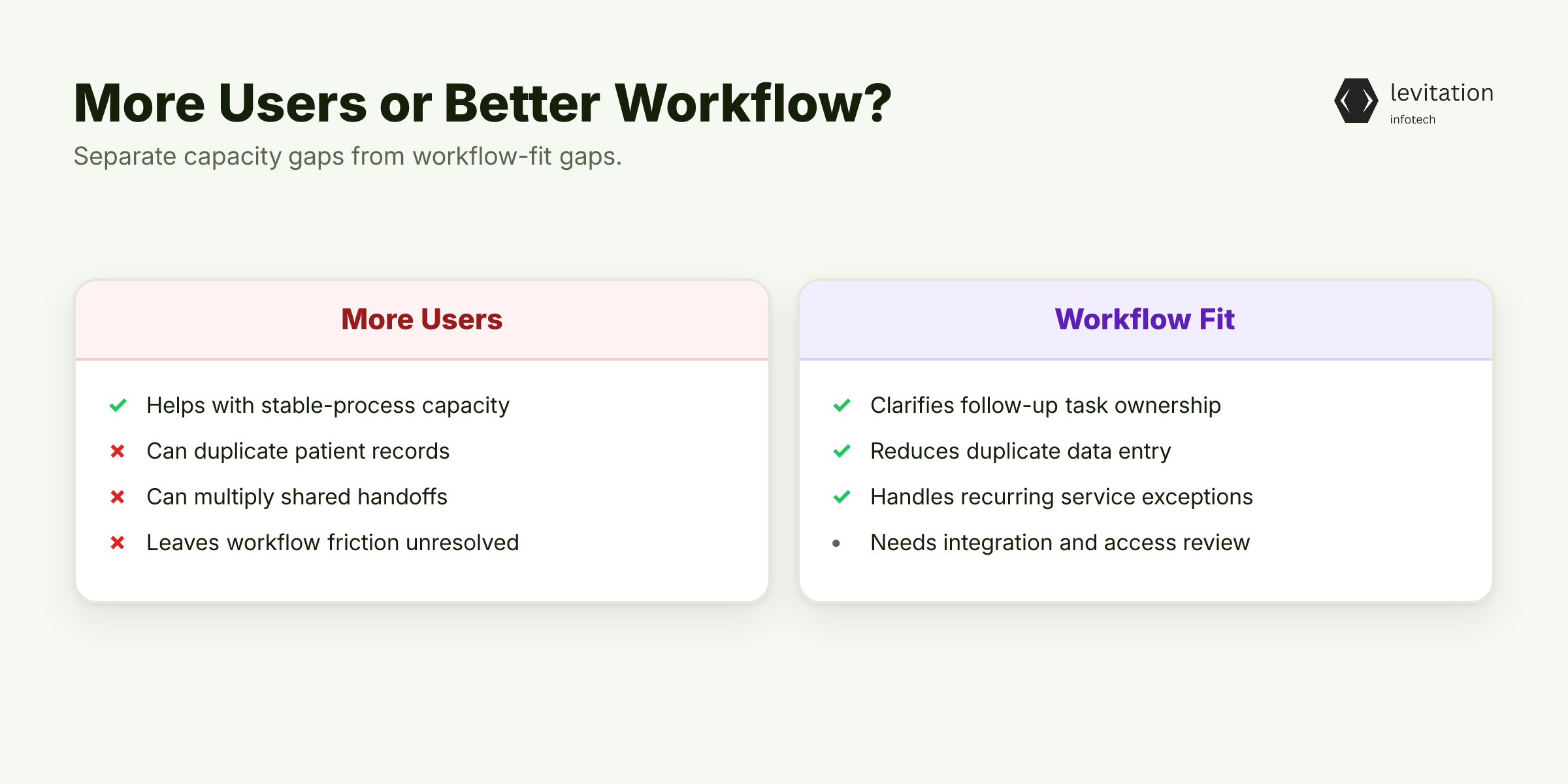
When the front desk requests another CRM license because the queue feels crowded, added users can increase record duplication. This happens when the system cannot show who owns the next follow-up. More people then share the same broken handoff.
Capacity and workflow fit are different problems. More users solve the first. They can amplify the second. - A capacity gap means the clinic needs more people to handle a stable process. - A workflow-fit gap means the existing process, data, or tools force staff to work around the system.
These friction signals are easy to misread as a need for more capacity: - Staff enter the same patient information in two systems. - A follow-up appears in one person's chat but not the shared task list. - Managers rebuild reports from spreadsheets because the dashboard doesn't answer their question. - Coordinators copy records because a standard field cannot represent the actual service.
Each workaround looks small in isolation. Together, they create an operating model that demands more attention as the clinic grows.
That doesn't make custom software the automatic answer. A Noida clinic should consider a custom CRM when standard tools cannot handle recurring exceptions. The decision must also cover integration duties, data ownership, and access requirements.
The commercial decision is total operating cost, not subscription price alone. Use the CRM development cost in India guide as the starting frame for every option.
If workflow fit is the real issue, why does another seat or another configuration so often feel like the safer answer?
Why Buying More Seals the Leaks
Buying a standard CRM remains the right choice when the clinic follows a standard journey, has a small team, and needs neither deep customization nor specialized integrations.
The mistake begins when the clinic forces its operating model into generic records. A coordinator may save a service package as free-text notes because the CRM has no suitable structure. The manager then exports those notes into a spreadsheet for reporting.
The failure chain usually follows a familiar pattern: - The team configures around rigid fields. - Staff maintain a parallel spreadsheet for missing details. - Coordinators re-enter information between systems. - The clinic hires another person to reconcile records and chase tasks. - Reporting becomes a reconstruction exercise rather than a system output.
This is why adding users can conceal the problem. The new person handles more exceptions, but inherits the same exception-driven process.
Custom CRM development isn't free either. Discovery, data modeling, integrations, QA, training, maintenance, and future changes all contribute to its cost. Avoiding conventional per-user fees doesn't remove the obligation to operate the system well.
The CRM software development comparison helps separate three real choices: - A standard product provides established processes. - A configurable platform adds fields, workflows, and integrations. - A custom system supports a distinctive operating model that the other two cannot safely sustain.
The counterpoint matters. If the clinic uses a standard workflow and faces excessive workload, adding seats or hiring staff is often wiser than building software.
The cost of these leaks remains invisible until the clinic measures exactly where patient and lead information breaks. How can the clinic price those hidden leaks before choosing a CRM?
The Workflow-Fit Test Standard CRMs Miss
A clinic offers consultations, diagnostics, and multi-visit plans. A standard CRM can record contacts, tasks, and pipeline stages, but not every relationship between them.
The test isn't whether the demo looks familiar. Test whether the system can handle the exceptions your staff already manage.
Use five questions: - Workflow exceptions: Which recurring steps depart from the standard path, and can configuration support them safely? - Data structure: Does one patient need several related records, service tracks, or ownership states that generic objects cannot represent cleanly? - Integration requirements: Which scheduling, billing, hospital, or clinical systems must exchange data, and how will failures be handled? - Role-based access: Can each user see and change only the records required for their job, with an auditable history? - Reporting needs: Can the CRM produce the decisions the clinic needs without rebuilding data outside the system?
A custom-build signal appears when recurring exceptions require code. It also appears when access rules cannot be maintained safely through configuration. Reporting dependence on data that standard objects cannot represent is another signal.
A configurable-platform signal appears when the clinic can map its standard journey into existing objects. It can enable the required fields and approvals. Staff should then complete daily work without duplicate entry or parallel spreadsheets.
Small clinics can still justify a custom CRM. Recurring exceptions, specialized integrations, and clear data ownership can outweigh the simplicity of a standard product. Team size alone isn't the deciding factor.
The CRM should coordinate patient relationships, appointments, follow-ups, and service coordination. It should not become a second HIS, EMR, or clinical record.
This reflects the operational gap described in Your AI Reads the X-Ray. Your Workflow Still Faxes. Better technology doesn't fix a disconnected process.
The broader healthcare technology decision should follow the same rule. Add only what the clinic must operate safely, and avoid recreating clinical truth elsewhere.
Once workflow fit is clear, what will the recurring cost of operational friction look like over three years?
Cost the Friction Before You Cost the Software
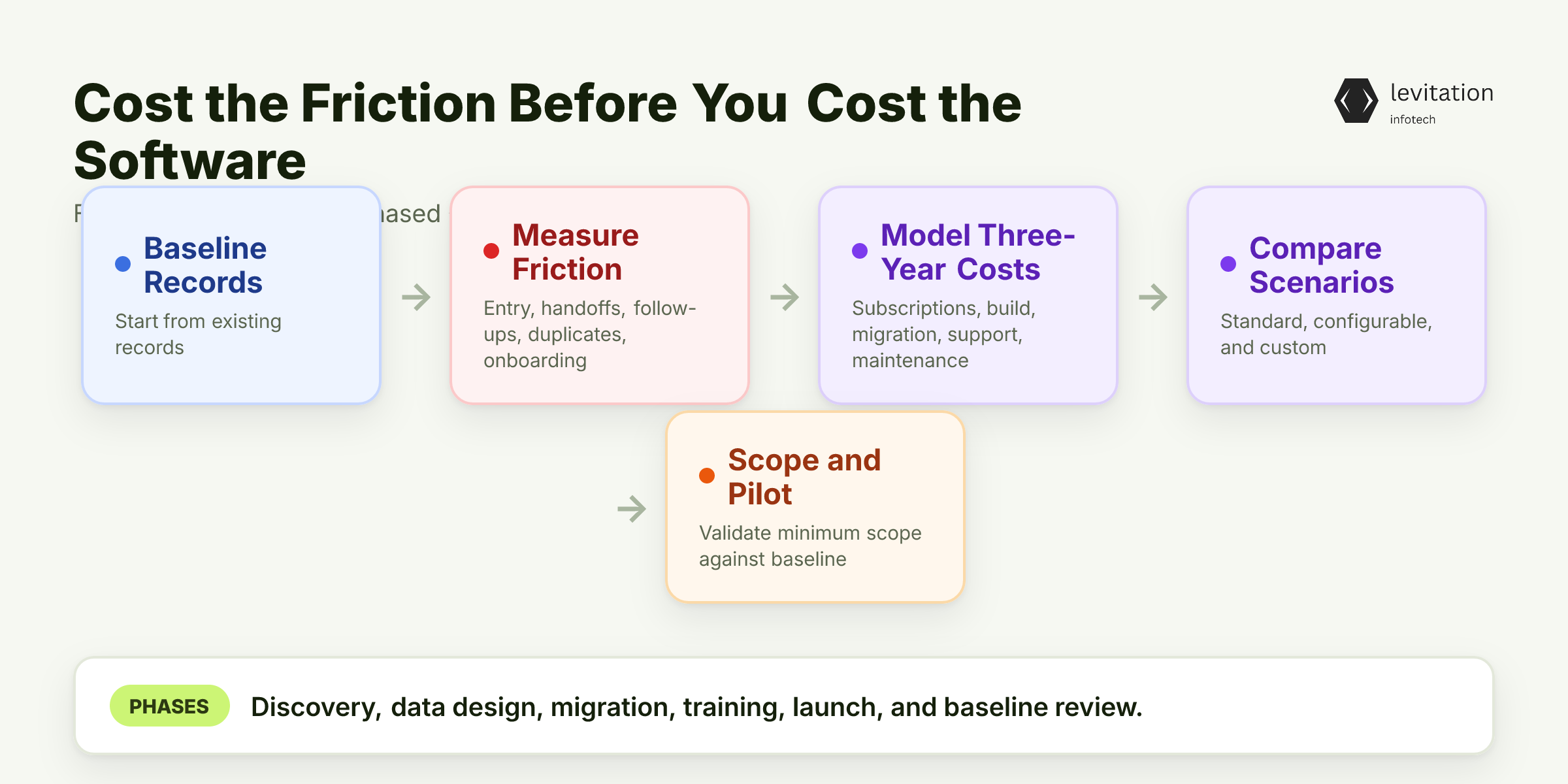
The license quote isn't the business case. It's one line in a cost model that must include the work required to make records usable.
Start with a baseline from existing records. Measure the time spent on manual entry and report preparation. Track repeated handoffs, delayed follow-ups, duplicate records, and staff onboarding effort.
A useful baseline captures: - Minutes spent entering the same information in multiple places. - Delayed or unowned follow-up tasks. - Reports rebuilt from spreadsheets. - Duplicate patient or lead records. - New staff time needed to learn workarounds. - Manager time spent reconciling conflicting information.
This exposure is why Your CRM Budget Is Sabotaging Delivery treats operating effort as part of the software decision. It also shows why The Year-Two Bill That Kills Custom CRMs matters before a contract is signed.
Then create a three-year cost worksheet for each option. Use the cost to build a custom CRM guide to expose missing scope.
Include: - Subscriptions, configuration, development, data migration, and integrations. - QA, security, training, support, and internal staff time. - Maintenance, future changes, and the cost of keeping parallel workarounds.
Compare three explicit scenarios: - A standard CRM minimizes initial customization. - A configurable platform adds controlled flexibility. - A custom CRM starts with the clinic's operating model.
Separate must-have requirements from useful enhancements and deferred ideas. Define the minimum viable scope, then pilot it against the measured baseline.
The healthcare CRM implementation plan should then proceed through defined phases: - Discovery and workflow mapping. - Data ownership and integration design. - Migration, user testing, and training. - Launch, post-launch support, and baseline review.
A sound business case identifies what to build. Yet implementation still fails when teams treat a custom CRM like software that can simply be installed and announced. What scope keeps those promises tied to the clinic's daily work?
Scope a Healthcare CRM That Survives Implementation
Suppose the front desk needs patient records, while coordinators need ownership of every follow-up. A usable first release must connect those views without copying data.
Define the first release around patient or lead records, appointment and follow-up pipelines, task ownership, and communication history. Include dashboards, role-based permissions, and auditability.
Define integration boundaries before development starts. Identify the source of truth for each field. Document required APIs or interfaces, data ownership, duplicate-handling rules, and failure recovery.
Then test real journeys. A front-desk user should complete an appointment request without bypassing access controls, while a coordinator should own the next task. A manager should see the correct pipeline view. Role-based acceptance tests should also cover failed handoffs, duplicate data, and exception handling. A feature that works in isolation can still break the next person's work.
Turn that scope into an RFP checklist. Require itemized estimates, architecture details, migration assumptions, and security responsibilities. Ask about support terms, update policy, documentation access, and total cost of ownership.
Do not compare feature-list length. Compare how each vendor will deliver, support, and evolve the agreed scope.
The top CRM development companies in India shortlist offers a vendor pool for comparison. Relevant proposals should include an implementation plan, named delivery responsibilities, and references from comparable environments.
The custom CRM development approach should make ownership and maintenance explicit before work starts.
Longevity is a useful vendor signal. A provider such as Levitation should be evaluated through references, support terms, documentation access, and operating details rather than broad credential claims.
The longest feature list does not decide the outcome. The real question is which operating model the clinic can afford to own and maintain for years.
Choose the Model Your Team Can Sustain
The decision is simpler than most vendor pitches suggest. Choose the least complex model that safely supports the clinic's real work. - Choose a standard CRM for standard journeys, limited exceptions, and simple reporting. - Choose a configurable platform when fields, approvals, and workflows need controlled adjustment. - Choose a custom CRM when workflow, data, integration, and access requirements consistently exceed both options.
The payoff isn't vague transformation. It should show up in measurable operating changes: - Fewer manual touches and duplicate entries. - Cleaner handoffs and fewer unowned follow-ups. - Clearer pipeline visibility for managers. - Faster onboarding for new staff. - Reports produced without spreadsheet reconstruction.
Compare the agreed baseline with post-pilot measures. Test whether the clinic can maintain the system without depending on the original developer for every small change.
CRM changes rarely end at launch, so partnership quality matters. Provider credentials don't guarantee an individual clinic's outcome, so references and operating details still need scrutiny.
Three artifacts should anchor the comparison. They are an itemized three-year cost, a minimum viable CRM scope, and a vendor shortlist with relevant delivery experience.
The healthcare technology implementation partners link provides a lens for judging implementation depth. The top CRM development companies in India shortlist provides a starting set for comparison.
A final test remains: can the clinic afford to own and maintain the chosen model for years?
Frequently Asked Questions
Before comparing quotes, separate four decisions: - Which workflow exceptions are genuinely recurring? - Which system owns each important data field? - Which integrations and access rules are mandatory? - Which operating improvements will prove the pilot worthwhile?
Q: How much does it cost to build a custom CRM in Noida?
A: A responsible quote should itemize discovery, workflow and data modeling, integrations, migration, development, QA, security, training, and long-term support. Compare that total with configuration, subscription, and internal maintenance costs over the same period rather than relying on a generic price range. The cost to build a CRM should expose assumptions before negotiation begins.
Q: Is a custom CRM overkill for a small healthcare clinic?
A: It is usually unnecessary when the clinic follows a standard journey, has a small team, and needs neither specialized integrations nor complex access rules. A small clinic still needs one when recurring exceptions, data ownership, or existing-system integration make standard tools unreliable.
Q: What is the difference between custom and configurable CRM software?
A: A configurable CRM starts with standard objects and features that can be adjusted through settings, fields, workflows, and integrations. A custom CRM is built around a distinctive operating model. It is needed when required exceptions, data structures, permissions, or reports cannot be maintained safely through configuration. Compare the CRM software development options against the clinic's recurring exceptions.
Q: What should a healthcare CRM implementation plan include?
A: It should cover workflow discovery, data ownership and migration, integrations, role-based security, testing, training, launch, and support. The CRM should coordinate patient-facing operations without creating a second clinical record or an uncontrolled duplicate data store.
Q: Can a clinic CRM integrate with an existing HIS or hospital system?
A: Yes, when both systems expose a supported interface or a secure integration method. The clinic must also define which system owns each data field. A phased rollout can begin with the highest-value workflow while validating synchronization, permissions, and error handling.
The correct CRM is the least complex option that safely supports the clinic's workflows and total-cost goals. Before signing, can each vendor show exactly how that promise will work?
About the author
Mayank Singh is a software developer at Levitation Infotech, where he builds web and AI-powered applications across the company’s fintech, healthcare, and enterprise projects.