


TL;DR:
A ₹6 lakh Noida SaaS quote rarely covers 12 features. It covers the 3 most visible ones and quietly drops the rest.
The gap isn't vendor malice. It's arithmetic.
A SaaS MVP needs a full team across discovery, backend, frontend, QA, and DevOps. The cost reflects those hours, not the headline number. Twelve features means twelve modules, each with its own depth.
Founders who treat quotes as budgets instead of floors sign up for a fraction of the work.
Key Takeaways: - A ₹6 lakh quote buys a few months of dev time, the equivalent of one engineer's effort over several weeks. - Cheap quotes strip out roles (PM, QA, DevOps, architect) and skip discovery, then bill dropped work as change requests. - Reading a quote means demanding a phase breakdown, named role hours, and explicit feature-level effort, not a lump sum.
The ₹6 Lakh Quote That Built Three Features
You asked for 12 features. The Noida company quoted ₹6 lakh. You signed.
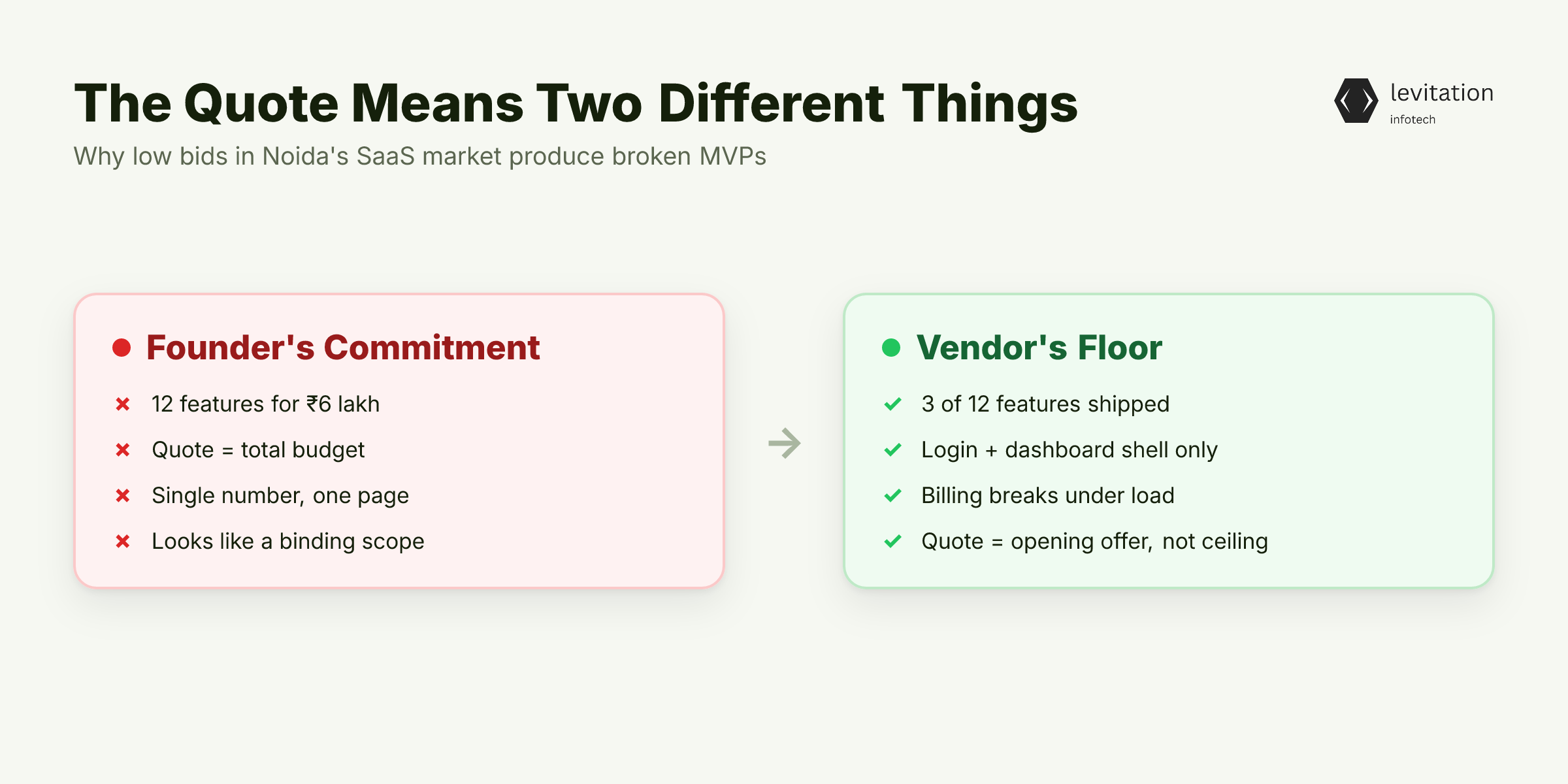
Months later, you have a login screen and a dashboard shell. The billing integration breaks under production load. This is not a horror story.
It's a pattern, and it repeats across SaaS builds in India's NCR. Noida hosts 710 Vertical SaaS startups with $1.71B in total funding over the last decade. The market stays crowded.
Low quotes are the norm, not the exception. When ten software companies in Noida compete for your contract, price becomes the first differentiator. Quality and fit come second.
The 3-of-12 outcome is not vendor malice. It's arithmetic. Six lakh rupees cannot fund the team, time, and roles a real SaaS MVP demands.
Founders treat the quoted number as the budget. Vendors treat it as the floor for a minimum deliverable. Those two definitions never meet.
The trap compounds when SaaS product development becomes a single number on one page. The quote looks like a commitment but behaves like an opening offer, and it tells a different story than the one you wanted to hear.
Why Every "Affordable" Noida SaaS Quote Underspecs
Hourly rate compression is the first culprit. Vendors don't hit a low price by cutting their own margin. They hit it by cutting the role coverage.
A real SaaS build needs a product manager, QA engineer, DevOps specialist, UI/UX designer, and a solutions architect. In cheap quotes, these roles don't appear as line items. The "lump sum" trap makes it worse.
When a quote says "12 features, ₹6 lakh" with no phase breakdown, you can't see where the hours go. You can't tell which features get built fully, which get a skeleton, and which get deprioritized. The lump sum hides scope decisions until delivery time.
Vendors who quote this way know what they're doing. They've priced the visible features: the login screen, the dashboard, the billing flow. The remaining nine features get an hour count that rounds to zero.
When you ask for them at sprint two, you'll hear a familiar phrase: "That's a change request." The software development cost in India conversation starts with role coverage, not headline price. If the quote doesn't name the people building your product, you're paying for whoever shows up.
So if ₹6 lakh can't fund a 12-feature SaaS, what does it actually deliver?
What ₹6 Lakh Actually Buys You in 2026
Six lakh rupees funds a few months of dev time at mid-tier Noida rates. That's about one senior engineer for several weeks, or a small team for a few weeks. What you get is a prototype, not a SaaS product.
A SaaS MVP needs a full team across product, design, backend, frontend, QA, and DevOps. The floor is already above ₹6 lakh once you account for discovery, design, integrations, and compliance. Medium-complexity products require more hours per feature.
A full-featured platform with compliance and third-party integrations runs into the higher budgets. The work compounds across roles and phases. Discovery is a separate phase that takes real engineering time.
If your quote skipped discovery, every subsequent hour was spent guessing what you actually wanted. Rework eats the budget before a single user logs in. This is why bespoke software quotes that look expensive up front often cost less than "affordable" ones by month six.
The cheap quote assumes perfect requirements. The realistic quote funds the work of figuring out what the requirements actually are. The problem runs deeper than the number.
Founders treat "12 features" as a single line item when each one carries its own cost weight.
The 12-Feature Spec: What Each Line Item Actually Costs
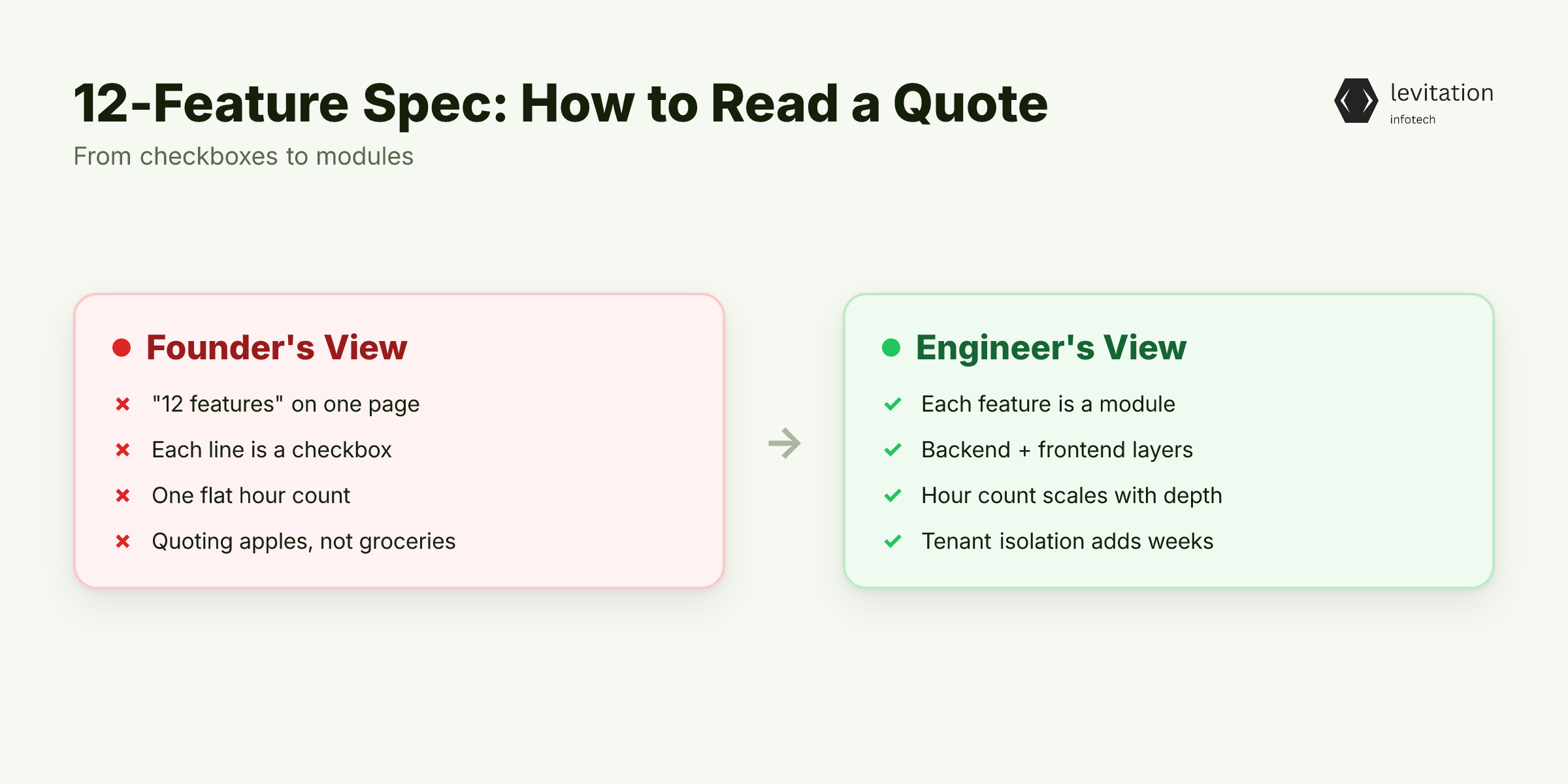
A typical 12-feature SaaS spec includes auth, multi-tenancy, billing, an admin panel, and role-based access control. It also covers API layers, integrations, notifications, analytics, audit logs, file handling, search, and reporting. Each one is a module, not a checkbox.
Backend work like APIs, databases, auth, billing, integrations, and business logic scales with feature depth. Frontend adds another layer of work proportional to design complexity. These are different scopes at different complexity levels.
Founders who list "12 features" on a single page are quoting apples. Vendors who price them are quoting a full grocery list. The gap is the missing conversation about what each feature actually contains.
A "search" feature might mean basic keyword matching or full-text indexing with filters. The hour count scales with the depth of the feature chosen. For multi-tenant SaaS, tenant isolation, data partitioning, and per-tenant configuration add weeks of engineering time.
So how do you read a quote like an engineer?
Reading a Noida Quote Like an Engineer
Demand a phase breakdown: discovery, design, backend, frontend, QA, DevOps, and deployment. If the quote skips phases, the contract is a guess. Look for explicit role hours.
A quote that names only "developers" assumes no PM, no QA, no architect, and no designer. Compliance is a line item, not a vibe. HIPAA-grade healthcare systems require specific audit logs, encryption, and access controls.
These never belong in a generic "security features" bucket. Vendors who bundle compliance into one line are either inexperienced or optimistic. Both cost you money.
Ask for references at the quoted budget. Not the vendor's best project, but the project closest to yours. The difference shows you what scope negotiation looks like mid-build.
Fixed-price quotes that look honest often become hourly by sprint three. We've seen it repeatedly in Noida fixed-price SaaS engagements. Check whether the MVP development cost includes post-launch support.
Most don't. If your quote ends at deployment, you're budgeting twice: once for build, once for the bugs that surface in week one.
So what does a quote look like when it's built to last, and priced honestly?
What a Right-Sized SaaS Quote Actually Looks Like
A realistic 12-feature SaaS MVP budget reflects the actual hours required, not a sales target. Discovery becomes a deliverable. Named architect on the project.
QA milestones with acceptance criteria. Deployment pipeline with monitoring. A roadmap for post-launch iteration.
Maintenance is not a footnote. Budget a recurring share of the initial build cost for updates, security patches, and scaling. Founders who skip this line item discover it in month nine when the first security patch breaks their checkout flow.
Quality signals separate real quotes from sales decks. We've seen Noida's ₹6 lakh down-payment pattern play out often: the initial quote covers entry, the real cost arrives in change requests. The pattern is visible in six hidden costs that surface later, which vendors who skip line items in the first quote rely on to recover margin.
Engineering teams that have shipped systems still running in production five years later know the difference between a build and a product. Software development in Noida firms trusted by Fortune 500 brands follow the same approach: phases, roles, and explicit deliverables, not lump sums.
Frequently Asked Questions
How much does SaaS development cost in India in 2026?
A SaaS MVP starts with a full team across discovery, design, backend, frontend, QA, and DevOps. Costs scale with the hours required at each role, the depth of each feature, and the integrations involved. Full-featured platforms with compliance and third-party integrations run into the higher budgets because the work compounds across roles and phases.
Why are SaaS quotes from Noida companies so cheap?
Low quotes usually reflect scope cuts, not lower skill. Vendors strip out roles (PM, QA, DevOps, architect), skip discovery, and price only the visible features. The remaining work is either dropped or billed as change requests.
What should a SaaS development quote include?
A credible quote breaks down hours by phase: discovery, UI/UX design, backend, frontend, QA, DevOps, and deployment. It names specific roles, lists feature-level effort, and separates one-time build cost from ongoing maintenance.
How do I verify a software development quote before signing?
Ask for an hour-by-hour breakdown by role, a fixed-scope discovery deliverable, and references for projects shipped at that budget. If the vendor can't itemise the work, the quote is a guess dressed up as a commitment.
Is ₹6 lakh enough to build a SaaS MVP?
Only for an extremely narrow micro-SaaS: one user role, no payments, no integrations, no admin panel. For a 12-feature spec targeting real users, ₹6 lakh funds a fraction of the work the spec actually requires.
About the author
Mayank Singh is a software developer at Levitation Infotech, where he builds web and AI-powered applications across the company’s fintech, healthcare, and enterprise projects.