


TL;DR: A recent FHIR event does not prove that an AI recommendation used the current medication state. The durable fix is a replayable freshness contract. It preserves clinical time, reconciles source evidence, and binds each inference to a verifiable as-of snapshot.
Key Takeaways: - Event delivery speed does not prove clinical or decision-time freshness. - FHIR version history does not define medication truth without source-aware reconciliation. - Every AI recommendation needs a replayable snapshot with versions, effective times, and evidence.
The Freshness Your Pipeline Measures Is Not the Freshness Your AI Sees
A clinician discontinues a medication. The EHR commits the change, and the integration receives it. Yet the projection keeps the old state, so the AI treats the drug as active.
That sequence exposes the weak link in healthcare technology. A pipeline can deliver a recent event and still present stale clinical truth.
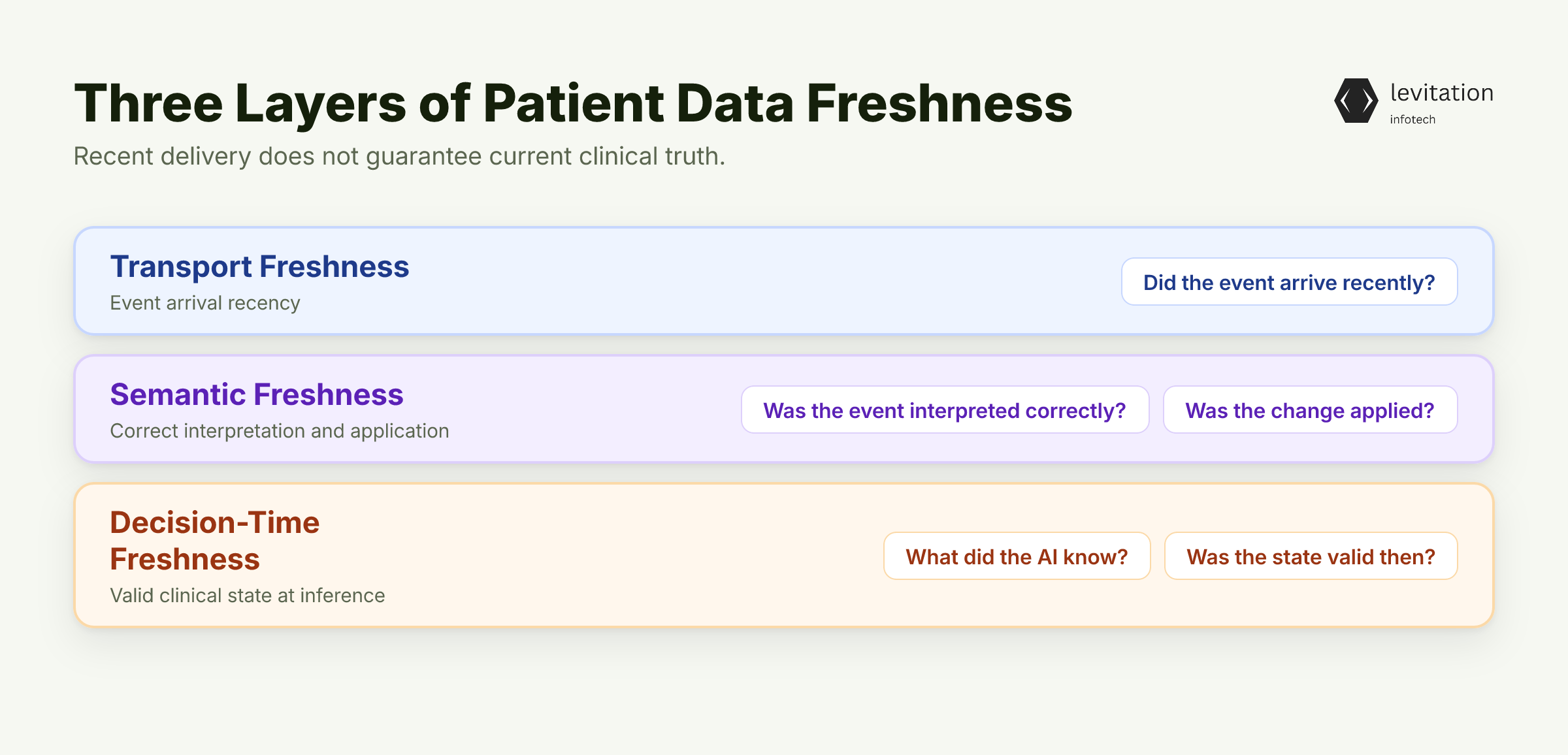
Three freshness layers matter here: - Transport freshness: Did the event arrive recently? - Semantic freshness: Did the pipeline interpret and apply it correctly? - Decision-time freshness: Was the state used at inference valid then?
The last layer answers the question a clinician actually cares about: what did the AI know when it produced the recommendation?
As clinical AI operates with less human oversight, stale inputs can affect several decisions before anyone reviews them. The error compounds between checkpoints.
For any recommendation, a CTO should be able to trace: - The exact source version - The reconciled medication snapshot - Its clinical effective time - Any unresolved evidence conflicts
The CTO should then verify that the snapshot was authoritative at inference. A green ingestion dashboard proves none of this.
Patient data freshness is a decision-system property, not a transport metric. If the medication event arrived, why did the clinical state remain wrong?
FHIR Versions Do Not Guarantee Temporal Data Consistency
healthcare technology teams can use FHIR, but it does not close the gap. `meta.versionId` identifies a resource revision, while server history exposes its revision chain.
By itself, neither provides an ordered log of clinically effective events.
Version chain versus event stream
FHIR resource history answers, “Which revision did the server hold?” An event stream must answer, “Which clinical change should affect state now?”
These are different questions. A delayed discontinuation can arrive after a replacement order, so arrival order can reverse source order.
Compare versions only within an authoritative source lineage. Do not treat version identifiers as globally sortable. Never treat later arrival as later clinical truth.
Teams can borrow lessons from streaming data freshness monitoring. A projection still needs source-aware rules. FHIR data quality findings also show why generic payload checks miss some temporal faults.
Distinct clocks
Every relevant event carries several clocks: - Source event or recorded time: When the source recorded the change. - Clinical effective time: When the change should alter patient state. - Server update time: When the source stored the revision, including `meta.lastUpdated`. - Ingestion time: When the platform received the event. - Materialization time: When the platform applied it to the projection.
These clocks can disagree. A retrospective entry can arrive today but describe care from an earlier period.
Failure modes
Temporal consistency breaks in familiar ways: - Out-of-order delivery lets an older state replace a newer state. - Duplicate retries apply the same change more than once. - Late corrections revise facts without changing the original effective time. - Explicit retractions invalidate earlier conclusions. - Patient or resource merges make last-arrival-wins roll backward.
Source reconciliation, idempotent handling, and explicit lineage turn raw notifications into a temporally consistent state. Without them, every replay can produce a different clinical answer.
Even with perfect ordering, which medication state should be authoritative?
Medication Reconciliation Exposes the Semantic Gap
For healthcare technology, medication reconciliation exposes a semantic gap that event monitoring cannot see: a technically successful pipeline can still produce the wrong clinical context.
Multiple truths
One medication can appear in several clinical records: - `MedicationRequest` records an order. - `MedicationDispense` records supply. - `MedicationAdministration` records administration. - `MedicationStatement` records reported medication use.
An order says stop, while a dispense record shows supply. An administration record shows what was given. The patient's report may say they are still taking it.
Reconciliation combines these records to identify the current medication set. It also exposes dose changes, holds, discontinuations, and unresolved conflicts.
Why the newest timestamp misleads
A retrospectively entered prescription can arrive today but have an earlier effective time. An older prescription can also receive a newly entered correction.
The latest arrival is therefore a weak authority rule. Source lineage, recorded time, effective window, and event action must determine how the change applies.
Keep disagreement visible
Every medication conclusion should retain: - Its source and version - Its clinical effective window - The evidence supporting it - Any unresolved source conflict
Do not silently collapse disagreement into one answer. The medication list may look cleaner than the underlying evidence, but that cleanliness is false confidence.
Automated ingestion validation should reject incomplete or invalid events before they enter the canonical record. Material conflicts should go to manual review.
Humans should resolve material ambiguity, not certify every routine refresh. Otherwise, the exception queue becomes the ingestion system by accident.
The needed control is not another ingestion SLA but a freshness contract with explicit guarantees from source change to AI inference. The hard part is defining guarantees that can be tested. The next question is how each guarantee can be made concrete.
Build a Freshness Contract Across Five Guarantees
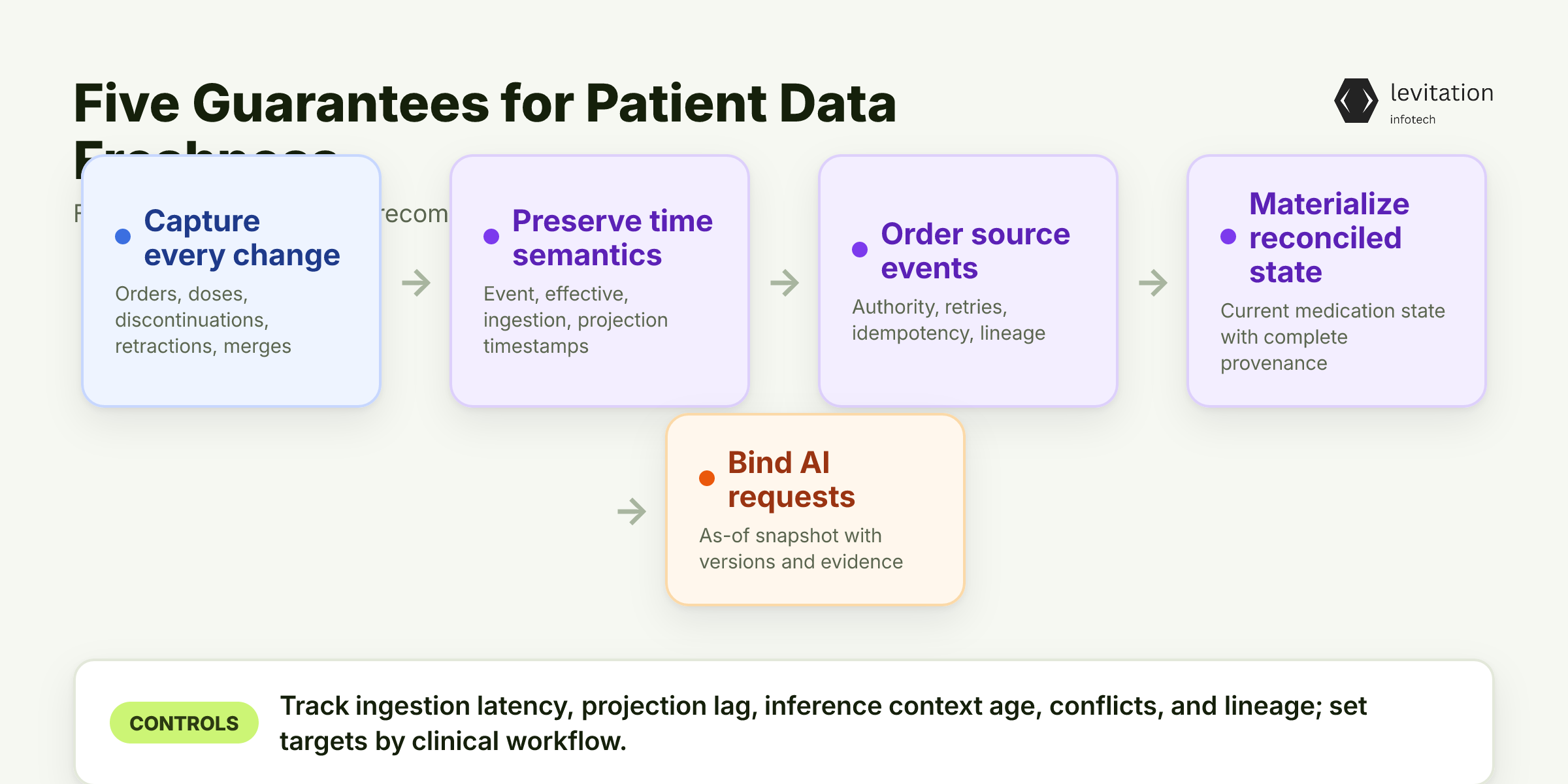
A durable healthcare technology foundation needs five explicit guarantees. Each closes a gap between a source change and an AI recommendation.
Guarantee 1: Capture every relevant change
Capture order status changes, dose corrections, discontinuations, retractions, and record merges. Missing a rare action is still a clinical failure.
Guarantee 2: Preserve time semantics
Record when the change happened, when it became clinically effective, when it entered the platform, and when it was projected. One timestamp cannot answer every question.
Guarantee 3: Establish source-aware ordering and idempotency
Define authority within each source lineage. Retries and out-of-order events must not overwrite an authoritative state.
Guarantee 4: Materialize reconciled state
Create a reconciled medication state with complete provenance. Raw resource updates are evidence, not the current medication list.
Guarantee 5: Bind every AI request to an as-of snapshot
Attach source versions and evidence metadata to the snapshot. Freshness must remain verifiable after the recommendation is produced.
Operational controls should measure: - Source-to-ingestion latency - Event-to-projection lag - Decision-context age at inference - Unresolved reconciliation conflicts - Incomplete lineage
Set targets by clinical workflow rather than through a single generic healthcare threshold. A retrospective analytics batch and an active medication alert have different risk profiles.
Deployment maturity should be a selection criterion for a durable data foundation, but design alone does not eliminate execution risk. The contract must become a working system that engineers can replay, inspect, and audit. How should these guarantees translate into controls that remain reliable in daily operation?
Build a Replayable Medication-State Projection
A FHIR-compatible system for healthcare technology should separate transport, clinical events, and decision context. That separation makes replay possible without locking the interface to one notification format.
Canonical event envelope
Retain these fields in every canonical medication event: - Resource type and ID - `meta.versionId` - Source identifier - Source-native revision or ordering data - Event action - Clinical effective time - Recorded time - Ingestion time
Derive an idempotency key from source, resource, version, and action. This makes retries safe to skip without hiding legitimate corrections.
Version-aware projector
For each event, the projector applies three rules: - If the idempotency key was seen, skip the event. - If the event is not authoritative for a newer state, retain the current state or quarantine the event. - If it is authoritative for a newer state, apply it.
Define authority per source. Arrival time is a transport fact, not a universal clinical ordering rule.
Medication resolver
Map status transitions and effective windows across medication orders, statements, administrations, and dispensing records. Preserve source-specific evidence and unresolved conflicts.
The resolver must represent “active,” “held,” “discontinued,” and “not supplied” as different clinical facts. A dispense record does not prove continued use.
As-of decision interface
The AI request interface must return: - The medication snapshot time - The clinical effective time represented - Every included source version - Evidence and conflict status
Invalidate downstream caches only after the new projection commits. Otherwise, models can receive old and new snapshots during the same transition.
Replay and rebuild
Reconstruct state from the canonical event log. Compare the replayed result with the live projection, and expose differences as operational alerts.
Handle corrections, retractions, merges, and source outages as explicit actions. None should resemble an ordinary status update or disappear silently.
Keep the internal event model independent of FHIR transport. Other clinical sources can then use the same freshness contract without changing the AI interface.
Replay turns a freshness claim into evidence. Without it, clinical AI reproducibility failures remain hidden behind green dashboards.
The architecture protects decisions only if freshness remains observable after go-live. Integration tests alone cannot provide that assurance. What evidence can show that the system still behaves correctly once real clinical events begin arriving?
Test Freshness Against Replayed Clinical Failures
For healthcare technology teams, replayable freshness should be proven against failure sequences. Happy-path volume proves much less.
Failure matrix
The replay suite should cover: - Duplicate delivery - Out-of-order versions - Late corrections - Discontinuations followed by replacements - Retrospective entry - Source downtime and backfill - Conflicting medication sources
These sequences expose whether ordering, reconciliation, and lineage work together.
Contract tests
Each replay must assert the final medication state and its attached evidence. Checking that every event arrived proves only transport.
Include stale and conflicting contexts in the expected output. A correct final list with incorrect lineage still fails the freshness contract.
Production controls
Monitor: - Event lag - Projection lag - Snapshot age at inference - Version conflicts - Stale-context incidents - Unreconciled medication discrepancies
The snapshot age at inference is especially important. It measures freshness where the clinical decision actually occurs.
Ownership
Assign a named owner to every clinical source, freshness objective, exception queue, and remediation runbook. Stale records then require someone to resolve them.
Automated validation should keep malformed events out of the canonical log. Manual review should focus on material ambiguities that software cannot safely resolve.
Replayed medication tests and clinician-reviewed exceptions remain the decisive controls.
When freshness is measurable and replayable, it becomes a decision-system property rather than an integration hope. What changes when that proof reaches the clinician's screen?
What Changes When Freshness Is Provable
Provable freshness changes both the AI recommendation and the operating model around it.
The organization gains five practical outcomes: - The AI explains which medication list it used, which versions it included, and what clinical time that list represented. - Contradictory recommendations trace to an ordering, reconciliation, or source-quality failure instead of disappearing into an opaque model error. - Clinical reviewers receive a smaller, evidence-rich exception queue focused on unresolved medication conflicts. - Engineering teams measure stale-context exposure at the decision boundary. - The audit chain runs from source event to projected state to recommendation.
The organization can shorten the interval between a clinically relevant change and its appearance in AI context. It can also support transparency and audit requirements without pretending freshness alone prevents adverse outcomes.
That is a stronger claim than “the feed was fast.” The feed merely started the chain. Freshness is provable only when that chain can be reconstructed.
For healthcare technology leaders, this is the difference between operational freshness and an integration promise. Which freshness measures should a CTO ask teams to prove before selecting this foundation?
Frequently Asked Questions
What is patient data freshness in clinical AI?
Patient data freshness is the degree to which the state used during inference reflects the latest clinically relevant source changes. Transport timeliness is only one component. Ingestion latency, clinical effective time, projection lag, and decision-snapshot age must also be measured.
How does FHIR event versioning prevent missed medication changes?
FHIR `meta.versionId` and server history help integrations identify resource revisions, deduplicate events, and avoid replaying older states. They do not by themselves order clinical events across resources or reconcile medications. Those jobs still require source-aware ordering, status handling, and an as-of projection.
What is medication reconciliation in a clinical AI architecture?
Medication reconciliation compares ordered medications with dispensing, administration, and patient-reported use. It determines the current medication list and identifies conflicts. The AI should consume that reconciled state with provenance and effective dates rather than infer current use from the newest timestamp alone.
How fresh must clinical AI data be?
There is no universal safe interval because medication alerts, documentation, retrospective analytics, and operational reporting have different tolerances. Define source-to-decision freshness objectives for each use case. Measure the actual age of the snapshot used at inference.
How can a CTO detect stale patient data?
Track source-to-ingestion latency, event-to-projection lag, and decision-snapshot age at inference, then test those signals against replayed medication failures.
About the author
Mayank Singh is a software developer at Levitation Infotech, where he builds web and AI-powered applications across the company’s fintech, healthcare, and enterprise projects.