


A benchmark score can coexist with an operational system that no independent team can replay. A study published in Nature found that only five of 40 tested healthcare AI pipelines reproduced their predictions. That result exposes a gap between clinical model validation and real-world operational readiness. It sets a hard boundary for the release frameworks that follow.
The Benchmark Result That Model Accuracy Cannot Hide
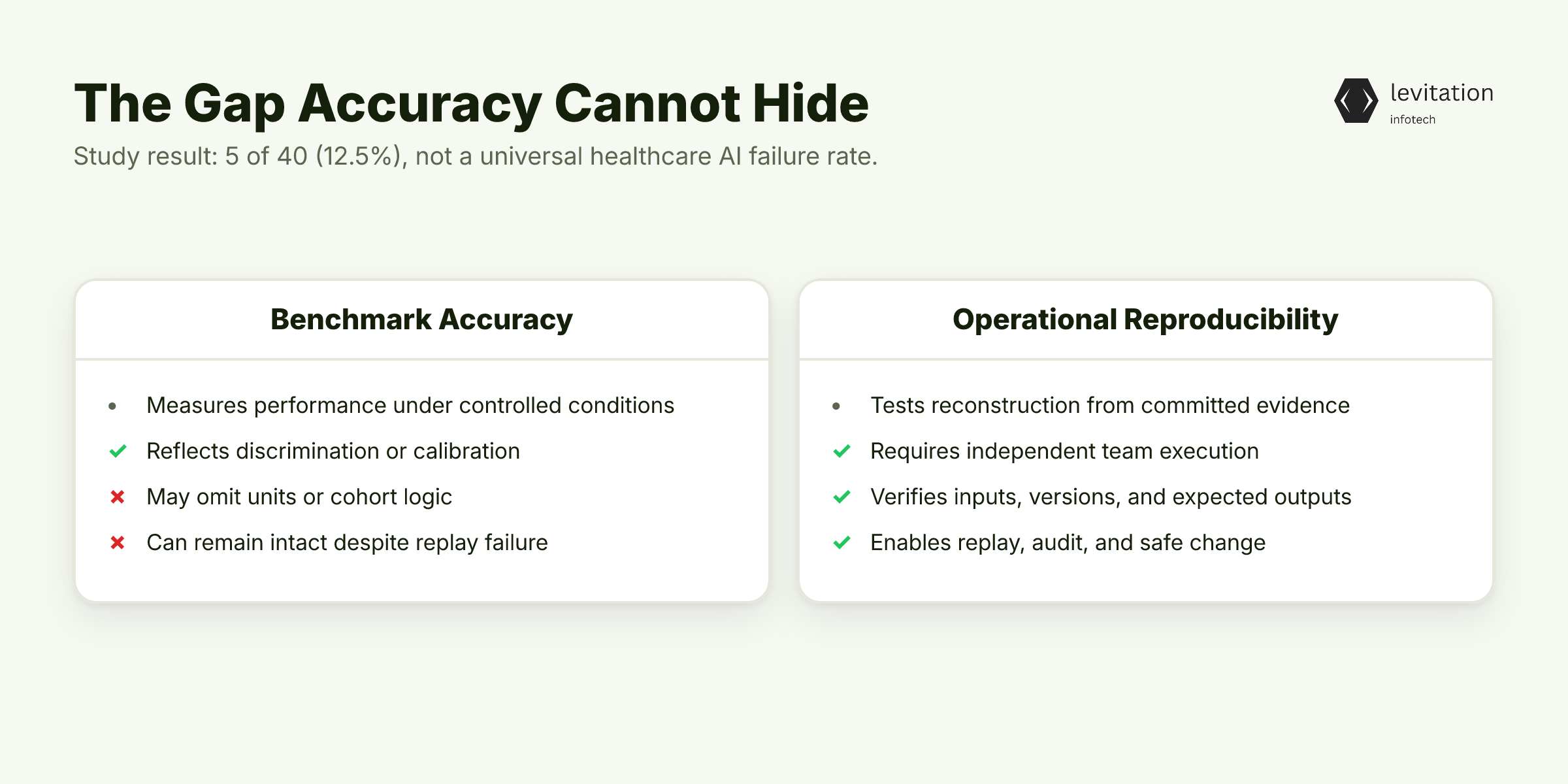
The result was stark. Benchmark success did not guarantee operational replay.
Read the result precisely
Five of 40 equals 12.5% in that study, not a universal healthcare AI failure rate. The study examined a defined set of pipelines under specific conditions.
Its value lies in exposing a gap that accuracy slides conceal. A benchmark measures performance under controlled conditions. Reproducibility asks whether another team can reconstruct the result from committed evidence.
Separate accuracy from reproducibility
A model can achieve strong discrimination or calibration on a held-out cohort while its complete prediction path cannot be reconstructed. Omitting units, cohort logic, or a dependency version can leave benchmark accuracy intact while breaking production replay.
Accuracy measures distance from a reference. Reproducibility tests whether another team can reach that output from the same evidence.
Frame the operational consequence
Can the hospital replay, audit, and safely reproduce a prediction after a model, dependency, or integration change?
The CTO's recurring diagnostic question is simpler: can a team that did not build the system regenerate the prediction from committed evidence? Apply it when assessing top AI companies for healthcare in India: request replay evidence, not only an accuracy slide, architecture diagram, or demo.
1replay_review:2 independent_execution: required3 owner_assistance: none4 evidence: - input_manifest - code_and_model_versions - environment_lockfile - expected_outputs - output_diffs
Accuracy describes benchmark performance. Replay tests reconstruction. Clinical replay tests whether that reconstruction preserves safe behavior.
But if accuracy and documentation are already table stakes, why do production-grade pipelines still break under independent replay?
Where Clinical AI Reproduction Breaks Before the Model Runs
A replay can break before inference. Model artifacts are easy to identify because they have checksums. The route into one is harder because it has state, owners, and dependencies.
Data lineage is the first hidden dependency
Start with the chain that transforms a clinical record into model input:
1replay_dependencies: - clinical_source_snapshot - cohort_filters_and_joins - unit_normalization - missing_value_policy - feature_order - preprocessing - model_artifact - post_processing
Record the source snapshot, filters, joins, units, missing-value handling, feature order, and post-processing. Miss one transformation, and a faithful-looking model receives a different patient representation.
The same pattern appears in Your Model Didn't Break. The Feature Contract Did. A model can remain unchanged while its input contract drifts. - Every dependency needs an owner. - Every mutable version needs an identifier. - Every unknown transformation needs a risk flag.
The runtime is part of the result
Library versions, model artifacts, execution settings, random seeds, hardware, and parallel execution can affect outputs. Parallel reductions can change floating-point order.
Library defaults can change rounding. Source code can remain unchanged while output moves.
Interoperability creates clinical variation
Legacy EHR systems, fragmented pipelines, and changes to interface or extraction behavior can alter model input. A payload can look equivalent while codes, units, ordering, or null handling differ.
This is where healthcare technology becomes a model concern. Interfaces, extractors, and workflow changes belong in the replay contract.
Transparency has limits in healthcare
Independent review needs code and enough methodological detail. But licensed datasets and protected patient information mean teams cannot solve reproducibility by publishing everything.
Controlled access, approved de-identified or synthetic cohorts, and artifact hashes can enable review without releasing patient records. Synthetic data is not a privacy guarantee; it is only one controlled test input.
When the model is treated as only the last mile, the remedy becomes clearer. Reproducibility must be a contract for the entire route. Which artifact should carry that contract into every release?
Make Reproduction an Executable Release Contract
A release contract turns "reproducible" from an adjective into a test with a pass or fail result. It states which artifacts must exist, how to execute them, what output should appear, and who decides whether differences matter.
1release_contract:2 version: "2026.11"3 input_manifest: manifests/input.json4 code_version: manifests/code.json5 model_artifact: manifests/model.sha2566 environment_manifest: manifests/environment.lock.json7 executable_command: "scripts/replay.py --contract contracts/clinical-release.yaml"8 expected_outputs: expectations/clinical-golden.jsonl9 comparison_method: scripts/compare_replay.py10 tolerance_profile: tolerances/clinical-risk.yaml11 clinical_approver: approvals/clinical-safety-owner.json
Artifact replay
Artifact replay proves that committed inputs, preprocessing, weights, configuration, dependencies, and instructions regenerate the intended prediction. If the independent run cannot start, the artifact replay fails.
Behavioral replay
Behavioral replay allows controlled numerical variation when stochastic operations require it. Compare per-record outputs, aggregate metrics, decisions, and thresholds within tolerances set before testing. Never choose a tolerance after seeing the diff.
Clinical replay
Clinical replay asks whether variation could change diagnosis, treatment selection, monitoring, escalation, or another safety-relevant action. A generic epsilon cannot make that decision. A named clinical approver must own it.
Treat the contract as the basis for MLOps audits. - Input, code, model, and environment manifests. - An executable command and expected outputs. - A comparison method, tolerance profile, and named clinical approver.
A model card remains useful. It becomes audit evidence only when each claim links to an artifact and a repeatable validation result. This extends Your MLOps Pipeline Is Undermining Model Safety: testing the model is not testing the release.
A clinical AI benchmark should therefore act like a release benchmark. It should include replayability, independent validation, and prospective clinical behavior, not merely offline accuracy.
When reviewing top AI companies for healthcare in India, ask for an executed contract from a prior release. A template proves intent. A prior clean-room run proves operability.
A contract creates value only when an independent team can execute it without the model owner. That requires a replay harness, not another slide deck. Can your current release process produce that evidence on demand?
Build a Golden-Replay Harness Before Clinical Validation
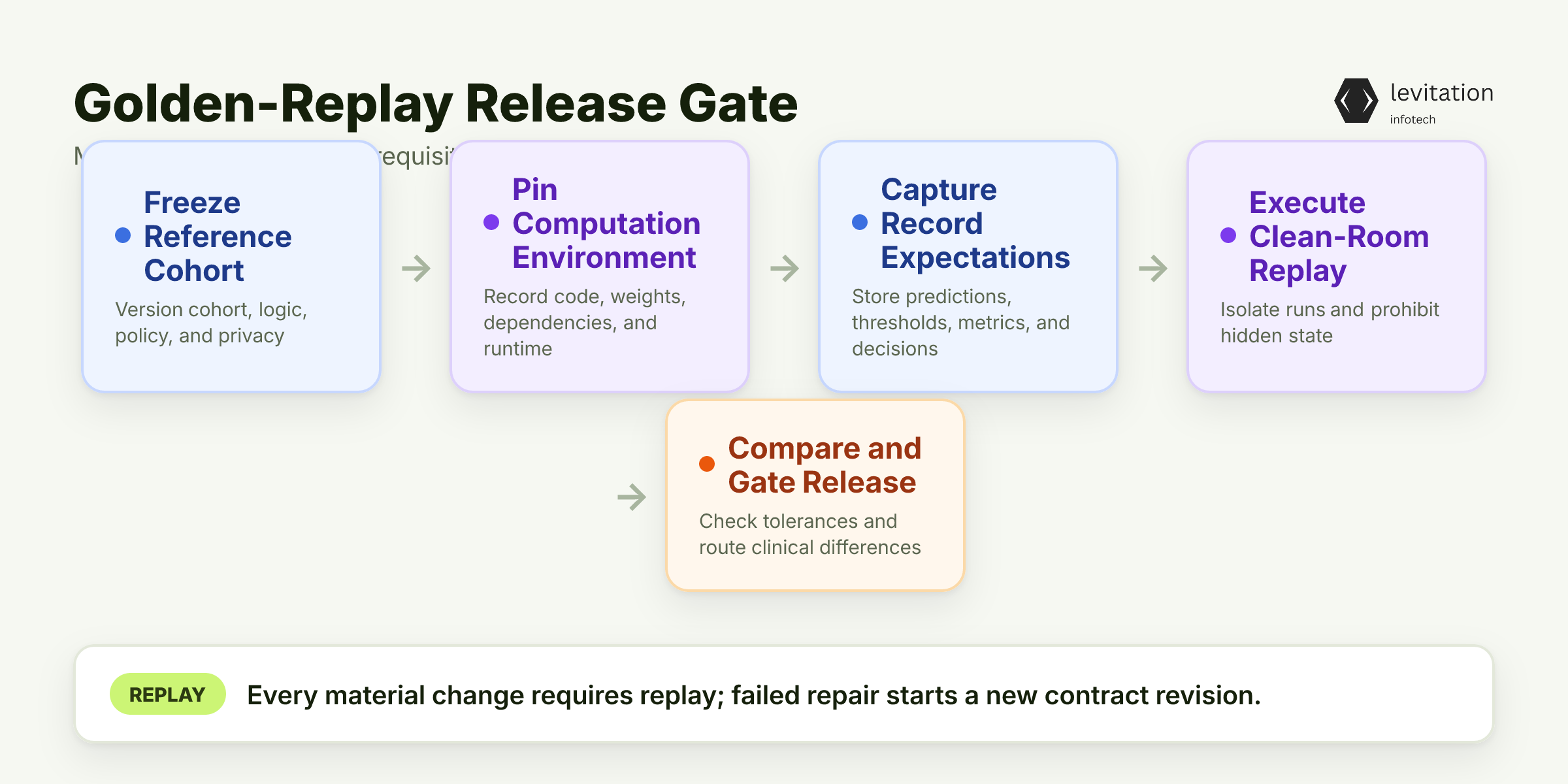
Clinical validation is the wrong place to discover that a pipeline depends on a notebook cache. Build the golden-replay harness first. Use it to gate the move into clinical validation.
1. Freeze the reference cohort
Version the eligible patient set, extraction logic, data dictionary, preprocessing code, feature order, and missing-value policy. Preserve privacy controls while making the cohort identifier stable.
2. Pin the computation
Record the code commit, model weights, model checksum, and dependency lockfile or container image. Also record runtime configuration, random seed, and relevant hardware or accelerator details.
Pinning a seed does not guarantee identical results across hardware. That is why the comparison profile belongs beside the environment manifest.
3. Capture per-record expectations
Store expected predictions, decision thresholds, post-processing results, and aggregate metrics. Aggregate accuracy can hide record-level divergence. Two systems can show the same average while changing decisions for different patients.
1python scripts/replay.py \2 --contract contracts/clinical-release.yaml \3 --clean-room \4 --expected expectations/clinical-golden.jsonl \5 --report artifacts/replay-report.json
4. Execute a clean replay
Run the command in an isolated environment under a separate project account. Do not rely on local files, caches, notebook state, or manual steps.
If the model owner must repair the run, an independent replay has failed. The repair becomes a new contract revision.
5. Compare in two layers
Check exact agreement where required. Use justified tolerances for numerical variation. Route clinically material differences to clinical reviewers.
Every healthcare technology integration becomes a replay dependency rather than an assumed external service. An interface change can alter the result without touching model code.
6. Replay on every material change
Trigger replay when data sources, cohort logic, preprocessing, artifacts, dependencies, thresholds, or integrations change. This makes replay a release control, like autonomous CI/CD governance, rather than a one-time test.
Package the evidence into an audit bundle: - Manifests and artifact hashes. - Commands and environment revisions. - Per-record output diffs and aggregate results. - Exception records, approvals, and exact artifact revisions.
Keep accepted and rejected revisions. Otherwise, rollback can erase the evidence described in Model Rollback Is Evidence Deletion.
Who decides whether a computationally acceptable deviation is clinically acceptable? More importantly, how will that decision be applied when the next release arrives?
Operationalize Governance Beyond Reporting Checklists
Governance fails when it reviews a spreadsheet after engineering has already shipped. Acceptance rules, evidence requirements, and authority must exist before the clean-room test starts.
1release_gates:2 engineering:3 owner: ml-platform4 evidence: artifacts/replay-report.json5 decision: reproducible6 clinical:7 owner: clinical-safety8 evidence: artifacts/clinical-impact-review.json9 decision: clinically_safe10 governance:11 owner: model-risk12 evidence: artifacts/release-decision.json13 decision: approved
Separate the approval gates - Engineering verifies replay and artifact integrity. - Clinical reviewers assess behavior and safety impact. - Governance checks evidence, exceptions, and material changes.
One combined sign-off hides too many questions.
Define acceptance before seeing results
Specify required artifacts, replay tolerances, clinical-review rules, escalation paths, and release authority. Then compare the result against those rules.
Close the reporting-to-practice gap
Reporting frameworks can expose missing documentation and gaps between documented and executed workflows. Reporting guidance matters, but it cannot prove that the next release replays. It also cannot establish prospective clinical impact.
Make reproducibility continuous
Monitor data, schema, dependency, threshold, and integration drift, then route releases through the same contract. This closes the loop described in Your AI Model Is Drifting and You Don't Know.
When reviewing top AI companies for healthcare in India, treat deployment history as diligence context, not model-level evidence. Establish replayability with an executed contract, a clean-room result, and named clinical approval.
Assign ownership and define escalation paths by clinical risk. When evidence is missing, the release is blocked or escalated. It is never silently accepted.
This changes the CTO-level question from "Can we deploy this model?" to "Can we replay, explain, and safely change this system?" Build, buy, or audit: which choice actually reduces that risk?
A CTO's Build, Buy, or Audit Decision Framework
Reproducibility changes build-or-buy decisions because the hidden cost is not model training. It is the work needed to replay, diagnose, and change the system after launch.
1vendor_scorecard:2 replay_success: required3 artifact_completeness: required4 time_to_independent_validation: measured5 dependency_and_integration_controls: required6 clinical_review_coverage: required7 production_longevity: diligence_context
Build when clinical differentiation is central
Build when your team can own the replay harness, data contracts, and change-control process. Your organization must also maintain the reference cohort and clinical review process.
Buy when the vendor can prove independent execution
Buy when the vendor supplies complete artifacts and supports a clean-room replay. Contractual access to evidence matters more than a polished architecture diagram.
Audit when evidence is incomplete
Audit the pipeline when neither side can execute the contract. Treat missing manifests, hidden state, and undefined tolerances as release risks.
Score each option on replay success, artifact completeness, time to independent validation, dependency controls, clinical review, and production longevity. Keep production longevity as diligence context, and do not let demo quality substitute for operational evidence.
Connect the build, buy, or audit choice to the broader healthcare technology stack. The model decision is inseparable from the EHR, HIS, data pipeline, clinical workflow, and release governance around it. This is why enterprise AI is judged on integration, not the model alone.
When evaluating top AI companies for healthcare in India, use the same scorecard. A reference customer does not replace artifact inspection. An architecture diagram does not replace a replay result.
The practical payoff is faster, safer change after launch. What does a complete answer look like in a procurement evaluation?
Frequently Asked Questions
A replay requirement becomes vague when assurance stops at "validated." Keep the request executable in procurement evaluations, architecture reviews, and vendor scorecards.
What should a vendor provide for independent replay?
A compliant request should specify:
1vendor_replay_request:2 independent_execution: required3 protected_data: controlled_environment4 evidence: - manifests - commands - hashes - output_diffs - approvals5 revalidation: risk_based
Use this request in your next vendor review to identify which item the vendor has not proved.
Which missing proof should block deployment in your organization?
About the author
Mayank Singh is a software developer at Levitation Infotech, where he builds web and AI-powered applications across the company’s fintech, healthcare, and enterprise projects.