


TL;DR: Passing FHIR R4 validation proves structural conformance, not that clinical data is complete, linked, plausible, or fit for a workload. A credible 10,000-record benchmark must separate those claims, reproduce the same graph and rules, and turn defects into workload-specific release gates.
Key Takeaways: - A valid FHIR resource can still be clinically incomplete, incorrectly mapped, or disconnected from its patient graph. - A reproducible benchmark needs explicit denominators, pinned rules, immutable inputs, and an issue ledger. - Release gates become useful only when every defect has an owner, a correction path, and a retest.
FHIR Validation Passes. Clinical Trust Still Fails.
A FHIR R4 response can pass every declared structural rule and still create an unsafe analytical conclusion. Consider a lab Observation with a valid code and value, but no expected encounter link. Its local terminology can lack a usable standard mapping, while its referenced Patient carries a corrupted identifier.
Interoperability has solved the handshake, not the meaning. Clinical defects can therefore hide behind a successful validator run.
Separate Transport Success From Data Fitness
A successful API call only says the server responded. A downloaded payload adds evidence of transfer, not fitness. A validator result adds evidence of conformance, not clinical truth.
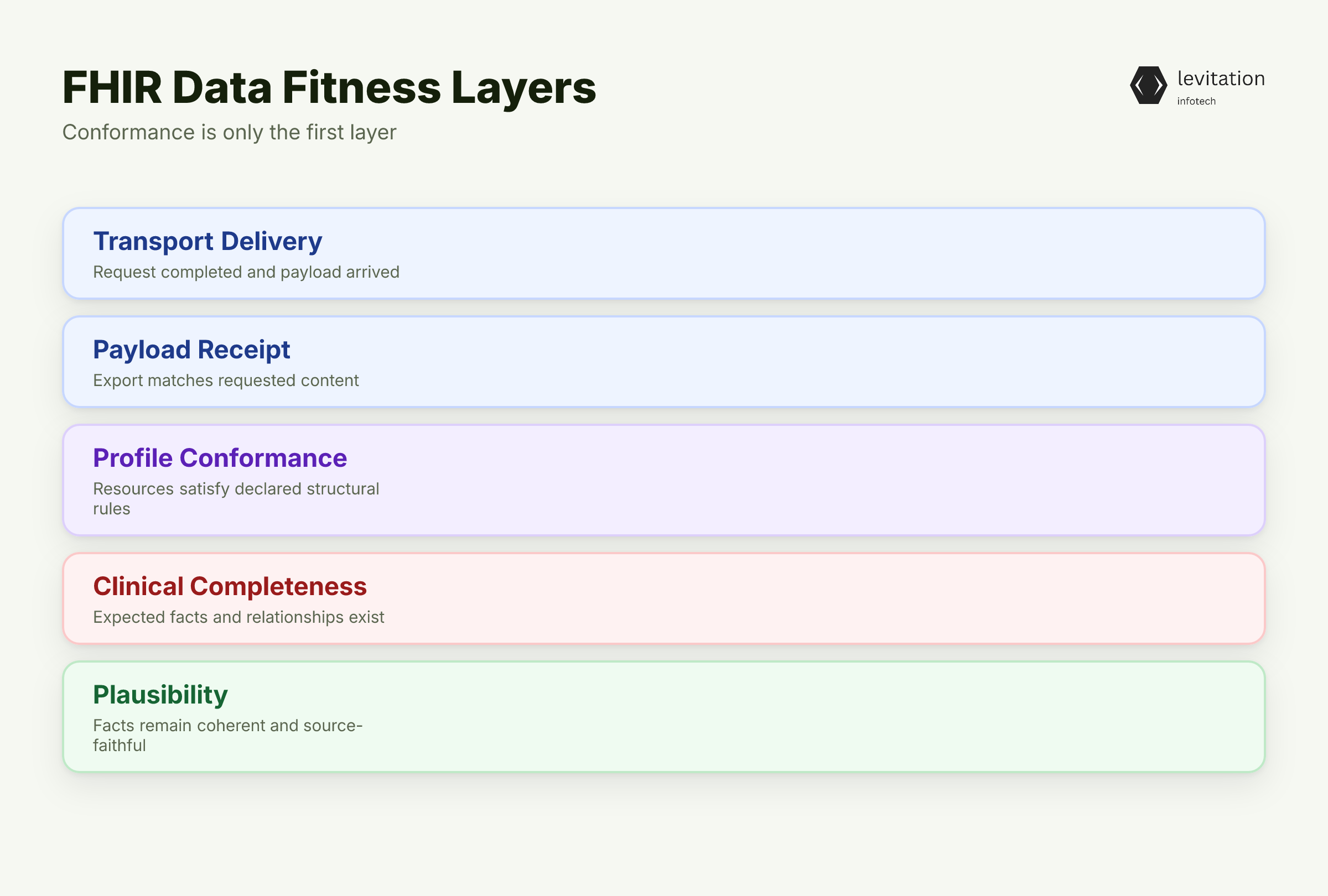
Treat these as separate claims: - Transport delivery: The request completed and the expected payload arrived. - Payload receipt: The downloaded content matches the requested export. - Profile conformance: The resources satisfy declared structural and profile rules. - Clinical completeness: Expected clinical facts and relationships exist for the stated cohort. - Plausibility: The facts are coherent and faithful to their source.
Conformance, completeness, and plausibility are separate quality layers. NCQA's Bulk FHIR Quality Coalition provides related background on that distinction. FHIR conformance is the first layer, not the final verdict.
A benchmark unit must also be exact. 10,000 records means 10,000 resource instances. It does not mean 10,000 patients, encounters, or complete clinical stories.
Ten thousand Observations can describe far fewer people. Ten thousand mixed resources can also represent many incomplete patient graphs.
US Core and USCDI provide a shared foundation for US use cases. Their profiles support extensions, but they cannot create missing facts or repair inconsistent source data.
This distinction matters for regulated production and for healthcare technology teams. Prior delivery experience can establish operational relevance, but it does not establish benchmark results.
If the cleanest validation result can still hide clinical gaps, where does standardized interoperability actually stop?
Why 10,000 Records Break Bulk FHIR Workflows
Scale exposes behavior a single-resource test never sees. In early Epic implementations, Bulk FHIR exports for groups of 1,000 patients or more encountered errors. Processing issues appeared as requests scaled.
The US Cures Act Final Rule requires certified EHRs to support Bulk FHIR export for predefined patient groups. Neither group definition nor supported group size is standardized across systems.
That gap matters for healthcare technology teams. A standard can define the export operation while vendors still differ in group selection, job execution, payload assembly, and recovery behavior.
Keep the Denominators Separate
A corpus of 10,000 Observations can belong to fewer than 1,000 patients. It cannot reproduce a 1,000-patient cohort test unless the manifest proves patient coverage, expected resource combinations, and group selection.
This is the denominator trap described in Your Patient Deduplication Benchmark May Double-Count One Patient. Counting rows does not measure a population. For FHIR, a population includes Patients, Encounters, Observations, and the links among them.
Keep two test layers: - Export contract: Can the system define, request, complete, and retrieve the intended group? - Delivered graph: Does the output contain the complete, linked, and plausible facts needed for that group?
Successful delivery does not prove cohort completeness. It also does not prove cross-resource linkage, terminology quality, or source fidelity.
Delivery failures are visible, but the more dangerous defects appear after delivery succeeds. Which quality layers can catch those hidden defects?
A Four-Layer Contract for FHIR Data Quality
A checklist can list many checks without defining a release contract. The stronger design makes each quality claim explicit, measurable, and tied to a workload.
Layer One: Conformance
Validate each resource against the declared FHIR R4 schema and implementation guide. Check profiles, cardinalities, datatypes, bindings, and value sets.
This layer answers a narrow question: does the resource obey the declared contract? It does not show whether the needed resource was exported. Which required clinical facts did the export actually include?
Layer Two: Completeness
Calculate clinical completeness against an explicit denominator. Include required elements, expected resource combinations, and population coverage.
Raw field counts are misleading. A resource can be full of administrative fields while missing the clinical event that made it useful. Completeness must ask whether expected facts and links exist, not whether fields are populated. Can populated fields still hide a clinically implausible record?
Layer Three: Plausibility
Test temporal coherence, source fidelity, and expected links to patients, encounters, practitioners, and clinical context. An Observation can carry valid syntax and still conflict with its encounter or source record. Which conflicts matter, and which workload exposes them?
Layer Four: Workload Fitness
Declare the intended use before choosing acceptance rules. Research, care coordination, and digital quality measurement need different resources, relationships, and profiles. Use QI-Core where it applies to the quality-measure workload.
A validator's within-resource checks cannot carry the full contract. Some defects appear as binary rules inside one resource. Others involve several resources, such as an Encounter, a Patient, and a Practitioner.
Population-level rules then ask whether expected facts exist across the cohort.
CumulusQ, the NIH All of Us Qualifier metric definitions, and the Kahn framework provide useful foundations. Extend them with workload-specific rules instead of treating any one framework as universal.
Keep the evaluation in FHIR and preserve lineage. A flat table can erase the resource, profile, reference, and code context needed to explain a failure.
The same contract can serve a technical architect, data engineer, clinical informaticist, and quality analyst without changing its meaning. A broken patient graph can pass every local rule while breaking the actual query. Neo4j 4.0 Scales. Broken Patient Graphs Still Fail explains the problem for a different data layer.
A layered checklist still leaves one critical ambiguity: which defects should stop a release, and which can be monitored?
Build a Reproducible 10,000-Record FHIR R4 Benchmark
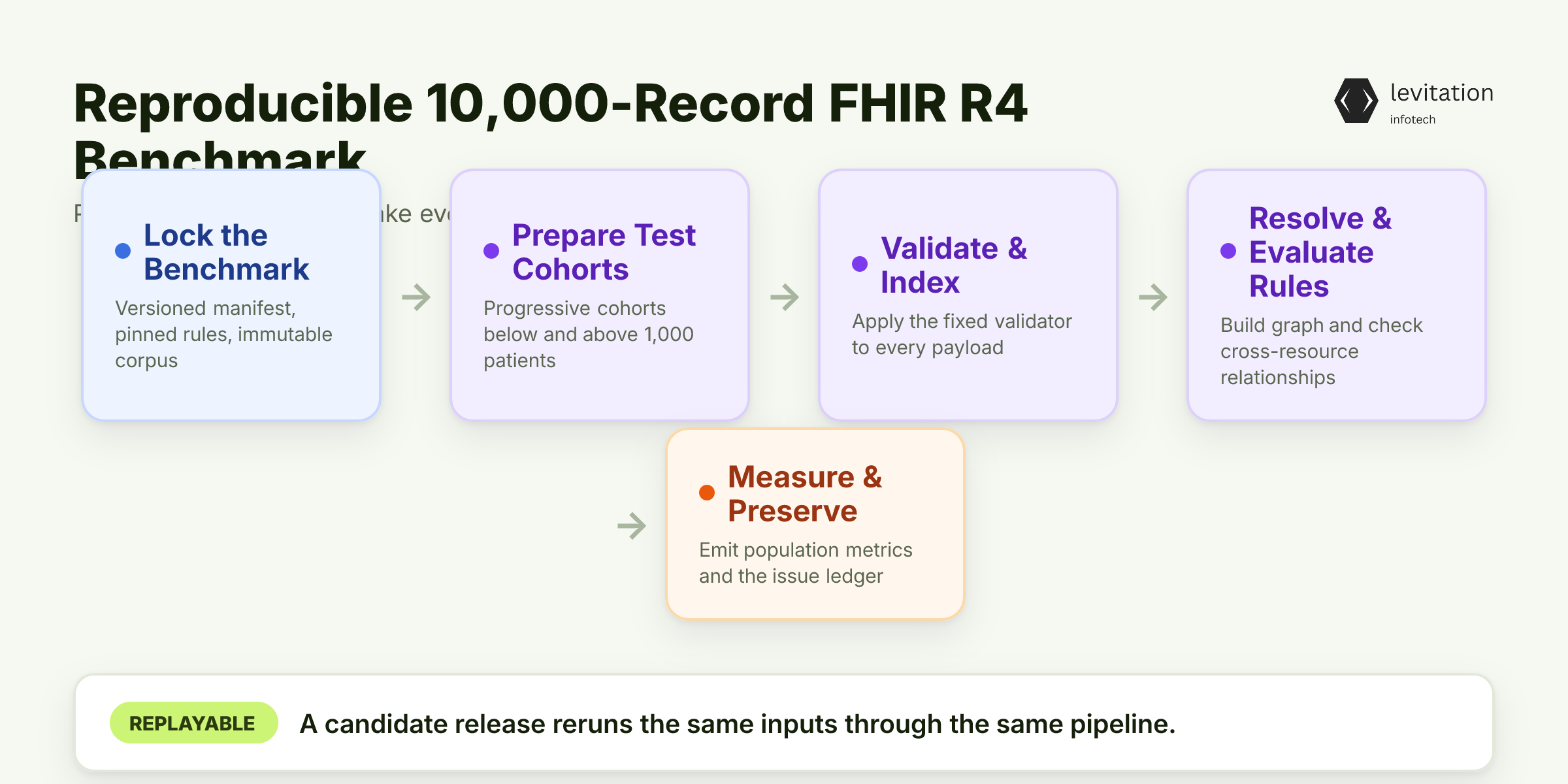
A benchmark becomes evidence only when another team can replay it. That requires a versioned corpus, pinned rules, immutable inputs, and a durable record of every failure.
For healthcare technology teams, reproducibility turns a release claim into an auditable decision.
Create a Corpus Manifest
Record what the benchmark contains before anyone runs a validator: - Scope: 10,000 resource instances, with the resource mix stated explicitly. - Population: Patient and encounter coverage, including distinct counts and expected relationships. - Provenance: Source system, extraction path, source dates, and known transformations. - Profiles: Declared implementation guide, profile set, code systems, and terminology versions. - Expectations: Required elements, expected resource combinations, and workload purpose.
Do not call the corpus representative unless those fields justify the claim. A precise denominator prevents a convenient sample from becoming a false benchmark. Can another team reproduce that scope without relying on informal knowledge?
Pin the Test Environment
Record the FHIR R4 release, implementation guide, profile set, terminology versions, validator version, metric definitions, and transformation logic. Use US Core STU6 and USCDI V3 only where that scope applies.
Pin the validator too. A rule change can alter results without any source data changing. That makes apparent quality movement meaningless and undermines replayability.
How should those fixed rules enter the execution pipeline?
Build the Execution Pipeline
The flow is straightforward: validate, index, resolve references, evaluate rules, calculate metrics, and emit the issue ledger.
Start with immutable raw payloads. Build the patient-resource graph, resolve references, and evaluate cross-resource rules. Calculate population metrics, then retain every issue as structured evidence.
A candidate release replays the same inputs through the same pipeline. Will that pipeline remain stable when cohort size and graph complexity change?
Test Scale Independently
Run progressive cohorts below and above 1,000 patients. Capture export job behavior separately from delivered payload completeness. Then count duplicate, missing, unresolved, and implausible records independently.
Bulk export success and clinical graph quality are different claims. Mixing them creates a green result that hides the defective layer.
Measure completeness with explicit denominators: - Expected observations per eligible encounter. - Expected resource coverage per eligible patient. - Expected linked resources per completed clinical event. - Expected population coverage for the declared workload.
Store each failure with resource ID, profile, rule ID, severity, source, expected value, observed value, affected cohort, and remediation owner. This turns a raw validator warning into actionable evidence.
Define acceptance criteria per workload. Hard-stop on structural or referential failures.
Warn on workload-specific quality metrics. Record documented exceptions with owners and expiry conditions. Do not invent a universal pass percentage.
A benchmark that reports defects without explaining them is just another dashboard. Who can change each failing layer, and what must happen before release?
Route Every Failure to an Owner and Retest
A defect category without an accountable owner becomes recurring background noise. The release gate must identify who can change the failing layer.
For healthcare technology teams, ownership bridges finding a defect and preventing its return.
Route Defects by Cause
Build a failure-ownership matrix before production use: - Capture defect: Route to the EHR capture workflow. - Profile mismatch: Route to interface configuration and profile governance. - Terminology problem: Route to mapping and terminology management. - Broken cross-resource link: Route to resource-linking and identity logic. - Source-fidelity concern: Route to source-data review. - Bulk FHIR group-export defect: Route to the export adapter and vendor interface team.
Separate categories when the evidence supports it. A dashboard can group a missing code with a failed reference, but their corrections differ. How should those owners act without freezing the pipeline?
Quarantine Without Freezing the Pipeline
Use a quarantine path for records that fail blocking rules. Clean independent resources can continue, while failed records wait for correction and review.
A streaming implementation can group related resources, validate cross-resource rules, and quarantine failures. This FHIR data-quality workflow provides a reference for the pattern. Quarantine contains the defect. How does the correction loop close?
Close the Correction Loop
Use one auditable sequence: detect, classify, assign, remediate, regenerate, retest, and version. Retain the original payload, correction evidence, and result. That record proves what changed and why.
Do not silently overwrite clinically meaningful values. Automated normalization must preserve the original value, mapping decision, confidence, and review status. How will reviewers inspect those decisions when another failure appears?
Publish Evidence, Not One Score
Publish an issue ledger rather than one average. Report metrics by resource, profile, source, cohort, time period, and rule severity. Link every score to its underlying failures.
Compare measures produced from FHIR with results from the existing reporting process, then investigate gaps and inconsistencies.
A single average can improve while one critical cohort collapses. Why AI Dashboards Can Look Right and Be Wrong applies beyond dashboards: presentation does not replace inspectable evidence.
Owned defects create value only when teams prove the correction worked and prevent its return. Can that proof become a repeatable production release gate?
Turn the Benchmark Into a Production Release Gate
A benchmark becomes operational only when its findings can approve or block a release. For healthcare technology teams, apply five sequential gates: - Transport delivery: The export job completes and the expected payload arrives. - FHIR conformance: Declared structural and profile rules pass. - Clinical completeness: Expected facts exist for the declared denominator. - Plausibility: Relationships, timing, and source alignment hold. - Workload fitness: The data supports the declared use and required profiles.
Hard-stop failures should block release. Other defects need explicit owners, remediation deadlines, and approved exceptions. Every decision should point to the replayable benchmark version and issue ledger.
The payoff is precise. Teams can separate interoperable interfaces from trustworthy data, find defects before downstream use, assign remediation, and reproduce each release decision.
That delivery context, Levitation, should not be confused with benchmark evidence. Delivery timelines describe delivery history, not this benchmark's results.
FHIR standardizes how healthcare systems exchange resources. A quality contract standardizes when those resources are trustworthy enough to use. The remaining questions are practical: what belongs in the corpus, and what should block a release?
Frequently Asked Questions
Does passing FHIR validation prove high FHIR data quality?
No. Validation establishes that a resource satisfies specified structural and profile rules. It does not prove that expected clinical fields were captured or that terminology is correctly mapped.
It also does not prove that related resources are complete or plausible for the intended use. Which additional layers must pass before the data is fit for its intended workload?
What should a 10,000-record FHIR R4 benchmark include?
It should include a versioned corpus manifest, representative resource and patient graphs, schema and profile validation, cross-resource checks, population-level metrics, and a reproducible issue ledger. It should distinguish 10,000 resource instances from 10,000 patients or encounters.
Which denominator and resource mix will the benchmark declare?
Is Bulk FHIR reliable for exports of 1,000 or more patients?
It cannot be assumed to be reliable across every implementation. Although certified EHRs must support Bulk FHIR export for predefined patient groups, group definitions and supported sizes are not standardized. Initial Epic implementations also encountered errors and processing issues at larger scales.
What evidence should a team require before scaling exports beyond its tested cohort?
Which frameworks can measure FHIR data quality?
CumulusQ, metric definitions from the NIH All of Us Qualifier project, and the Kahn framework provide useful foundations. Which framework can be pinned, extended, and replayed against a specific workload?
About the author
Mayank Singh is a software developer at Levitation Infotech, where he builds web and AI-powered applications across the company’s fintech, healthcare, and enterprise projects.