


TL;DR: Patient deletion is not an EHR delete. Use lineage to track each artifact and model influence, assign truthful states, and test every serving path before closure. Unknown must remain unknown.
Key Takeaways: - A deleted source row does not delete chunks, vectors, logs, summaries, caches, exports, evaluation data, or model influence. - Artifact disposition and model influence need separate states because a clean store can still have unresolved model status. - Lineage, immutable manifests, idempotent propagation, and destination-specific tests create defensible deletion evidence.
The EHR Row Is Only the First Place a Patient Lives
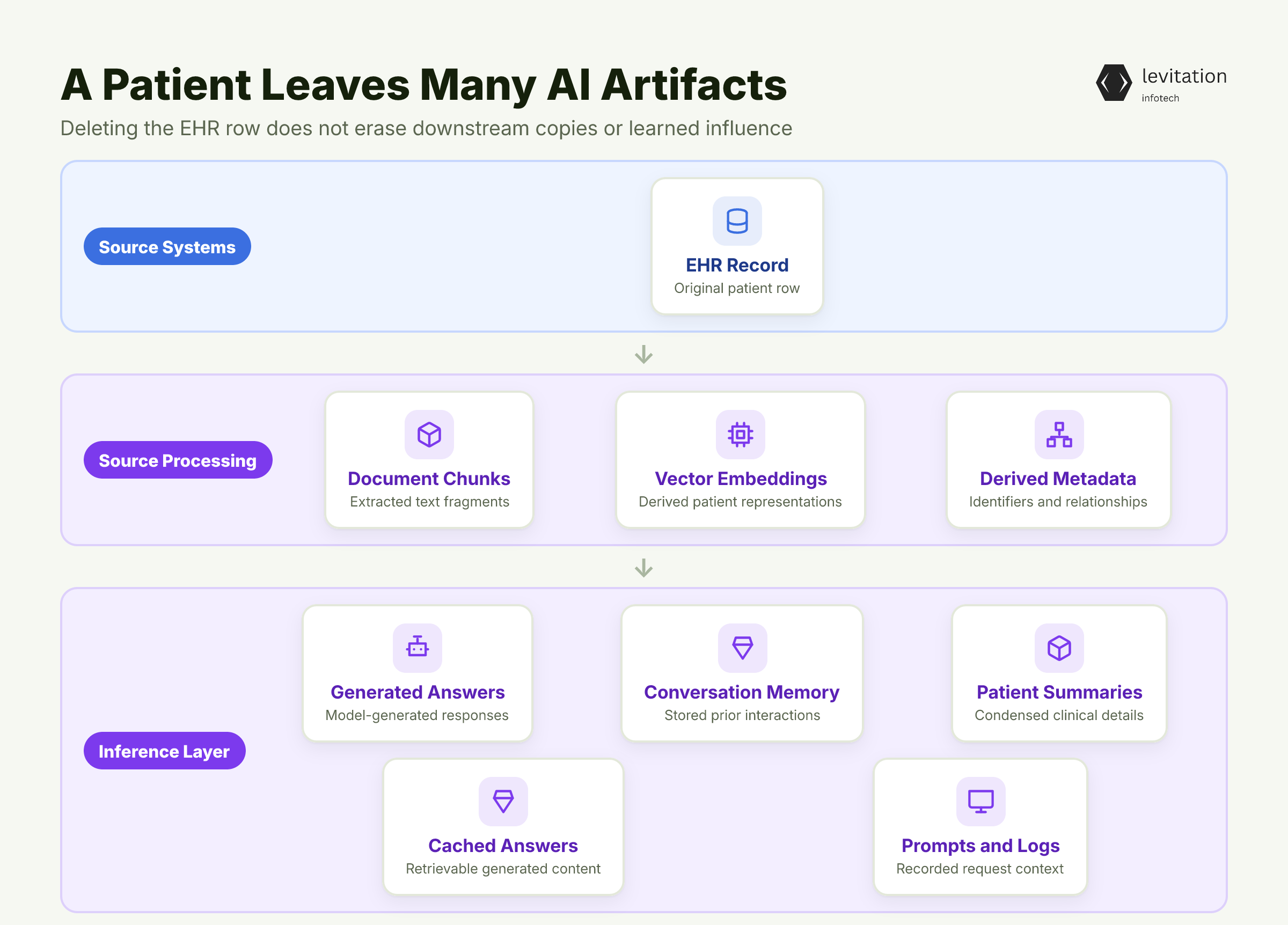
A hospital can remove a patient from the EHR. Yet the data can remain in embeddings, chat logs, cached answers, summaries, evaluation sets, or model updates.
The dangerous assumption is that deleted means the same thing everywhere. In AI systems, it does not. That gap turns a routine privacy request into a graph-wide incident.
Picture one request. The EHR row disappears, but an authorized retrieval still returns a note from the vector index. Moments later, a chat session reloads a stored summary.
This is not a stale EHR view. The AI estate is still serving old derivatives.
One request now has many destinations: - Source processing creates document chunks, embeddings, and metadata. - Inference creates prompts, generated answers, conversation memory, summaries, caches, and logs. - Data reuse creates exports, evaluation datasets, training manifests, and model-release artifacts.
The spread matters to any healthcare technology architecture. It should also shape vendor reviews of top AI companies for healthcare in India.
A retrievable copy can be found and deleted by reference. Model influence is different.
A trained model can carry statistical influence without exposing an addressable patient record. Training on the record still changes its parameters.
Source-first deletion creates false closure. The team removes the database row but cannot name downstream objects, recipients, or model versions.
Ask one diagnostic question: can the system identify every artifact influenced by a patient without manually searching databases, logs, and model registries? Operational credentials matter, but they are not erasure evidence.
The obvious remedy is to find and delete every copy. That breaks when patient data becomes statistical influence inside a model. If lookup cannot reach learned influence, how can a team assign a truthful deletion state?
Why Model Influence Cannot Be Deleted by Lookup
Fine-tuning changes the unit of deletion.
In a conventional database, a row identifier locates and removes the record. A fine-tuned model does not expose an equivalent identifier for the patient's contribution. It cannot reveal how that contribution changed the parameters.
The available model remedies fail in different ways: - Retraining rebuilds the model from an eligible dataset. It creates a new release, but still needs release-specific verification. - Suppression blocks a known behavior from surfacing. It does not prove the old influence is absent. - Machine unlearning targets a trained contribution. Its assurance depends on the method, artifacts tested, and evaluation limits.
Retraining is not a universal compliance rule.
California's AB 1008, effective in 2025, requires AI developers to honor deletion requests for personal information embedded in AI models. Treating weights as exempt is the wrong default under that duty.
Model-layer status becomes a core AI compliance issue. Retrieval memory and learned influence need different paths.
Vector stores, key-value stores, profiles, and conversation memory are mutable and addressable. Delete or invalidate them directly. Learned influence requires a documented way to address it.
This creates an overclaiming trap. No retrievable copy does not prove complete erasure. The inability to retrieve a record also does not prove that no residual influence exists.
Technical perfection is not the only question. The system still needs a status it can defend. How can teams label artifacts and influence without claiming certainty they lack?
Give Every AI Artifact an Honest Erasure State
Treat deletion as a state machine with two axes. They describe different facts.
Artifact disposition asks whether a stored copy can still be served. Model-influence status asks whether a source shaped a release. An artifact can be deleted and verified while its influence on one model remains unresolved.
Use these artifact states: - Deleted and verified: Content is removed, and destination checks passed. - Restricted under documented exception: Serving or processing is blocked under a named exception. - Deletion in progress: One or more destinations still await an outcome. - Unknown: Lineage or verification is incomplete.
Use these model states: - Not in model path: Manifests prove the source was absent from training and fine-tuning. - Assessed and remediated: A documented method addresses the identified influence. - Unresolved: Influence was not assessed, or the assessment remains unverified.
Allowed transitions must be explicit. An artifact starts in progress. It may end as deleted and verified, restricted under a documented exception, or unknown.
It cannot move from unknown to deleted and verified without new evidence. Unknown is a valid operating state, not an administrative failure.
Build a lineage graph before the request arrives
Give every chunk and vector a non-content source identifier and version. It records source history without copying clinical text into the lineage store.
Preserve an immutable dataset manifest for each training build. Record export recipients and purposes.
The core rule is simple. If the system cannot determine which source items produced an object, its deletion state is unknown, not complete. The graph is a chain of custody for data, not a search index for it. Without that chain, how can the team issue a defensible completion receipt?
Issue a content-free deletion receipt
Record the request scope, immutable event, artifact outcomes, verification results, retention exceptions, model status, approver, and timestamp. Never reproduce the deleted content in the receipt.
Bind closure to predefined acceptance criteria. An operator cannot declare success because the main ingestion pipeline returned success.
For AI compliance, this turns vague completion into inspectable evidence. Any vendor shortlist of top AI companies for healthcare in India should be judged on whether it can produce this evidence.
An honest state helps only if a workflow can move every known artifact into it. Which workflow can carry that state across every destination?
Make Deletion Propagate Across the AI Data Graph
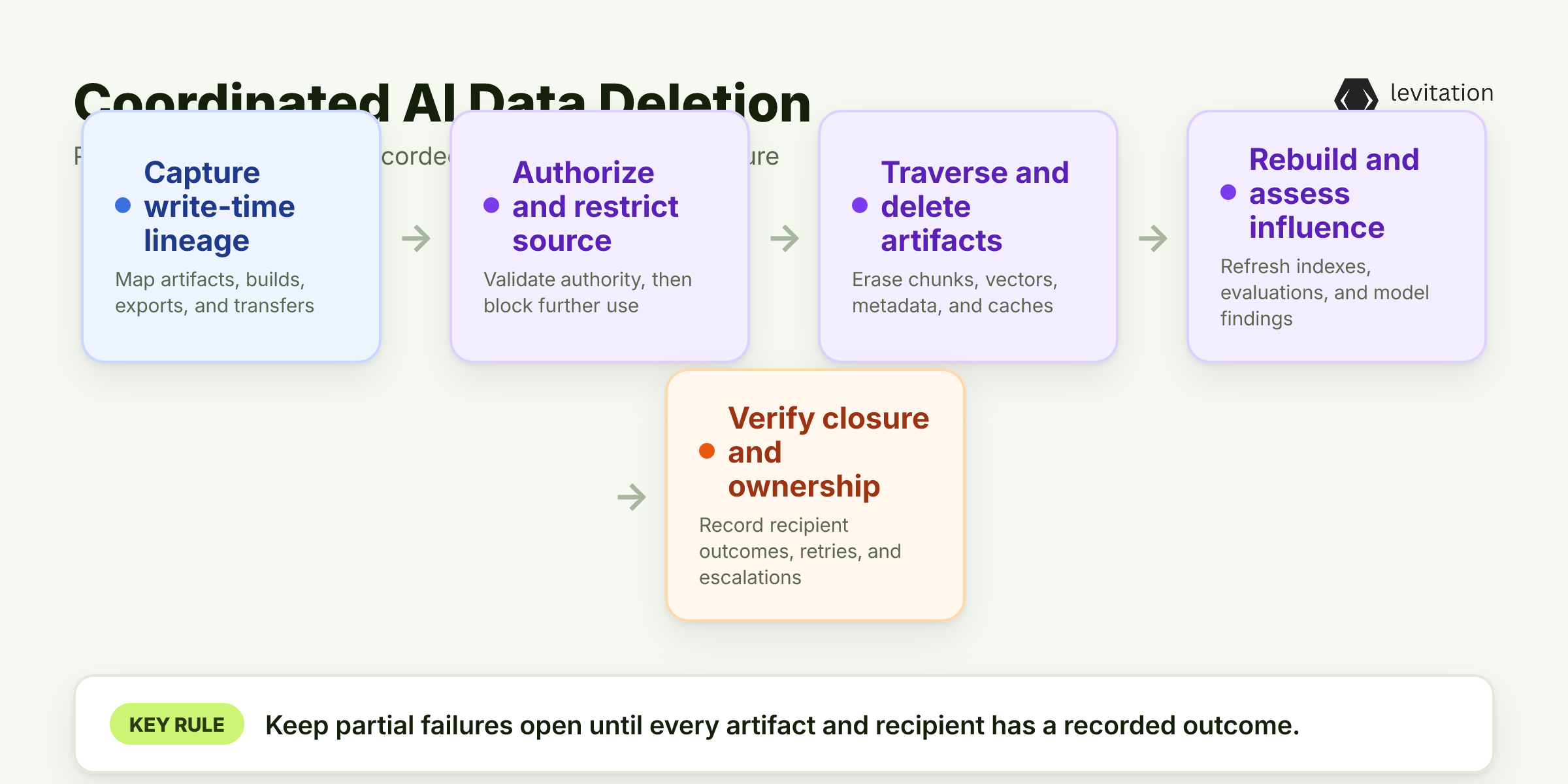
Deletion cannot propagate through a system that never recorded where data went.
Emit lineage at write time
Associate every chunk, vector, summary, cache entry, and derivative with its source identifier and version. Each training build should point to an immutable dataset manifest. Record export recipients, purposes, and transfer events.
If lineage appears only after a request, the process is archaeology, not erasure. That is why vector speed loses to AI data provenance once deletion depends on traceability. With the map in place, how should the deletion event proceed?
Execute one coordinated deletion event
The coordinator should: - Validate and authorize the request. - Restrict the source immediately. - Invalidate affected answer caches. - Traverse source versions to chunks, vectors, and metadata. - Mark content as deleted and rebuild the active index generation. - Remove affected cases from future evaluation suites. - Preserve only a content-free record that each case was withdrawn. - Record model-registry findings and export dispositions.
Make the event idempotent and safe to retry. Repeating it must not create duplicate side effects or false closure.
Keep every artifact in progress until its outcome is recorded. Partial failure stays open.
Use the model registry to establish whether a source version influenced a training build or release. If that link cannot be proved, record model influence as unknown.
Document any retraining, suppression, or unlearning assessment. Use export lineage to identify each external destination needing follow-up.
External recipients may have received different subsets or derivatives. Their disposition must be proved individually.
Give operational ownership to ingestion, retrieval, evaluation, model release, legal approval, and incident handling. The runbook must define retries, escalations, and conditions that keep a request open.
For healthcare technology buyers, product-specific acceptance tests still decide. The same applies to vendors on the top AI companies for healthcare in India shortlist.
Propagation proves where the data went. It does not prove that no destination can still serve the data. Which tests close that gap?
Prove the Result at Every Retrieval Destination
A clean graph can still serve stale data if the serving path was never tested.
Define destination-specific acceptance criteria
Each destination needs its own test: - Retrieval and vector layer: Associated chunks, vectors, and metadata are removed. The active generation is verified. - Conversation and agent memory: Saved content and derived summaries are removed. - Caches: Affected entries are invalidated, not merely overwritten. - Exports: Each recipient has a recorded disposition. - Logs and observability: Prompts and responses receive separate treatment.
Run authorized retrieval checks against affected content. Start fresh sessions to catch restored summaries or memory.
Verify the rebuilt index generation. Confirm that unrelated records were not deleted.
Treat logs and observability systems as separate destinations. Prompts and responses can contain patient information even when the source record and index are clean.
A model-layer claim must name its method, artifacts tested, limitations, and unknowns. A failed extraction attempt does not prove anonymity.
Produce an evidence bundle containing: - The deletion event and lineage snapshot. - Per-artifact outcomes. - Retrieval-test results. - Documented exceptions. - The model-registry finding. - Signed approval.
Keep failed or partially verified requests open with an explicit unknown state. Closing them as complete converts uncertainty into compliance risk.
Retrieval tests are stronger than RAG citations, but they still need a defined scope. Authorization also needs a stronger boundary than tenant filtering, as a tenant filter is not a complete PHI boundary shows.
For AI compliance, evidence must follow the destination, not stop at one green dashboard.
Once the technical path works, organizational risk remains. Unclear authority, undocumented exceptions, and inconsistent evidence can still make valid deletion indefensible. Who approves exceptions, and who can close the request?
Turn Patient Deletion into a Repeatable Trust Workflow
Put governance inside the workflow, not beside it.
Require written justification for every deletion decision. Involve compliance or legal when retention exceptions or contested model fixes arise.
Run requests through one queue. Each shows an owner, current state, dependency status, exception record, and content-free completion receipt.
Do not split the work across ingestion, ML, security, and legal tickets. That creates invisible gaps between teams.
The payoff for healthcare AI compliance teams is concrete: - Fewer orphaned derivatives. - Consistent evidence across systems. - Clearer audit responses. - A defensible distinction between deleted data and unresolved model influence.
Evaluate implementation partners on production evidence.
Any evaluation of top AI companies for healthcare in India should test healthcare technology production evidence alongside AI compliance controls.
Deletion is complete only when the organization can name what it deleted, restricted, and left unknown. It must also show how each claim was verified. The first unresolved dependency will reveal which architectural control is missing.
Frequently Asked Questions
What is AI data erasure in a healthcare system?
AI data erasure is the controlled removal or restriction of patient information. It covers source records, retrieval indexes, embeddings, logs, memory, and caches. It also covers exports, evaluation data, and documented model influence.
Completion requires lineage, per-artifact outcomes, verification evidence, and a truthful model-influence status.
Can a patient be completely erased from a trained AI model?
Not through a database lookup alone. Mutable stores can be deleted directly. Model influence needs a documented method, such as retraining, suppression, or machine unlearning, when lineage confirms a model path.
Does deleting a patient from the EHR automatically remove their data from vector stores and logs?
No. Without lineage across every derivative, patient data can survive in embeddings, summaries, prompts, responses, and cached answers. Automated propagation and destination-specific retrieval checks are required.
Is machine unlearning required for every patient deletion request?
No. If patient data existed only in retrieval stores, profiles, logs, or conversation memory, those artifacts can be deleted directly. Model weights need no modification when lineage shows no model path.
Model-level fixes matter only when lineage shows influence, or residual influence remains an assessed risk.
How should a CTO prove that patient data deletion is complete?
Require an immutable deletion event, source-to-derivative lineage, per-artifact status, documented exceptions, model-registry findings, and authorized retrieval tests. If any dependency cannot be traced or verified, report the state as unknown or in progress, rather than complete. Can your organization make that statement for the next request?
About the author
Mayank Singh is a software developer at Levitation Infotech, where he builds web and AI-powered applications across the company’s fintech, healthcare, and enterprise projects.