


TL;DR: A ₹1L/month React developer in Noida is not a bargain. By month three, turnover taxes, rework, and founder drag compound the real cost well beyond the headline salary, often rivaling what a properly priced senior would have cost. The cheapest hire is rarely the cheapest to keep, so the winning move is to hire for retention and code quality rather than headline salary.
Key Takeaways: - A ₹1L/month React posting in Noida signals a moonlighter, a freelancer, or someone on their way out. It is rarely a market bargain. - Three hidden multipliers (turnover tax, rework, and founder drag) compound the effective monthly cost within the first quarter. - A 5-question framework built around retention, longevity, rework ratio, security, and all-in TCO separates profitable hires from headline bargains.
The ₹1L/Month Illusion: What Noida's Job Market Actually Pays
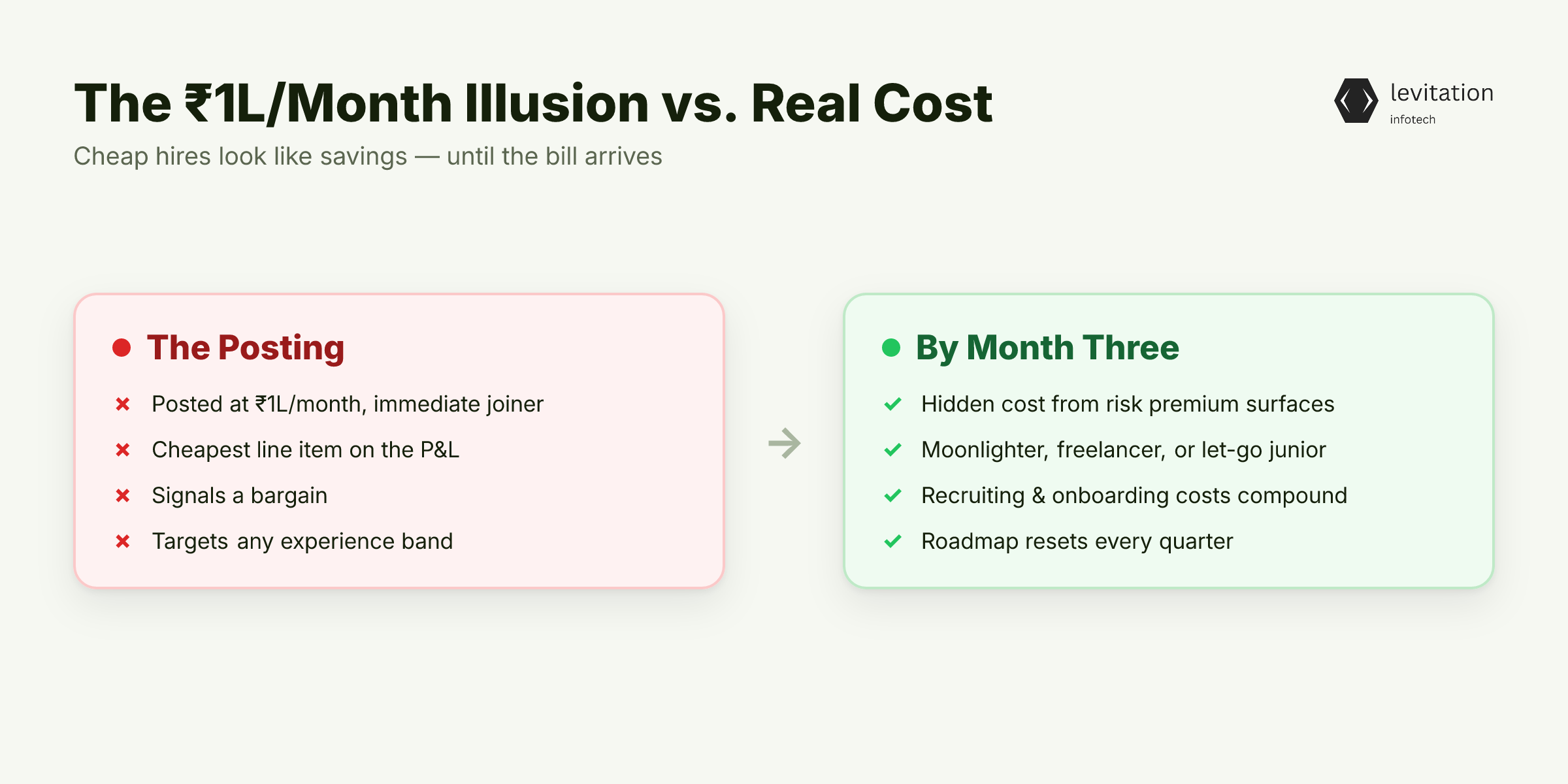
You saw the posting. "₹1L/month React developer, Noida, immediate joiner."
Three months in, you're paying far more for that same seat. And the developer's already polishing their LinkedIn.
The cheapest line item on your P&L just became the most expensive.
Fresh data from MailerMen shows fresher React developers in Noida earn ₹2.4L to ₹2.9L per year. That works out to ₹20,000 to ₹24,000 per month.
A ₹1L/month posting is well above that range. It targets a different experience band. The gap between the posting and the actual hire is where the hidden cost lives.
A ₹1L/month rate doesn't signal a bargain. It signals one of three things. A moonlighter splitting attention across clients. A freelancer who couldn't land full-time work. Or a junior whose last employer let them go.
None of these are discounts. They're risk premiums dressed up as savings.
Salaries for developers with production React experience scale with years shipped and architectural judgment. The gap between a ₹1L hire and an experienced engineer who can own a codebase looks expensive on paper. In practice, the cheap hire usually costs more by month three.
The "savings" founders chase are the same savings that vanish first. Recruiting, onboarding, and ramping up a replacement cycle each carry friction costs. These costs compound across every quarter you repeat the cycle.
Every quarter you do this, you reset your roadmap. For a deeper look at what React talent actually costs across India, see React developer cost in India.
But founders who hire at that price point don't see the cost. They see the savings. Until the bill arrives three months later.
Three Hidden Cost Multipliers That Double Your React Developer Bill
Cheap React hires don't cost ₹1L. They cost far more once three hidden multipliers land on your books.
Multiplier 1: Turnover tax. A developer hired at the bottom of the market rarely stays long enough to recoup the cost of finding them.
Each replacement cycle burns cash in three places. Recruiter fees and sourcing costs scale with annual CTC. Onboarding time drops output during ramp-up. And ramp-up loss mounts while the new hire learns your codebase.
Each cycle adds friction that scales with the salary you tried to save.
Multiplier 2: Rewrites and bug fixes. Developers below the ₹1L mark rarely have the architectural judgment to make decisions that survive contact with scale.
State management goes wrong. API contracts drift. Test coverage is missing. Code shipped in month one gets rewritten in month four by a senior you hire to clean it up.
The "savings" you booked at hiring disappear into the rework line.
Multiplier 3: Founder drag. Your CTO or tech lead now spends a growing share of their week unblocking, reviewing, or rewriting a junior's output. That's time not spent on product, fundraising, or hiring the next senior.
Every hour your tech lead spends babysitting a cheap hire is an hour stolen from the work that actually moves the company forward. It's a real line item. It just doesn't show up on payroll.
This pattern shows up across Indian tech hiring data. As we covered in We Hired 60 MERN Developers in Noida. 18 Lasted Past Six Months., the retention cliff is steep at the low end. The same dynamic plays out in India Outsourced Devs Cost 60% Less. Quarter One Closes the Gap., where lower headline costs erase themselves inside 90 days.
Our breakdown of the hidden costs of cheap developers maps these multipliers across hundreds of hiring decisions.
Add those three multipliers to the ₹1L base, and the math stops looking like a deal. Most founders don't see the full number until they run it. Here's the actual TCO breakdown.
Calculating the Real Cost: A Month-One TCO Breakdown
The real cost is a multiplier on the base salary, not a flat number. It's the sum of every cost that lands on your books the day a cheap hire starts producing.
Here's the month-one TCO breakdown for a ₹1L/month React hire: - Base salary: ₹1,00,000. The line item you budgeted. - Amortized recruiting and onboarding: A share of the base that scales with the recruiter's fee and the short tenure over which you spread it. The shorter the hire stays, the more of this cost lands on month one. - Expected rework and senior oversight: Hours of code review and bug fixes that compound because code shipped without architectural judgment generates more defects per feature. - Lost founder time: Hours the CTO diverts from product and fundraising to unblock, review, or rewrite a junior's output. These hours scale with the gap between the hire's skill and the work they're assigned.
Your "cheap" hire is now one of the most expensive lines on your engineering P&L. It often rivals or exceeds what a senior hire would have cost all along.
Contrast this with a senior React developer hired at market rate. They ship clean code in week one. They have a tenure measured in years. They free your tech lead entirely.
The first-year cost per month stays close to the offer letter. The second-year cost stays the same. No replacement cycles. No reworks. No drag.
The senior's higher salary buys back your founder's time, your roadmap, and your codebase quality. How to evaluate React developer skills walks through the screening signals that predict which side of this trade you'll land on.
If "cheap" doesn't actually mean cheap, what does it mean? And how do founders accidentally end up optimizing for it?
What 'Cheap' Actually Buys You in React Development
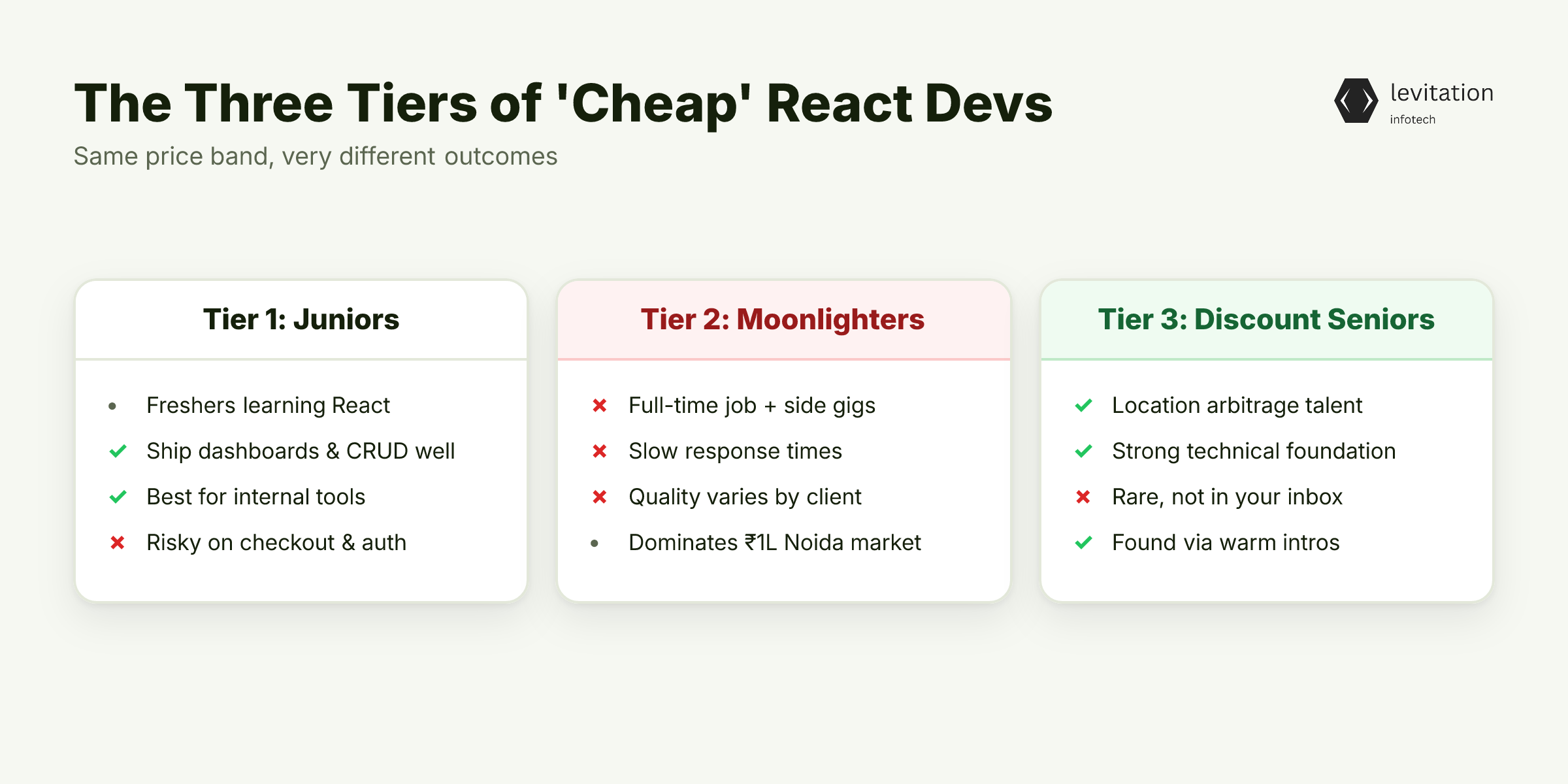
"Cheap" isn't one market. It's three, and the difference between them decides whether you get burned.
Tier 1: Genuine juniors building internal tools. A motivated fresher learning React can ship dashboards, admin panels, and internal CRUD features. Their ₹1L price reflects skill level, not a hidden liability.
Use them where mistakes don't compound. Don't put them on your checkout flow or your auth layer.
Tier 2: Freelancers moonlighting across clients. This is the dominant tier in the ₹1L/month Noida market. They hold a full-time job or run two or three side contracts.
Response times stretch because their attention is split across clients paying different rates. Code quality varies by which client is paying fastest.
You're not getting cheap React. You're getting the scraps of someone's divided attention.
Tier 3: Senior developers priced low. Rare but real.
Sometimes driven by location arbitrage (developers in Tier 2 cities who don't need Bangalore rent). Sometimes by market illiquidity (a strong developer stuck in a quiet hiring market).
These hires are worth pursuing. They don't show up in your inbox. They show up through referrals and warm intros.
The Noida ₹1L market is dominated by Tier 2. The unicorn "founder-friendly bargain" is mostly moonlighters, not quiet seniors. Our breakdown of React developer tiers explained maps how to tell them apart in a 30-minute interview.
So what does a profitable hire actually look like? You need a framework, not a salary band.
The 5-Question Framework to Hire React Developers Profitably
Here's the framework that cuts through salary noise. Five questions, asked in order.
Question 1: "What's your 12-month retention rate for React developers?" A retention rate that forces you to rehire every quarter means you're paying turnover tax on a loop. The honest answer is often worse than the number they quote. Push for specifics: "How many of your last five React hires are still with you?" A vague "we have great retention" is itself a red flag.
Question 2: "Show me code you've shipped that's still in production after 2 years." Longevity is the only honest quality signal. A take-home test measures algorithmic speed. A production code review measures architectural judgment. If nothing they've written has survived 24 months, neither will your codebase. Ask them to walk you through why each decision was made and what they'd change today.
Question 3: "What's the ratio of features shipped versus features reworked?" A low rework ratio indicates senior judgment. A high ratio is a flashing red light. The work that gets reworked was always going to be reworked. The only question is who eats the cost. The candidate should be able to put a number on it and explain what drives it in their work.
Question 4: "How do you handle security and compliance requirements?" Non-negotiable for fintech, healthtech, and any B2B platform handling customer data. If the candidate can't talk about input validation, secrets management, and dependency auditing, you're hiring a liability, not a developer. Silence here is more expensive than a wrong answer.
Question 5: "What's your all-in monthly cost including oversight, ramp-up, and rework?" This question reframes the conversation. It forces the candidate (and you) to think in TCO, not sticker price. The right answer is "I don't know" or a number that includes everything. The wrong answer is a clean salary figure with no friction. Our React developer hiring checklist turns these questions into a structured 45-minute interview.
Apply this framework and your shortlist shrinks fast. The real question becomes: what does your product look like 12 months after you get this right?
From Cost Center to Compound Asset: What Changes When You Stop Optimizing for ₹1L/Month
When you hire for retention and clean code, your codebase stops being a depreciating liability. It becomes a compound asset.
Every feature built by a senior who stays makes the next feature cheaper to ship. The opposite is also true: every cheap hire who leaves resets your team to zero.
The math is brutal when you zoom out. A ₹1L/month developer who stays a few months costs their salary. It also costs the replacement drag that lands another big sum on the bill. That's the cost of code that never made it past the rewrite.
A developer hired at market rate who stays for years costs more in total salary. But the cost per shipped feature drops as the team and codebase align. Teams ship faster on a codebase they own.
Engineering teams that turn over every quarter can't build systems that last. If you want to hire senior React developers backed by teams who measure themselves in years of retention, not months, the conversation starts with TCO, not salary. See what that looks like in our React development case studies.
The contrarian reframe is this. The most expensive React developer in your network costs ₹1L/month and leaves after a few months. The cheapest is the one who costs more per month and stays for years.
Frequently Asked Questions
Q: What is the average salary of a React developer in Noida?
A: Fresher React developers in Noida typically earn ₹2.4L to ₹2.9L per year, or ₹20,000 to ₹24,000 per month. Salaries scale significantly with production experience, architectural judgment, and ownership of complex systems. A ₹1L/month posting targets experienced hires, not freshers, and the gap between the headline rate and the actual cost of keeping that hire is where the real expense hides.
Q: Is it cheaper to hire a React developer in Noida vs Bangalore?
A: Noida salaries generally run below Bangalore for equivalent experience, primarily due to lower living costs and supply density. However, the gap shrinks once you account for hidden costs like turnover, rework, and founder oversight, which are location-agnostic. A cheap Noida hire that leaves after a few months still costs more than a Bangalore hire who stays for years.
Q: What is the total cost of hiring a React developer in India?
A: True TCO includes base salary, recruiting fees, and onboarding time when output drops. It also includes expected rework and founder oversight hours. For a developer earning ₹1L/month, realistic first-year TCO lands well above the headline salary once every friction line is counted.
Q: Should I hire a freelance React developer or a full-time employee?
A: Freelancers make sense for scoped, time-boxed projects like a 6-week dashboard build or a one-time migration. For ongoing product work, full-time hires are cheaper once you cross 4 to 6 months of continuous need. You eliminate context-switching costs and start building institutional knowledge in the codebase.
Q: How do I verify a React developer's skill before hiring?
A: Skip algorithmic coding tests. Instead, ask for a code sample from a production system they're proud of. Then a 30-minute walkthrough of architectural decisions and why. Finally, references from a founder who worked with them for 12+ months. Longevity on past projects is a stronger signal than any take-home test.
About the author
Mayank Singh is a software developer at Levitation Infotech, where he builds web and AI-powered applications across the company’s fintech, healthcare, and enterprise projects.