


TL;DR: Open-source AI agents cut infrastructure and licensing costs by about 75% compared to hosted proprietary platforms. But standard vendor risk audits stall approval. Their templates were designed for SaaS vendors, not self-hosted source code. The fix is structural: reframe the submission around your team as the operator. Then build an architecture whose auditability pre-answers every auditor question.
Key Takeaways: - The bottleneck blocking open-source AI agents is a process template, not a technology flaw - Auditors care about transparency, inspectability, and data sovereignty. Self-hosted open source scores higher on all three - Replacing "Vendor Security Posture" with "Operator Security Posture" is the single change that gets approvals moving
Your CFO saw the 75% number and asked why you're not already deploying open-source AI agents. Your CISO ran the vendor risk checklist, found no "open source" checkbox, and put the request on hold.
You're stuck between two people who are both right, and that's the problem.
The 75% Cost Gap Is Real. The Approval Gap Is Bigger.
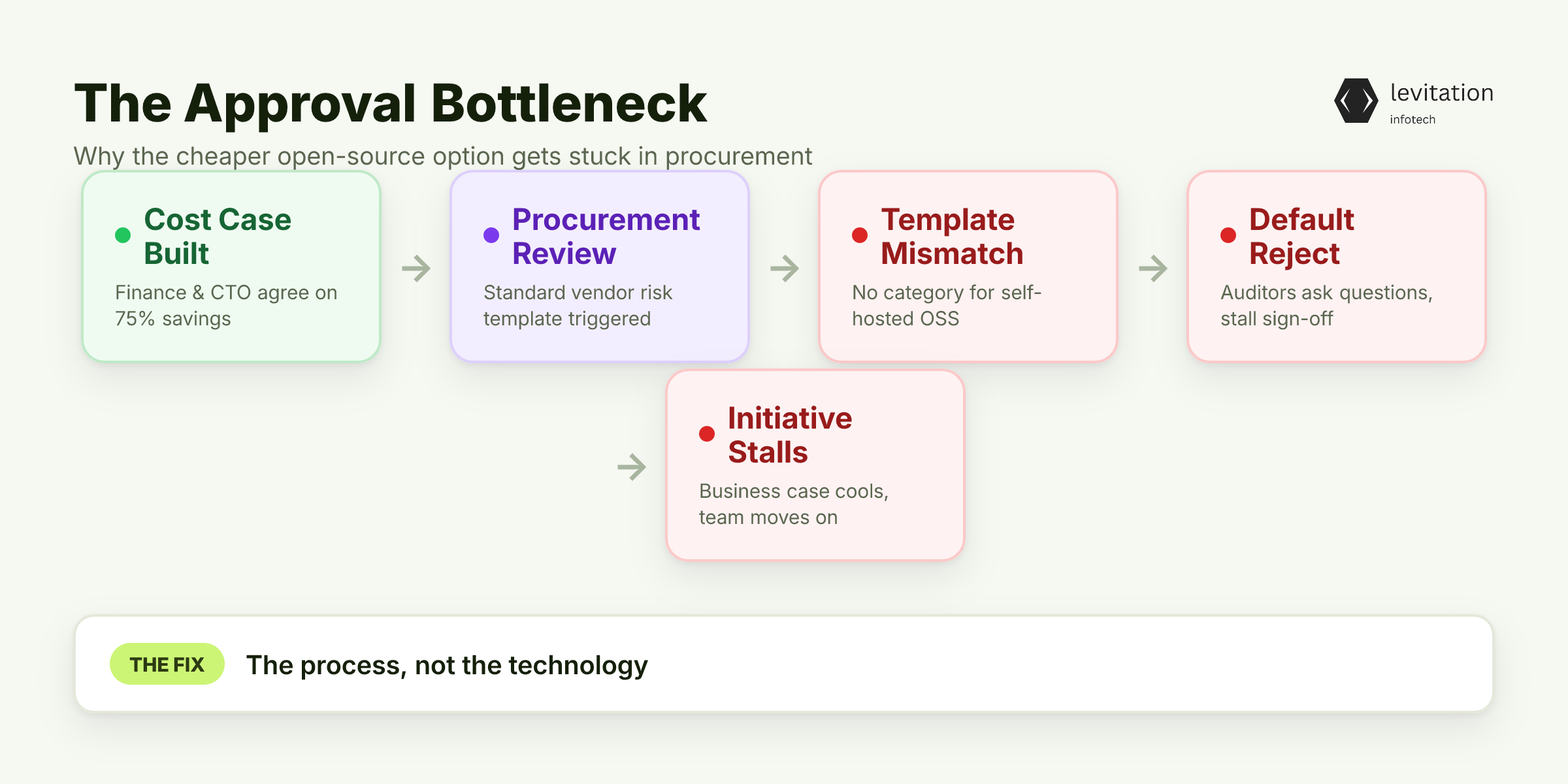
Once you strip out per-seat licensing, token markups, and annual platform fees, self-hosted open-source AI agents run about 75% cheaper than hosted proprietary platforms. The math is simple: you're paying for infrastructure rather than SaaS margins. As usage scales, that gap widens. Every additional query costs you compute, not a vendor's per-call surcharge.
The cloud budget line that keeps showing up in our analysis of open-source AI agent costs is infrastructure, not licences. Finance pushes hard for the switch. The CTO agrees.
Then procurement, running its standard vendor risk template, hits a wall.
The cheaper option triggers more scrutiny, not less. The template has no clean category for self-hosted open-source software. Every field for "vendor security posture" or "subprocessor list" returns blank.
Auditors default to the safest verdict: reject and ask questions.
The result is a quiet bottleneck. AI initiatives stall for months waiting on a risk review. That review was never designed to evaluate source code.
By the time the review is done, the business case has cooled. The team has moved on, or a competitor has shipped.
Here's what most teams get wrong: the audit team isn't objecting to open source. They're objecting to a process with no category for self-hosted software. The fix starts with the process, not the technology.
So how does the process actually work?
Vendor Risk Frameworks Were Built for SaaS, Not Source Code
Standard vendor risk audits assume a counterparty. They expect a company with a SOC 2 report. They also look for a data processing agreement and infrastructure you can point to on a diagram. Every field in the template maps to that assumption.
"Vendor name." "Vendor security certifications." "Vendor incident response policy." "Vendor subprocessor list."
The template keeps asking for a third party.
Self-hosted open-source deployments have no counterparty. The "vendor" is a project on GitHub. It could also be a maintainer foundation, or your own team. The template fields return blanks.
Auditors interpret blanks as missing evidence. Missing evidence fails the review by default.
The same pattern shows up in extended LLM stack submissions. Reviewers reject when the template doesn't fit the deployment model.
The hidden risk auditors react to is continuity. With a hosted vendor, disappearance means an outage. It also means a scramble for data extraction. Your autonomous agents, audit history, and configuration all live on infrastructure you don't control.
The data is theirs until you negotiate a transition plan, if you can.
With self-hosted open source, vendor disappearance is not an outage. The software already runs on your infrastructure. Your data never left.
The "vendor" going away changes nothing about your operations. This is the strongest continuity story in the stack. Most submissions never tell it.
The fix isn't arguing harder for open source in the existing template. It's understanding what your auditors are actually trying to protect. Open source already does most of it better, but only if you show it.
What are they actually trying to protect?
What Auditors Actually Worry About (Hint: It's Not the License)
Three principles drive every vendor risk review, no matter the template. Transparency into how decisions get made. Inspectability of the system doing the deciding. Data sovereignty over what flows through it. Every checkbox and scoring rubric reduces to one of these three. The same goes for every "explain this" question.
It's the same gap that sinks most explainable AI external audits. Good intent, wrong evidence.
Self-hosted open-source agentic systems score higher on all three. The code is auditable line by line. The decision logic is inspectable because the source lives in your repository. It's also version-controlled and diff-able.
Data never leaves your infrastructure. Your data residency and sovereignty claims are literal, not contractual.
Here's the reframe your CISO needs to hear: regulators don't distinguish between your AI agents and your vendors'. Your audit report won't either. The control you have over a third-party platform is contractual.
The control you have over a self-hosted system is operational.
Auditors weight operational control more heavily when they can see it. Your responsibility for agent behavior is the same. It doesn't matter whether you bought it or built it.
The difference is which controls you can prove. With open source, you can prove everything. The evidence is in the code you own.
Understanding the principles aligns you with your auditors. Restructuring the submission is what gets you approved. The first rewrite starts with one section name.
How to Restructure the Vendor Risk Submission for Self-Hosted Agents
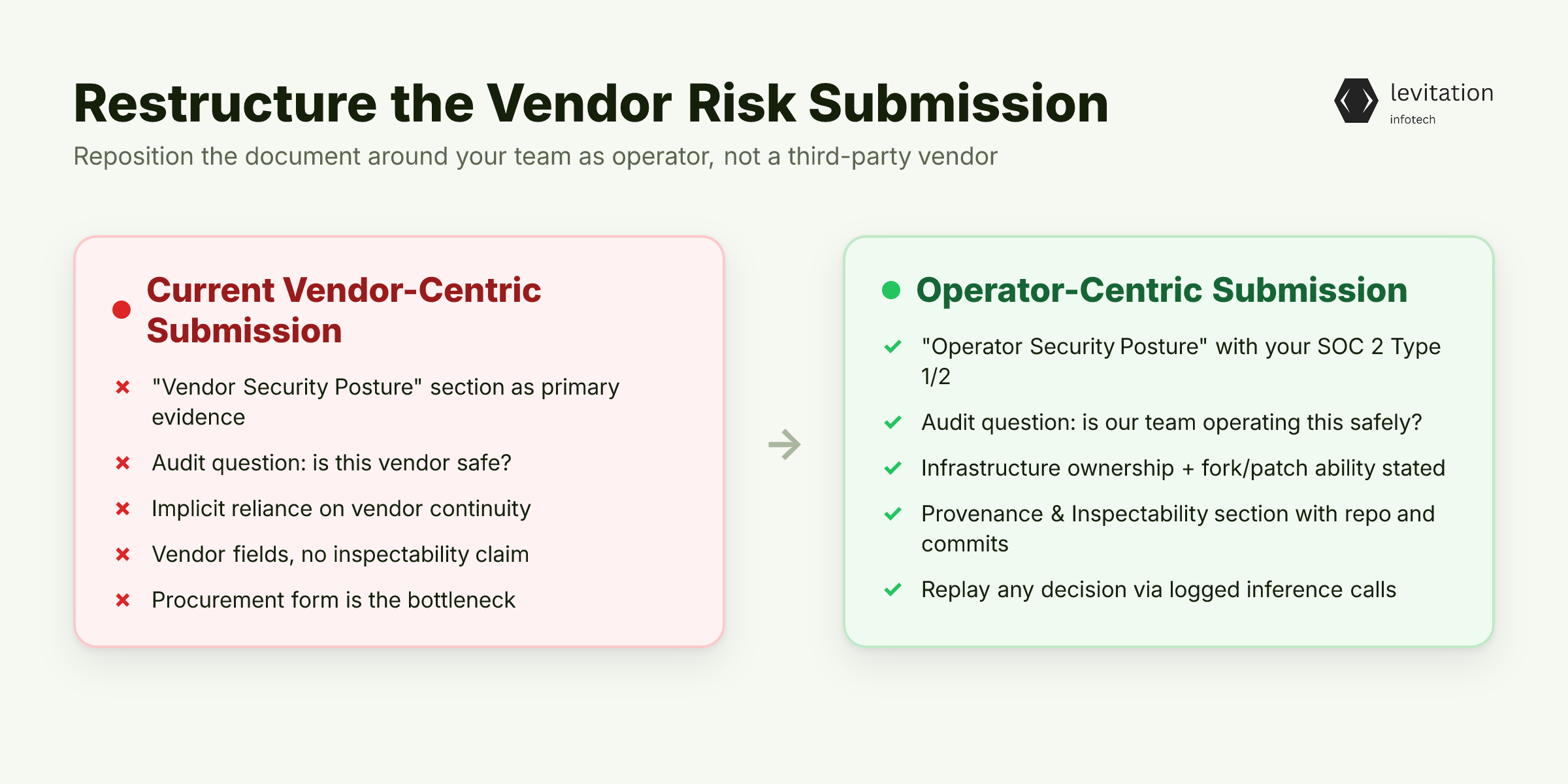
The current submission template is the bottleneck, and you control the template. Most procurement processes allow the requester to propose alternative documentation when the standard form doesn't fit. Use that clause.
Replace the "Vendor Security Posture" section with an "Operator Security Posture" section. Your team is the operator now, not a third party. Provide your own SOC 2 report. Use Type 2 if you have it, or Type 1 with a roadmap if you don't.
Document your own access controls, key management, and incident response plan. The audit question shifts. It goes from "is this vendor safe?" to "is our team operating this safely?" That second question is easier to answer.
This is the same reframe that opens up open-source agent toolkits for regulated use. This works once you stop treating them as third-party products.
Address the continuity question head-on. State your infrastructure ownership in one sentence. Then point auditors to the public repository. Show them the licence and your documented ability to fork, patch, and continue without upstream coordination.
Add a "Provenance and Inspectability" section. Show the agent framework source repository and commit history. Also include the governance tooling you use to track upstream changes.
Show your ability to replay any decision path through logged inference calls. This is the section that wins the review. It answers questions auditors didn't know how to ask. - Replace vendor fields with operator fields - Address continuity by describing your infrastructure ownership - Document provenance with links to source, commits, and governance tooling - Show how auditors can independently verify any decision
Once the submission lands, the architecture choices you locked in before the audit matter more than anything you wrote in the document. Here's what those choices look like.
Architecture Choices That Pre-Approve Your Open-Source Stack
The architecture is your real audit submission. Every choice you made during the build pre-answers a question your auditors will ask, or fails to.
Keep the data plane on your infrastructure. Only the model inference crosses a trust boundary, and even that can be self-hosted with open weights.
When auditors see that customer data, prompts, and responses never leave your VPC, the data sovereignty section of their review completes itself.
Treat audit logs as a first-class system. Immutable, exportable, queryable by your auditors without vendor assistance. Every agent invocation, tool call, and decision branch should be logged. Add enough context to replay the decision end-to-end.
This is where self-hosted platforms outperform hosted ones. The logging layer is yours to instrument, not a vendor's roadmap item.
Reference proven patterns when the architecture review lands. Open-source intelligent agents have a track record across regulated industries. They use mature frameworks used by enterprise teams. That history turns the conversation from "is this experimental?" to "why are we not standardising on it?"
Get the architecture and the submission right, and you don't just pass the audit. You change the conversation about who owns AI risk in your organization. The next move is the one most teams never make.
When Finance and Risk Both Sign: The Compound Advantage
When finance and risk both sign, something quiet but powerful happens. The same architecture that cut your cost by 75% also reduced your compliance surface area. The two goals stopped competing and started reinforcing each other.
The case grows sharper over time. Mature open-source frameworks reduce deployment time compared to building agentic infrastructure from scratch. Production systems with years of uptime prove the longevity auditors quietly want to see.
Sustained adoption across regulated industries is the market signal. It shows that open-source self-hosted agents aren't experimental anymore. They're infrastructure.
The compound effect shows up in three places: - Audit cycles shorten because your controls are visible, not contractual - Operating costs drop because infrastructure replaces per-query markups - Vendor lock-in disappears because the software and your data are already yours
This is the shift. It turns AI agents from a contested line item into a platform decision. The teams that get there first compound the advantage every quarter.
Teams that keep submitting open-source deployments on SaaS-era templates will keep losing both fights. Finance won't get the savings. Risk won't get the audit they can defend. The pattern repeats until someone rewrites the template.
Frequently Asked Questions
Are open-source AI agents actually 75% cheaper than proprietary platforms?
Once you remove per-seat licensing, token markups, and annual platform fees, self-hosted open-source AI agents run about 75% cheaper at scale. The savings come from infrastructure costs replacing SaaS margins. They compound as usage grows. You're not paying per query.
How do I get a vendor risk audit to approve open-source AI agents?
Restructure the submission around your team's role as the operator, not a vendor counterparty. Provide your own SOC 2. Document your data sovereignty. Show the agent framework's provenance. Address continuity: self-hosted source code survives vendor disappearance without an outage.
**Can self-hosted AI agents meet SOC 2 and regulatory requirements?
About the author
Mayank Singh is a software developer at Levitation Infotech, where he builds web and AI-powered applications across the company’s fintech, healthcare, and enterprise projects.