


TL;DR: Task-aware AI compression can break the audit trail when tasks discard different evidence. Control the source snapshot, task policy, compressed artifact, and final decision as one linked evidence chain.
Key Takeaways: - One filing can produce different artifacts for financial and legal tasks. - A source citation shows where evidence came from, not what the model received. - Auditability means reconstructing controlled inputs rather than explaining hidden model internals.
One Filing, Two Compressed Realities
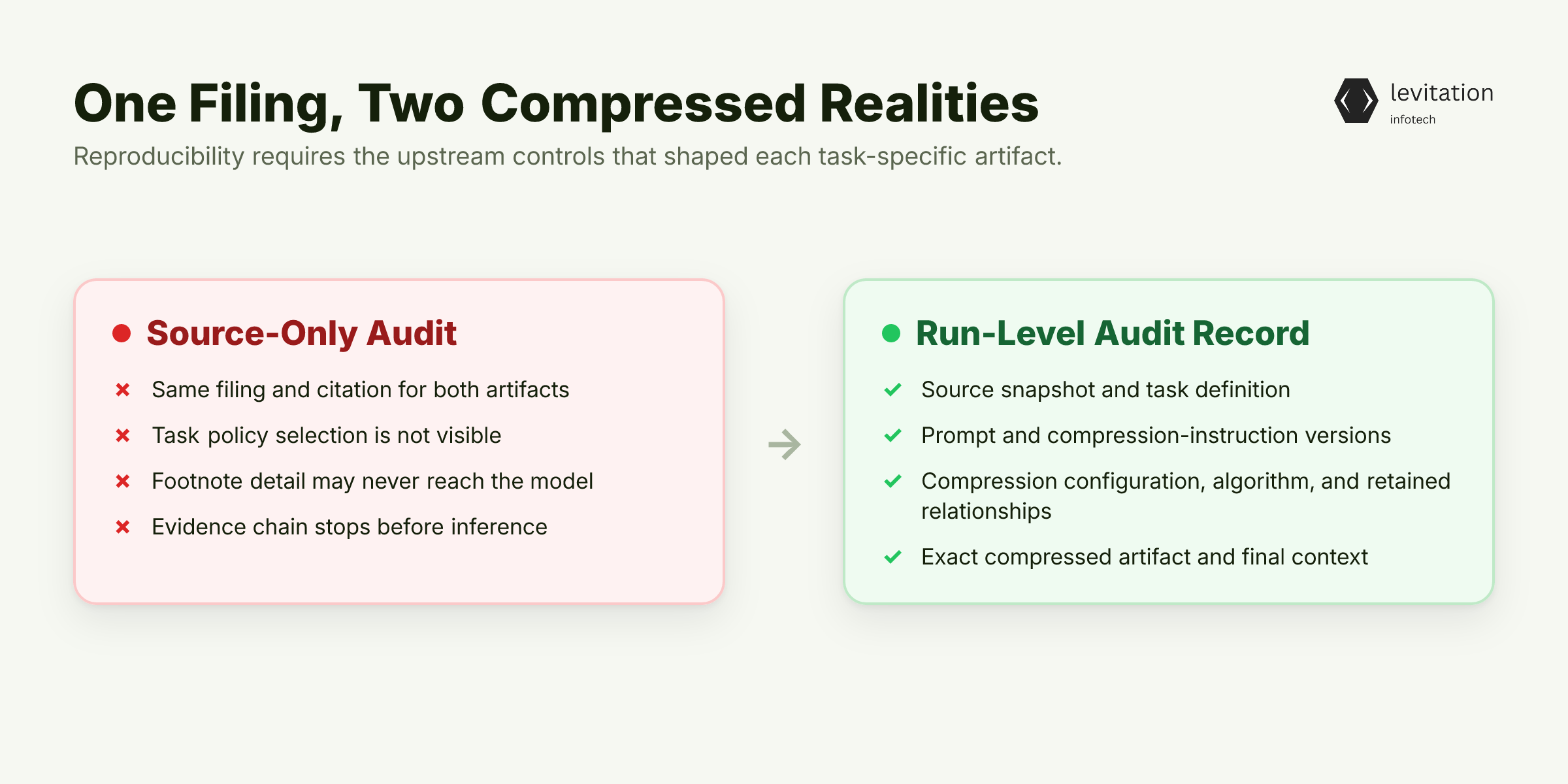
The same filing can become a financial-analysis artifact or a legal-risk artifact. The two can look nothing alike. Yet citing the filing no longer tells an auditor what evidence the model received.
The 10-K split in two
Task-aware compression makes the split concrete. A financial task can ask the compressor to retain revenue metrics, margins, cash flow, debt obligations, and risk indicators. A legal-risk task can produce a different representation of the same filing.
The source remains unchanged, but the selection policy changes.
For teams working with AI/ML training fundamentals for transformers, inference, and RAG, this difference belongs in context architecture rather than model tuning.
Which policy choices determine the evidence each model actually sees?
Relevance can weaken traceability
A financial compression can preserve revenue metrics, margins, cash flow, debt obligations, entities, and causal dependencies. A legal-risk view can instead center obligations, disputes, exceptions, and relevant entities.
Suppose a liquidity decision depends on a covenant buried in a footnote. If the task policy treats that footnote as irrelevant noise, the detail never reaches the model.
The filing still contains the detail, and the source link remains valid. The evidence chain, however, stops before inference.
What does that leave an auditor to reconstruct?
The audit surface moved upstream
The audit surface now sits in the controls that shaped the run: - The source snapshot and task definition - The prompt and compression-instruction versions - The compression configuration, algorithm, and retained relationships - The exact compressed artifact and final context
These aren't housekeeping details. They are decision inputs.
Which controls must be captured as one record?
The CTO diagnostic
Ask a blunt question: Can an auditor reproduce the evidence supplied to the model? Locating the source document isn't enough.
If both artifacts cite the same filing, why does one citation not settle the audit? Keeping the original file cannot reveal the evidence that each task discarded.
Why Keeping the Source Still Fails
Originals answer the wrong audit question
Keeping the source corpus still matters. It proves what existed and supports later verification. It does not show which facts, relationships, values, and exclusions were visible during inference.
Two analysts can open the same filing and extract different evidence. If the system retains only the filing, an auditor sees the archive rather than the decision environment. The missing record is the path from source to model.
How can an audit recover that path without recording the model's actual inputs?
Loss is task-conditioned
Loss is not a uniform cut in context. Financial and legal policies create different omissions. Each output therefore answers a different question: What mattered?
That makes enterprise AI solutions for governed context and knowledge pipelines a governance concern. Each task needs its own evidence policy. An omission can be operationally harmless and audit-critical.
When does that distinction become visible in practice?
Aggressive compression magnifies exposure
More aggressive compression sends less context to the model. It also raises the cost of a selection error.
As the output grows more selective, omitted evidence becomes harder to detect. The selection policy matters more to reconstruction.
How do retrieval and compression differ in the evidence they expose?
RAG and compression expose different evidence
Standard RAG exposes a top-k retrieval set. Task-aware compression can process documents jointly, preserve cross-document connections, and represent the broader knowledge base.
Each technique creates a different audit surface. Chunk lists reveal what retrieval selected. Compression instructions and the resulting artifact reveal what the policy tried to retain.
A reviewer needs both to reconstruct the decision. This is the same weakness described in Your RAG Citations Aren't Audit Trails.
Source-grounded retrieval is easier to inspect but narrower. Compression can be broader while making omissions less obvious.
What else can an audit miss when it focuses only on technical mechanics?
Framing is governance
The German Marshall Fund warns that narrowly technical audits can miss framing decisions that shape how an AI system functions. A task prompt makes exactly those decisions.
An instruction to preserve cash flow while omitting contingencies is not disposable configuration. It is a risk policy. It needs an owner, version, approval, and recorded scope.
Require an explicit justification for every compression choice that could exclude evidence capable of changing the business decision.
The fix is not better source citation. It is a test that proves the decision can be reconstructed from controlled inputs.
What should that test require?
Auditability Is a Reconstruction Test
Define auditability as reconstruction
A decision is reconstructible when a reviewer can recover the exact inputs and outputs behind it. That record includes the source snapshot, task definition, compression prompt, compression configuration, model path, output, and source evidence.
Anything less supports a plausible account, not proof of the actual decision.
This shifts enterprise AI context architecture and governance from access control to evidence control. It also requires AI/ML training guidance for model, inference, and attention configuration that records the actual serving path.
How can teams prove that exact chain in practice?
Audit inputs, not invented rationales
Don't promise a transparent explanation of hidden model internals. Instead, establish whether the evidence and its selection policy can be inspected and reproduced.
Three elements need scrutiny: the evidence presented to the transformer, the policy that selected it, and the resulting decision.
Explainability can produce a fluent story after the fact. That story isn't evidence. This is why Why Your Explainable AI Still Fails Its First External Audit matters here.
What minimum record can prove the actual decision?
Require a seven-part evidence chain
Store these seven elements as one linked, immutable record: - Source snapshot identifier - Task prompt version - Compression configuration and algorithm version - Compressed artifact hash - Model configuration - Final decision - Source-to-output evidence map
A manifest without a downstream decision identifier documents an experiment. It does not yet document a business decision.
How should a reviewer test that record?
Apply four audit questions
Every consequential output should answer four questions: - Was the task definition approved? - Can omissions that could affect the decision be identified? - Can the decision be reproduced, or its variance explained? - Can a reviewer trace each decisive claim to preserved source evidence?
Reject any high-stakes output whose evidence packet fails one question, even if the compressed artifact appears accurate.
How do you keep these checks separate from model and memory tuning?
Separate the compression layers
Task-aware context compression, model-weight compression, and KV-cache optimization aren't interchangeable: - Task-aware context compression changes which business evidence reaches the model. - Model-weight compression changes model capacity. - KV-cache optimization changes inference-memory usage.
The first directly changes the decision evidence. The other two still affect outputs, so their versions belong in the manifest.
This control becomes practical only if provenance is captured during compression, not reconstructed after an incident.
What must a production pipeline capture from the first run?
Build Provenance Into Every Compression Run
Create an immutable source registry
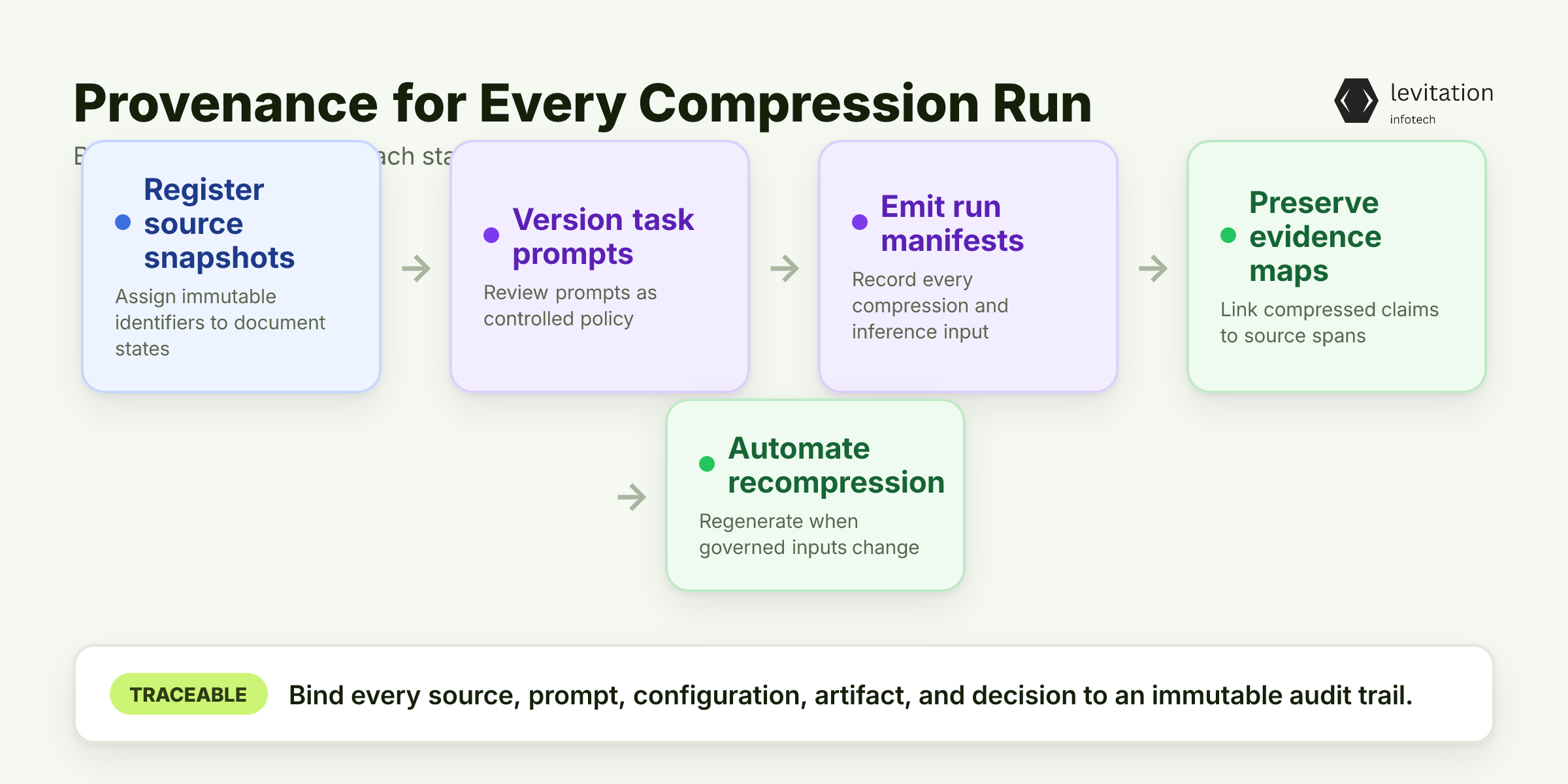
Assign every document collection and incremental update a content-addressed snapshot identifier. It shows which source state the run used, even if the live knowledge base has changed.
Store document versions and span locators with that snapshot. A filename isn't enough because the same filing can be amended or replaced.
What else must define the evidence boundary?
Version task prompts as policy
Store each task's prompt in AWS Systems Manager Parameter Store or a dedicated prefix in a versioned S3 bucket. Give the prompt a semantic version, content hash, approver, effective date, and change reason.
A prompt defines the evidence boundary. It needs the same review discipline as a control policy. That is where enterprise AI implementation patterns for auditable production systems matter more than a successful notebook demo.
How do you bind that policy to each run?
Emit an immutable run manifest
Every compression run should record: - Source snapshot and task type - Prompt identifier and hash - Compression configuration and algorithm version - Compressed artifact hash - Model identifier and inference configuration - Timestamp and downstream decision identifier
The model and inference fields must also reflect AI/ML training and inference practices for production pipelines. A decision isn't reproducible if its serving path is a mystery.
How will a reviewer connect the manifest to the evidence inside it?
Preserve an evidence map
Link retained numerical facts, entities, key attributes, causal relationships, and dependencies to their original document and span. Store this map separately from the compressed interpretation.
That separation prevents a reviewer from mistaking the summary for the source. It also lets someone inspect how a relationship was represented without rewriting the compressed artifact.
What should happen when any of these inputs changes?
Automate recompression
Trigger regeneration when the source snapshot, task prompt, or compression configuration changes. Preserve both the prior and new artifacts.
This distinction matters during incidents. A reviewer must separate a prompt-policy change from an underlying data change. Otherwise, every difference looks like data drift.
How should risk determine how much context to retain?
Apply decision-risk gates
Use workload guidance as a starting point, not a safety certificate. Match compression aggressiveness to task complexity.
Preserve more context for multi-step and cross-document reasoning. Factual questions can use a narrower view when decisive claims are easy to verify against the source.
For financially consequential decisions, use lighter compression, stronger source verification, and independent review. Less aggressive compression isn't automatically safer if its prompt remains unreviewed.
How will teams detect failures that appear only after deployment?
Monitor provenance failures
Alert on several specific failures: - Missing manifests - Prompt drift - Unlinked evidence - Silent compression-configuration changes - Artifacts that don't match a final decision
Make complete provenance a release condition, not a reporting afterthought. A pipeline that can produce answers but can't reconstruct them hasn't reached production.
A durable pipeline changes what task-aware compression means as a RAG alternative. That comparison must include audit burden, not just token reduction.
How should teams compare the evidence each method exposes?
RAG Alternatives Change the Evidence Model
Compare techniques by what they change
Enterprise AI solutions for RAG alternatives and governed knowledge access should separate these techniques before choosing one: - Standard RAG changes the retrieved context. - Task-aware compression creates a task-conditioned representation of the knowledge base. - Model compression changes model capacity. - KV-cache optimization changes inference-memory usage.
Many comparisons collapse them because each can reduce resource use. Auditors care about which technique changes the evidence.
What does that difference mean for retrieval and compression?
Understand the RAG trade-off
Standard RAG makes its selected chunks inspectable, but it exposes only a top-k view. Task-aware compression can jointly represent the entire knowledge base and preserve connections across documents.
That broader view can improve synthesis while making omissions less obvious. It supports the argument in RAG Won Retrieval. The Real Enterprise AI Problem Is Decisions.
Source-grounded retrieval solves visibility, while decision systems still need broader context and stronger controls.
Does broader coverage remove the need for source-level verification?
Use a hybrid verification pattern
A hybrid pattern separates analysis from final verification:
- Task-aware compression creates the analysis workspace.
- Original passages are retrieved for decisive claims.
- A verifier compares claims with source evidence and the evidence map.
- The decision proceeds only when the evidence agrees.
Retain the compressed artifact, retrieved passages, and verification result. This gives high-stakes decisions both cross-document context and source-level confirmation.
When is that extra control worth its cost?
Choose by workload and risk
Use task-specific compression when cross-document reasoning and context efficiency justify the added governance. Don't treat it as an automatic replacement for source-grounded retrieval, and don't discard the originals.
Evaluate alternatives on evidence completeness, reconstruction speed, cross-document coverage, and exception handling. Include answer quality and token reduction, but don't let them dominate the score.
Once the evidence model is explicit, the adoption decision should follow business risk rather than the most aggressive compression ratio.
What control level should each risk class receive?
Adopt by Decision Risk, Not Token Savings
Assign control intensity to the decision
Control intensity should reflect the consequence of a wrong decision: - Low-risk exploration: Permit aggressive compression and lightweight review. - Operational recommendations: Require source-linked evidence for decisive claims. - Regulated or financially consequential decisions: Require lighter compression, independent review, and complete provenance.
Compression ratio is an engineering choice. Control intensity is a governance choice.
How can teams prove those controls work in practice?
Measure auditability directly
Track whether outputs have complete manifests and source-span coverage for decisive claims. Measure the time required to reconstruct a decision. Count silent prompt changes and exceptions in high-risk workflows.
These measures reveal governance debt before an incident does. They also expose tasks where compression savings don't justify the review burden.
Can a pilot test that burden against a current workflow?
Pilot against a decision workflow
Compare task-aware compression with the current RAG or full-context process for one decision family. Measure decision quality, evidence completeness, reconstruction time, and review effort.
Use real source updates and deliberate prompt changes during the pilot. An artifact that looks accurate under stable inputs doesn't prove the system can handle policy drift.
What makes one vendor or architecture easier to trust than another?
The payoff is controlled efficiency
A compact enterprise AI context can support cross-document reasoning without creating a disposable audit trail. The objective is enterprise AI systems with long-term production support, supported by AI/ML training and model operations for production AI.
Use implementation maturity as buying evidence. Look for regulated delivery experience, systems maintained in production for years, and a build cycle shorter than an in-house reconstruction.
The adoption decision now comes down to one test: Can the evidence survive the decision?
Before adoption, what does task-aware compression actually change?
Frequently Asked Questions
What is task-aware AI compression?
Task-aware AI compression transforms the same source corpus into task-specific representations. It preserves facts, entities, relationships, and dependencies needed for a declared task while removing redundancy.
Unlike weight distillation or KV-cache compression, it changes the enterprise AI context the model receives. The task prompt and compression policy therefore become decision evidence.
Why does task-aware AI compression reduce decision auditability?
Task-aware compression can omit different facts, relationships, and exceptions for different tasks, even when they use the same source corpus. A source citation therefore cannot prove which evidence reached the model. The audit trail must link the task policy and compressed artifact to the final decision so the actual input can be reconstructed.
About the author
Mayank Singh is a software developer at Levitation Infotech, where he builds web and AI-powered applications across the company’s fintech, healthcare, and enterprise projects.