


TL;DR: Tokenization can contain the impact of a database breach while live-card misuse, wallet provisioning fraud, and refund abuse continue. Secure payments need separate controls for token lifecycle, transaction authorization, and refund entitlement, backed by end-to-end evidence.
Key Takeaways: - Token validity proves a credential representation, not the legitimacy of the person or request. - Token lifecycle events and contextual checks protect provisioning and device-binding paths. - Refund approval needs its own identity, order, policy, and step-up controls.
Tokenization Reduces Exposure, Not Fraud
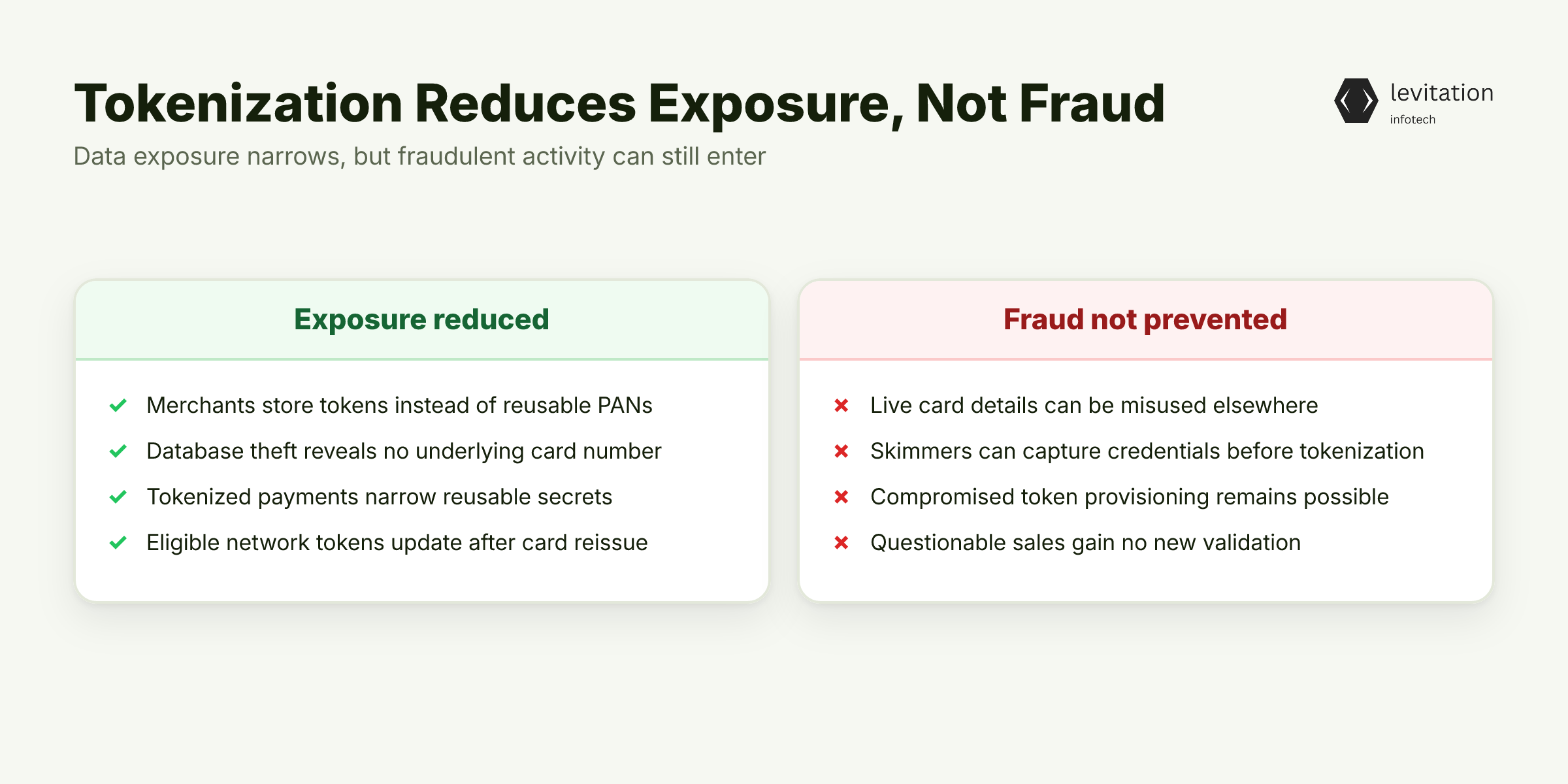
Tokenization can remove reusable card numbers from merchant systems. Fraud can still involve a live card, compromised token provisioning, or an abusive refund. That is not a contradiction. It is the hidden boundary inside most tokenization programs.
The breach win
In a typical merchant-token flow, the merchant stores a unique token. The token service retains the secure mapping needed for payment processing.
Consider an order database containing token TKT-4831 instead of the customer's PAN. An attacker who steals those database records doesn't learn the underlying card number. The payment tokenization architecture separates the merchant's reference from the protected card data.
That separation reduces exposure of card data at rest and in motion. It also gives tokenized card payments a narrower reusable secret to protect.
The token's actual usability still depends on its scope and binding. Don't assume every stolen token is globally usable. Treat token validity and token usefulness as separate properties. That leaves a harder question: what can a valid token still do?
The boundary
Tokenization doesn't stop someone who already has real card details from misusing them elsewhere. It doesn't stop a card skimmer from capturing live credentials before tokenization. It also adds no validation to a questionable sale.
Card reissue exposes another important nuance. Eligible network tokens can update after a bank replaces a card. Recurring charges continue against the updated token instead of failing because the merchant stored a stale PAN.
Your architecture, vendor requirements, and risk register should use one precise scope statement:
Payment tokenization reduces exposure to reusable card data by replacing PANs with tokens in defined merchant and transmission paths. It is not a complete payment fraud prevention control.
Once the reusable-data breach path narrows, the next question is where fraudulent activity can still enter.
Where Fraud Moves After Card Data Disappears
Consider a criminal adding someone else's card to a wallet they control. If provisioning checks are weak, the system can create a valid token linked to the victim's card. The tokenized path can then process a fraudulent relationship as if it were legitimate.
Provisioning and device binding
Device binding changes the mechanics, not the boundary. A device-bound token can resist simple copying. Risk persists when an attacker controls the device, steals device-held credentials, or abuses enrollment itself.
This is why token lifecycle security must cover creation, binding, activation, updates, and revocation. Basic data tokenization protects the stored representation. It doesn't establish who requested it, on which device it was created, or whether the request was legitimate.
The open risk is enrollment: who requested the token, and on whose device was it created?
The live-card path
A token is a handle to an account. The underlying card account still exists and can remain usable through another channel.
If a skimmer captures live card details, those details can be misused before any tokenization process occurs. Tokenization cannot protect an account from misuse that never passes through the tokenized environment.
Payment teams therefore need payment fraud prevention for issuer risk signals, transaction behavior, and account context. Token validity cannot replace those signals. The next risk sits on the other side of the payment flow: the refund.
The refund path
Refunds expose a different gap. A valid token can identify the original payment instrument without proving that the person requesting money back is entitled to it.
A customer account compromise can expose a genuine order and its token. The request can look valid at the payment layer while lacking legitimate entitlement at the business layer.
Build an abuse-path map covering four distinct routes: - Wallet provisioning: Who requested the token, and why? - Device binding: Does the device and account match the expected customer context? - Live-card transactions: Is the underlying account being misused outside the tokenized path? - Refunds: Do the claimant's identity and request match the order state and merchant policy?
Don't mark a flow protected merely because it uses a token. To avoid disconnected countermeasures, the team needs one model that separates token proof from every authorization decision. The key question is where each decision belongs.
Separate Token Proof From Authorization Decisions
A token answers a narrow question: which protected card representation should this payment flow use? It doesn't answer whether the customer, device, transaction, or refund request deserves approval.
Data plane
The data plane governs how reusable card data is stored or transmitted. Its strongest claim is about exposure of that data.
In this plane, tokenization can remove PANs from merchant databases and network-facing applications. That remains valuable even when stronger fraud controls sit elsewhere.
The data plane does not decide whether a purchase is genuine. It cannot determine whether a wallet enrollment belongs to the named customer. Authorization needs a separate decision path.
Those authorization questions belong in a different plane.
Decision plane
The decision plane contains several different questions: - Should this transaction be approved? - Should this device be provisioned? - Should this recurring charge continue? - Should this refund be paid?
Each question needs its own evidence and accountable owner. Treating one approval response as proof for every later action creates a dangerous dependency.
Broader payment automation makes this separation more important. Agentic payment systems can break fraud controls before launch when implicit assumptions replace explicit decisions. Control ownership must keep the split intact. That requires a named owner for every decision.
Control ownership
The token service provider manages token generation, mapping, and status, while the issuer participates in account authorization. The merchant owns its business and refund rules. The fraud-prevention layer evaluates context beyond token validity.
This responsibility split is central to payment control-plane design. It also clarifies why payment tokenization belongs in the data plane rather than serving as the entire fraud decision.
Create a flow-control matrix with these columns: - Flow - Exposed asset - Tokenization control - Additional fraud control - Signal source - Owner - Incident response
Apply it to checkout, card-on-file transactions, wallet provisioning, and refunds. Then test the matrix with a card reissue. An eligible token update should preserve recurring payments, while each layer checks that the update and transaction remain expected.
That model becomes operationally useful only when engineers can trace every meaningful state change in a token's lifecycle.
Make Token Lifecycle Events Observable End to End
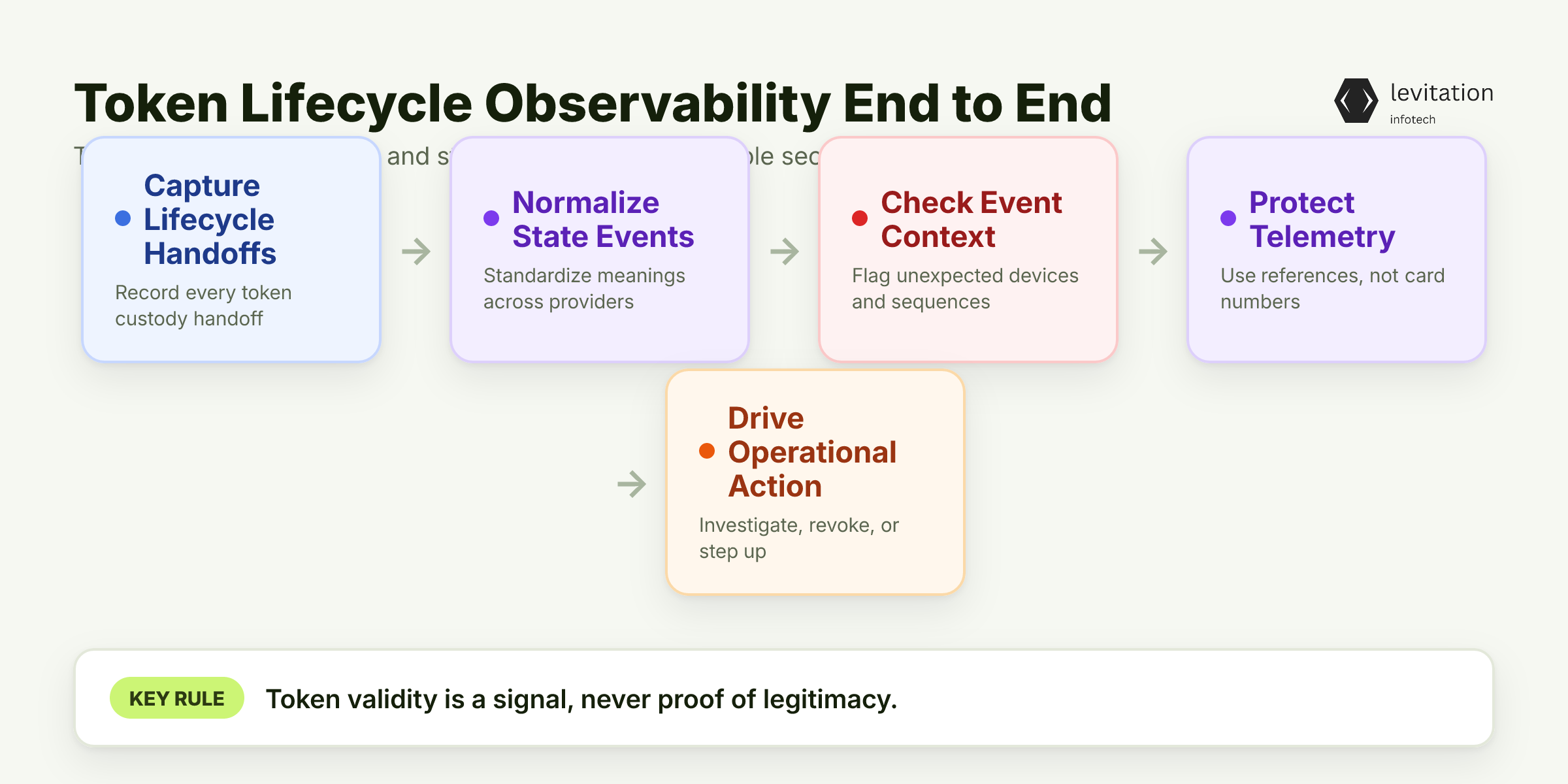
A token can remain technically valid while its context changes in dangerous ways. Without lifecycle events, the team sees a successful transaction but misses the suspicious path that created it.
Creation and binding
Instrument the path your customers already use:
- The customer adds a card.
- The token requestor asks the token service provider for a token.
- The merchant or wallet stores the token.
- Subsequent payment requests use the token instead of the PAN.
Capture events at each handoff. These events reveal where provisioning behavior changed, even when the final payment succeeds. The next question is which state changes matter.
State changes
Record token creation, activation, first use, device or account binding, lifecycle updates after reissue, deactivation, and failed provisioning or transaction attempts. Provider and network event names will differ, so normalize meaning rather than copying labels. Context checks turn those state changes into useful evidence.
That makes event context the next control point.
Contextual checks
Alert when a token appears in an unexpected device or account, or when use falls outside its intended context.
Other useful signals include suspicious provisioning sequences and mismatches between token and customer context. Treat token validity as one signal, never as proof of legitimacy. The remaining question is how to capture it all without exposing another reusable secret.
Telemetry design
Use a normalized event schema containing a token reference rather than a PAN. Include the event type, timestamp, customer or account reference, device context, provider correlation identifier, and outcome.
Protect token references as sensitive operational data. They can reveal payment relationships even when they don't expose the card number. The next step is turning that telemetry into action.
Operational action
Give fraud operations a dashboard that separates provisioning events, transaction use, and lifecycle updates. Pair every alert with an investigation, revocation, or step-up review path.
That matters because fraud detection is instant while containment remains a manual queue in many operating models. Detection without a prepared response simply creates a faster backlog.
Lifecycle visibility protects the token path, but it still can't decide whether a legitimate-looking refund request should be paid.
Make Refund Approval a Separate Fraud Decision
A settled payment records what happened. A refund asks a different question: should money return now to this claimant?
Separate entitlement from payment validity
Refund eligibility depends on customer identity, account and order state, original payment status, merchant policy, and refund context. Token validity does not settle any of those checks.
A token can confirm that a payment instrument maps to an original transaction. It can't confirm that the requester made the purchase or that the purchase qualifies for reimbursement. Entitlement still needs its own decision.
Which records can establish it?
Progressive controls
Build refund approval as a separate service or policy layer. The decision path should work as follows: - Approve automatically when identity, order state, payment status, and policy all match trusted records. - Route ambiguous requests to step-up review. - Reject unsupported requests and record the reason. - Write every outcome to an immutable audit trail.
The service checks identity, account, order, original payment, policy, and context. It then approves, requests step-up, or rejects. A settled tokenized payment doesn't automatically make its refund legitimate.
This boundary is the core of refund fraud prevention. It also gives auditors evidence that isn't blended into a single generic payment score. Refund controls must not sit on the payment authorization path.
That separation must hold when exceptions arrive under pressure.
Protect legitimate payment continuity
Keep tokenized recurring payments and card-reissue handling on the authorization path. Route refund exceptions independently.
A legitimate network-token update shouldn't become suspicious merely because the underlying card was reissued. Verify the expected update, inspect its context, and monitor any fallback to the underlying card.
This separation protects tokenized recurring payments while preventing refund controls from degrading legitimate charges. The final proof belongs in a test matrix.
Test matrix
Exercise these scenarios and record the expected control and accountable owner: - Stolen card data: Tokenize wherever possible, while issuer and fraud controls monitor live credentials. - Live-card misuse: Apply issuer risk rules and account-level fraud monitoring. - Fraudulent wallet provisioning: Use enrollment checks, step-up challenges, and revocation readiness. - Stolen device-bound credentials: Validate device binding, revoke access, and replace compromised credentials. - Card reissue: Accept an expected lifecycle update without generating a false alarm. - Legitimate recurring charges: Preserve authorization and retry continuity. - Abusive refund requests: Evaluate entitlement, order state, policy, and step-up review.
Payment success, token lifecycle health, and refund disposition should generate distinct evidence. The final test is whether these controls remain operable, measurable, and durable in production.
Put Controls Into Practice and Measure Results
Architecture fails at handoffs. A healthy token does not prove that an approved transaction or requested refund is legitimate. Each outcome needs an owner who can act.
Named ownership
Assign accountable owners for: - Token operations - Fraud decisions - Refund policy - Provider escalation - Incident response
Define service levels for provisioning failures, lifecycle-event delays, refund reviews, and false-positive corrections. Each service level needs a measurement method, escalation path, and recovery path. Without owners and service levels, measurement has no clear action. The next question is which outcomes those owners should track.
Measure outcomes, not promises
Track operational results across each flow and provider: - The share of payment flows without PAN in merchant scope - Token lifecycle event coverage - Time to detect provisioning anomalies - Refund step-up rates - False positives - Recurring-payment failures following reissue
Treat false positives with the same discipline as an error budget for your fraud model. A lower alert count isn't automatically better if legitimate payments suffer.
The payoff isn't zero fraud. It's narrower exposure of card data, visibility into token-lifecycle abuse, and a refund process capable of resisting abuse without degrading legitimate tokenized payments. The remaining task is to turn those measures into a strict architecture checklist.
Partner selection and the CTO checklist
Use this checklist: - Define tokenization's narrow guarantee. - Map the remaining abuse paths. - Instrument token state changes. - Separate refund entitlement. - Assign named owners. - Test the combined system before declaring payment fraud prevention complete.
The checklist leaves one final operational question: can the controls still work when providers change, tokens rotate, and refunds arrive under pressure?
Frequently Asked Questions
Does payment tokenization prevent refund fraud?
No. A refund can exploit a legitimate payment relationship without exposing a PAN. Token validity cannot establish refund entitlement.
Payment teams need separate identity, account, order, and workflow controls, with step-up review and an audit trail.
Can a stolen payment token be used at any merchant?
It depends on the token's scope and binding, so a token should never be assumed to be globally usable. A compromised provisioning or device-binding flow can still create serious risk.
That's why lifecycle telemetry, revocation procedures, and contextual checks matter.
Does tokenization stop card skimming?
No. Tokenization can protect card data at rest and in transit when it replaces PANs throughout those paths. It cannot prevent a skimmer from capturing live card details before tokenization.
Source acquisition and misuse of the live account therefore require separate controls.
Do payment tokens still work after a card is reissued?
For eligible network-tokenized recurring payments, the token can update automatically when the bank reissues the card. This prevents failures caused by a stale stored card number.
Can a payment architecture review test whether owners can still act when providers change, tokens rotate, and refunds arrive under pressure?
About the author
Mayank Singh is a software developer at Levitation Infotech, where he builds web and AI-powered applications across the company’s fintech, healthcare, and enterprise projects.