


TL;DR: Real-time fraud detection prevents loss only when its decision becomes an effective control. Build an event-driven response layer that prioritizes actions, sets deadlines, executes safely, and confirms containment from the authoritative payment system.
Key Takeaways: - Measure time from the transaction event to confirmed control, not model latency alone. - Treat containment as a stateful workflow with deadlines, idempotency, and reconciliation. - Let risk teams activate versioned policies without waiting for software releases.
A Fast Fraud Decision Can Still Leave the Payment Exposed
A score returns in milliseconds, but the hold request sits in a shared queue. The bank already knows. It hasn't acted.
The model can identify a suspicious card transaction inside the authorization window while the hold request waits. Speed alone leaves the payment exposed.
Think of two separate planes: - Detection plane: Calculates risk from available signals. - Response plane: Turns risk into an effective hold, cancellation, step-up, or escalation.
Latency measures only the first plane. A decision can fit the authorization budget and still fail to prevent fraud because execution waits.
Speed can also be cosmetic. A score computed from features built overnight returns quickly, but describes yesterday's customer. Freshness and actionability need separate measurements, as do latency and containment.
This is the trap behind streaming SQL dashboards that look current.
Time-to-containment closes the gap. It starts at the originating transaction event. It ends when the authoritative system confirms that the intended control is active.
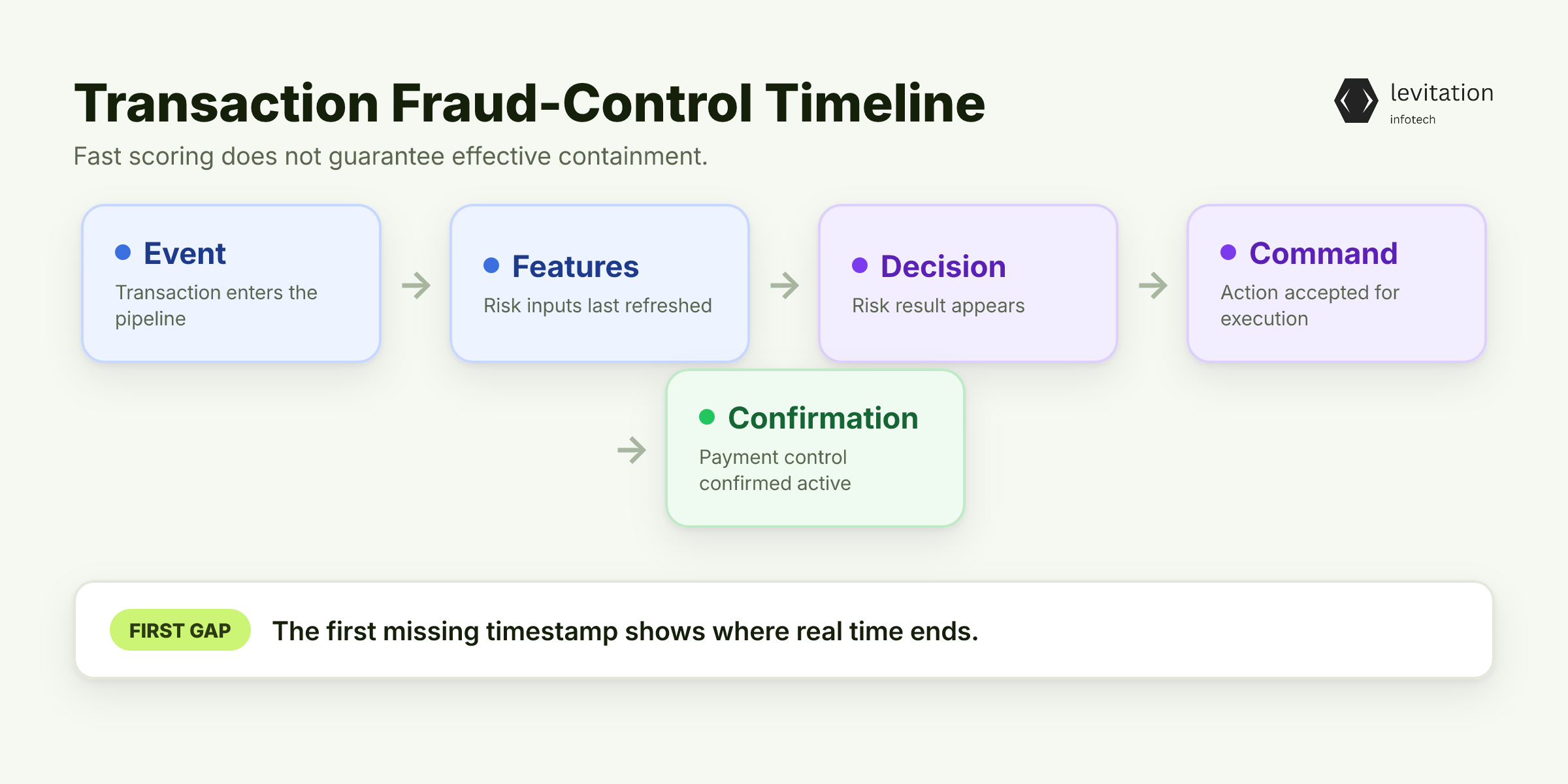
Run this diagnostic on one suspicious transaction: - Event: When did the source record enter the pipeline? - Features: When were its inputs last refreshed? - Decision: When did the risk result appear? - Command: When was an action accepted for execution? - Confirmation: When did the payment system confirm the control?
The first missing timestamp marks where real time ends.
Use the event-driven fraud pipeline to connect detection and containment. Treat the model endpoint as one stage, not the end of the workflow.
If the delay sits after the model, why does the response path keep breaking down under operational pressure?
Why Faster Models and More Reviewers Do Not Clear the Queue
A faster model shortens scoring. Another reviewer adds capacity. Neither removes the hand-offs, retries, missing context, and ownership gaps inside the containment queue.
Those gaps become harder to ignore during an incident. This is the production gap behind why event-driven banking wins demos and fails in production.
Most dashboards collapse four different clocks into one: - Event time: When the transaction or signal occurred. - Decision time: When the risk result was produced. - Containment-command time: When an action entered the execution path. - Effective-action confirmation time: When the authority confirmed the control was active.
These clocks describe different obligations. A fast decision with a slow confirmation isn't real-time containment.
Manual queues become especially dangerous during fraud incidents. Alert volume rises and context splits across systems. The highest-risk case can wait behind lower-value work.
The response policy should use progressive friction, not one binary decision: - Allow: Normal activity can proceed. - Step-up: Customer verification can resolve uncertainty. - Hold: Credible risk needs control before payment release. - Manual review: Evidence is ambiguous or the proposed action has high impact. - Account freeze: Activity suggests wider account compromise.
Treat these responses as distinct operations. Prioritize queue entries by: - Action urgency. - Reversibility. - Customer impact. - Decision confidence.
Instrument the stream-processing architecture for event lag, decision age, queue age, execution failures, and stale feature windows before redesigning the response layer. Separate execution failures from model errors. They need different owners.
The answer is not another analyst or a faster model. It is to make the response itself a first-class event-driven workflow. What does that workflow look like when several payment actions compete at once?
Build Fraud Response Orchestration as an Event-Driven State Machine
The response path should behave like a state machine, not a chain of screens and email alerts.
Start with six components: - Decision producer: Produces the risk result and supporting reasons. - Policy evaluator: Selects the permitted action for that result. - Response orchestrator: Tracks deadlines, ownership, retries, and escalation. - Payment-action adapters: Execute holds, blocks, cancellations, or freezes. - Human-review service: Handles ambiguous or high-impact cases. - Authoritative confirmation service: Verifies that the requested control is active.
Kafka can serve as the event backbone for transaction attempts, failed logins, device changes, and spending velocity. Flink can maintain correlated state as those events arrive. These are representative technologies, not mandatory products.
Represent the workflow with explicit states and transitions:
1observed -> scored -> decisioned -> command_issued -> contained2command_issued -> failed -> escalated3command_issued -> unknown -> reconciliation -> contained / failed / escalated
Any decision can branch to `escalated`. An explicit rejection moves to `failed`. A missing executor response moves to `unknown`, then reconciliation.
Unknown is essential. It prevents false optimism and unsafe duplicate actions. A missing response proves neither failure nor success.
Publish canonical events such as: - fraud.decision: Includes the score, reasons, model version, policy version, deadline, and correlation identifiers. - containment.command: Includes the requested action, reason code, deadline, idempotency key, and policy version. - containment.result: Includes the executor outcome, authoritative confirmation, and matching correlation identifiers.
Preserve ordering where it matters. Correlate events around an account, device, and transaction while independent payment streams continue concurrently.
Do not assume end-to-end exactly-once delivery across the broker, processor, policy engine, and external payment API. Use transactional publication, idempotent consumers, and durable command receipts to make retries safe. The delivery caveat in Flink's exactly-once limits with Kafka transactions still applies here.
An issued command isn't proof of containment. The authoritative payment or account system must confirm that the hold, block, or cancellation is active. Reliable containment depends on the discipline behind data engineering services, not just a model endpoint.
A state machine shows where the response stands, but it doesn't define how quickly each response must land. Which deadline belongs to each action?
Give Holds, Step-Ups, and Cancellations Separate Deadlines
A state machine without deadlines is only a pretty audit trail.
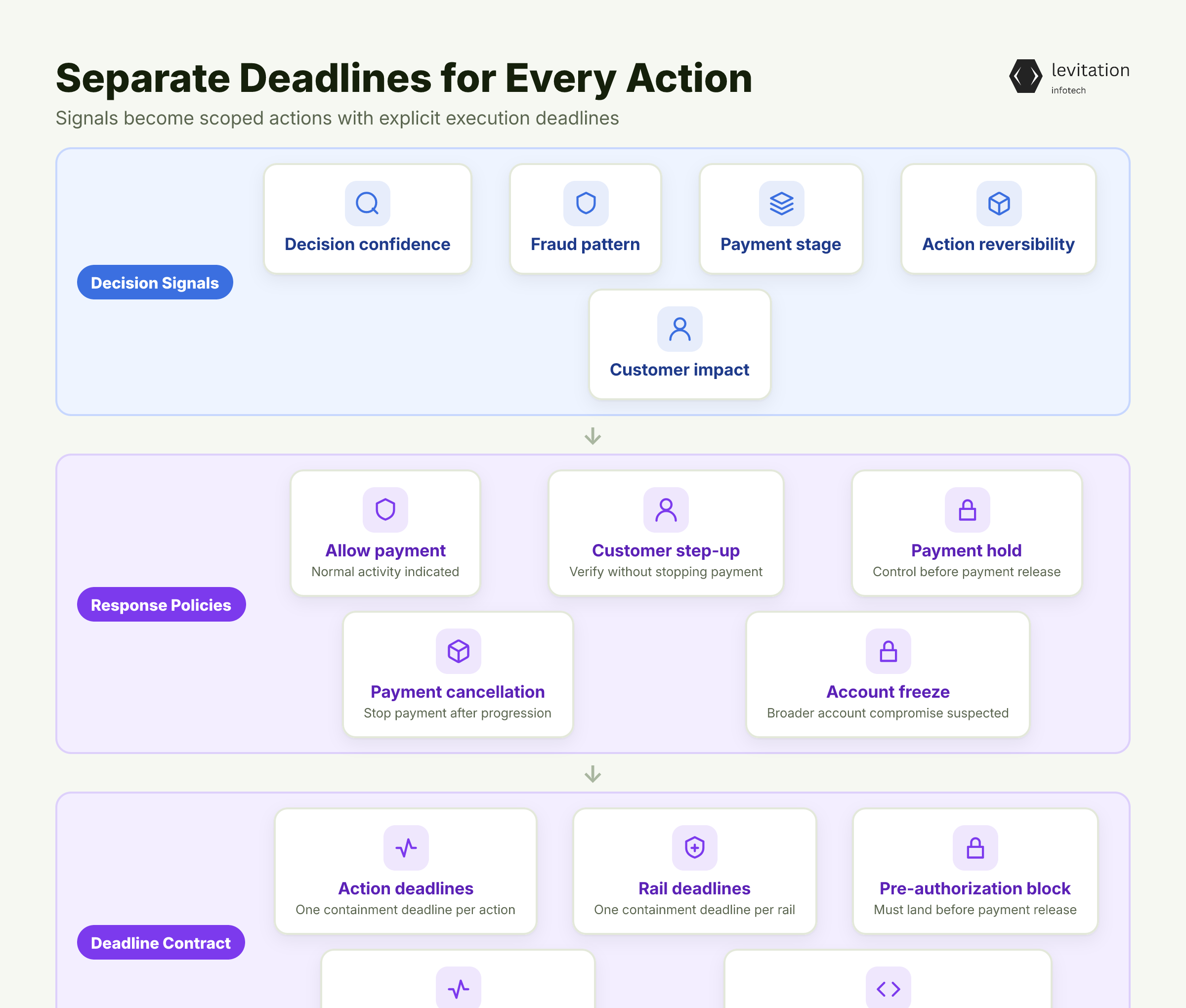
Map decision confidence, fraud pattern, payment stage, reversibility, and customer impact to distinct responses: - Allow: Evidence and customer impact indicate normal activity. - Step-up: Customer verification can reduce uncertainty without stopping the payment. - Hold: Credible risk requires control before payment release. - Cancellation: The payment has progressed, and evidence supports stopping it. - Account freeze: Activity suggests broader account compromise. - Manual review: Evidence is ambiguous, or the proposed action carries high impact.
These actions aren't interchangeable. Payment stage changes the answer. So do reversibility and customer impact.
Set a separate containment deadline for every action and payment rail. A pre-authorization block must land before release. A post-authorization response must minimize the window of continued exposure.
Every executor should receive an unambiguous contract. A compact containment command carries: - transaction_id: Identifies the attempted payment. - customer_id: Identifies the affected account. - action: Specifies the requested control. - reason_code: Explains the policy basis. - policy_version: Identifies the rules used for the decision. - deadline: Defines when the action must take effect. - idempotency_key: Prevents duplicate execution during retries.
Use a payment-blocking adapter instead of embedding processor-specific calls in the model service. The adapter normalizes commands, enforces timeouts, and returns structured outcomes.
Treat an unknown execution outcome as a reconciliation case, not a routine retry. Query the authoritative system before replaying. Never replay an irreversible command blindly after a lost response.
Trigger proportionate customer communication alongside containment. Step-up verification, transaction confirmation, and account-protection notices should belong to the same workflow.
Route manual review to a queue only when automated containment is unsafe or insufficiently certain. Attach the evidence, decision context, policy version, and recommended action. Investigators should decide, not rebuild the case.
Publish every command and result to the real-time data pipeline for operational telemetry and immutable audit reconstruction. This becomes more important as agentic payments expose gaps in existing fraud controls.
Even an excellent orchestrator becomes a bottleneck if every pattern change waits for an engineering release. So where should policy control live?
Change Fraud Policies Without Waiting for an Engineering Release
Separate the policy control plane from the model release cycle. Routine rule and threshold changes should use a controlled activation workflow. Risky model releases can still require formal review.
Every policy version needs: - An accountable owner. - A clear rationale. - An approval record. - An effective time. - An expiry or review date. - A defined rollback target.
A response must remain reproducible against the policy that produced it. Otherwise, investigators cannot explain why the system held one payment and allowed another.
Activate changes through four stages:
- Replay: Test the proposed policy against representative event history.
- Shadow: Run it without affecting live containment decisions.
- Canary: Enable it for a controlled cohort and monitor outcomes.
- Broad activation: Expand the policy only after its evidence holds.
Define automatic rollback triggers before release. Watch containment errors, customer-impact indicators, and decision-distribution changes. Don't wait for a human to discover that the new policy is causing harm.
Keep model governance intact. A policy adjustment reacting to an emerging pattern doesn't need the same release cycle as a new model. But it still needs ownership, evidence, and control.
Provide an emergency stop that disables one action or policy version. The broader event-driven system must keep running while responders disable or roll back the change.
Use this activation checklist: - Owner. - Scope. - Test evidence. - Approval. - Canary cohort. - Monitoring window. - Rollback procedure.
Event-driven deployment lets risk teams react without turning every policy adjustment into a software release. It preserves auditability while reducing the wait for an engineering cycle.
Once containment is measured end-to-end, the dashboard reveals which operational bottleneck deserves attention first. Which bottleneck will your first distribution expose?
Measure Time-to-Containment, Not Just Time-to-Decision
Most fraud dashboards stop at decision latency. That's like measuring order-entry speed while delivery vans wait outside.
The executive metric is the distribution of time from the transaction event to effective containment. Report it by: - Payment rail. - Action type. - Region. - Risk segment.
Pair that metric with diagnostic measures: - Freshness: Event lag and feature freshness. - Decision: Decision latency and decision age. - Response: Command dispatch, queue residency, adapter success, and unknown outcomes. - Operations: Manual-review resolution and policy-change lead time.
Assign clear SLO ownership: - Engineering: Pipeline availability. - Fraud strategy: Decision quality. - Operations: Review throughput. - Payment operations: Authoritative action confirmation.
This also keeps fraud model error budgets honest. A model can perform well while the response system loses the value of its decision.
Create runbooks for action-adapter outages, delayed payment confirmations, late events, policy rollback, and overloaded review queues. Exercise them before an incident forces the lesson.
The operational payoff is straightforward. Real-time fraud prevention becomes genuine. Customer friction stays bounded.
Teams adapt faster. Auditors can reconstruct every signal, decision, command, and result.
Vendor claims need the same discipline and two columns: fraud-performance evidence and production-operations evidence.
Frame the data infrastructure decision around durability and operability across the full decision-to-action chain. Model availability alone won't answer the harder question. Which stage loses time first?
Frequently Asked Questions: Real-Time Fraud Containment
Q: What is the difference between real-time fraud detection and real-time fraud prevention?
A: Detection identifies suspicious behavior. Prevention ensures the resulting hold, block, cancellation, or step-up becomes effective within the transaction's risk window. A fast score is insufficient if its data is stale or its response waits in a manual queue.
Q: What is fraud response orchestration?
A: It converts a risk decision into a governed action. It also confirms that the payment or account control took effect. It coordinates policy, executors, customer communication, review, retries, reconciliation, and audit evidence.
Q: How can an institution automate payment blocking without blocking legitimate customers?
A: Use graduated actions: - Allow low-risk activity. - Challenge uncertain activity. - Reserve holds and cancellations for stronger evidence.
Add idempotency, authoritative confirmation, policy versioning, and rollback controls. Automation stays safe only when its boundaries are explicit.
Q: How quickly should fraud containment happen?
A: The deadline depends on the payment rail, authorization stage, and reversibility of the action. Define it per transaction class rather than imposing one universal target. Measure the full distribution of time-to-containment.
Q: Can manual review remain part of a real-time fraud prevention system?
A: Yes. Clear cases should receive automated, time-bound responses. Human review should handle genuinely ambiguous or high-impact cases.
Which deadline, owner, and failure mode are missing from your current operating model?
About the author
Mayank Singh is a software developer at Levitation Infotech, where he builds web and AI-powered applications across the company’s fintech, healthcare, and enterprise projects.