


TL;DR: A Neo4j 4.0 cluster can stay healthy while its patient graph tells the wrong clinical story. The engine cannot decide which records identify the same patient, repair stale relationships, or create missing provenance. Govern identity, time, evidence, and release gates before scaling clinical decision support.
Key Takeaways: - Evaluate scalability and patient-graph integrity as separate workstreams, each with its own acceptance criteria. - Treat identity, time, and provenance as requirements of the graph model, not cleanup after each query. - Gate every write, then scale only when security and traceability survive the new topology.
Separate Graph Throughput From Patient-Graph Integrity
Neo4j 4.0 can distribute graph property data across a cluster while keeping the graph logically whole. That solves an infrastructure problem, not a semantic one. Yet duplicate identities, stale relationships, and missing provenance can still make a healthcare graph unsafe for clinical decision support.
Separate engine health from graph health
Neo4j 4.0's Infinigraph architecture distributes property data across cluster members while presenting one logical graph. Cluster health shows that the engine can store, traverse, and serve that graph.
It says nothing about whether every node represents the correct patient. Those are different questions. A fast path can still lead to the wrong record.
Name the failures load tests cannot expose
Load tests expose engine limits. They cannot expose defects already carried by source data: - Duplicate identities split one patient into several graph entities. - Conflated records merge different people into one entity. - Stale relationships preserve conditions that no longer apply. - Missing provenance leaves clinical claims without an authoritative source. - Unauthorized connections expose context that node-level filters missed.
Consider a medication relationship linked to the wrong encounter. The query executes correctly and returns a plausible answer. Still, the graph has produced an unsupported clinical conclusion.
Give CTOs a two-axis scorecard
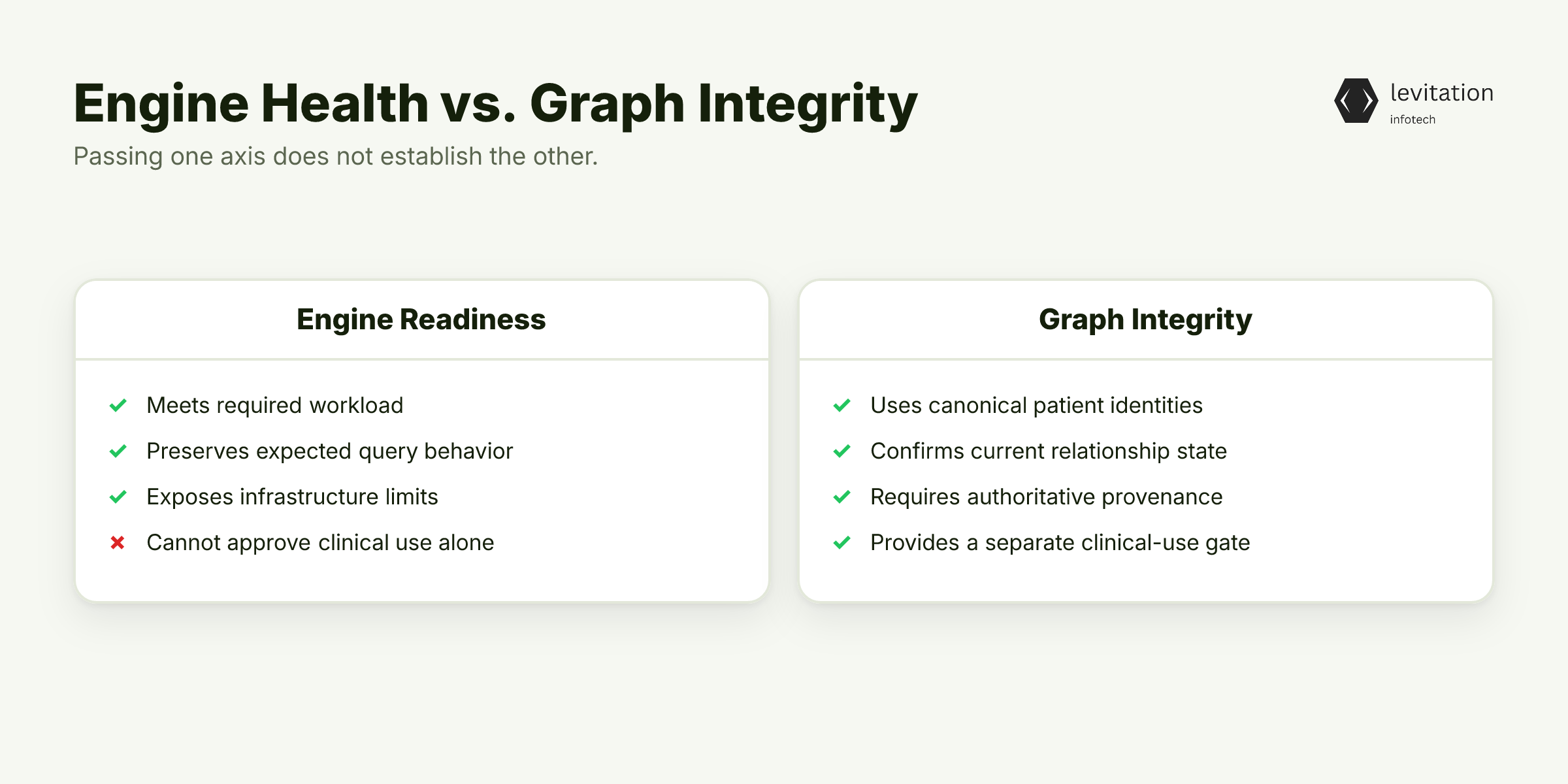
Use two independent acceptance tests: - Engine axis: Can the graph meet the required workload while preserving expected query behavior? - Graph axis: Can every answer trace to a canonical patient, current relationship state, and authoritative source?
The axes fail independently. A team can pass one and fail the other.
This changes procurement for healthcare technology. Evaluate Neo4j scalability and semantic readiness with separate owners, evidence, and release criteria. Do not let a successful capacity test approve clinical use.
A successful deployment does not establish that a customer's graph has correct patient identities, current relationships, or complete provenance. A graph can pass every infrastructure test and still fail the test clinicians care about most. Can the answer be trusted, explained, and challenged?
Why Logical Wholeness Does Not Mean Clinical Truth
Logical wholeness answers where data lives. It does not answer whether that data means what the application thinks it means.
Distinguish topology guarantees from semantic guarantees
Sharding determines where property data is placed and how the cluster presents one logical graph. It does not decide that two source records identify the same real-world patient.
A graph can therefore be technically whole and clinically fragmented. The same patient may appear under several identifiers, while the same encounter may carry conflicting dates. An edge may exist without proof.
That gap becomes dangerous when a clinical application treats every returned path as equivalent. Topology consistency encourages trust. Semantic consistency must earn it.
Set the evidence boundary
The available Neo4j research describes large-scale operational and analytical workloads, sharded property data, and very large connection sets. It provides no benchmark showing that Neo4j repairs patient identity, temporal consistency, or provenance.
This is not a criticism of the engine. It is a limit on the claim being made. Speed is a graph capability, while identity resolution and evidence management are operating disciplines.
Consider a path from an encounter to a medication and then to an observation. If the encounter belongs to the wrong patient, every step may be structurally valid. The answer can still be clinically false.
Run a semantic preflight
Before tuning partitions or query patterns, inventory these defects: - Unresolved source identifiers. - Suspected duplicate patients. - Orphan relationships. - Stale or superseded links. - Clinical facts without provenance.
Assign each defect class to a data-quality owner. The graph-engine team should not become the owner of ambiguous clinical identities.
A faster query reduces the time needed to answer a question. A governed graph determines whether that answer can influence care. The distinction matters throughout healthcare technology.
Once you separate infrastructure scalability from semantic correctness, the real design problem becomes visible. The graph must represent claims, time, and identity rather than merely connect rows. How do you encode those concerns without creating a black box?
Model Identity, Time, and Provenance Before Queries
A trustworthy patient graph starts before the first query. It defines what each node means, what each edge asserts, and when that assertion remains valid.
Create a canonical patient layer
Give each accepted patient a stable internal identity. Retain every source identifier as an alias. Route ambiguous matches into review instead of silently merging records by name or date.
The distinction matters because matching logic can create two kinds of harm. A false split separates one person's history. A false merge combines two people's clinical stories.
A patient deduplication benchmark must test both risks. Counting apparently different records does not prove that they represent different people.
Treat every edge as a sourced assertion
Every clinical relationship needs more than its endpoints. Record: - Its source and source record. - When it was observed. - When it became effective. - Its current status: active, corrected, or superseded. - The transformation or decision that created it.
Preserve history instead of overwriting the only available explanation. A correction should show what changed, when it changed, and which version replaced it.
This is the same principle behind AI data provenance. Speed cannot compensate for an answer whose origin has disappeared.
Treat FHIR as an interchange contract, not an identity engine
FHIR provides a useful structure for exchanging clinical resources. Mapping into FHIR can standardize what arrives at the graph.
It does not by itself resolve organization-specific identities, conflicting observations, or missing provenance. A standards-based message can still describe the wrong patient or an outdated fact.
Require evidence paths and sensitive access
A clinical recommendation should return the facts, relationships, source records, and effective times that produced it. Clinicians and auditors need to inspect the reasoning, not receive an opaque answer.
Access rules must also account for connected information. Two permitted fields can reveal a sensitive diagnosis when linked through an encounter or medication.
A carefully designed model still fails if questionable records enter it unchecked. That is why ingestion quality must be controlled before the graph write path. Can that boundary be enforced without slowing every team to a crawl?
Install a Data-Quality Gate Before Every Graph Write
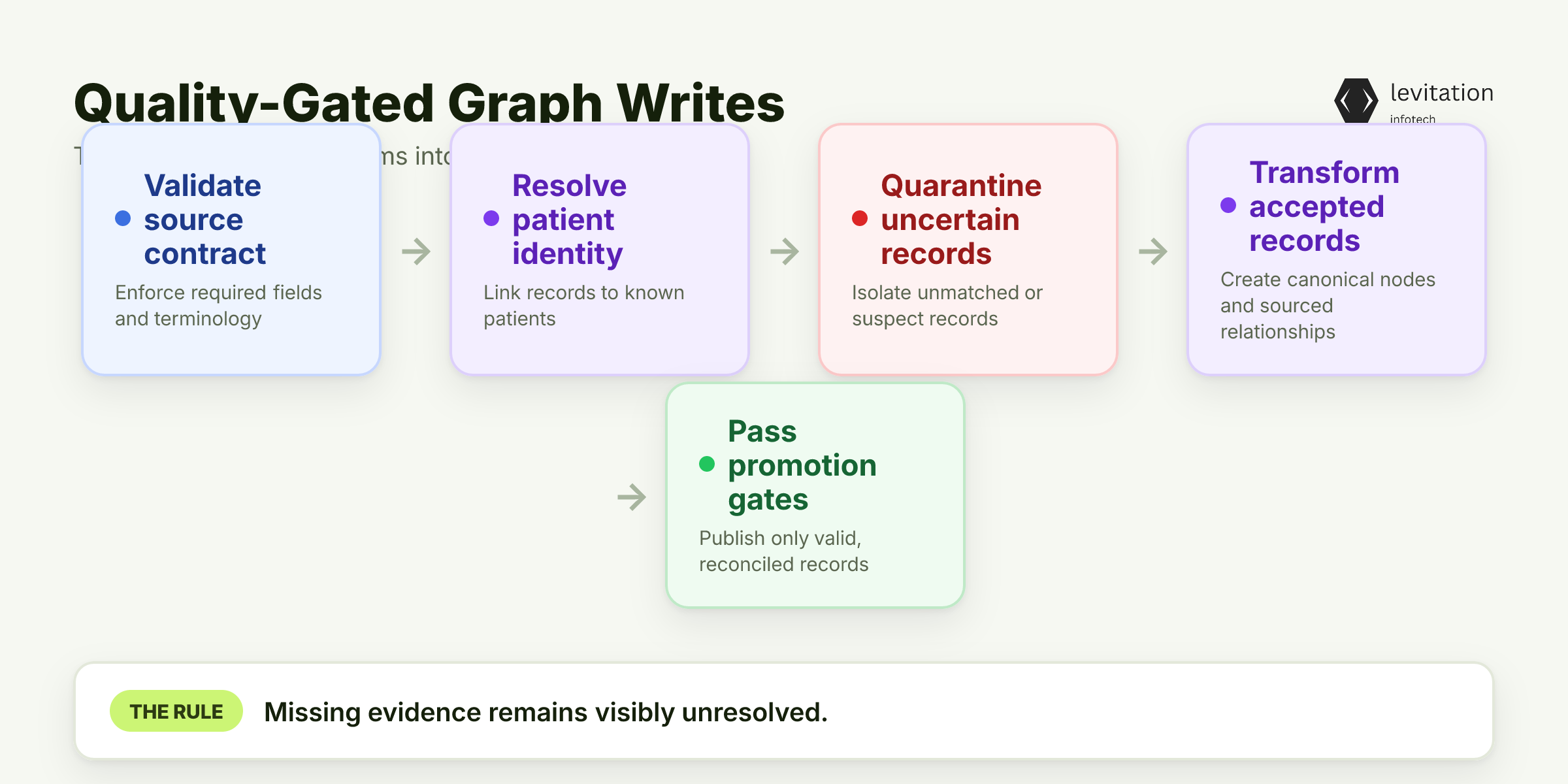
The write path is where uncertain source claims become trusted graph facts. That makes it the right place to stop false certainty.
Define an enforceable data contract
Require these fields before accepting a clinical fact: - A stable source key. - The source system and its identifier. - Observation and effective timestamps. - The record's current status. - A provenance reference. - The transformation version that produced the record.
Without a stable source key, the pipeline cannot distinguish a replay from a correction. Without effective time, the graph cannot tell current state from historical context.
The contract should block invalid input. It should not merely document missing fields after ingestion.
Stage records before promoting them
Use a deliberate promotion path:
- Validate source structure and terminology.
- Resolve the patient identity.
- Quarantine unmatched or uncertain records.
- Transform accepted records into canonical nodes and sourced relationships.
Quarantine is not failure. It is visible uncertainty that prevents a convenient guess from becoming clinical infrastructure.
Make loading repeatable and auditable
Use idempotent ingestion so the same source event does not create conflicting state. Apply constraints and indexes appropriate to the selected Neo4j 4.0 version.
Record transformation versions and publish reconciliation reports. Compare accepted, quarantined, rejected, and published records. Explain every difference before promotion.
This makes data corrections routine rather than archaeological.
Publish through explicit quality gates
Block or quarantine a release when: - Required provenance is absent. - A relationship references an unresolved patient. - Temporal rules are violated. - Reconciliation finds unexplained count differences. - A corrected source record has not propagated.
Monitor data defects alongside latency and errors. Track unresolved identities, suspect merges, stale relationships, orphan links, provenance coverage, and correction turnaround.
The ingestion layer must not manufacture certainty. Missing evidence should remain visibly unresolved.
Once low-quality facts cannot silently enter the graph, Neo4j's sharding can address capacity. Scale only if the new topology preserves clinical isolation and traceability. Which controls must travel with every shard?
Scale Neo4j Without Leaking Patient Context
A clean write path does not guarantee safe scale. Partition placement and expanded access can change both performance and exposure.
Validate the sharding strategy with representative work
Test read, write, and mixed analytical workloads against a topology that reflects real patient relationships. Look for hot partitions and expensive cross-cluster traversals.
Synthetic uniformity can hide production concentration. A few patients, providers, or observation types can create uneven read and write pressure. A simple load test can miss that concentration.
Keep security outside the performance silo
Security controls cannot wait for the cluster to grow. Require: - Least-privilege roles. - Encryption in transit and at rest. - Audit logging for graph access. - Environment isolation. - Tested recovery procedures. - Controls that keep protected health information, or PHI, out of test data and logs.
A sharding plan without these controls changes where protected data sits. It does not reduce its sensitivity.
Treat inferred relationships as sensitive
Graph connections can reveal more than individual fields. A role allowed to see an encounter and medication can learn a diagnosis through their relationship.
A tenant filter is not a complete PHI boundary in multi-tenant RAG. The same principle applies to graph traversal. Verify which detailed access controls the selected Neo4j edition supports, then enforce remaining gaps at the service boundary.
Test operations before clinical expansion
Include backup restoration, version upgrades, failed ingestion recovery, access revocation, and data reconciliation in readiness testing. These are clinical operating conditions, not post-launch chores.
Delivery timelines are not Neo4j product benchmarks. Scope, data readiness, and internal governance still determine the actual timeline.
A larger cluster increases both the value of a curated graph and the impact of an identity or provenance defect. Promotion criteria should therefore become stricter as usage expands.
A secure, scalable graph has limited value until its outputs fit the workflow. Clinicians and operators must know when to trust those outputs and when to challenge them. Who gets the authority to make that call?
Operationalize Trust Before Expanding Clinical Decisions
Trust becomes operational when teams measure it, assign it, and exercise it under real workload.
Change the scorecard
Keep latency and throughput. Add measures that expose semantic failure: - Semantically valid answer rate. - Provenance completeness. - Unresolved identity queues. - Data-correction time. - Unsupported recommendation rates. - Decision-support agreement.
An evaluation protocol should test whether these measures remain stable under workload. A prepared demo is not enough.
Assign ownership across organizational boundaries
Give data stewards authority over identity and provenance rules. Give graph engineers authority over model and platform integrity. Give clinical, security, and compliance leaders authority over release criteria.
This separation prevents one team from declaring the graph trustworthy because its own controls passed.
Expand use in controlled stages
Start with an advisory or shadow workflow. Compare graph recommendations with the existing process. Inspect disagreements instead of averaging them away.
Define rollback conditions before launch. Widen use only when identity, provenance, and security gates hold under real workload.
Make correction a normal operation
Maintain reconciliation schedules, incident runbooks, model-version history, and accountable response times. The graph should improve as evidence changes, not accumulate silent corrections.
The payoff is decision support that exposes its evidence, reveals uncertainty, and can be corrected without undermining trust. Which parts of your current plan address those outcomes?
Frequently Asked Questions
Can Neo4j 4.0 fix a broken patient graph?
No. Neo4j can scale the graph and execute traversals efficiently. It cannot infer that two records identify the same patient. It also cannot repair stale relationships or manufacture missing provenance. Those problems require governed processes for identity, time, reconciliation, and data quality around the database.
Does Neo4j 4.0 sharding mean patient records are split into disconnected graphs?
No. Neo4j's Infinigraph architecture is designed to distribute graph property data across a cluster. It preserves a logically whole graph and expected query behavior.
Logical wholeness does not guarantee semantic correctness, so identity and relationship governance remain necessary. This distinction is central to any healthcare technology evaluation.
Does modeling patient data as FHIR automatically make a healthcare graph database trustworthy?
No. FHIR provides a useful interchange model. It does not by itself resolve conflicting patient identities. It also cannot determine the effective time of a relationship or establish provenance. The more useful question is whether your pipeline enforces those guarantees before every graph write.
About the author
Mayank Singh is a software developer at Levitation Infotech, where he builds web and AI-powered applications across the company’s fintech, healthcare, and enterprise projects.