


TL;DR: Failures at acceptance usually expose a broken business contract, not weak code. Prevent rejection early. Link each business outcome to a testable criterion, evidence, owner, and change rule before the build starts.
Key Takeaways: - Green pipelines and closed tickets measure delivery activity, not business acceptance. - Requirements drift and weak UX usually appear before sign-off becomes contentious. - Acceptance works when it operates as a traceable contract, not a final ceremony.
Green Tests, Missed Sign-Off: Where Projects Break
Every ticket is green. The sprint demo passes. Then the operations lead refuses sign-off because the approval flow doesn't match how the business works.
A late technical complaint can lead teams to confuse a delivery issue with an acceptance issue.
Research on failed projects is not specific to Noida. It points to poor planning, unclear or shifting requirements, ignored risks, and weak UX. Coding volume rarely explains why stakeholders reject a workflow they can already see.
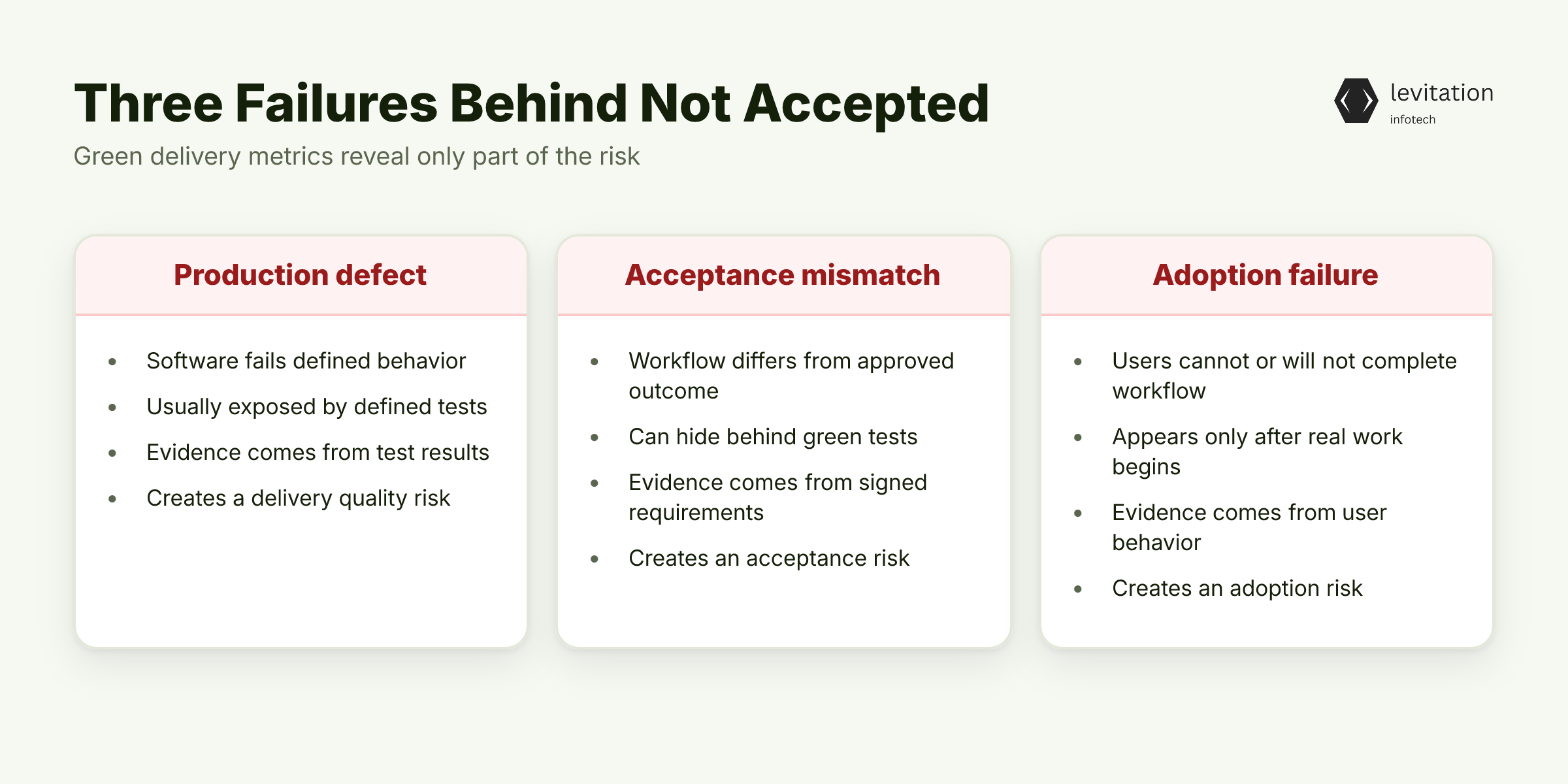
Separate three failures hidden behind “not accepted”
Failures can be divided into three categories. The first is a production defect. Here, the software fails a defined behavior or produces an incorrect result. The second is an acceptance mismatch. Here, the feature works, but the delivered workflow differs from the approved business outcome. The third is an adoption failure. The workflow works technically, but users cannot or will not complete it.
Test pass rates expose only the first category fully. The second can hide inside a technically complete feature. The third appears only after real work begins.
Which failure is hiding in your project now?
Delivery dashboards deepen the false confidence: - Sprint velocity measures delivery cadence. - Ticket closure measures task status. - A clean pipeline measures code health.
These signals describe delivery activity. They don't prove the business problem was solved.
Ask three questions before the next status meeting: - Which signed document defines acceptance? - Where is the supporting evidence? - Who has authority to approve it?
If any answer is vague, the project already carries acceptance risk.
Use that lens when reviewing the top software development companies in Noida guide. Compare delivery capability only when the provider also has a credible acceptance system.
If code is not the main culprit, the real contract must have broken long before the final sprint. Which contract?
Requirements Drift Quietly Rewrites the Scope
Requirements drift can enter without a formal scope change. It may come through deadlines set without stakeholder input. It may also come through responsibilities assigned without explanation. Informal requests can also cause drift when they never reach the backlog.
Each move looks harmless in isolation. Together, they make delivery faster than agreement.
Imagine a ticket saying, “Let a manager reject a request.” The business also expects a reason code, finance notification, and escalation clock.
The team builds exactly what the ticket says. The business still rejects it.
When workflow order, permissions, or business constraints remain unstated, technical correctness cannot rescue the product.
Trace decisions, not just tickets
Connect each business outcome to its requirement, design decision, acceptance criterion, test, and approving owner.
Trace forward to prove that every built feature supports an outcome. Trace backward to find orphaned features and criteria without an owner.
Before estimation, require an outcome-based brief: - Target workflow - Intended users - Operational constraints - Explicit exclusions - Non-functional expectations - Authority to resolve unclear points
Add a readiness gate. A requirement cannot enter the committed backlog until key details are known. These details include its owner, workflow, evidence, dependencies, and acceptance conditions.
This matters in custom software development. Here, frontend, backend, API, and business-process decisions drift apart when each team works in isolation.
Vendor selection offers a sharp test. Compare top custom software development companies in India and ask: - How does the vendor record requirement decisions? - How does it block unapproved scope from entering a sprint?
A stable backlog can still produce a rejected workflow when user experience was treated as an afterthought. Can your process trace both ways and block unapproved scope?
Feature-Correct Software Can Still Fail Real Workflows
Feature-complete software can still lose acceptance. UX research links difficult navigation with blocked acceptance and adoption. The same applies when software fails to solve the end user's problem, even when the code is sound.
Feature validation asks whether a capability exists and behaves as specified. Workflow validation asks whether a person can finish the real job across tools, handoffs, exceptions, and permissions.
Test the journey before polishing the screens
Prototype the highest-risk workflow with representative users. Observe where they hesitate, repeat a step, or invent a workaround. Revise the journey before the broad build.
For web and mobile systems, validate the complete path: - Frontend behavior - Backend state changes - API responses - Permission rules - Failure and recovery states
An isolated screen can look perfect. It can also create an unusable journey.
Turn every exploratory finding into a decision. Record the affected user, workflow step, severity, suggested fix, owner, and resulting acceptance criterion.
Without that chain, UX research becomes a presentation that nobody acts on.
How does that evidence enter your delivery estimate?
Budgets must reflect the consequence. When a CTO compares custom software development cost in India, include expected rework. Also include delayed adoption and extended support. Don't count engineering hours alone.
The same lesson appears in why India's software is still cheap but the bill isn't. A cheaper build of the wrong workflow isn't economical delivery.
The fix isn't another meeting. It starts with a shared operating contract. What must that contract contain?
Acceptance Is a Shared Operating Contract
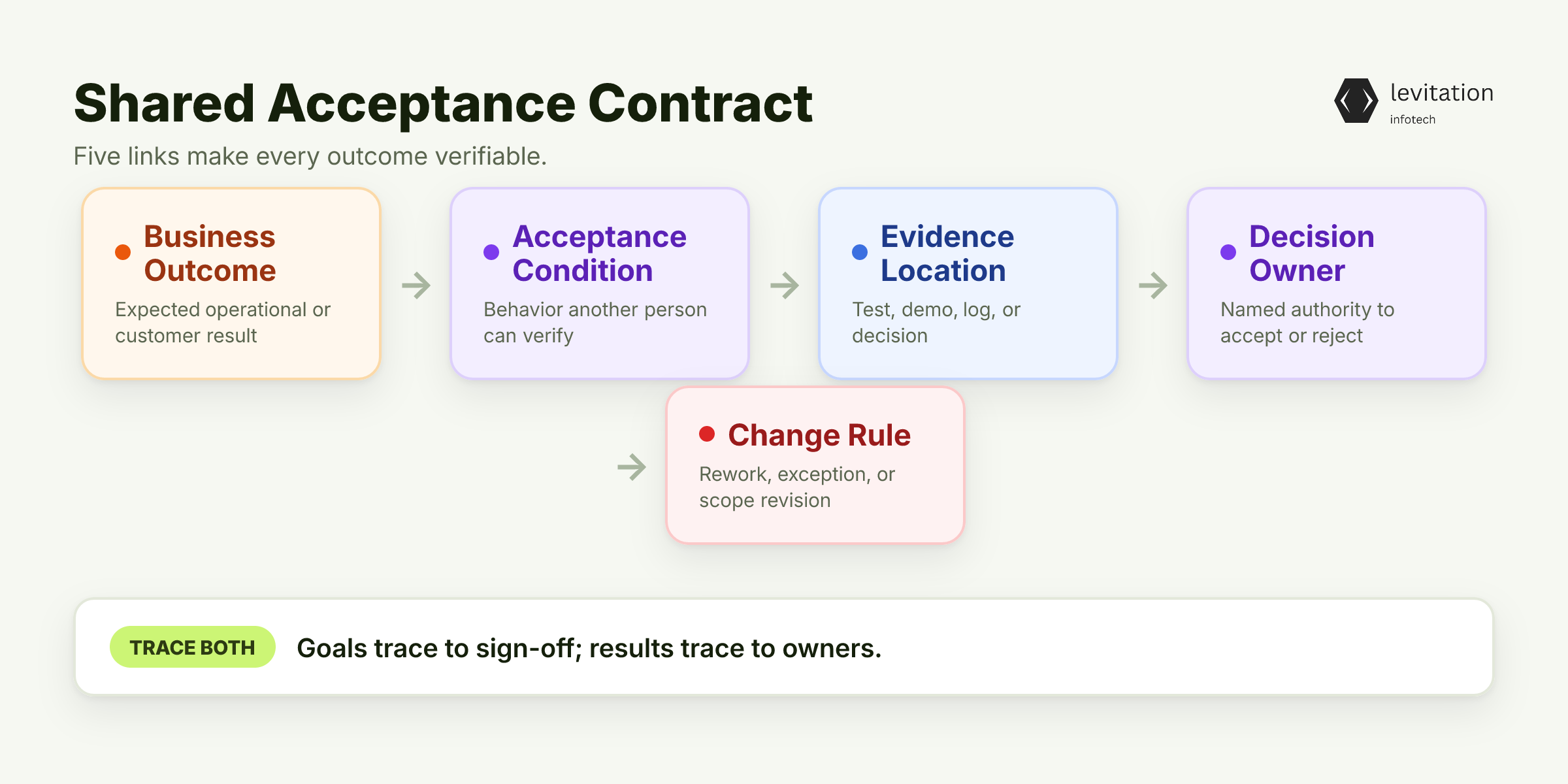
Acceptance succeeds when key parts connect before the build starts. These parts are the business outcome, testable criterion, evidence, decision owner, and change rule.
Build five linked components for every outcome
Every outcome requires five linked components. The expected business result defines the operational or customer outcome. The acceptance condition specifies behavior another person can verify. The evidence location identifies the test, demo, log, or signed decision. The named approver determines the person allowed to accept or reject the result. Finally, the permitted response defines what happens when the result differs.
The last component prevents a silent loop. A failed criterion should trigger rework, exception approval, or scope revision. The consequence must be recorded.
Create two-way traceability. A goal should reach a requirement, design, sprint output, test result, and sign-off. A test result should trace back to the goal and its owner.
Which control is missing from your delivery process?
Separate Ready from Done
A Definition of Ready determines whether a requirement is safe to build. A Definition of Done determines whether there is enough evidence to accept it.
These controls solve different problems. Readiness protects the delivery team. Done protects the business decision.
Who gets the final say when those controls disagree?
Make sign-off evidence-based
Use workflow demos, approved test results, exception logs, and documented decisions. Don't replace evidence with statements that the software “looks complete.”
Clarify who has decision rights. Product, engineering, security, operations, and business owners can hold different approval duties. Name the final authority before sign-off day.
Unclear roles here create delay, not safety. The same problem appears in AI agents that scale faster than your decision rights.
Treat enterprise experience as a credibility signal, not process proof. When evaluating a provider such as Levitation, treat claims about major clients or retention as claims to investigate. Ask whether the provider can show the same acceptance trail on your project.
When evaluating a custom software development company, ask for an actual acceptance matrix and change-control example. When comparing top custom software development companies in India, compare evidence, not promises.
Without a shared chain, acceptance can become open to negotiation. Vendors should make that chain visible before estimates harden.
The principle is simple. Make the mechanism visible before sprint one. Can yours show it?
Build the Acceptance Gate Before Sprint One
Run an acceptance-design workshop
Bring the CTO, product owner, operations lead, and representative users together. Map the target workflow, exceptions, risks, and final decision authority.
The output is an agreed baseline, not another slide deck.
Can the group agree on that baseline before estimation?
Create the acceptance matrix
The matrix should have columns for requirement ID, business outcome, criterion, evidence, owner, approval status, and exception.
Give each meaningful workflow outcome one row. Keep minor interface actions in supporting tests.
Use a plain-language pattern. Begin with “Given the relevant role and data.” Then use “when the user performs the defined action.” The system must then produce the expected result. Record the required evidence with the result.
Who owns each row?
Define readiness
Require these items before commitment: - Accountable business owner - Approved workflow - Representative test data - Resolved dependencies - UX direction - Security expectations - Testable acceptance conditions
Until these exist, the item isn't ready for estimation. This protects the team from false precision.
What would your team add to this list?
Validate in slices
Show an end-to-end workflow during each relevant sprint. Use the same matrix for formal user acceptance testing. Fix unclear criteria while they remain cheap to change.
A rejected criterion then becomes useful feedback. That feedback arrives before the team has built an entire system around the wrong interpretation.
Who reviews that feedback and records the change?
Control changes
Route every new request through a short impact note. It must cover scope, architecture, schedule, cost, testing, and acceptance. Require the named business owner to approve the revised baseline.
No informal approval. No silent commitment. The baseline changes only when someone with authority accepts the new trade-off.
Where will that decision be recorded?
Assemble the acceptance pack
Include these records before final sign-off: - Signed acceptance matrix - Test evidence - Approved exceptions - Unresolved-risk register - Dated sign-off record
This creates an audit trail for launch and support decisions. For sensitive domains, add relevant privacy, security, and compliance evidence to the criteria.
Apply the same logic to commercial planning. Show vendors that scope, effort, and acceptance are linked through the custom software development cost in India estimate. Then compare that commercial logic with the custom software development delivery process.
Once acceptance becomes visible early, teams can plan delivery and catch late surprises. Real users can adopt the workflow rather than merely attend a launch-day ceremony.
What becomes possible when that visibility appears before sprint one?
Measure Acceptance Early, Not at Launch
Track leading indicators
Monitor these before launch: - Acceptance-criteria coverage before build - Unapproved scope changes - Unresolved exceptions - Evidence-to-sign-off time - User-task completion during validation
These reveal friction while the team can still respond.
Earlier visibility reduces rework, clarifies who is responsible, and makes budgets more predictable. It also separates product-fit rejection from avoidable production defects.
Which signal is missing from your current dashboard?
Run a pilot before scaling
Give every vendor the same scorecard by asking: - How do you define Ready and Done? - How do you control requirement changes? - How do you demonstrate user workflows? - How do you record sign-off? - How do you report exceptions?
Then run a short pilot. Require a sample acceptance matrix, change-impact note, and evidence package before scaling the engagement.
Geographic distance is manageable when records, approvals, and evidence are clear. Silence and informal approvals aren't. That lesson also matters in a Noida pilot cost-risk analysis.
Use the top software development companies in Noida list to compare delivery partners. Expand the search with top custom software development companies in India for broader expertise. Use the custom software development cost in India guide to compare total delivery exposure, including validation and rework.
The right record reveals whether a vendor controls change. Which record would expose that process?
Frequently Asked Questions
Why do software projects fail during acceptance rather than coding?
Coding defects usually surface through tests. Acceptance failures arise when requirements, workflows, evidence, and sign-off authority don't align. Research on failed projects points to several causes. These include weak planning, shifting requirements, unclear ownership, ignored risks, and UX treated too late.
How can a CTO prevent acceptance-stage failures before coding begins?
Define business outcomes and testable criteria before estimation. Assign an owner to every requirement and test critical workflows with representative users.
Version every approved change. Sign off against evidence, not a subjective claim that the build is complete.
What should software acceptance criteria include?
Include the business result, relevant role and data, expected action and response, and important exceptions. Also include the evidence location and approving owner. For custom software development, also cover frontend, backend, API, UX, security, and performance behavior.
How should a CTO compare software development companies in Noida?
Ask each vendor to show an acceptance matrix, sample user acceptance test, change-control record, and sign-off checklist. Don't stop at architecture, estimates, or delivery speed. The top software development companies in Noida directory can support a broader comparison.
Does software development cost in India reduce the risk of acceptance failure?
Lower development cost doesn't remove rework, delayed adoption, or unclear sign-off costs. Use the custom software development cost in India guide to compare delivery, validation, controlled changes, and post-launch support. The buying question is simple: does the acceptance system prevent more rework than it adds to planning?
About the author
Mayank Singh is a software developer at Levitation Infotech, where he builds web and AI-powered applications across the company’s fintech, healthcare, and enterprise projects.