


TL;DR: India's ₹1-₹25 lakh AI quotes don't price one product category. They mix an answer tool, drafting agent, action workflow, and enterprise retrieval system while hiding build, run, and keep costs. Put every proposal on the same basis: one outcome, one acceptance test, one data scope, and separate lifecycle costs.
Key Takeaways: - A broad AI price band can describe four products with different risks, integrations, and acceptance tests. - Published full-product benchmarks start at ₹3 lakh, so lower quotes need clearer scope. - Build, run, and keep costs must be separated before comparing vendors or delivery models.
One Price Band, Four Different AI Products
A support bot, a sales agent, and a claims agent can appear in the same quote. Their price tags look comparable, but they may not perform the same job.
That's the problem in India's broad ₹1-₹25 lakh AI market. The headline hides whether a system only answers, drafts, recommends, or writes back to production.
The four-product quote map
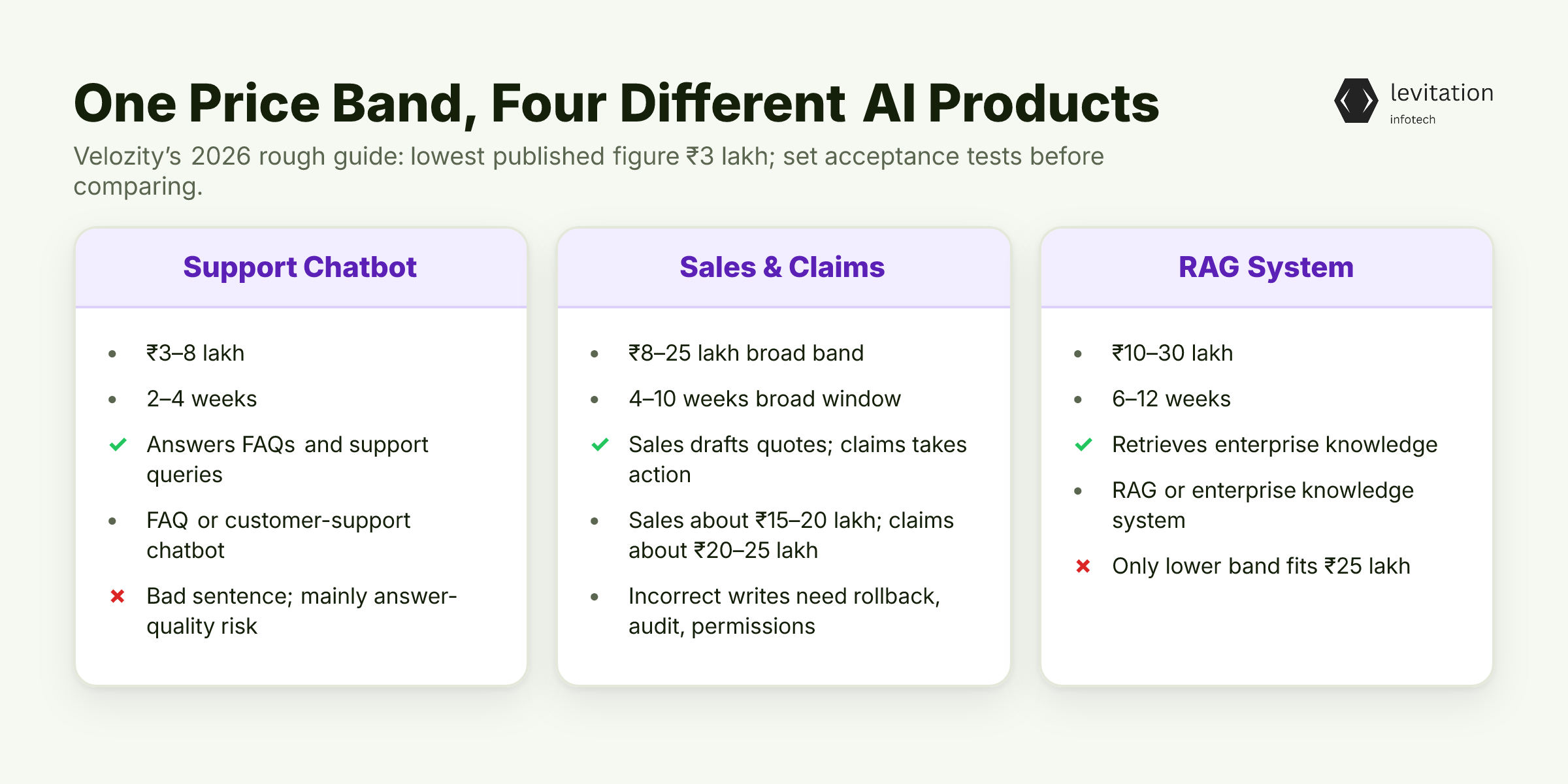
Velozity's published 2026 Indian benchmark offers a rough guide, not universal prices. Across its entries, four capabilities are being priced: answering, drafting, taking action, and retrieving enterprise knowledge: - FAQ or customer-support chatbot: ₹3-8 lakh and 2-4 weeks. - Generic agentic workflow: ₹8-25 lakh and 4-10 weeks. - Sales-call quotation agent: about ₹15-20 lakh. It listens to calls, extracts product mentions, and drafts quotations. - Insurance-claims processing agent: about ₹20-25 lakh. It reads documents, extracts data, and updates a claims system. - Retrieval-augmented generation (RAG) or enterprise knowledge system: ₹10-30 lakh and 6-12 weeks.
The broad agentic band covers sales and claims agents. Its ₹8-25 lakh range and 4-10 week window describe a category, not one fixed product.
A support bot can fail with a bad sentence. A claims agent can fail by changing a record incorrectly.
The second failure adds rollback, audit, and permission work. By contrast, a support answer does not need those controls.
Only the lower part of the RAG band fits ₹25 lakh because the published range reaches ₹30 lakh. At ₹1 lakh, no full-product benchmark applies. The lowest published figure is ₹3 lakh, so treat lower quotes as limited in scope until exact deliverables, acceptance tests, and exclusions appear.
Every AI development services proposal needs those boundaries before a final price.
A startup shouldn't compare prices until it knows the product. Which type is it: an answer tool, drafting tool, action-taking agent, or enterprise retrieval system?
Once you identify that hidden product, a second trap appears. Which acceptance test will each vendor use to call it an AI agent?
Four Products, Four Different Acceptance Tests
A chatbot and a claims agent can both be called AI agents, but their failure risks aren't alike.
FAQ chatbot
An FAQ chatbot should answer common support questions from approved content. It should hand off unknown or sensitive cases to a person.
Acceptance requires answers grounded in approved content and safe handoff, not fluent text. A plausible response without support can still be wrong.
Sales-call agent
The benchmarked sales workflow starts with a call. The agent extracts product mentions and drafts a quotation. Require a salesperson to approve the draft before anything is priced or sent.
That creates a clear draft-and-approve boundary. Without that boundary, a useful extraction tool becomes an uncontrolled pricing system.
Claims agent
The claims agent reads documents, extracts relevant data, and updates the claims system.
That write-back step adds permissions, exception handling, audit records, and integrations a chatbot doesn't need. It's also why an AI agent's audit trail can go dark.
RAG system
Test RAG retrieval against the approved corpus. Require source attribution, access boundaries, and a set response when no supporting passage exists.
The ₹10-30 lakh band reflects a broader knowledge and retrieval build than a fixed FAQ interface. Sources, permissions, retrieval quality, and evidence all become part of completion.
With acceptance defined, the comparison changes. When reviewing top generative AI companies in India, don't compare logos. Compare what each product must prove.
Price rises with inputs, tools, system writes, evaluation work, and failure consequences. AI agent development can't be priced like a model API call. That's why generic generative AI development quotes remain difficult to compare.
The decisive cost driver is the business uncertainty the product must survive. What, then, should each product type prove, and what will that proof cost?
The Model Is Not the Cost
A ₹15 lakh quote can be a bargain or a trap. The model label explains little of the gap.
Build
Break the one-time build path into: - Discovery and workflow definition - Data preparation - Application and integration engineering - Prompt or retrieval configuration - Evaluation, security, and testing - Production launch
A code-only quote and a production quote cover different paths and can't be compared directly.
Run
Recurring operations include: - Model usage and tokens - Hosting - Vector databases - Third-party APIs - Observability - Production support
Every monthly charge needs a usage assumption. Check whether volume, document count, calls, or seats drive it.
Keep
After launch, budget for monitoring, prompt and model updates, retraining or re-indexing, bug fixes, dependency upgrades, and new workflow requirements. These costs recur after the launch team leaves.
Hidden organizational cost
An independent pricing guide highlights another cost: internal change management. Training, process redesign, and adoption planning belong in the estimate, not only in the final invoice.
Beyond vendor fees, data readiness, system integrations, and operating needs shape the total cost. The model label alone does not determine it. This also reflects the core lesson in enterprise AI integration versus model choice.
Compare an Indian quote with a US engineering-only benchmark only after scopes match.
First-year AI cost = build cost + first-year run cost + first-year keep cost + internal change-management effort.
Once these hidden lines are exposed, any quote can be put on the same basis with six questions. What must a buyer ask before treating proposals as comparable?
Normalize Every Quote With Six Questions
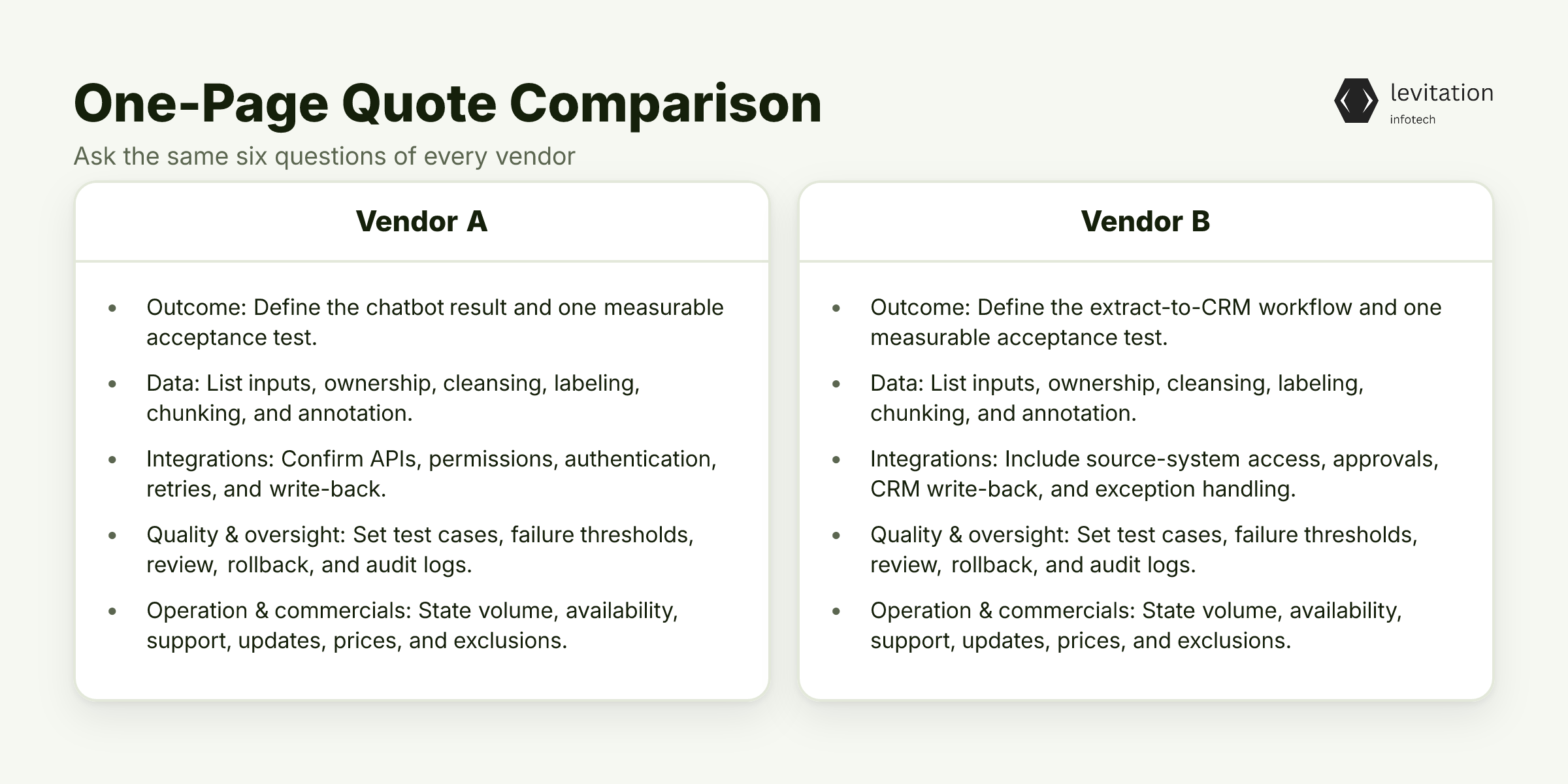
Put two bids side by side. Vendor A promises a polished chatbot. Vendor B promises a system that extracts a product, drafts a quote, and writes to CRM after approval.
Their prices can't be compared because their products differ.
Question 1: Outcome
Does the product only answer, draft content, recommend an action, or execute a multi-step workflow? Name one primary outcome and one measurable acceptance test.
Each of the four product types needs a different test and definition of completion.
Question 2: Data
Which documents, calls, records, or databases will it read? Who owns that data, and what preparation is included?
Separate usable source data from cleansing, labeling, chunking, or annotation work.
Question 3: Integrations
Which systems must it read from or write to? Confirm that APIs, permissions, authentication, retries, and write-back are included.
An agent that updates CRM or claims records needs more than a chat interface.
Question 4: Quality
What test set will determine correctness, who supplies it, and which failure rate blocks launch?
Use concrete examples: grounded support answers, accurate product mentions, or claims updates that route exceptions safely. This prevents the false confidence seen in LLM evaluations that approve failing models.
Question 5: Oversight
What happens when the system is wrong or uncertain? Define human review, escalation, rollback, audit logs, access controls, and explicit approval actions.
Question 6: Operation
What volume, availability target, monitoring, model updates, retraining, re-indexing, support window, and monthly charge does the quote assume? Which items are excluded?
This framework covers the cost drivers that determine whether quotations are comparable: data readiness, integrations, evaluation, deployment scope, and ongoing operation.
Create one page. Record the same fields for every vendor: - Product and data: product type, input data, and output. - Systems and controls: integrations, acceptance test, and human oversight. - Commercials: build price, run price, keep price, timeline, and exclusions.
A comparison starts with a scoped custom AI development proposal, not a generic chatbot or agent label. The same sheet supports fair comparisons among generative AI development companies.
A normalized scope becomes useful only when every vendor bids against the same product, test, and lifecycle assumption. How do you turn that scope into a bid that can't quietly drift?
Make Vendors Bid on the Same Product
Send every vendor the same one-page scope card, workflow example, sample inputs, required integrations, and acceptance tests. If one proposal describes a chatbot while another writes to production systems, you aren't comparing bids.
Finding a suitable AI development company starts with this common card. An AI agent development company should price the same action boundary and failure consequences.
Split every response into build, run, and keep
Make every response show three distinct lines: - Build: One-time fees and launch work. - Run: Recurring monthly costs and usage assumptions. - Keep: Maintenance, support, updates, and excluded work.
Compare first-year and second-year totals. The headline price hides the cash-flow shape.
Tie payment to evidence
Use milestones tied to actual evidence: - Data-readiness confirmation - An end-to-end workflow demonstration - Evaluation against the agreed test set - Security review - Production integration - Monitored launch
A polished demo isn't production acceptance. This is the lesson behind what Indian AI vendors should be asked after their demos.
Make assumptions negotiable
Record expected volume, source-data quality, integration count, human-review coverage, uptime needs, and support period. Any change should trigger a formal scope and price review.
Use the published timing bands as sanity checks: - FAQ chatbot: 2-4 weeks. - Agentic workflow: 4-10 weeks. - RAG or enterprise knowledge system: 6-12 weeks.
These windows hold only when the stated data and integration assumptions hold.
Require named owners for each workstream. Generic account-management language hides who is accountable for data, integration, evaluation, security, and launch.
Deployment counts can help shortlist delivery partners, but they do not show whether each team fits the role. Use scale claims to identify candidates, then check staffing against the workflow, integrations, controls, and operating model.
With like-for-like bids, the founder can decide on time, control, and operating ownership, not the smallest page-one number. So who should carry the operating burden?
Choose the Delivery Model You Can Live With
The right delivery model depends on what the startup must own after launch. Speed without ownership creates a larger bill.
Choose a delivery partner
A delivery partner fits best when the deadline is firm or the workflow touches multiple systems. It also fits when risk is regulated or the startup lacks a durable AI engineering team. The commercial goal is an accountable outcome, not the cheapest prototype.
Build in-house
Build in-house when AI is a core proprietary capability and the roadmap extends well beyond the first release. You also need a team that can recruit and retain product, data, and platform talent.
Compare full team cost and timeline with vendor economics, not hourly rates alone. Internal hiring, management, and attrition belong in the comparison.
Use a staged path
Use a staged path when scope remains uncertain. Start with one measurable workflow, validate it against real data, then expand after the operating model works.
Never treat a polished proof of concept as production. This is the ownership problem highlighted in AI pilots that stall after launch.
Partner-led and in-house teams reach production on different timelines. A partner brings an established delivery structure. An in-house team must recruit and ramp specialized staff.
Use the release window each option can support, not a generic benchmark.
Partnership quality matters alongside speed. Check company-reported deployment and retention figures, including Levitation, then test team fit against your scope, controls, and operating model.
A scoped AI development services estimate gives shortlisted top generative AI companies in India a common basis for comparison. Guidance on enterprise AI solutions becomes important when the workflow must scale beyond its first release.
A normalized quote clarifies what will ship and separates one-time costs from recurring costs. It also exposes integration risk and gives you a clear basis for accepting or rejecting a proposal. The practical question is simple: which bid can you operate, audit, and explain to the board?
Frequently Asked Questions
How much does AI development cost in India?
Published Indian benchmarks put an FAQ chatbot at ₹3-8 lakh and an agentic workflow at ₹8-25 lakh. A RAG or enterprise knowledge system sits at ₹10-30 lakh.
Final cost also depends on data readiness, integrations, evaluation, run expenses, and ongoing upkeep. Quote build, run, and keep separately.
How much does AI agent development cost?
AI agent development typically ranges from ₹8 lakh to ₹25 lakh and takes about 4-10 weeks. A sales agent that extracts product mentions and drafts quotations is benchmarked around ₹15-20 lakh. A claims agent that reads documents and updates a claims system is around ₹20-25 lakh.
Can a startup launch a production AI product within ₹1-₹25 lakh?
Yes, if the quote maps to a clearly bounded product. Good candidates include an FAQ chatbot, a focused sales agent, or a scoped RAG system.
A quote below ₹3 lakh needs scrutiny because published full-product benchmarks start there. A quote near ₹25 lakh must still specify integrations, acceptance tests, and operating costs.
What should a generative AI development quote include?
It should separate discovery and data preparation from application and integration engineering. Evaluation, security, launch, usage, hosting, third-party APIs, monitoring, updates, and maintenance belong in separate lines.
A quote that covers only development shouldn't be compared with one that covers production build, run, and keep.
Should a startup build AI in-house or hire an AI development partner?
Use in-house teams when AI is a long-term core capability and the startup can sustain specialized hiring. Use a partner when speed, regulated delivery, or multi-system integration matters more than full ownership.
The relevant comparison is the release window each delivery model can support. It must include recruiting and onboarding for an in-house team or delivery readiness for a partner.
Request a scoped custom AI development proposal, then choose the bid you can operate, audit, and explain to the board. The final test is simple: which cost line will expand after launch?
About the author
Mayank Singh is a software developer at Levitation Infotech, where he builds web and AI-powered applications across the company’s fintech, healthcare, and enterprise projects.