


TL;DR: AI-native rewrites blow their budgets early. The architecture forces non-linear integration costs. Traditional estimation frameworks were never designed to model these. The fix is not better model pricing. It is a sprint restructure that treats data plumbing, evaluation infrastructure, and non-deterministic behavior as first-class budgeted workstreams from day one.
Key Takeaways: - The overrun shows up early, not late. That is when the first architectural compromise forces hidden rework. - Traditional estimation models are blind to AI-native rewrites. They assume complexity grows linearly with features, not with model swaps and prompt revisions. - Sprint restructure with front-loaded data foundations, decoupled evaluation cycles, and CI-based prompt regression turns the overrun from a surprise into a tracked variance.
The Over Budget Problem Isn't What You Think It Is
Early in the rewrite is where the spreadsheet breaks. Not because your model costs are wrong. Not because your vendor raised inference prices.
The leak lives in integration and rework that traditional estimation never priced in.
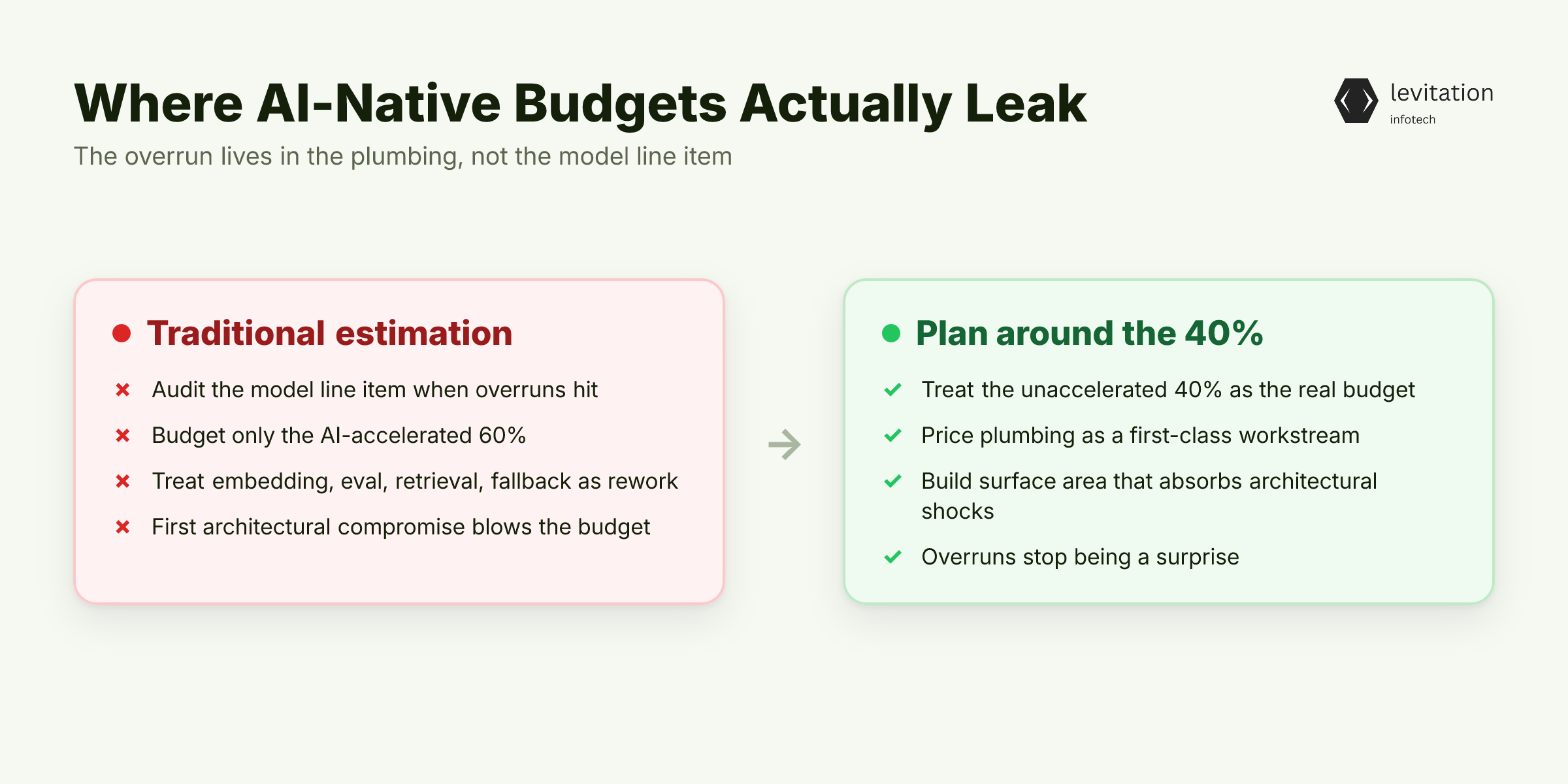
Most CTOs look at an early-sprint overrun. They start auditing the model line item. That is the wrong place. The real money sits in the unaccelerated 40% of daily operational work. AI cannot speed this up.
When engineering teams report spending nearly 60% of their day on tasks AI can now accelerate, the other 40% is where the overrun lives. That residual work is exactly the plumbing under AI-native systems. It includes embedding pipelines, evaluation harnesses, retrieval tuning, and fallback orchestration.
By the time the first real architectural compromise hits, your team has built enough of the AI-native surface area to absorb the shock.
Maybe a prompt revision breaks a downstream evaluation. Maybe the vector store schema cannot support the new retrieval strategy. Maybe the legacy data model was never designed for streaming inference.
The original estimate modeled none of these as a first-class workstream. So the budget absorbs them as rework. The same pattern shows up in Why 7 of 10 Indian AI Builds Quietly Double in Cost by Day 90. The overrun is rarely where leadership is looking.
The teams that survive this do one thing differently. They treat the unaccelerated 40% as the real budget, not the AI-accelerated 60%. When you plan around the plumbing, the overrun stops being a surprise. AI development services work confirms this. The ones who don't end up asking why the early sprints broke.
If the problem isn't where you think it is, then neither is the fix. So what makes traditional estimation so blind to the work that follows?
Why Traditional Estimation Models Can't See AI-Native Rewrites Coming
Waterfall and linear sprint estimation assume complexity grows proportionally with features. Add ten screens, add ten days. That math worked when systems were deterministic. It collapses when AI becomes the substrate.
In an AI-native rewrite, every legacy dependency becomes a friction point the original estimate never modeled. The estimation framework treats AI as a feature layer you bolt on. In reality, AI is the foundation.
Every model swap, every prompt revision, every embedding migration rewrites the contract between layers. The cost grows non-linearly, not proportionally.
The blind spots cluster in three areas: - Evaluation harnesses for non-deterministic behavior, covered in depth by Why Your LLM Evals Approve Models That Fail - Vector store tuning that drifts as data shapes change - Fallback orchestration that handles model provider failures
Even experienced delivery leads underweight these. They estimate the visible feature work. They assume the invisible plumbing comes free.
It doesn't. It comes back as rework across the first several sprints. The pattern shows up across AI consulting engagements too. The teams that budget evaluation infrastructure as a separate line item ship on time. The teams that fold it into feature work discover the overrun when it is too late to recover the sprint.
The structural problem is not estimation skill. It is the assumption baked into the framework itself. Linear estimation cannot price non-linear cost growth. No amount of better forecasting fixes a model that assumes the wrong shape.
The second problem hiding underneath is even worse. The architecture itself is charging you a tax nobody put in the budget.
The Hidden Architecture Tax: Where AI-Native Sprint Budgets Actually Go
The architecture tax is the cost of choices nobody planned for. It surfaces in three places. All three show up early in the rewrite.
Schema flexibility for AI-native systems means every migration carries a rewrite cost the original sprint didn't carry. A team that adds a new embedding model or changes the chunking strategy has to re-index. Then they must re-evaluate and often re-architect the retrieval layer.
Most teams discover this only after the first real migration hits production. The cost compounds in ways fintech teams know well. Why Fintech AI Cost Forecasts Always Break by Month 4 covers the same pattern for financial systems.
Prompt engineering changes cascade through retrieval pipelines, evaluation suites, and downstream APIs. A single prompt revision can break a full sprint of feature work. The team spent two weeks building a feature on top of a prompt that no longer exists. Those two weeks are now rework, not delivered value.
Evaluation infrastructure is the third tax. Test harnesses, golden datasets, and regression checks for non-deterministic model behavior are almost never estimated up front. When teams finally build them, they absorb large amounts of capacity.
The work feels invisible because it does not ship a user-facing feature. It feels optional until the first silent model regression reaches production.
A few examples of where the tax hides: - Re-indexing costs that don't appear in the original feature estimate - Golden dataset maintenance that grows with every prompt change - Drift monitoring that requires statistical tests, not unit tests
This is why AI solution development engagements always include a separate evaluation budget line. The tax is real. Pretending it isn't just pushes the overrun to a later sprint where it compounds.
So if estimation is broken and the architecture carries a hidden tax, what are the actual forces driving the overrun? There are three, and they interact.
The Three Forces Driving AI-Native Sprint Overruns
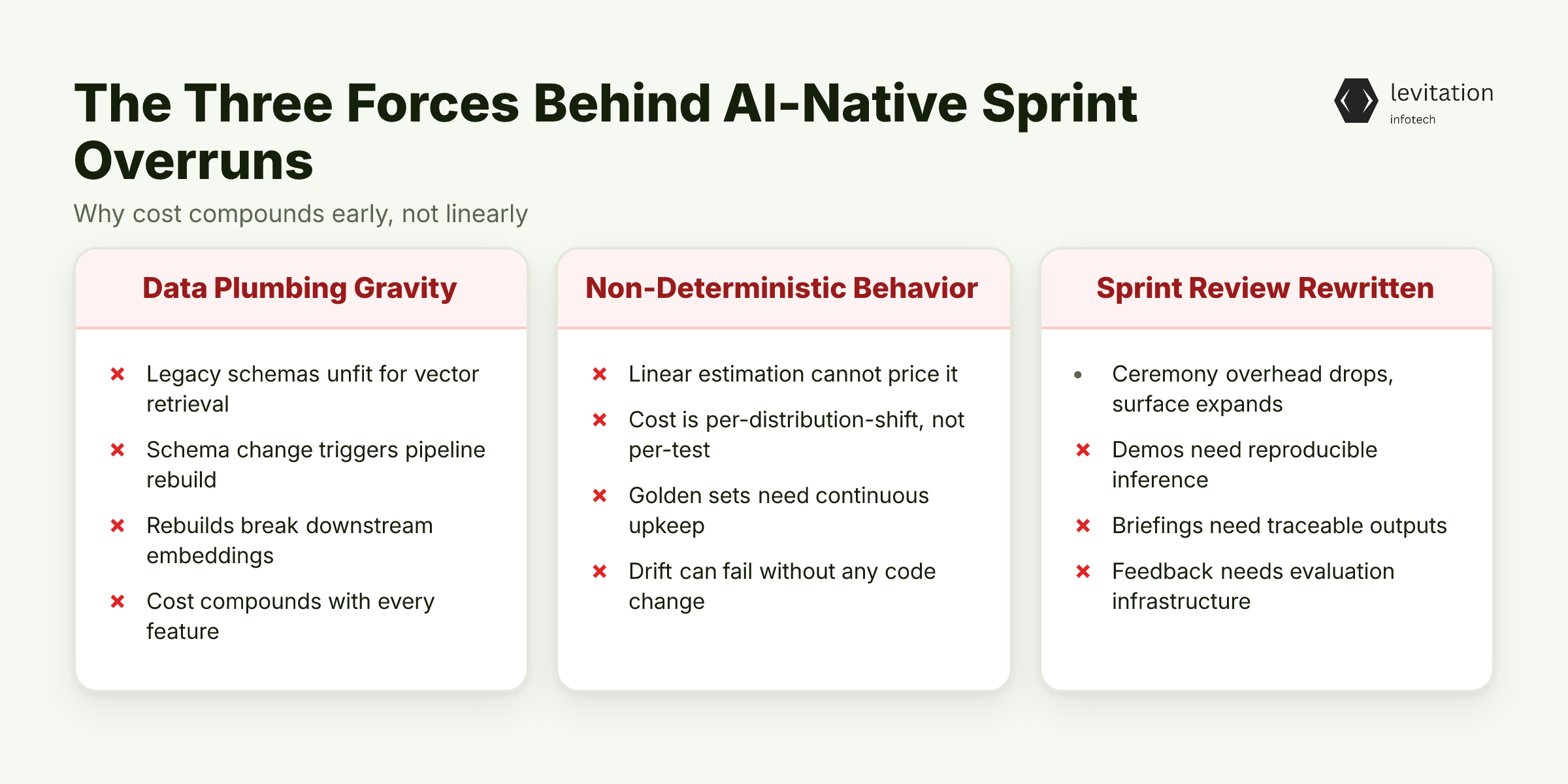
The three forces are diagnostic. Once you can name them, you can budget for them.
Force 1: Data plumbing gravity. Data ingestion, transformation, and embedding pipelines eat large amounts of sprint capacity in early rewrites. The reason is structural. Legacy data models were never designed for vector retrieval or streaming inference. Every schema change triggers a pipeline rebuild. Every pipeline rebuild breaks downstream embeddings. The cost compounds with every feature, not linearly with features.
Force 2: Non-deterministic behavior. Traditional test coverage assumes deterministic outputs. Pass or fail. AI-native systems require statistical evaluation, golden set maintenance, and continuous drift monitoring. Linear estimation cannot price this because the cost is not per-test. It is per-distribution-shift. A model that passed last week's golden set can fail this week's production traffic without any code change.
Force 3: The sprint review itself is being rewritten. AI-native teams now run async demos, auto-generated stakeholder briefings, and live feedback synthesis. The ceremony overhead drops. But the engineering surface area that feeds those reviews expands. Every demo needs reproducible inference. Every briefing needs traceable outputs. Every feedback cycle needs evaluation infrastructure to test proposed changes. The same early-sprint collapse shows up in Why India Web App Quotes Break at Sprint Three for traditional builds. The AI-native version is worse.
The three forces interact. Data plumbing changes trigger non-determinism. Non-determinism forces richer reviews. Richer reviews demand more engineering surface.
The compounding effect is why the overrun shows up early. It does not show up much later.
Teams that have shipped production AI systems for years treat these three forces as a single integrated planning problem. The diagnostic is useful. The next question is operational: how do you actually restructure sprints so these forces stop eating your budget?
How to Restructure Your Sprints for AI-Native Realities
The restructure is four steps. None of them are exotic. All of them are routinely skipped.
Step 1: Front-load data infrastructure into a dedicated foundation sprint. Before feature work begins, treat embeddings, retrieval, and evaluation harnesses as sprint-zero deliverables with their own budget line. This is the single biggest lever. When data plumbing is funded explicitly, it stops being absorbed as rework.
Step 2: Decouple evaluation sprints from feature sprints. Model behavior changes should not break shipped work. Budget one evaluation sprint per three feature sprints as a working rule. The evaluation sprint maintains golden sets, refreshes drift thresholds, and validates the model under realistic load.
Step 3: Bake prompt regression into CI. Every prompt change should trigger automated golden-set evaluation before merge. This converts hidden rework into visible, bounded engineering work. The merge is blocked if the golden set regresses. The team knows the cost before they ship, not after.
Step 4: Replace point estimates with ranges tied to model behavior. Report confidence intervals, not single numbers. The overrun stops being a surprise and starts being a tracked variance. Stakeholders can plan around a range. They cannot plan around a single number that turns out to be wrong.
The four steps together produce a sprint structure that matches the work. A typical enterprise AI development engagement deploys far faster than in-house teams trying to build the evaluation and data plumbing capabilities from scratch. The gap is the restructure.
When the sprint structure matches the work, the budget math changes. And so do the outcomes you can promise the board.
What Changes When the Budget Math Finally Works
Three things change, and they compound.
Predictable sprint velocity. Variance tightens once the three forces are explicitly budgeted rather than absorbed as rework. The board stops getting surprised. Engineering stops getting blamed for surprises that were structurally baked into the estimate.
Lower total cost of ownership. Systems architected with the restructure survive longer in production. The evaluation surface prevents the silent drift that kills most AI deployments after a couple of years. The cost of a rewrite in year three is far higher than the cost of an evaluation sprint in year one.
Faster time-to-value. Teams that restructure ship production-grade AI features without re-architecting after every model swap. The speed advantage is not magic. It is the absence of rework.
The pattern is consistent enough that AI software development work delivered with this restructure keeps clients engaged long-term. The clients stay because the budget math finally works. The systems keep running long after the engagement ends.
If your team at Levitation is staring at an early-sprint overrun right now, the diagnosis is probably not model cost. It is estimation blindness to one or more of the three forces. The fix is not a better forecast. It is a different sprint structure.
Frequently Asked Questions
Why do AI-native rewrites go over budget so much faster than traditional rewrites?
AI-native rewrites blow budgets early. The architecture introduces non-linear integration costs, non-deterministic model behavior, and hidden evaluation infrastructure. Traditional estimation frameworks were never designed to model these. The overrun shows up early because that is when the first architectural compromise forces a rewrite.
How long should an AI-native rewrite actually take?
A well-scoped AI-native rewrite deploys far faster when delivered by a team experienced with the architecture. In-house teams trying to build the evaluation and data plumbing capabilities from scratch take much longer. The gap reflects the difference between a team that budgets for the three forces and one that discovers them as rework.
What is the biggest cost driver in AI-native sprint overruns?
Data plumbing. Ingestion, transformation, embedding pipelines, and retrieval infrastructure routinely absorb large amounts of early-sprint capacity. This work is almost never estimated as a first-class workstream in the original budget.
Can agile sprint methods actually fix AI development cost overruns?
Standard agile methods help but aren't enough on their own. AI-native delivery requires explicit evaluation sprints, prompt regression in CI, and range-based estimation tied to model behavior. Adopt a modified agile model that accounts for non-deterministic outputs.
When should a CTO bring in an external AI development company instead of building in-house?
Bring in an external team when the in-house team lacks production experience with evaluation harnesses, vector retrieval, and non-deterministic testing. These three capabilities decide whether a rewrite ships on a realistic timeline or drags past it.
About the author
Mayank Singh is a software developer at Levitation Infotech, where he builds web and AI-powered applications across the company’s fintech, healthcare, and enterprise projects.