


TL;DR: HIPAA validates how clinical AI handles patient data. Joint Commission validates who is accountable when that AI acts on a patient. A system can pass one with flying colors and fail the other on the same deployment. The fix is a layered compliance architecture (NIST AI RMF, RUAIH, HIPAA). This stack should be built in from day one. It should not be bolted on after the agent goes live.
Key Takeaways: - HIPAA is a data-layer standard. Joint Commission's RUAIH is a workflow-layer standard measuring clinical accountability. - The four RUAIH domains (governance owner, risk mapping, ongoing measurement, human-in-the-loop) have no HIPAA equivalent. - Agentic AI compounds compliance debt because one agent's action can trigger another's, creating untraceable accountability chains. - Layered compliance architected from inception avoids the rework cost of retrofitting governance after deployment.
Your HIPAA-Compliant AI Agent Is About to Fail Its Joint Commission Survey
A CTO watches her hospital's flagship AI agent pass a third-party HIPAA audit. Encryption airtight. Access controls verified. Audit logging confirmed. Eight months later, the same system flunks a Joint Commission survey. It fails over a missing governance sign-off that nobody had documented. No breach. No data leak. Just an empty row in a spreadsheet that asked a question HIPAA never asked.
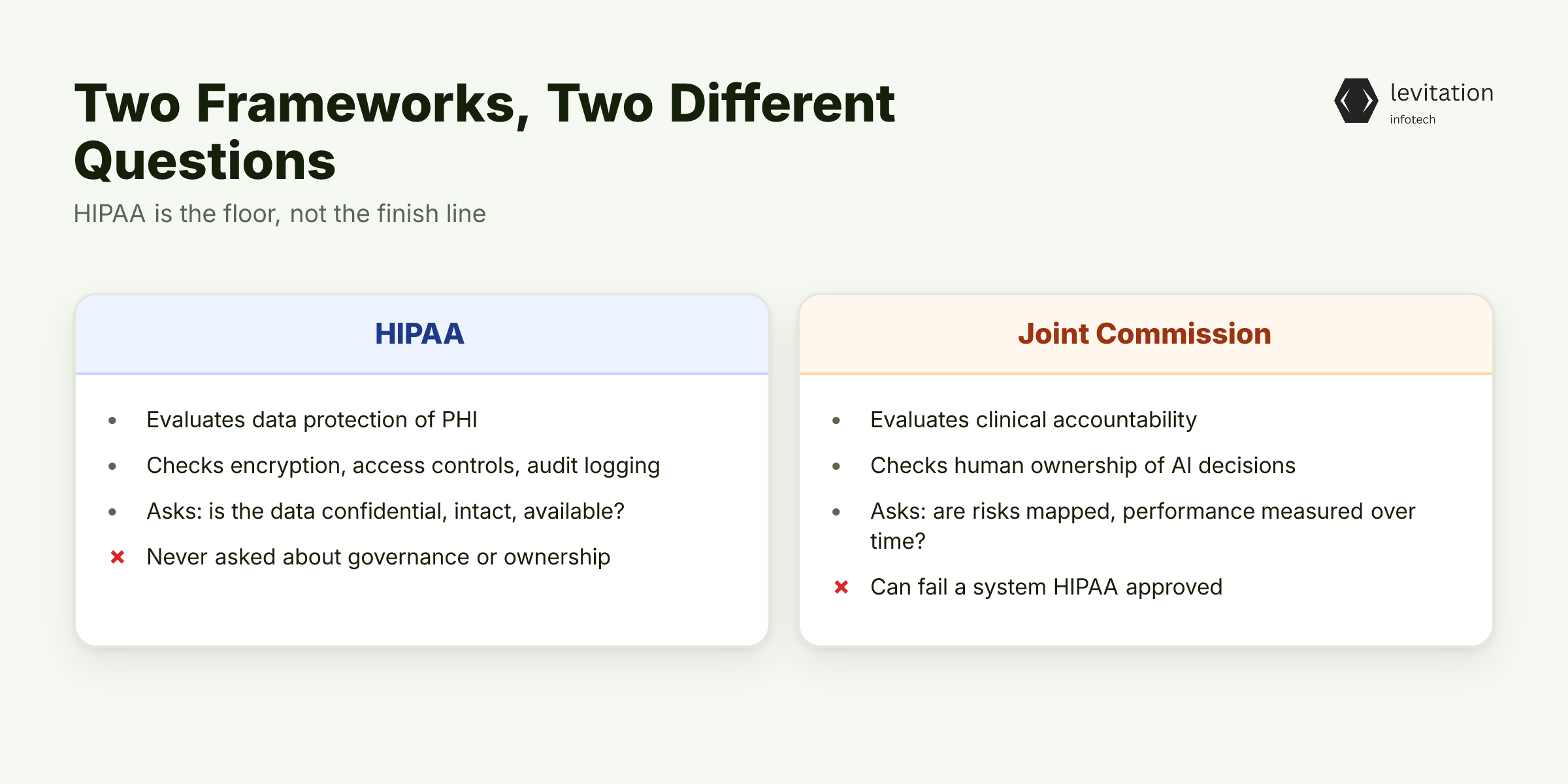
This is the new compliance gap. Healthcare CTOs have spent years treating HIPAA as the finish line for clinical AI. It's not. It's the floor. The two frameworks measure different things. HIPAA evaluates data protection. It checks whether PHI stays confidential, intact, and available. Joint Commission evaluates clinical accountability. Does a human own what the AI does? Are risks mapped to workflows? Is someone measuring performance over time?
A well-known chatbot incident showed this in plain language. A healthcare chatbot falsely claimed to be a licensed psychiatrist. It also gave a fabricated license number to a patient. Encryption did nothing to stop it. Access controls did nothing to stop it. The failure was governance. No one had classified the risk. No one had assigned ownership. No one had built a checkpoint that might have caught the lie before it reached a patient. For AI agents operating in clinical settings, that gap is not theoretical. It is the next survey finding.
But HIPAA was never designed to evaluate the thing Joint Commission actually audits.
HIPAA Protects Data. Joint Commission Protects Patients.
HIPAA's technical safeguards address three things: confidentiality, integrity, and availability of protected health information. Access controls. Encryption at rest and in transit. Audit trails showing who touched a record and when. These are data-layer guarantees. They answer one question: did patient data stay safe?
Joint Commission's Responsible Use of AI in Healthcare (RUAIH) certification asks a different question. Who is accountable when an AI agent recommends a treatment? And how do you know the recommendation was safe? The RUAIH framework evaluates four operational domains across governance, risk, measurement, and ongoing management. None of those domains live in the HIPAA rulebook.
The two frameworks target different layers of the stack. HIPAA is a data-layer standard. RUAIH is a workflow-layer standard. It follows the AI's output through the clinical process. It does not just track input through the database. A system can be fully HIPAA-compliant and still lack key controls. It might lack a named governance owner. It might lack a risk classification for each clinical workflow. It might lack any evidence that performance is being measured after deployment.
Healthcare technology leaders who treat these as interchangeable are about to learn the difference the hard way. Surveyors do not accept "we passed HIPAA" as a substitute for the four RUAIH domains. The frameworks are complementary, not equivalent. And AI compliance in clinical settings demands both. Healthcare technology stacks now face new standards. See Why 73% of Hospital AI Pilots Die in Year One.
So what exactly does Joint Commission RUAIH certification require that HIPAA never mentions?
The Four RUAIH Domains That Don't Exist in HIPAA
RUAIH certification is built on four operational domains. Each one maps to a gap that HIPAA leaves wide open.
Domain 1: Governance Structure. RUAIH requires a named AI governance owner with documented authority over clinical AI systems. Not a privacy officer. Not a CISO. A person whose title, role, and decision-making power is written down and visible to surveyors. HIPAA has no equivalent role designation. It expects a security officer and a privacy officer. But neither owns the clinical output of an AI agent. For AI governance to satisfy Joint Commission, the accountability chain must terminate at a named human. That human must have clinical authority.
Domain 2: Risk Mapping. Every clinical AI must be classified by risk tier across every workflow it touches. A triage chatbot is not the same risk as a radiology model that influences diagnosis. HIPAA's risk analysis is scope-limited to PHI exposure. RUAIH expands the risk frame. It includes clinical harm, bias across patient populations, and downstream actions triggered by the AI's output. The surveyor will ask: what happens to a patient when this model is wrong?
Domain 3: Ongoing Measurement. RUAIH demands continuous performance and bias monitoring in production. Not at deployment. Not annually. Continuously. The system must surface drift, accuracy degradation, and demographic disparities in near real-time. HIPAA's audit cycle is annual at best. By the time a HIPAA audit catches a model drifting for nine months, the harm is already done. Too much time has passed. For systems still relying on periodic review, this is the domain that takes the longest to retrofit. (We cover the audit-trail gap in Why Your Explainable AI Still Fails Its First External Audit.)
Domain 4: Human-in-the-Loop Checkpoints. The FDA's non-device CDS classification requires AI to display the basis for recommendations. This way, clinicians can review them on their own. RUAIH codifies this as a surveyable control. The AI must pause for human review at defined decision boundaries. It cannot just suggest and continue. A system that lets a clinician rubber-stamp every recommendation without showing the model's reasoning does not meet the standard.
None of these challenges are theoretical when your AI is agentic rather than assistive.
Why Agentic AI Multiplies the Compliance Debt

Traditional clinical decision support (CDS) shows a recommendation and waits. Agentic AI acts. It schedules appointments, orders follow-ups, routes referrals, and triggers downstream workflows. That autonomy creates governance problems that HIPAA was never built to handle.
Consider what happens when one agent triggers another. A patient arrives at the ER. A triage agent classifies urgency and books a bed. A scheduling agent then books follow-up appointments based on the triage output. A billing agent assigns a code. Three agents acted on one patient. The Joint Commission surveyor asks: who owns the outcome? If the triage classification was wrong, the scheduling cascade, the follow-up, and the billing entry are all wrong. Accountability has become compound.
Rate limiting and resource controls are now surveyable items. An AI agent that can schedule 10,000 follow-up appointments in an hour is a clinical risk. It is not just a performance metric. The system has no governor. Surveyors will ask how rate limits are enforced, not just documented. AI agents operating without resource controls are a survey finding waiting to happen.
Human checkpoint requirements shift from advisory to enforced. In traditional CDS, a clinician can ignore a recommendation. In agentic systems, the agent can complete an action before the clinician sees it. This happens unless a checkpoint API pauses the workflow. The architecture must enforce the pause, not rely on the clinician to remember. For more on how agent stacks accumulate hidden violations, see Your AI Agent Stack Is Secretly Violating Rules.
These governance challenges demand more than policy documents. They demand code-level enforcement. And that means AI governance must be an architecture decision, not a compliance afterthought.
The fix is not a longer audit checklist. It is an architecture decision.
The Layered Compliance Stack: NIST AI RMF + RUAIH + HIPAA
The CTOs who pass both HIPAA and Joint Commission on the same deployment are not running two separate programs. They run one layered stack. In that stack, each framework covers a layer the others miss.
Layer 1: NIST AI RMF as enterprise foundation. The NIST AI Risk Management Framework provides four functions: Govern, Map, Measure, Manage. These give you the cross-industry governance backbone that both HIPAA and RUAIH expect to find underneath. A risk register, a model inventory, defined roles, and continuous monitoring infrastructure. When NIST is in place, RUAIH and HIPAA sit on top of it instead of duplicating it. For more on how this connects to broader AI compliance work, see AI compliance in regulated industries.
Layer 2: RUAIH for clinical workflow integration. This is where patient-safety considerations, human checkpoint design, and bias monitoring get codified into the agent's decision logic. The four RUAIH domains become engineering requirements. A named governance owner maps to a role in your RACI chart. Risk mapping maps to a model card. Ongoing measurement maps to your monitoring pipeline. Human checkpoints map to API calls that pause agent execution.
Layer 3: HIPAA for data-layer rigor. Encryption, access governance, and audit trails remain non-negotiable. But they are now the floor, not the ceiling. HIPAA validates that patient data stayed protected. RUAIH validates that the clinical decision was safe. NIST validates that the governance system itself is functioning.
The implementation shortcut: a well-architected stack reaches joint readiness far faster. When governance is retrofitted after the agent is in production, rework is required. When every workflow is built from day one, it carries its audit trail. It also carries model version stamp, confidence score, and human checkpoint API call. All of these are part of the code path. When governance is code, it does not need to be re-validated against survey requirements. It already meets them.
Architectural specifics that make this work: - Every agent action writes to an immutable audit log with model version, input hash, and decision timestamp. - Every recommendation carries its model version and confidence score in the response payload. - Every workflow boundary triggers a human checkpoint API call. This call blocks downstream action until the clinician responds. - Every model retraining event triggers a re-classification of risk tier and a re-validation of the human checkpoint logic.
For health systems evaluating partners, see top AI companies for healthcare in India. The differentiator is whether they deliver this stack or just a HIPAA report. (For a deeper look at how compliance debt accumulates in production, see Agentic AI Codebases Accumulate 3x More Debt.)
Here is what changes when you build governance in from day one instead of bolting it on.
From Audit Failure to Long-Term Production Stability
When governance controls are code rather than policy documents, they do not drift. They do not get out of sync with the model. They do not pile up exceptions every time a clinician asks for a shortcut. The audit trail is generated automatically. The human checkpoint is enforced at the API layer. The risk classification updates when the model changes.
The pattern across regulated health systems is consistent. Organizations that pass their first Joint Commission survey with the same AI agent do not churn. They expand. Systems that survive their first survey without findings can grow into new use cases. They do not need to re-architect to do so.
The layered stack scales across multi-site health systems, not just single-hospital pilots. What works in one facility works across many when the governance is encoded in the platform. The governance does not need to be maintained per site. For more on scaling clinical AI across enterprise deployments, see Why 73% of Hospital AI Pilots Die in Year One.
The compounding effect is what matters. Every quarter that a system runs cleanly is a quarter where the compliance team is not firefighting. Every survey that passes without findings is credibility earned with the accreditation body. Every new use case on the same governed platform costs a fraction of the first. New use cases build on the same foundation.
Frequently Asked Questions
What is the difference between HIPAA compliance and Joint Commission certification for clinical AI?
HIPAA is a federal data-protection regulation. It focuses on the confidentiality, integrity, and availability of PHI through technical and administrative safeguards. Joint Commission certification, especially the Responsible Use of AI in Healthcare (RUAIH) program, evaluates governance. It also covers risk management, clinical accountability, and ongoing performance monitoring. A system can be fully HIPAA-compliant and still fail a Joint Commission survey. Failure happens when it lacks documented governance owners, risk classifications, or human-in-the-loop controls.
What does Joint Commission RUAIH certification actually require?
RUAIH certification requires four operational domains. First, a named AI governance structure with documented authority. Second, risk mapping across clinical workflows. Third, ongoing measurement of AI performance and bias in production. Fourth, enforced human-in-the-loop checkpoints at defined decision boundaries. Health systems must show these controls during survey, not just describe them in policy.
Do AI agents need different compliance controls than traditional clinical decision support software?
Yes. Agentic AI introduces compound accountability. When one agent triggers another, surveyors need to trace ownership across the chain. Agents also need rate limiting, resource controls, and enforced human checkpoints. Traditional CDS can address these with advisory prompts. The FDA's non-device CDS classification requires AI to display the basis for recommendations. RUAIH turns that requirement into a surveyable control for agentic systems.
How long does it take to make a clinical AI agent Joint Commission-ready?
When governance is architected into the agent from inception alongside HIPAA controls, organizations avoid rework. Every workflow does not need to be retrofitted against survey requirements after deployment. Governance built into the code path is validated once, not re-validated repeatedly.
**What governance framework should a CTO use for clinical AI compliance?
About the author
Mayank Singh is a software developer at Levitation Infotech, where he builds web and AI-powered applications across the company’s fintech, healthcare, and enterprise projects.