


TL;DR: The 30% actionable result is neither a universal target nor a false-positive rate. It exposes a broken contract between model output and clinical action. CTOs must fix that contract through event-level measurement, local validation, tiered routing, and governed feedback.
Key Takeaways: - Measure actionability from delivered alerts, then track whether those alerts produce documented action. - Separate model errors from duplicate, stale, mistimed, context-poor, and misrouted alerts. - Treat local validation, safety floors, policy versioning, and rollback as product requirements.
Clinical AI Alert Fatigue Is an Actionability Failure
Ten thousand clinical AI alerts can look like clinical progress while adding little to care. In the measurement behind this story, only three in ten were actionable.
The uncomfortable diagnosis is simple. Alert fatigue is usually a broken contract between model output and clinical action, not merely a false-positive problem.
The benchmark that changes the business case
That result is an observed benchmark, not a universal ceiling for clinical AI. It changes the business case because alert volume can't stand in for clinical value.
A medication-alert scoping review reported positive predictive value ranging from 9% to 100% across included studies. That spread warns against copying another hospital's operating target without local evidence.
Positive predictive value asks how often a fired alert matches its intended target. It doesn't ask whether a recipient can act.
The 30% finding doesn't establish a universal threshold. It doesn't compare alert precision with patient-outcome validation. Seven in ten alerts were not shown to be clinically wrong, so the next question is whether a correct alert can drive action.
Correct isn't the same as actionable
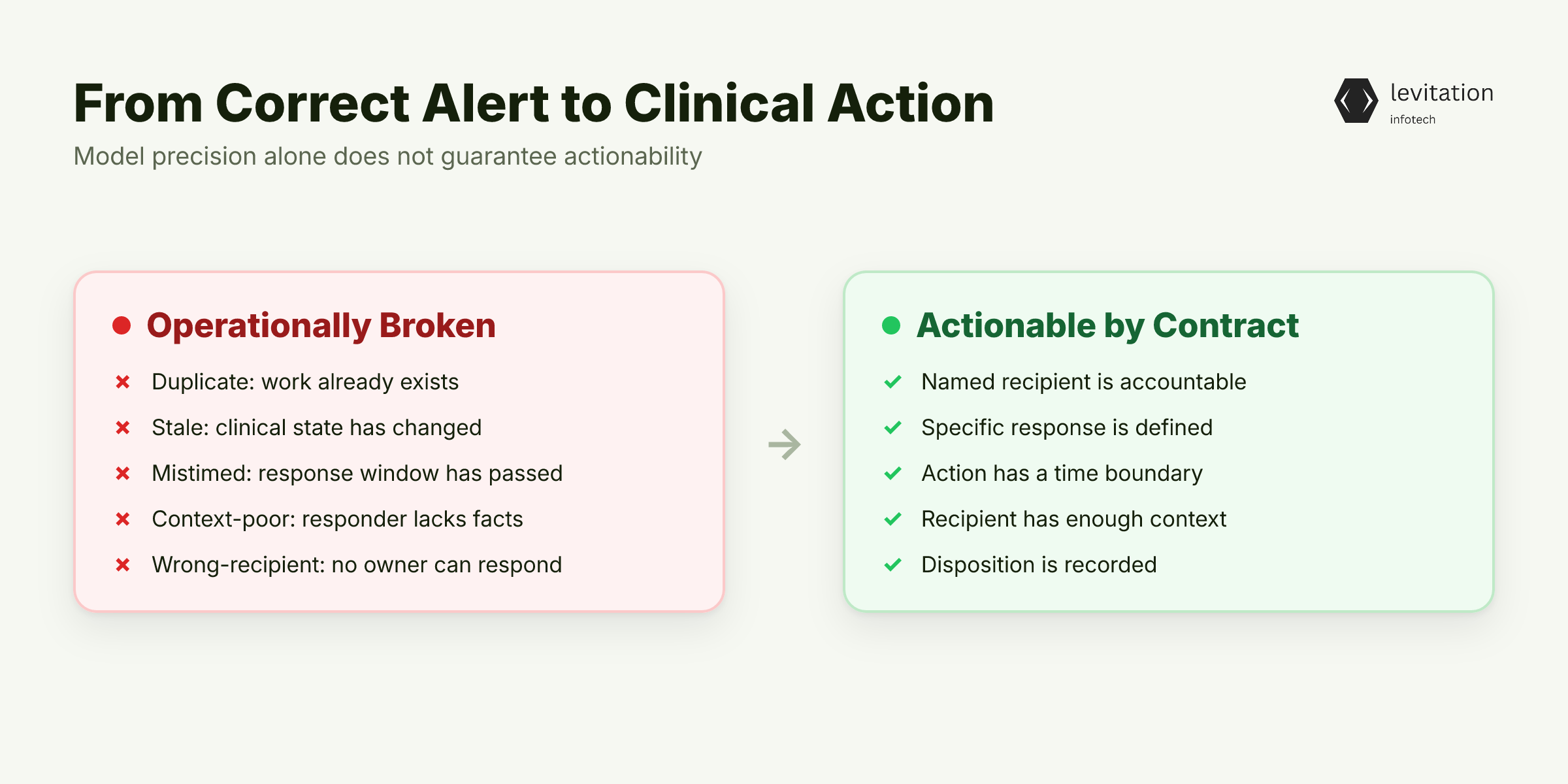
A technically correct alert can still fail operationally: - Duplicate: Open work already covers the same event. - Stale: The clinical state changed before delivery. - Mistimed: The response window has passed or hasn't arrived. - Context-poor: The recipient lacks facts needed for a safe response. - Wrong-recipient: No accountable owner can respond.
These failures occur after inference, where model precision alone can't explain them. Fixing them requires more than raising a confidence threshold.
Inference quality is only the first filter. The missing question is where a correct alert stops becoming a clinical action.
A missing contract after inference
A useful working framework sets a clear bar. An alert is actionable when a named recipient can take a specific, time-bounded action with enough context. The recipient must also record the disposition.
This framework is separate from the source measurement. It exposes the missing agreement among the model, delivery system, clinical owner, and workflow.
Under AI governance for clinical decision support, actionability becomes an acceptance criterion, a governance obligation, and a product requirement. Procurement should reject attractive model metrics that hide operating costs absorbed by clinicians.
The real work starts with locating exactly where each alert dies between inference and care.
The Alert Funnel Leaks Before the Model Is Wrong
Most alert leaks happen after inference. Expose them by splitting every run into six handoffs: - Generated: The model emits a candidate event. - Delivered: Policy and routing accept the event for a recipient. - Seen: The recipient's interface displays it. - Acknowledged: The recipient confirms receipt. - Acted upon: The recipient completes the promised work. - Outcome-linked: The action connects to a downstream result.
Assign every drop-off a reason code. Then teams can separate model error from delivery, routing, timing, context, and workflow failures.
A delivery failure and a workflow failure have different owners. The model shouldn't absorb blame for either.
Build a non-actionability taxonomy
Every non-actionable event needs a reason code. Use a working taxonomy: - Duplicate: The same event already has open work. - Stale: The event no longer reflects current clinical state. - Wrong-recipient: No responsible owner can act. - Context-poor: Required facts are missing. - No-clear-next-step: No specific response is defined. - Correctly informational: Useful context exists, but no action is promised. - Model error: The generated claim isn't supported.
Only the model-error category counts as a false positive. Every other category points to a different fix, so the label tells teams where to intervene.
That distinction raises a harder question: what evidence should teams collect when the alert itself is correct?
The evidence gap extends beyond false positives
A medication-alert scoping review screened 5,625 citations and included 10 studies. Three of those 10 reported both statistical performance and clinical outcomes.
A separate observation found that only 3 of 1,357 FDA-cleared AI-based medical devices had been tested on patient outcomes.
The 10,000-alert measurement concerns actionability. The device finding concerns clinical evaluation. Neither number substitutes for the other, so teams must choose which question their next deployment needs to answer.
One threshold can't repair every alert family
Medication warnings, diagnostic flags, sepsis signals, and anomaly detections have different response windows, harms, prevalence, and clinical owners. A site-wide threshold may remove noise while silently removing sensitivity.
Use the comparison set for top AI companies for healthcare in India to build an alert-specific vendor scorecard. Ask vendors for event-level evidence by alert family, not generic rankings.
If alerts leak for different reasons, one confidence threshold can't repair the system. The repair must start with a shared definition of the action each alert promises.
Turn Actionability Into a Product Contract
Suppose a medication alert says only "review." That isn't a promise. It omits who acts, what they do, by when, and what evidence they need.
Every interruptive alert must specify: - The intended action - The accountable recipient - The response window - The supporting context - The expected disposition
If the team can't complete those five fields, the alert doesn't yet have a product contract. Every field changes behavior.
Without ownership, the alert can become everyone's concern and no one's job. The missing fields must become measurable before a team can improve them.
Measure actionability and conversion separately
Actionable rate equals contract-qualified alerts divided by delivered alerts. Action conversion equals documented actions divided by actionable alerts.
Report both. A high delivery count can't disguise low utility.
For example, an EHR can deliver every alert while few satisfy the contract. The delivery dashboard looks healthy, but clinical work isn't improving.
Track these operating and safety measures alongside both rates: - Interruptions per clinician shift - Duplicate and stale-alert rates - Acknowledgment latency - Time-to-action - Reason-coded overrides - Interrupted alerts - Critical misses
A lower alert count isn't success unless action and safety metrics hold. The next question is where each alert should arrive.
Match the channel to the promised action
The delivery channel must fit the response: - Interrupt: Immediate, time-sensitive work requires attention now. - Passive: Useful information can wait for routine review. - Digest: Related non-urgent alerts can be grouped for one session. - Suppress and log: Redundant events still need an auditable record.
Triage by alert family, not one site-wide threshold. Useful information can wait, but a critical warning cannot. Before choosing a channel, teams must set a safety floor.
Treat 30% as a diagnostic baseline
The measured rate should trigger leak analysis and priority setting. It shouldn't force every deployment toward the same number.
Different alert families carry different costs, harms, and response windows. A shared target can hide where the operating system actually fails.
Alert usefulness depends on workflow fit, available context, and disposition capture. That makes healthcare technology and hospital health information systems part of the product boundary, not an integration detail.
If the receiving health information system can't record the action, the contract is cosmetic. The same gap appears when your AI reads an X-ray while the workflow still faxes.
A precise action contract still needs a safety mechanism, because local noise reduction must not trade away critical events. That safety mechanism must rest on local evidence.
MLOps Alert Precision Needs Local Evidence and Safety Floors
Validate where the alert will fire
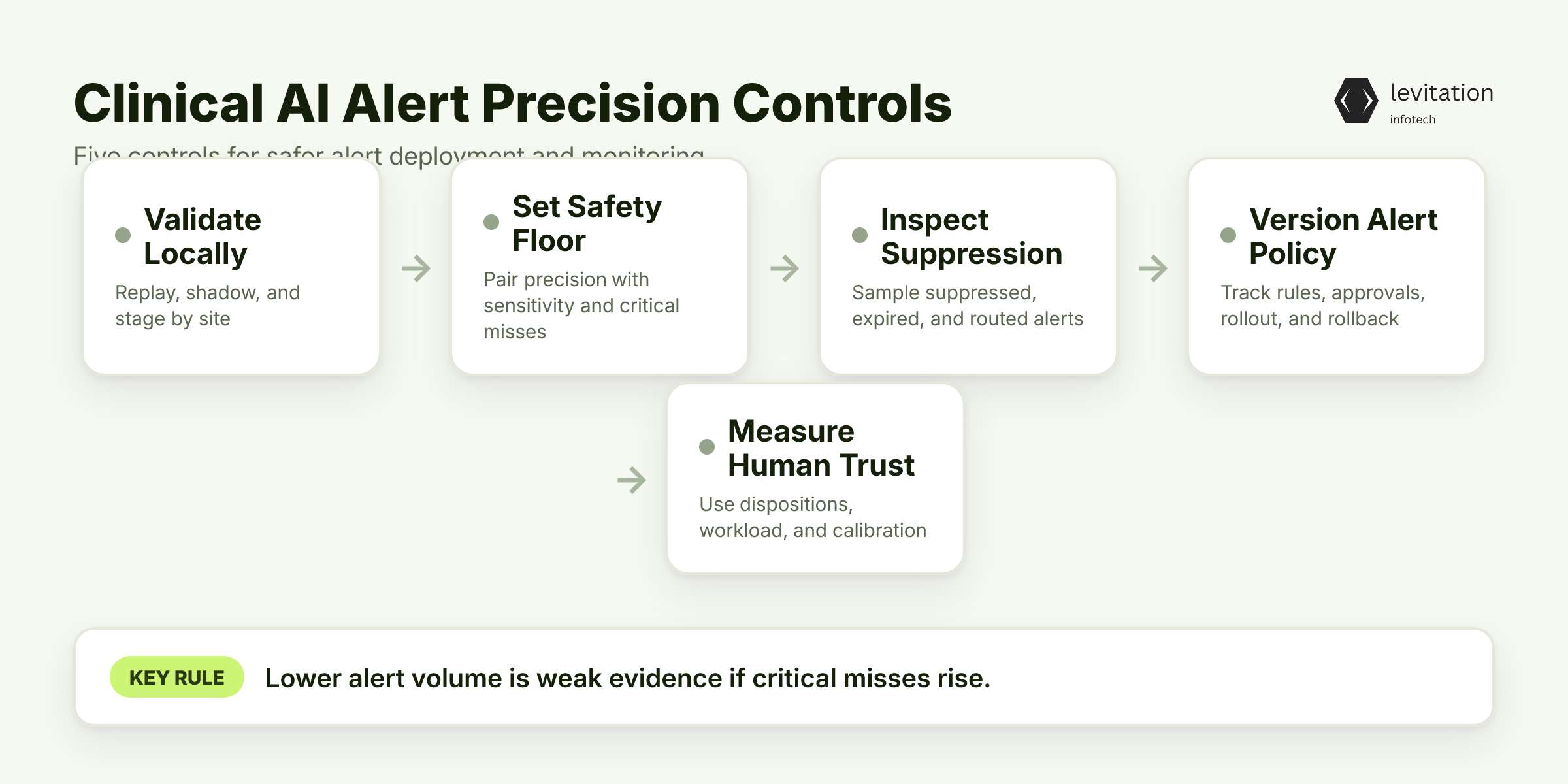
Validate each alert family by site, population, workflow, and time period. Use retrospective replay, shadow mode, and limited staged deployment.
Local prevalence and workflow differences can invalidate laboratory-level precision. A model can perform well in retrospective data but fire at the wrong moment in live care. Teams must close that live-care gap before release.
Shadow behavior will show whether retrospective accuracy survives the live workflow.
Preserve a safety floor
Pair positive predictive value with sensitivity, critical-miss rate, false-negative review, and subgroup results.
An interrupt budget can constrain low-value interruptions. It must never impose an unexamined cap on critical events.
A lower medication-alert count is weak evidence if critical medication misses rose. Volume and safety must move together, and safety limits must account for what suppression removes.
Sample what suppression prevents
Periodically review a stratified sample of suppressed, expired, and routed-away alerts. Otherwise, aggregate precision can conceal rare misses.
Sampling matters because silence isn't proof of absence. Suppressed events can still represent clinically important conditions, so the next control must make hidden decisions inspectable.
Version the policy, not only the model
Record every threshold, suppression, duplicate rule, routing, and escalation change. Each change needs a clinical reason, approver, rollout state, and rollback path.
This extends MLOps beyond model monitoring into the operating policy. Policy drift can change safety as much as model drift, yet a policy record alone cannot reveal how people respond.
Measure trust instead of assuming it
Use actual dispositions to monitor workload, moral distress, psychological safety, and trust calibration. Trust surveys can't replace event telemetry.
Under healthcare AI governance, the control system covers model output, alert policy, escalation, and retirement. It isn't a one-time model approval exercise.
Once the policy is designed, the next question is how to ship it without creating another shadow system nobody trusts.
Ship Alerts Through a Governed Control Plane
Separate inference from delivery
Use an explicit pipeline: - Model inference produces a candidate event. - Policy evaluates urgency, context, ownership, and duplicates. - Routing chooses the recipient and channel. - Delivery records the attempt and result. - Disposition capture records the human response. - Outcome feedback links the action to results.
The model should propose an event. The policy layer should decide how that event reaches care, and each handoff needs a durable record.
The first production test is whether every handoff leaves an auditable trace.
Define an append-only event contract
Record each generated event with these fields: - Identity: Alert ID, alert family, model version, policy version - Timing: Fired time, expiry time, expiration reason - Decision: Threshold, severity, recipient, channel - Evidence: Context references
Keep unnecessary patient data out of the event. Link clinical context through scoped references and role-based access.
Append dispositions separately: - Acknowledgment - Action code - Action timestamp - Override reason - Outcome link
This append-only history preserves what changed after generation and lets auditors rebuild the actual clinical decision path. A complete record still needs rules that explain each delivery choice.
Build family-specific policy rules
Before choosing interrupt, passive, digest, or suppress-and-log delivery, check: - Clinical urgency - Duplicate status - Freshness - Required context - Ownership - Existing open work - Escalation history
Record which checks passed and why delivery changed. A policy that can't explain its decisions can't be safely improved, and those rules need a staged path into live care.
Roll out in visible stages
Use this sequence: - Instrument the alert funnel. - Replay historical events. - Run shadow evaluation. - Tune thresholds with clinical owners. - Launch to a limited cohort. - Expand only after action and safety checks hold.
Preserve a kill switch and one-click rollback. Reproducibility must start before deployment, as discussed in reproducible healthcare AI pipelines.
A governed design also replaces a spreadsheet-based control plane with visible, versioned controls. Once live, every change must feed back into rule review.
Close the feedback loop
Feed dispositions into rule review and model evaluation. Distinguish correct overrides from workflow failures.
Run incident reviews for critical misses across data, model, policy, routing, and human factors. No single layer owns the whole failure.
Connect the control plane to patient data workflows in healthcare technology. Use top AI companies for healthcare in India only as a shortlist filter.
Each shortlisted vendor still needs alert-specific evidence. The technical control plane creates value only when it connects to adoption, safety, and operating cost. Can the executive scorecard show whether that connection improves care?
Make Clinical Action Yield an Executive Metric
Report a balanced scorecard
Pair these measures: - Clinical action yield and time-to-action - Clinician interruptions and override reasons - Critical misses and false-negative reviews - Outcome-linked alerts
Precision gains must not conceal reduced sensitivity. The board needs evidence of clinical utility, not a quieter notification channel. ROI must follow the same evidence chain.
The missing link is whether better alert behavior changes either cost or care.
Connect alert quality to ROI
Model the cost of interruptions, duplicate review, delayed escalation, unnecessary escalation, and clinician minutes per completed action. Include the cost of alerts that create no completed action.
Never claim patient-outcome impact unless the evaluation links actions to outcomes. Operational savings and clinical impact are different claims, and that distinction should also shape procurement.
Make alert evidence a procurement requirement
Require local shadow validation, reason codes, audit logs for policy decisions, monitoring for critical misses, outcome feedback linked to actions, and rollback capability. Make these part of AI governance and clinical AI risk management, not optional vendor extras.
Before approving another rollout, ask whether your team can measure dispositions, explain policy changes, and monitor critical misses. If not, the operating model, not the model, isn't ready.
The practical test starts with one question: how do you calculate an alert's actionability?
Frequently Asked Questions
What is clinical AI alert fatigue?
Clinical AI alert fatigue is reduced attention caused by too many alerts. Common alerts offer little value, repeat work, arrive late, or trigger no action. It affects both traditional EHR alerts and probabilistic AI outputs.
Reducing volume without protecting sensitivity can worsen safety. The key issue is not simply how many alerts arrive, but whether they produce a safe, documented response.
What percentage of clinical AI alerts should be actionable?
No universal percentage is defensible. The 30% figure describes one 10,000-alert measurement, while a medication-alert review reported positive predictive value from 9% to 100%.
Set targets per alert family, local population, and clinical harm. That leaves the practical question: how should teams calculate actionability?
How do you calculate the actionable alert rate?
Before launch, require a named owner, specific time-bounded action, sufficient context, and recorded disposition. Then divide contract-qualified alerts by delivered alerts to see where action breaks down.
About the author
Mayank Singh is a software developer at Levitation Infotech, where he builds web and AI-powered applications across the company’s fintech, healthcare, and enterprise projects.