


TL;DR: Weak model performance is not the main clinical AI outcomes problem. An evidence-design gap separates benchmark success from patient benefit. Closing it requires a staged path from retrospective validation to controlled deployment and ongoing outcome monitoring.
Key Takeaways: - Every clinical AI benefit claim must name its endpoint layer, comparator, population, and measurement period. - Study safeguards and missing outcome data can weaken causal evidence even when the model performs well. - Deployment evidence must connect model outputs to clinician decisions, care actions, safety, and patient outcomes.
High Accuracy Is Not a Patient Outcome
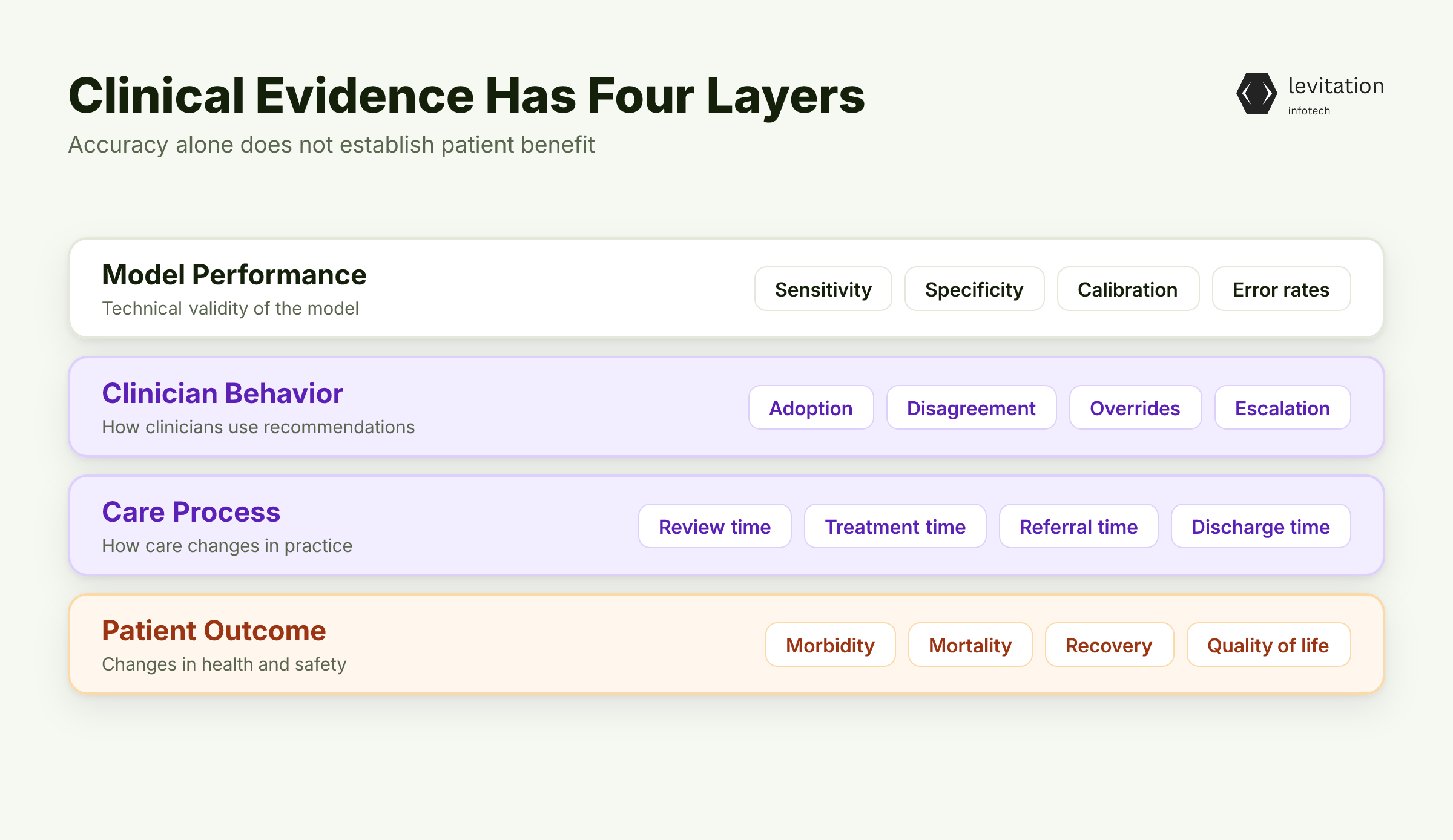
Clinical AI can achieve high accuracy while its evidence base fails to show that patients fare better. In the 100-study analysis, 85.0% of the 96 studies assessed had a high risk rating for outcome-data completeness.
Imagine a model identifying pneumonia on labeled scans. It agrees with radiologists and shortens reporting time. Neither result proves that patients receive treatment sooner or recover more often.
Those are different claims. Clinical evidence has four layers: - Model performance: sensitivity, specificity, calibration, and error rates. - Clinician behavior: adoption, disagreement, overrides, and escalation. - Care-process performance: time to review, treatment, referral, or discharge. - Patient outcome: morbidity, mortality, recovery, quality of life, or safety events.
Moving between layers needs a causal argument, not a prettier dashboard. When clinicians ignore most alerts despite higher accuracy, care remains unchanged. When response time falls but patient endpoints do not, clinical benefit stays unproven.
Diagnostic performance, clinician agreement, and faster completion are useful intermediate measures. They are not interchangeable endpoints.
Reserve “improves patient outcomes” for predefined patient endpoints, comparative evidence, and a documented path from recommendation to changed care.
Every benefit claim needs four labels: - Endpoint layer: technical, behavioral, process, or patient. - Comparator: current care, unassisted workflow, clinician, or another intervention. - Target population: the people and settings where the claim applies. - Measurement period: the period in which benefit should appear.
This discipline applies across healthcare technology, from imaging to deterioration alerts. The gap begins where technical evaluation ends, in study safeguards rather than model architecture. Which safeguards matter most when the model itself is performing well?
Where the 100-Study Evidence Gets Fragile
The 100-study analysis exposes three especially fragile safeguards: - Among 85 studies assessed, 75.2% were probably high risk for allocation concealment. - Among 82 assessed, 72.6% were probably or definitely high risk for participant blinding. - Among 98 assessed, 86.7% were probably or definitely high risk for provider blinding.
Allocation concealment keeps future assignments hidden before participants are allocated. Blinding reduces differences in attention and behavior after assignment. Without both, observed differences can reflect selection, extra attention, or clinician behavior rather than the AI itself.
Imagine two hospital teams, one receiving an AI alert and one receiving usual care. Predictable assignment lets teams prepare selected patients differently.
Known assignment changes how intensively clinicians manage cases. The observed difference would then reflect study design, not AI.
Outcome-data completeness was also high risk in 85.0% of 96 studies assessed. Missing outcomes can erase the cases most likely to show benefit or harm. Sound analysis must explain who is missing and why.
Read every percentage with its denominator. These figures describe subsets assessed for each bias domain, not all 100 studies.
CTOs should ask five questions: - What was randomized, and at what level? - When was allocation revealed? - Who could override or bypass the tool? - How were missing outcomes handled? - Was the analysis plan predefined before results were known?
Use those answers during vendor review. A list of top AI companies for healthcare in India is a market map, not an evidence substitute.
Inspect each protocol and outcome definition. This matters when clinicians track decisions reversed, not minutes saved.
Those flaws explain why causal claims are fragile. But they do not explain why most studies choose comparators that answer narrower questions than vendors often imply.
The Comparator Determines the Claim
What the studies tested
Diagnostic yield or performance was the largest intervention category at 49.6%. Patient behavior followed at 20.4%. Care management and clinical decision-making each accounted for 15.0%.
That mix points to a second issue: what each study actually used as its baseline.
How they compared it
At 64.6%, most studies tested an AI-assisted workflow against an unassisted workflow. Another 28.3% compared AI with routine care. Only 7.1% compared AI directly with a clinician.
Each design supports a narrower claim: - AI-assisted versus unassisted: the incremental value of AI inside an existing workflow. - AI versus routine care: the effect of an AI-enabled care pathway, not the model alone. - AI versus clinician: performance on a defined task, not benefit across a care journey.
Imagine a model beating radiologists on a retrospective scan set. That supports diagnostic-task performance. It does not prove faster treatment, fewer missed diagnoses, or better recovery in live care.
No single comparator can establish all three common claims: - The model works technically. - The existing workflow improves. - Patient outcomes improve.
Complete an evidence-contract matrix before procurement or go-live: - Population: who the claim covers. - Intervention: the model and intended decision. - Comparator: the baseline or alternative care. - Primary patient endpoint: the benefit that matters to patients. - Safety endpoint: the harm that must not rise. - Follow-up period: the time allowed for an effect. - Analysis method: subgroup rules, missing-data handling, and planned comparisons.
This discipline should shape any healthcare technology review and any shortlist of top AI companies for healthcare in India. It also exposes the integration gap described in where an accurate model still loses the workflow.
With the claim defined, the harder task is earning support through an evidence sequence. This sequence separates model validation from clinical validation. Which evidence supports which claim?
An Evidence Ladder for AI Clinical Validation
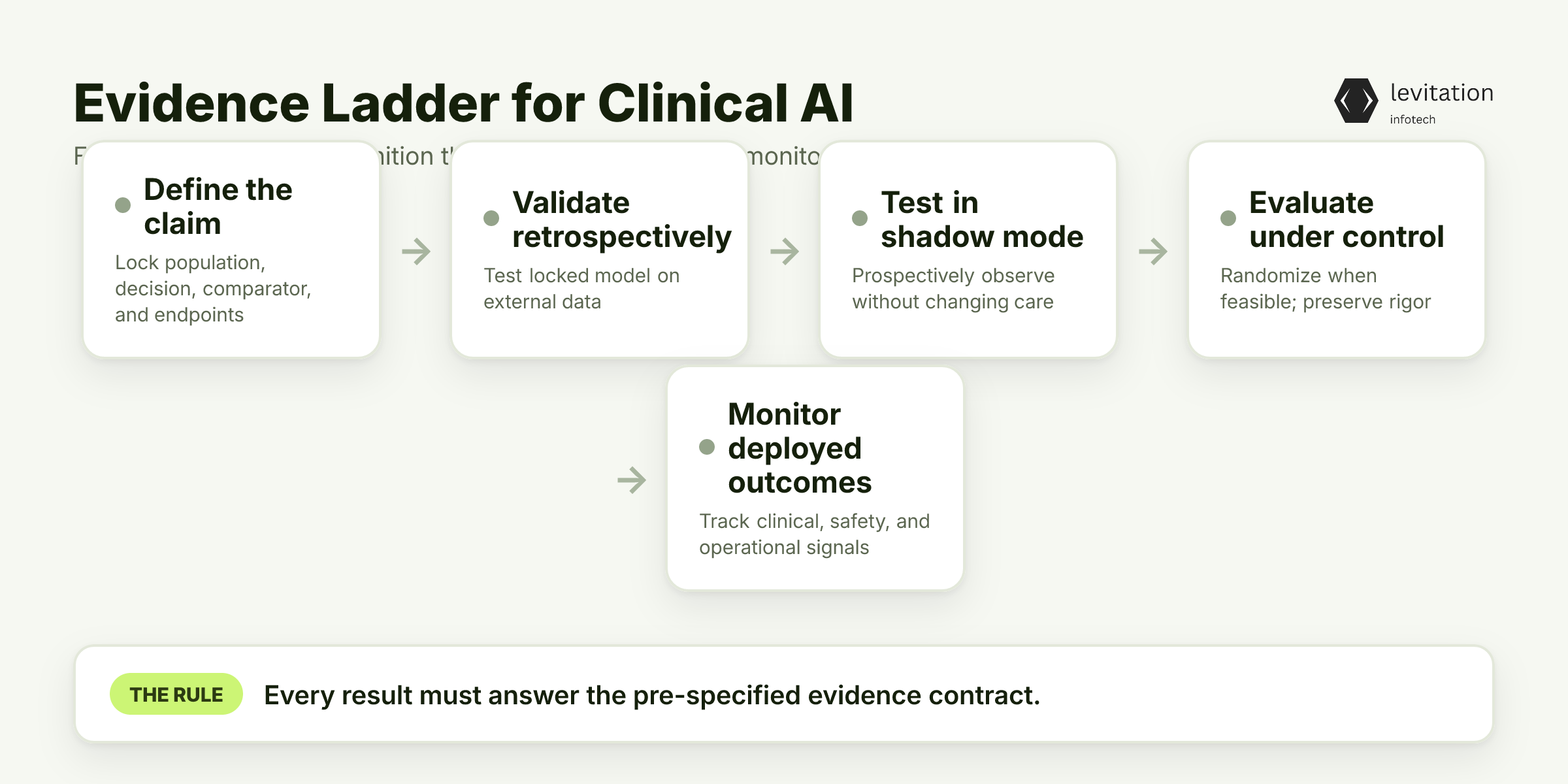
The ladder starts by refusing vague benefit language.
Gate 0: Define the claim
Write a one-page evidence contract before testing. It must specify the target population, intended clinical decision, comparator, primary patient endpoint, safety endpoint, time horizon, and analysis method.
Every later result must answer this contract, not a claim invented after results appear. Can retrospective testing earn support for the claim?
Gate 1: Validate retrospectively
Test a locked model on suitable external data. Document dataset shift, missingness, calibration, subgroup performance, false positives, false negatives, and the boundary between technical performance and patient benefit.
Locking prevents test results from becoming another tuning round. It also makes the comparison honest about which version produced the evidence. Can a retrospective test reveal what breaks in live care?
Gate 2: Run prospectively in shadow mode
Run the system prospectively in shadow mode. Collect inputs, outputs, uncertainty, clinician overrides, downstream actions, and eventual outcomes without letting the model change care.
This exposes data-pipeline and workflow failures before clinical exposure. It shows whether clinicians receive the output at the right moment. It also tests whether downstream systems can act on it.
The lesson in why operational failures sink hospital AI pilots applies here. Mature delivery joins evidence and operations. What happens when the model enters live care?
Gate 3: Run a controlled clinical evaluation
Use randomization when the study question allows it. In a stepped-wedge design, sites start in sequence.
Preserve allocation concealment and document blinding limits. Capture complete outcomes and predeclare statistical analysis, including missing-data handling.
Unavoidable blinding limits should be explained, not treated as missing paperwork. Can deployment preserve the same rigor after controlled evaluation?
Gate 4: Monitor outcomes after deployment
After deployment, track patient and safety endpoints alongside model drift, subgroup performance, overrides, alert burden, latency, and escalation events. Define rollback criteria before launch.
The ladder permits progressively stronger claims: - Gate 0: A design hypothesis, not a benefit claim. - Gate 1: Technical validity. - Gate 2: Prospective workflow validity. - Gate 3: Comparative clinical evidence. - Gate 4: Sustained real-world outcomes.
Require an evidence packet at every promotion: - The validation report. - The analysis plan. - The monitoring specification. - The safety and escalation plan. - A decision log explaining promotion to the next gate.
Together, these artifacts show what changed since the last gate and who accepted the risk.
A rigorous protocol cannot rescue a system that cannot show how recommendations changed care and outcomes. That failure starts with observability.
Engineer the Evidence, Not Just the Model
Technical validity does not prove that care changed. It proves only that the system produced outputs. The missing proof lives in the chain from model output to patient outcome.
Build an observability chain that joins: - The model version and input lineage. - The output and its uncertainty. - The clinician response and override reason. - The downstream care action. - The patient outcome.
Each link needs a traceable identifier. An accuracy dashboard cannot reconstruct that chain. Complete-looking clinical AI logs can still fail audit when those links remain disconnected.
Measure human-AI interaction as part of clinical validation: - Overrides and their reasons. - Alert burden and response time. - Missed escalations. - Whether added decision support changes behavior.
Make uncertainty, bias, and potential harm explicit for patient-facing systems. Where generated explanations support decisions, verify each factual claim against the source record. Use claim-level grounding, not fluent prose, as proof.
Create an operational safety loop with: - Monitored thresholds. - Named escalation owners. - Defined downtime behavior. - Complete audit logs. - Tested rollback procedures.
A one-time acceptance test cannot provide that loop.
When assessing top AI companies for healthcare in India, demand the same artifacts for each product. A better demo is not the goal. The goal is an auditable answer to one question: Did the deployment change decisions and patient outcomes?
What a Credible Clinical AI Outcomes Program Changes
The benchmark score is not what changes. Decision discipline around it does.
CTOs gain a defensible way to separate: - Model accuracy. - Workflow efficiency. - Patient safety evidence. - Patient outcomes.
These distinctions sharpen procurement, investment, and clinical-governance reviews. Clinical leaders can identify where a product belongs on the evidence ladder and what remains missing before expansion.
Engineering teams can connect reliability, human factors, safety monitoring, and outcome measurement through one release and observability strategy. Deployment stops meaning “the model is live.”
For healthcare technology leaders, this turns vendor selection into an evidence review. Shortlists of top AI companies for healthcare in India become starting maps, not substitutes for product-specific proof.
The 100-study analysis shows potential across important clinical uses. It does not support a universal claim that AI improves patient outcomes. Bias, missing outcome data, and comparator limitations remain.
A credible program distinguishes a workflow gain from a patient-outcome gain. That boundary improves trust and stops operational gains from being repackaged as clinical benefit.
Which decisions and outcomes can current clinical AI evidence support?
Frequently Asked Questions
Q: What do 100 clinical AI studies reveal about clinical AI outcomes?
A: They reveal an evidence gap between technical performance and demonstrated patient benefit. The analysis rated outcome-data completeness as high risk in 85.0% of 96 studies assessed. Allocation concealment and blinding also had high risk of bias across their assessed subsets.
Each percentage applies only to the studies assessed for that domain. It must not be read as a percentage of all 100 studies.
Q: Why are allocation concealment and blinding important in AI clinical validation?
A: They reduce the chance that differences in attention, selection, or clinician behavior will be mistaken for an AI effect. When concealment or blinding is weak, even accurate model outputs cannot reliably establish that the intervention caused better care or outcomes.
Q: Which healthcare AI benchmarks should a CTO require before deployment?
A: Require separate evidence for model performance, prospective workflow validity, comparative clinical performance, safety, and patient outcomes. State the population, comparator, endpoints, and time horizon explicitly.
Within healthcare technology, a single accuracy benchmark or simulated workflow result is not enough for a broad outcome claim.
Q: What patient safety evidence should be monitored after clinical AI deployment?
A: Monitor subgroup performance, uncertainty, false positives and negatives, clinician overrides, missed escalations, adverse events, and outcome completeness alongside technical drift. The monitoring plan should include predefined thresholds, accountable owners, and rollback procedures.
Q: Can clinical AI be deployed before randomized outcome evidence is available?
A: A carefully governed deployment can begin with retrospective validation, prospective shadow mode, or a controlled implementation. The controlled stage is designed to generate stronger evidence than retrospective testing alone. It does not prove improved patient outcomes. Monitoring must continue through the evidence ladder.
Where does your current evidence sit on that ladder?
About the author
Mayank Singh is a software developer at Levitation Infotech, where he builds web and AI-powered applications across the company’s fintech, healthcare, and enterprise projects.