


TL;DR: An ERP demo shows the product can process a clean path. It does not prove the Delhi plant can handle recurring exceptions. Price each exception pathway, then lock its owner, evidence, and five-year cost in the contract.
Key Takeaways: - Treat factory exceptions as recurring workflows, not one-off errors. - Compare bids using one exception register and identical scope. - Make UAT evidence, change rules, and five-year costs contractual.
The Demo Prices a Factory That Does Not Exist
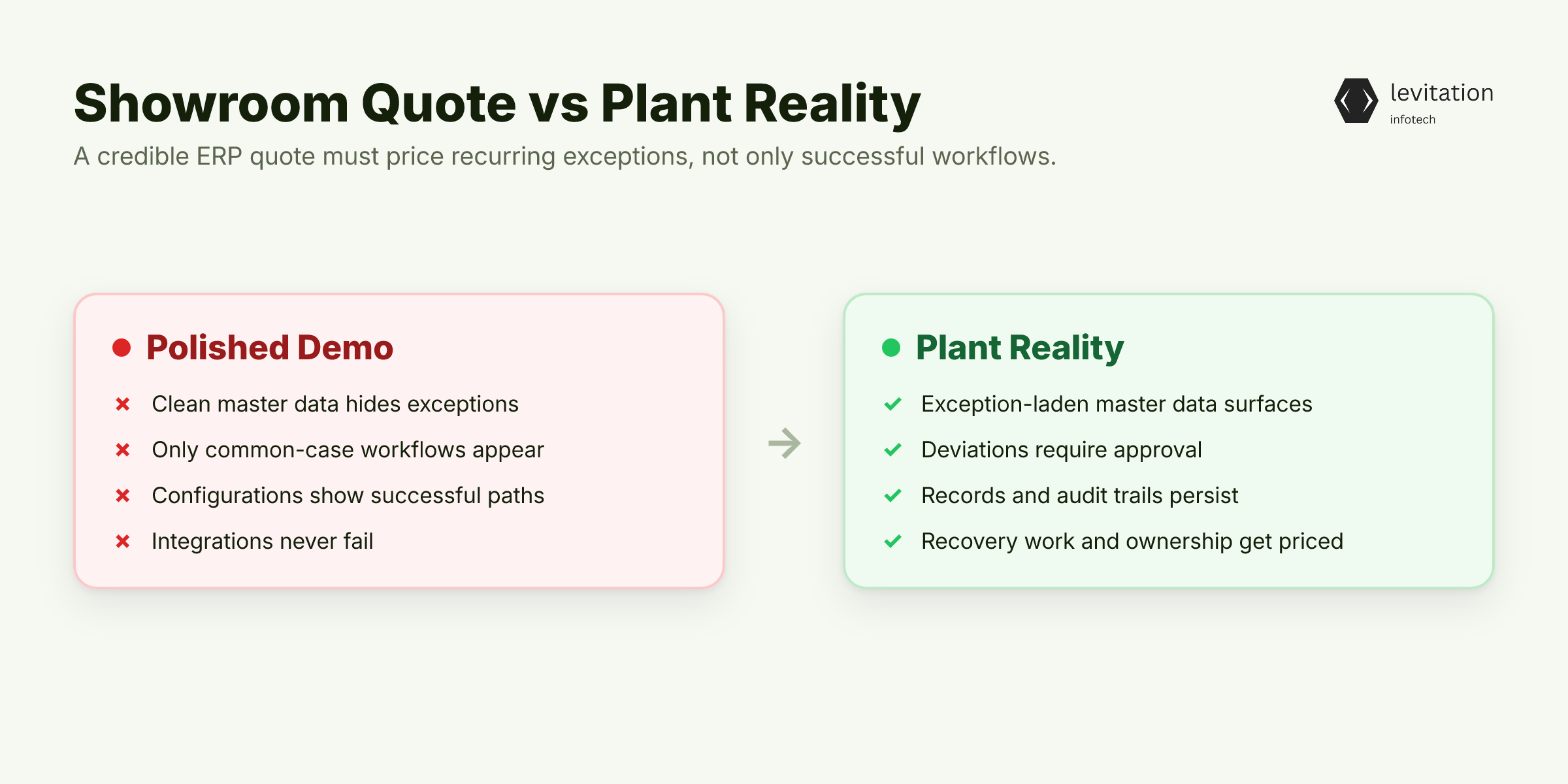
A polished ERP demo can make a Delhi factory look like a software showroom. It shows clean data, curated workflows, and perfect configurations. Nowhere do failed integrations or business exceptions appear.
The gap appears when a routine deviation must still be detected, approved, recorded, and recovered without stalling the line.
The quote looks affordable because it prices the showroom, not the plant.
Four Demo Conventions That Distort the Quote
Polished demonstrations often rely on conditions such as: - Master data appears clean rather than exception-laden. - The demo uses workflows matching the plant's most common cases. - Configurations work perfectly because only successful paths are shown. - Integrations do not fail, and business exceptions do not arise.
Individually, none is unrealistic. Together, they hide recurring implementation and operating work.
Where Plant Reality Returns
Consider a vendor invoice whose quantity differs from the purchase order. In the showroom, it matches. In the plant, someone must set the tolerance, decide who approves it, and preserve the recovery trail.
Ask every bidder to walk through one live exception expected at the prospective Delhi plant. The walkthrough must expose its trigger, approval path, downstream records, audit trail, and recovery path.
That evidence is more revealing than another polished purchase-order screen.
The Commercial Misread
A smooth screen demonstrates product capability, not implementation fit. The quote must separate the happy path from recurring deviations.
When reviewing ERP implementation cost in India, apply one test: a low quote excluding exception ownership isn't comparable with a complete quote.
The danger isn't one visible surprise fee. Every omitted exception multiplies cost across the processes connected to it.
Which costs multiply first? Follow one deviation across the plant.
How One Exception Multiplies Across Plant Systems
An exception is any recurring condition the standard workflow can't process cleanly. Examples include an invoice mismatch, a routing deviation, an inventory discrepancy, or a rework event.
Take a material substitution approved on the shop floor. It can alter the work order, stock ledger, production cost, quality record, and financial posting. One extra approval has become a chain of dependent records.
That dependency chain is where a seemingly local approval becomes a systems-wide cost.
Whether that chain belongs in configuration, an extension, or custom ERP depends on how far it changes the operating model. The same logic applies when scoping Odoo development: extensions and integration work can look small until dependencies are counted.
Three Cost Multipliers - Frequency: Recurring variance creates repeated review, support, and training work. - Reach: Each affected system adds interface, reconciliation, and test effort. - Ownership: Unclear decisions create queues, delayed postings, and disputed outcomes.
One-time cleanup differs from a recurring rule. Migration removes a bad opening balance. A recurring price variance keeps producing exceptions, approvals, and support requests.
Classify each case by cause and recurrence before choosing a remedy, because the same symptom may need different treatment in different plants.
Bounded rules fit configuration or a supported extension. Exceptions that redefine core production behavior justify deeper ERP software development.
A high exception count is a design signal, not a reason to build everything custom. The goal is to find where standard workflows stop being economical.
This also explains why factory complexity, rather than headcount, drives ERP cost. That pattern exposes a stock agreement problem the ERP cannot fix alone.
Once dependency chains are visible, quotes can compare exception pathways, not screens or named modules. But bidders will still price those pathways differently unless they share one scope. Which recurring deviations must that shared scope capture?
Build the Exception Register Before Requesting Quotes
ERP proposals become incomparable before anyone discusses software. The problem is scope, because bidders assume different factory conditions.
One Row per Exception
Create one register row for every recurring deviation. Each row should capture: - Process, trigger, standard path, and exception path. - Approver, source system, and downstream records. - Evidence required, frequency band, and proposed ERP response.
Version the register and give each row a stable identifier. This keeps bidders on the same trigger, decision rights, and evidence trail even as frequency or impact changes.
For example, an invoice mismatch row names tolerance, approver, blocked receipt, reconciliation evidence, and recovery action. Without that row, "invoice handling" is too broad to price or test.
A register does not need perfect forecasts; it needs stable scenarios that every bidder can price and test.
The Cost Stack
Ask each bidder to separate the quote into: - Baseline configuration and exception handling. - Extensions, integrations, and data remediation. - Testing, training, and post-go-live support. - Internal effort and a named change reserve.
Internal effort belongs in the business case even when no vendor invoice includes it.
Ask bidders to price both the first occurrence and the expected annual recurrence of each exception. A one-time charge may conceal a rule that will return every month.
A Market Range Is Only a Screening Band
Published ERP cost estimates, such as the linked estimates, serve only as screening bands. They do not price a plant's exception pathways.
Modules, users, branches, migration, integrations, and customization determine the position within that band. Normalize every proposal across the same locations, user groups, interfaces, data volumes, custom rules, migration effort, support period, and exception scenarios.
If a proposal omits a scenario, mark it as an assumption rather than silently treating it as standard scope.
Compare total cost over three to five years, not license or quote headlines. Include recurring subscriptions, hosting, maintenance, release upgrades, and future exception changes.
Require a quote for ERP for manufacturing in India to separate one-time delivery costs from recurring operating costs. Also state which quoted items depend on final exception counts.
An item tied to final counts should identify the unit rate, the assumed volume, and the threshold that triggers additional charges.
Review the broader ERP implementation cost in India only after that normalization.
The register exposes a second trap: every exception can be solved through configuration, extension, integration, or custom code. Those choices carry very different long-term economics.
So which path should each exception take?
Choose Configure, Extend, Integrate, or Build
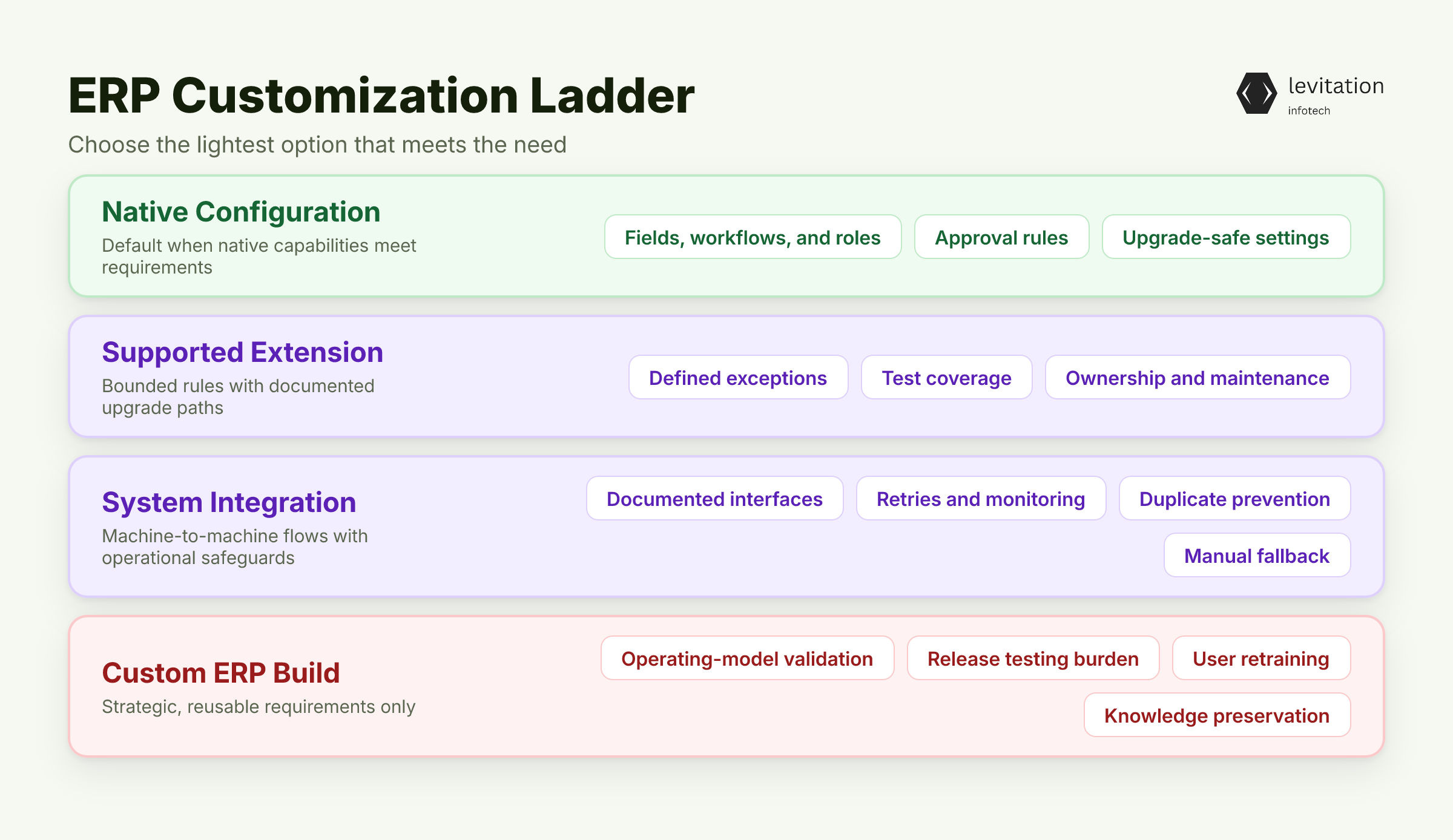
There's no virtue in custom code. There's no shame in standard configuration. The expensive mistake is pricing both as if they were one line.
Configuration
Use native fields, workflows, roles, and approval rules when the required behavior already exists. Keep it in supported settings so your team can maintain it without custom code.
An invoice tolerance within a native approval policy is a configuration candidate.
Configuration should be the default when it satisfies the control, evidence, and upgrade requirements without creating a workaround.
Extension
Choose a supported extension for a bounded, well-defined rule. Document its upgrade path, test coverage, ownership, and ongoing maintenance before accepting it.
Extensions work when the rule changes by exception, not by redesigning core production.
If the rule requires data from another system or changes several downstream records, reassess it as an integration or custom requirement.
Integration
Connect machines, legacy applications, marketplaces, or plant systems through documented interfaces. Include retries, duplicate prevention, monitoring, and manual fallback in scope.
Otherwise an integration can save entry time and create a new overnight queue.
An integration should have an accountable owner for failures between systems, not only for successful message delivery.
Custom ERP
Consider custom development only when a distinctive operating model repeatedly defeats standard and extension options. Document why the requirement is strategic, reusable, and worth its upgrade burden.
That burden is not free. It includes testing every release, retraining affected users, and preserving institutional knowledge. See how packaged ERP can miss the plant floor before choosing either route.
If the exception appears in every order or affects statutory records, validate the operating need before accepting a custom dependency.
Compare the Delivery Reality
Cost guides such as this ERP implementation cost guide are planning references only. The same exception register must drive the comparison.
Compare these paths over the same three-to-five-year horizon: - Odoo implementation cost: Emphasize configuration, hosting, training, support, and extension effort. - Proprietary ERP: Include licenses, implementation, upgrades, support, and future exception changes. - ERP software development: Include build, migration, integration, support, and the upgrade burden.
Compare each option using the same scenarios, support period, and change assumptions. Architecture alone won't prove the behavior.
Can screens prove it? No. Only live-data acceptance can test behavior when plant data introduces noise.
Turn Exception Tests into Contract Guardrails
Correct architecture can still fail at acceptance. The gap appears when a tested sample meets dirty production data.
Scenario-Based UAT
For each priority exception, test the normal path, exception path, and failure or recovery path. Verify expected approvals and the resulting inventory, production, finance, and audit records.
Use historical incidents and recently remediated transactions as test cases, with sensitive values masked but business relationships intact.
Imagine a rejected invoice. The test isn't complete when a warning appears. It must show whether stock stays blocked, who can release it, and what the ledger records afterward.
Migration and Integration Rehearsal
Load representative dirty data, then reconcile record counts and balances. Test interface timeouts, retries, duplicates, partial failures, and reconciliation reports before go-live.
Record reconciliation tolerances and name the owner for unresolved differences before go-live.
A clean rehearsal with unrealistic data proves very little. This is the same acceptance discipline described in why software projects fail at acceptance, not at coding.
Include Internal Capacity in the Business Case
Plan for executive sponsorship during discovery and testing. Department leads must own process decisions, prioritize data cleanup, and approve final operating procedures.
Measure data cleanup in days and account for reduced productivity while remediation and go-live changes disrupt normal work. These are business costs, even when the contract sheet doesn't name them.
Define Change-Order Rules
State what constitutes a new requirement, who can approve it, and how estimates and timelines are calculated. Identify which changes affect release scope and when the baseline is frozen.
Without this rule, a clarified exception becomes an open-ended consulting request.
Freeze the baseline only after the register and acceptance scenarios have been signed off, so later clarification cannot reopen settled scope.
Attach Acceptance to Evidence
Define objective exit criteria for every module and interface. Set defect severity levels, retest obligations, and sign-offs for data, workflow, integration, and support readiness.
Require the contract package to include: - Configuration documentation and data dictionaries. - Interface specifications and test evidence. - Ownership boundaries and support escalation paths. - Upgrade responsibilities and data-export provisions.
The evidence package should be stored in a shared repository with dates, environment details, and named approvers.
Make the commercial commitments behind ERP development cost and ERP implementation binding contract terms.
Once every assumption has an owner, evidence requirement, and change rule, uncertainty becomes visible instead of a post-go-live invoice.
The next filter is the partner itself: can it prove production endurance?
Use a Five-Year Partner Scorecard, Not Demo Polish
A vendor can excel at demos and still fail as a five-year operating partner. Use a scorecard, not a showreel.
Score each bidder on: - Exception coverage. - Three-to-five-year total cost. - Delivery evidence and a clear support model. - Upgrade ownership and documentation quality. - The number and severity of post-go-live changes still open.
Weight the score rather than averaging every line equally. Exception coverage and production references should carry more weight than polished feature lists.
Ask for production references and evidence that deployed systems remain supported over their operating life. Longevity is a stronger engineering signal than demo-day polish.
Partnership continuity is supporting evidence, not proof of manufacturing fit.
Before signing, request: - An exception-led scoping workshop. - A line-item quote tied to the register. - A five-year cost view. - Contractual change thresholds.
Accept only when the proposal shows normal work moving quickly and deviations remaining visible, traceable, and governed. The payoff is a plant that doesn't turn each deviation into a new consulting project.
The final proposals still leave two practical questions: what will this actually cost, and which route is cheaper over time?
Frequently Asked Questions
What is the realistic ERP implementation cost in India for a manufacturing plant?
An implementation quote depends on modules, users, branches, data migration, integrations, customization, and the factory's exception pathways. A broad market screening band cannot establish a plant-specific budget.
A plant shouldn't budget from the range alone. Request a line-item quote tied to its exception register.
How much does Odoo implementation cost for a manufacturing factory in India?
There is no defensible universal cost for Odoo implementation in a manufacturing factory. Licensing, configuration, migration, integrations, custom development, training, and support carry different costs across plants.
Require vendors to separate one-time implementation costs from recurring license and maintenance costs. Then compare identical factory scenarios across proposals.
Is custom ERP cheaper than Odoo for a manufacturing plant?
Not automatically. Custom ERP can fit distinctive processes and avoid per-user license fees. Odoo can be faster and more economical when standard modules cover most requirements. Both still carry configuration, migration, integration, and maintenance costs.
Compare total cost over three to five years using the same exception scenarios rather than headline license prices.
How can I stop factory exceptions from becoming ERP change-order costs?
Register each exception before contracting, map its downstream effects, and test both normal and exception paths during UAT. Freeze the included scope, define approval and pricing rules for new requirements, and require objective acceptance evidence before go-live.
Before accepting any headline price, request: - An exception-based scope. - A five-year commercial comparison. - Named change thresholds.
Can the bidder price that exception before it becomes an invoice?
About the author
Mayank Singh is a software developer at Levitation Infotech, where he builds web and AI-powered applications across the company’s fintech, healthcare, and enterprise projects.