


TL;DR: Compare real estate CRMs on normalized operating cost per attributable closed deal, not feature parity. Include implementation, migration, add-ons, and internal time, then verify the workflow in the field.
Key Takeaways: - Normalize every quote for the same projects, teams, partners, workflows, and period. - Pair cost per closed deal with time-to-close and source-to-close conversion. - Treat each feature as an operating chain that must change a record, trigger an action, and support a business outcome.
The Feature Checklist Can Hide the Costliest Mistake
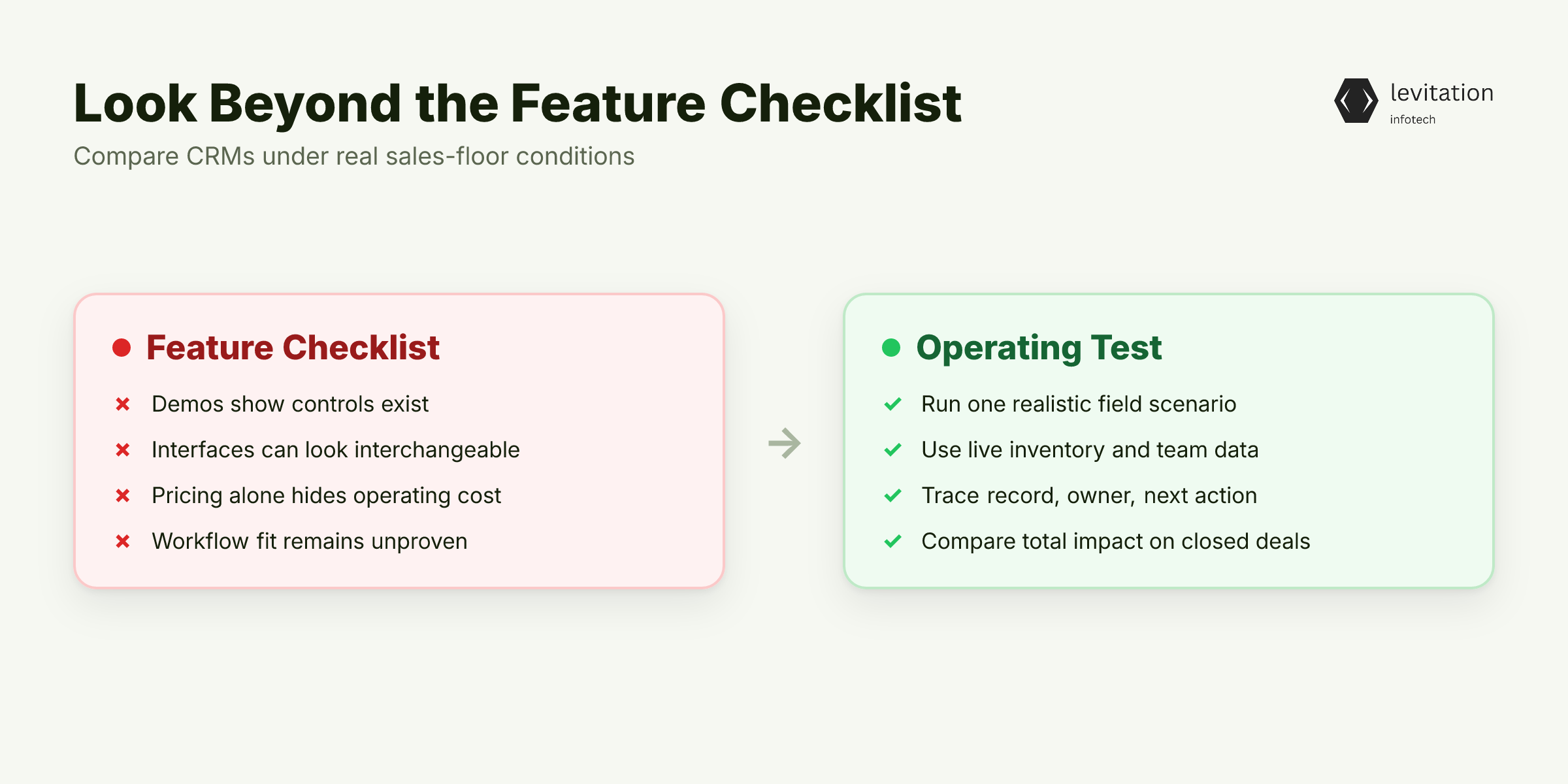
A Delhi-NCR sales head can shortlist two real estate CRMs with identical demos. Both cover automation, inventory, and reporting, yet one still costs more.
A feature comparison can make two systems look interchangeable. Pricing, implementation, migration, and impact on closed deals decide the purchase.
Separate What a Demo Proves From What It Hides
A demo proves a control exists. It doesn't prove that the control fits the sales floor.
Lead capture, nurturing, pipeline management, inventory, transactions, scheduling, communications, and reporting can look identical across vendors. Yet they can support very different sales workflows.
One team records every call. Another relies on memory until the weekly review. That operating difference decides whether a feature creates value.
Treat real estate crm pricing as a starting point, not a verdict. Lead ownership deserves special scrutiny. An NCR CRM demo cannot prove who owns a lead.
Test the Field Workflow, Not the Interface
Run one field scenario using a sample project, live inventory, and representative team data. - Can the sales head see where a team is while it shows a property? - Does the next follow-up action appear without a status call? - Can agents open the current brochure library and check property status? - Can the system identify which source brought the buyer?
Then ask which record changes, who acts on it, and what happens next. A feature without an accountable handoff is only an interface.
Convert Every Feature Into an Operating Test
For each proposed feature, ask: - Which record changes? - Who acts on it? - What follow-up becomes possible? - Where does the workflow prevent a lost inquiry, lead, or unit?
Feature value matters only when it changes lead handling, inventory accuracy, source attribution, or attributable closed deals.
Feature lists are useful only within the same operating conditions, which differently priced systems rarely share. Which normalized cost belongs in the comparison?
Normalize Delhi-NCR Quotes Before Comparing Them
Do not compare the smallest number printed on two quotes.
Builders and developers often receive quotes by project and team, not just per seat. They manage multiple projects, inventory, and channel partners. A per-user headline therefore gives the wrong comparison.
If one quote covers a project ecosystem while another covers named users, the totals answer different questions.
Price the Complete Bundle
General-purpose CRMs cover many real-estate requirements. Some capabilities still arrive through add-ons or setup work.
Use crm implementation cost as a checklist for the complete operating bundle: - Base subscription and required add-ons - Configuration and implementation - Data migration and cleansing - Third-party integrations - Training and support - Internal staff time for setup and adoption
Internal time is a cost even when no vendor invoices it. Ignoring it makes an expensive implementation appear economical.
Hold the Scope Constant
Compare the same projects, teams, channel partners, workflows, and evaluation period. Real-estate transactions can span months or years.
Never divide a current license cost by an unrelated historical deal count. The numerator and denominator must describe the same operating period.
Separate Committed, Likely, and Optional Costs
Committed costs are contractual. They include agreed subscriptions, implementation work, migration, and support.
Likely costs depend on confirmed scope. They include integration work, training, and record cleansing.
Optional costs follow future expansion, such as new projects, teams, or channel partners.
Keep these categories visible. Leadership needs to know which figures are contractual and which depend on implementation choices.
Once every quote represents the same operating scope, the remaining problem is the denominator. Which measure converts software expense into business economics?
Build a Cost-per-Closed-Deal Model That Survives Scrutiny
Use one formula:
Cost per closed deal = normalized CRM operating cost divided by attributable closed deals over the same evaluation period.
The formula looks simple. Its boundaries determine whether it means anything.
Include the Costs Buyers Usually Omit
The numerator should contain: - Subscriptions and required add-ons - Configuration and implementation - CRM data migration - Integrations - Training and support - Staff time spent configuring, cleaning, and adopting the system
Use cost per closed deal as the decision metric, but document every assumption behind the numerator. An unexplained total is another quote with a label attached.
Define Attribution as a Boundary, Not a Victory Claim
Use closed deals from the relevant project, team, or channel cohort that the CRM is expected to influence. Don't mix those results with unrelated company-wide transactions.
A narrow cohort or attractive period can improve the ratio. Fix attribution rules before comparing results.
The CRM should connect the source, project or channel, team, and eventual closed deal. If that chain is missing, source conversion becomes a story rather than evidence.
Pair Cost With Cycle Time and Conversion
Cost per closed deal shouldn't stand alone. Track time-to-close and source-to-close conversion beside it.
A cheaper system can appear more efficient even as follow-up slows. Longer sales cycles can reduce current closed deals even when the subscription looks attractive.
The three measures work together: cost shows efficiency, cycle time shows momentum, and conversion shows whether the source and workflow are working.
Test Break-Even Without Inventing Recovery
Compare total CRM cost with the value of leads the system can credibly recover or prevent from being lost. Count only outcomes the CRM can observe and influence.
Keep speculative pipeline value outside the business case. Repeat the calculation for a base case and a conservative scenario. Move uncertain migration and support assumptions between them.
The formula is only as reliable as the data beneath it. Which records and workflows must be correct before that data can guide the buying decision?
Make Every Feature Earn Its Place in the Field
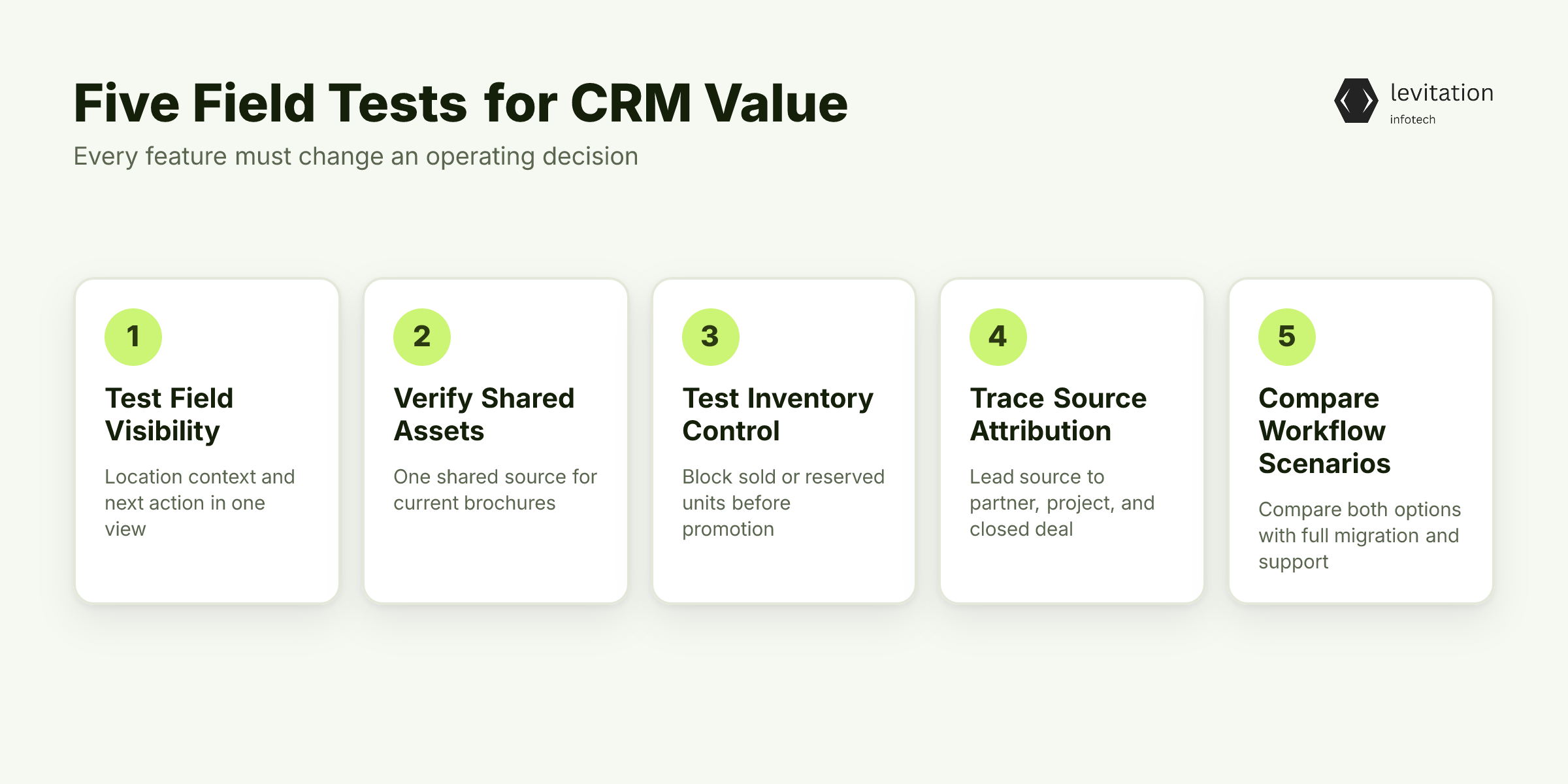
A feature becomes valuable when it changes an operating decision. The evaluation should begin with that test, not the menu.
Field Visibility
Ask the vendor to locate a team currently showing a property. The manager should see the location context and the next follow-up action without calling for a status update.
If the field team must report its activity separately, the CRM creates reporting work. It doesn't create visibility.
Shared Sales Assets
Agents should retrieve current brochures and property materials from one shared library. Copies shouldn't drift across phones, teams, or projects.
The correct version matters as much as the file itself. A stale brochure can cost more than a missing one because it creates false confidence.
Inventory Control
Test whether the CRM prevents an agent from promoting a unit that is already sold or reserved. Property and inventory status must appear inside the sales workflow.
A report generated after the promotion has already failed. Inventory control must happen before the customer commitment.
Source Attribution
Require a traceable chain from lead source to campaign or channel partner, project, and eventual closed deal. Without that chain, source reports are assumptions with charts.
This is where a CRM that counts visits instead of closings fails the business test. Activity volume matters only when it connects to outcomes.
Connected Workflow Behavior
Test lead nurturing, reminders, tour scheduling, and communications as one chain. Each step should produce a visible handoff, reminder, or deal-state change.
Run a general-purpose CRM and a real-estate-focused option through the same scenarios. Include every add-on, configuration, migration task, and support commitment needed to achieve the result. The right comparison includes crm data migration, not just licenses.
Polished demonstrations aren't enough. Can the vendor prove each economic job through quotes, migration scenarios, and field evidence?
Audit Implementation, Migration, and Vendor Credibility
The buying decision now has an economic model. It still needs a delivery model that can survive scrutiny.
Create One Comparison Sheet
Enter every quote using common categories and assumptions. Include: - Pricing unit and contract term - Base price, add-ons, and required integrations - Implementation assumptions - Historical data migration scope - Training and support period - Internal setup effort - Evaluation cohort and period
The sheet should expose where vendors have priced the same requirement differently. A cheaper quote that excludes inventory or source mapping isn't cheaper for the intended workflow.
Use CRM development cost in India as a structural reference, not as evidence that one vendor includes more than another.
Scope the Migration Explicitly
Inventory the source data and assets before asking for a migration estimate: - Historical leads, contacts, deals, and source fields - Property, project, and inventory records - Brochures and other attachments - Stage histories and ownership changes - Duplicate records and required field mappings
Then define cleansing, validation, and acceptance criteria.
Who signs off on record completeness? How are duplicates resolved? What happens to documents that fail the transfer?
A headline migration price says little when the source systems and records remain undefined. The CRM migration assessment guide covers this scope in more detail.
Run the Same Field Scenarios
Ask each vendor to demonstrate the same operating cases: - Shared brochure access with current versions - Real-time visibility of a team showing a property - Inventory checks before promotion or tour scheduling - Source attribution through project and closed deal - Reminder generation and follow-up handoffs - Communication history linked to the buyer record
Use comparable sample data. Change the vendor, not the test.
Clarify Commercial Boundaries
Write down who owns configuration, integrations, historical migration, training, post-launch support, and future expansion.
Also assign responsibility for additional projects and channel partners. Otherwise, operational work can move into hourly services after signature.
The five delivery tests for Indian CRM partners provide a useful pattern: test claimed outcomes, not vendor narratives.
Review Vendor Evidence
Buyers should demand evidence for custom or complex engagements. Test vendor claims against the same workflows, implementation scope, and acceptance criteria used in the comparison.
Calculate cost per closed deal from the normalized sheet. Document assumptions. Keep uncertain implementation and migration items in separate scenarios rather than hiding them inside the base price.
The audit produces a defensible recommendation. Can the sales head explain it in financial and operational terms?
Turn the Audit Into a Closed-Deal Investment Case
Leadership doesn't need another feature comparison. It needs one decision page containing: - Normalized total operating cost - Cost per attributable closed deal - Time-to-close and source-to-close conversion - Workflow-fit evidence - Migration readiness and remaining uncertainty - User adoption expectations
Negotiate each commercial layer separately. Subscription, project or team access, add-ons, implementation, migration, support, and expansion should each connect to an outcome.
Define post-launch measurement before signing. Track actual operating cost, attributable closed deals, sales-cycle duration, source conversion, inventory accuracy, and user adoption for the relevant cohort.
This turns real estate crm pricing into an operating commitment. It also reveals whether the same team can handle more qualified demand without losing control.
The objective is not the longest feature list. It is a CRM whose verified cost connects to the sales process it improves.
Which recurring questions must buyers settle before comparing quotes and signing a CRM contract?
Frequently Asked Questions
How Should a Delhi-NCR Real Estate Team Compare CRM Pricing?
Normalize each quote for the same projects, teams, partners, users, and workflows. Then divide total operating cost by attributable closed deals over the same period.
Include subscriptions, add-ons, implementation, migration, training, support, and internal setup time. Treat real estate crm pricing as the starting point for itemization, not the final cost.
Is Per-User CRM Pricing Enough for a Delhi-NCR Builder or Developer?
No. Builders and developers often receive quotes by project and team. They manage multiple projects, inventory, and channel partners rather than only individual seats.
Normalize the quote to the people, projects, partners, and workflows the CRM must support.
What Belongs in a CRM Implementation Cost?
Include configuration, required add-ons, integrations, training, support, and staff time required to adopt the system. A general-purpose CRM covers many requirements, but some capabilities come through add-ons or setup work.
Keep those costs visible in the comparison. Use crm implementation cost to check that both quotes describe the same operating outcome.
How Should Buyers Compare CRM Data Migration Costs?
Compare the scope rather than a headline price: source systems, record types, fields, attachments, cleansing, duplicate handling, mapping, validation, and cutover.
Ask each vendor to itemize the same assumptions. A lower quote must not simply omit required migration work.
Is a General-Purpose CRM Cheaper Than a Real-Estate-Specific CRM?
The answer depends on the workflow. Compare the total cost of delivering the same Delhi-NCR workflows and the resulting cost per closed deal.
Compare setup and add-ons for a purpose-built system. Then compare added configuration and migration work for a general-purpose system. The normalized model shows which trade-off is real.
Before signing, which vendor can answer the pricing, migration, workflow, and support questions without hiding a cost?
About the author
Mayank Singh is a software developer at Levitation Infotech, where he builds web and AI-powered applications across the company’s fintech, healthcare, and enterprise projects.