


TL;DR: Packaged ERP rollouts in India fail at the operations floor more often than they succeed, and the failure mode is always the same: the team routes back to Excel within weeks. The fix is not a bigger license. It is a custom ERP built around the team's actual workflows, deployed through a parallel-run migration, with AI workflow agents handling the unstructured handoffs that vendor modules never modeled well.
Key Takeaways: - The ERP did not fail. The implementation did. Shadow IT is the real cost line that never appears on the quote. - Custom ERP becomes infrastructure when it matches how the floor team works, not how a vendor template assumes they work. - Parallel-run migration over 4-8 weeks compresses cutover risk and lets old spreadsheets stay live as a reconciliation layer. - AI workflow agents kill the last tracker sheets by handling invoices, POs, and approval pings the ERP never absorbed.
The ₹12 Lakh ERP That Made Excel Stronger
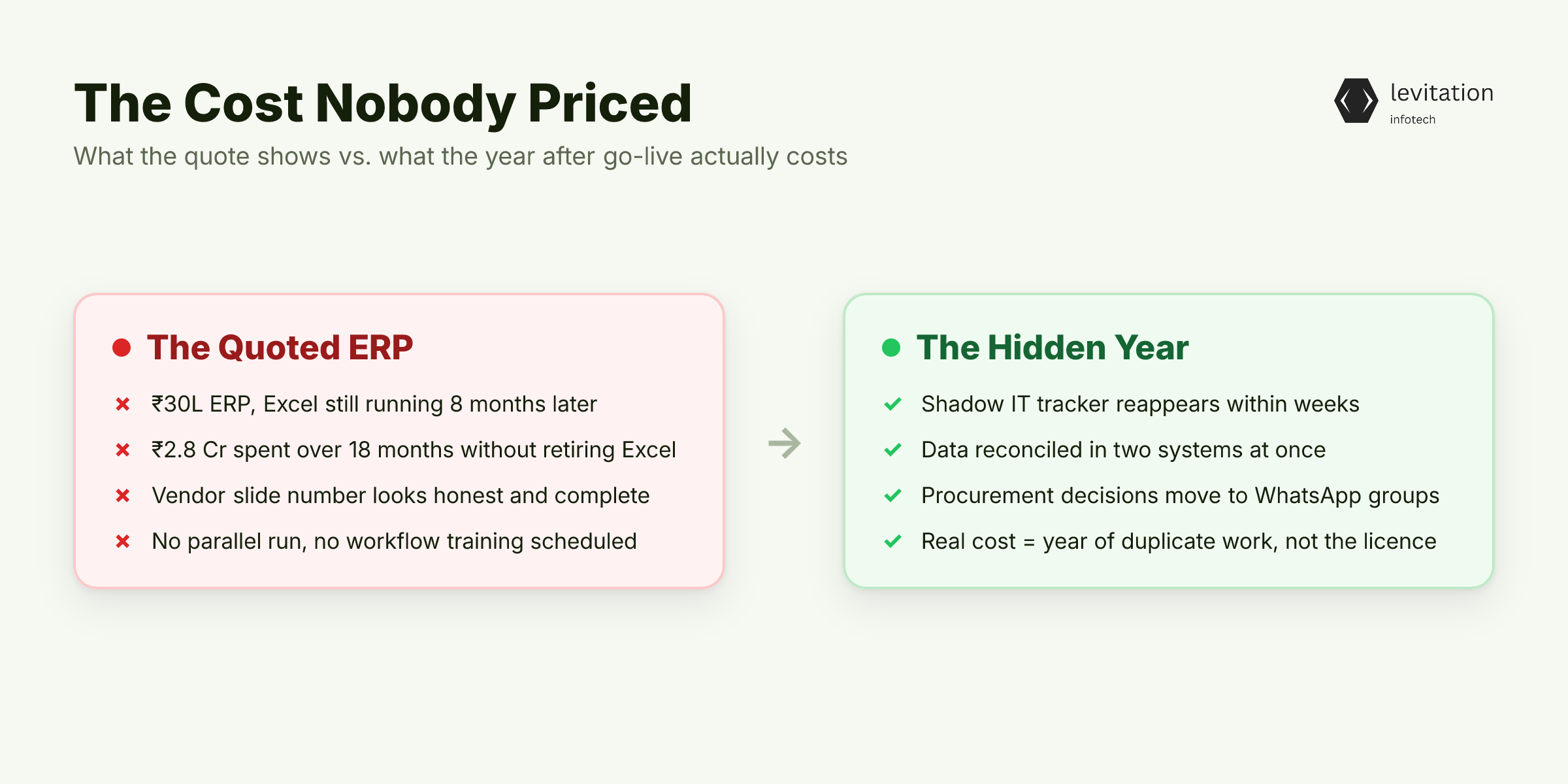
This is not an outlier. One mid-sized manufacturer spent ₹30 lakhs on an ERP and was still running Excel eight months later because the team had never been trained on the workflows the system expected. Another firm burned ₹2.8 crore over 18 months without replacing Excel on the factory floor. The pattern is consistent enough to predict. Once an ERP goes live without a parallel run, the tracker sheet survives the rollout by lunch.
The spreadsheet problem is not laziness. It is the operations team's fastest path back to the workflow they actually understand when the ERP's UI fights them. A custom-built tracker that matches how a plant manager reconciles inventory at 9 a.m. will always beat a vendor screen that demands a different sequence of clicks. Excel is the workaround, and it reappears within weeks of every failed rollout.
The ERP did not fail. The implementation failed. The cost of ERP implementation in India is rarely the line item on the quote. It is the year of shadow IT that follows, the data reconciliation that happens in two systems at once, and the procurement decisions made in a WhatsApp group because the ERP module was too slow to load. The vendor's number on the slide was honest. The number that matters is the one nobody priced.
So why does the operations team always route back to a spreadsheet when the ERP goes live? The vendor delivered the software. The training was scheduled. The senior consultants were on site. What went wrong?
Why Buy-First, Configure-Later Always Breaks at the Factory Floor
Three structural reasons explain why packaged ERP fails operations teams, and none of them surprise anyone who has sat through a steering committee meeting.
First, the software models a generic business process, not yours. Every ERP ships with a template that assumes a standard approval hierarchy, a standard SKU matrix, a standard multi-plant inventory flow. The moment your business deviates, configuration begins, and every hour of configuration is an hour the floor team is not validating the system against their actual work.
Second, configuration caps hit a ceiling. When your SKU matrix, your approval hierarchy, or your multi-plant inventory does not match the template, the vendor tells you it can be configured. It can, up to a point. Beyond that point, you are paying for custom modules anyway, just with the vendor's margin layered on top. An honest SAP vs Odoo cost analysis shows the configurability promise has a real ceiling, and most operations teams discover it in month four.
Third, implementation services run 2-3x the licensing fee. The license is the line item the CFO approved. The implementation is the line item that ate the budget. A ₹30 lakh license can easily become a ₹90 lakh project before a single user is trained. And most Indian ERP rollouts fail at adoption for one reason.
That reason is training, and it is the silent killer. The ₹30-lakh-on-Excel-after-eight-months case was not a budget problem. It was an adoption problem. No amount of vendor-side ERP software development fixes a workflow the floor team was never asked to design. The Appziac migration lessons make this concrete. The cost of doing nothing is always higher than the cost of a custom build, and the best ERP is the one your team will actually open on a Monday morning.
If licensing plus implementation does not guarantee adoption, and configurability has a ceiling, the real question is what the operations floor is actually leaking while the debate continues.
Custom ERP Treated as Operations Infrastructure, Not Software
A ₹20 crore manufacturing business typically leaks 8-12% of revenue through WhatsApp, Excel, and manual handoffs that no ERP module was configured to capture. That leak, sitting somewhere between ₹1.6 crore and ₹2.4 crore a year, is larger than the entire ERP implementation cost for most mid-market manufacturers. The leak is invisible because it does not show up on a vendor quote. It shows up on a margin walk at year-end.
A custom ERP system is rarely more expensive than the licensed alternative once you total five-year cost of ownership. On a five-year basis, per-user licensing costs are substantial, and implementation services typically run 2-3x the licensing fee. The custom build's license cost is lower, the implementation is faster, and the change-request cycle collapses because the team that uses the system is the same team that owns the roadmap.
What changes is the fit. A custom ERP matches how the team operates, not the other way around. Packaged ERP never fits the plant floor because the template assumes a process the shop floor never ran. That is why a custom build kills the four phantom spreadsheets at the root. The workflow is now native to the tool, not a workaround around the tool. The tracker sheet that procurement kept "just for visibility" no longer has a job because the visibility is built in.
The decision is not build vs buy. It is whether you want a system your team uses, or a system your team routes around. The first is infrastructure. The second is shelfware with a renewal contract attached.
Knowing the answer is custom does not solve the harder problem. How do you migrate 12 years of spreadsheet logic into a new system without breaking daily operations, and without losing the trust of a team that has been burned by the last rollout?
The Parallel-Run Migration That Kills Shadow IT
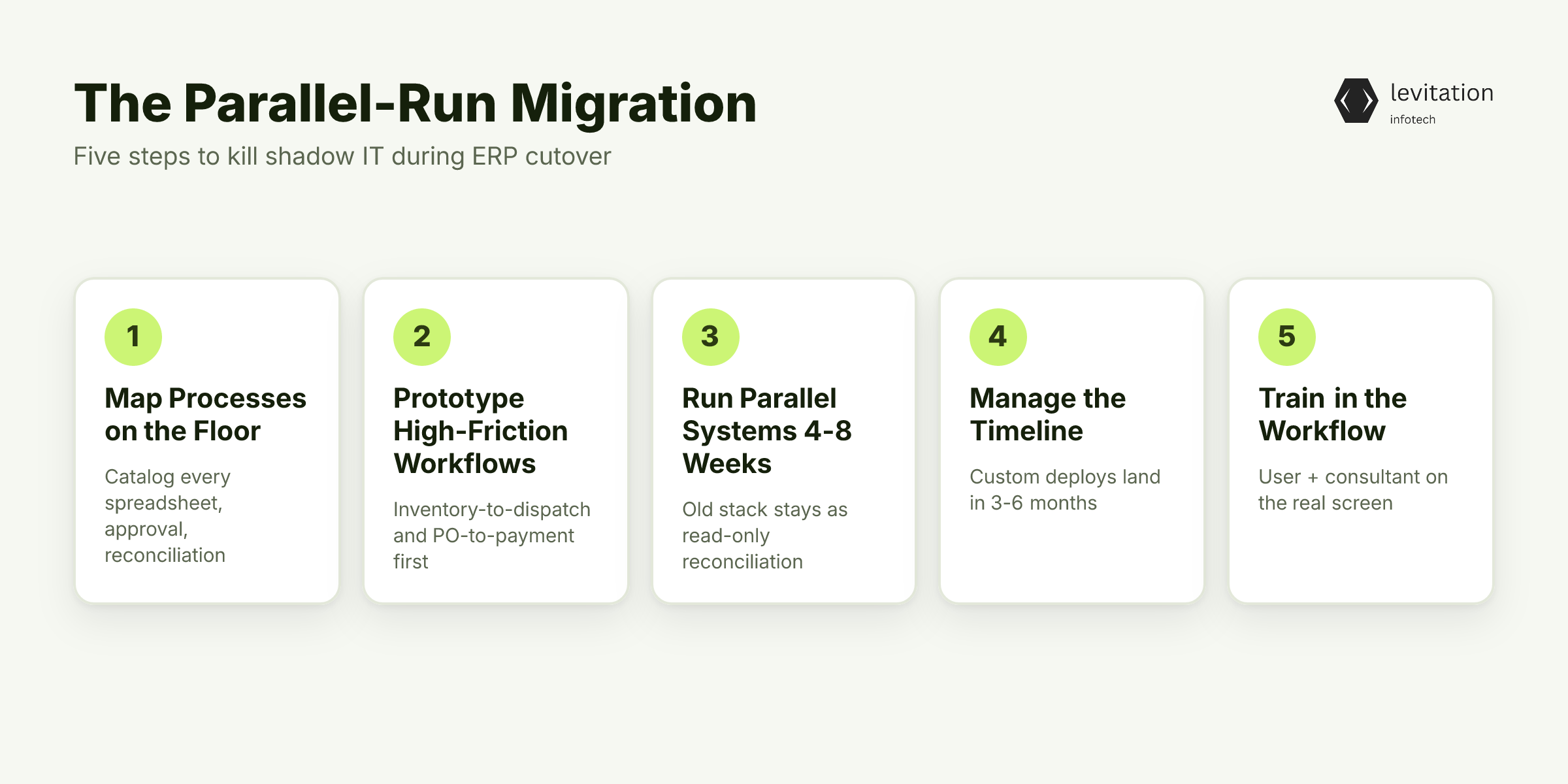
A parallel-run migration has five steps, and the order matters.
Step one is process mapping with the floor team, not the steering committee. Every spreadsheet column, every WhatsApp approval, every manual reconciliation gets catalogued before a line of code is written. The person who reconciles inventory at 9 a.m. knows more about the workflow than the consultant who flies in on Monday.
Step two is to prototype the two or three highest-friction workflows first. Inventory-to-dispatch and PO-to-payment almost always top the list. If those workflows work in UAT with real data, the rest of the system follows. If they do not, you learn that in week three, not month eighteen.
Step three is to run parallel systems for a defined cutover window, typically 4-8 weeks. The old spreadsheets stay live as a read-only reconciliation layer. Data is validated row-by-row before the legacy stack is decommissioned. This is where most rollouts fail, because most vendors want a hard cutover. The parallel run is the variable that makes a custom migration safe.
Step four is about the timeline. A typical custom ERP development deployment lands in 3-6 months. An in-house team, if you have one, takes 18-24 months to spec, hire, and build. The custom ERP development cost curve is front-loaded, and the spreadsheet tax disappears in the first quarter of go-live.
Step five is to train in the workflow, not the software. The user sits with the consultant on their actual screen, doing their actual task. This single variable separated the ₹30-lakh-on-Excel-after-eight-months failure from every successful migration in the Appziac portfolio.
Even a perfectly migrated ERP still hits one handoff that no vendor module was designed to handle cleanly: the unstructured documents, vendor invoices, and approval pings that arrive by email and WhatsApp.
Where AI Workflow Agents Replace the Manual Handoffs
The handoff zone is where shadow spreadsheets get reborn. Vendor invoices land in email. POD images arrive on WhatsApp. Customer POs come as scanned PDFs. Plant managers log line stops in WhatsApp, not ERP, for the same reason. The ERP has no clean way to ingest any of it, so someone retypes line items into a tracker sheet. That tracker sheet is the most common shadow IT artifact in Indian operations, and it is the one that survives every ERP rollout.
This is where an AI workflow automation agent earns its keep. Document processing agents read inbound invoices, match them to open POs in the ERP, flag mismatches, and route for approval without a human retyping a single line item. The operations agent layer sits on top of the ERP, not inside it. It pulls triggers from email, WhatsApp Business, and the ERP's own APIs, then writes structured entries back into the system.
This is the piece that finally kills the tracker sheet the procurement team kept "just for visibility." When the AI agent handles the inbox, the reconciliation, and the routing, the manual handoff disappears, and the spreadsheet it was feeding has no remaining job.
For an Operations Head evaluating workflow automation in India, the metric is not hours saved. It is spreadsheets decommissioned. Hours saved is a vanity number. Spreadsheets decommissioned is the line item that finally closes the shadow IT loop.
So what does the operations floor look like six months after a custom ERP rollout paired with workflow automation, and what changes for the team that owns it?
What Changes When Operations Owns the ERP
The four phantom spreadsheets do not get rebuilt. The workflows they were patching are now native to the system, so the workaround has no remaining function. Shadow IT dies at the workflow layer, not at the policy layer. A memo banning Excel never worked. A system that is faster than the spreadsheet always does.
The team opens the ERP on a Monday morning because it is faster than the alternative. Adoption is not driven by mandate. It is driven by latency. When the new screen loads in under a second and the reconciliation happens automatically, the old spreadsheet does not get reopened. This is the signal that a custom ERP has become operations infrastructure rather than a software purchase.
Rollouts land in 3-6 months instead of the 18-24 months an in-house team takes to spec, hire, and deliver. The system keeps evolving because the operations team, not the IT vendor, owns the roadmap. Change requests stop being a procurement exercise and start being a conversation between the floor and the engineer sitting two desks away.
The long-term signal matters. Long client relationships, the kind seen when teams treat ERP system delivery as operations infrastructure rather than a one-time software purchase, reflect what happens when the partnership compounds instead of churning at contract renewal. The system that the floor team owns is the system that survives a budget cycle, a leadership change, and a vendor renewal.
That is the difference between ERP as a line item and ERP as infrastructure. The first depreciates. The second compounds.
Frequently Asked Questions
Q: What is the typical ERP implementation cost in India for a mid-sized manufacturer?
A: For a mid-sized manufacturer, total ERP implementation cost in India typically runs ₹30 lakhs to ₹2.8 crore depending on scope, with implementation services running 2-3x the licensing fee. Custom ERP development in India is often competitive on five-year total cost of ownership when measured against licensed platforms plus their hidden configuration and training overhead.
Q: Why do operations teams keep returning to spreadsheets after an ERP rollout?
A: Three reasons recur: the ERP models a generic process that does not match the team's actual workflow, training was scheduled instead of embedded, and the implementation skipped a parallel-run phase. The team routes back to Excel because Excel matches how they work. The ERP did not.
Q: How long does a custom ERP take to deploy in India?
A: A custom ERP deployment in India typically lands in 3-6 months when scoped around the operations team's actual workflows, versus 18-24 months for an in-house team to spec, hire, and build from scratch. The parallel-run methodology compresses the cutover risk into a 4-8 week window.
Q: Is custom ERP cheaper than SAP or Odoo in the long run?
A: On five-year total cost of ownership, custom ERP is often cheaper than SAP or Odoo for mid-market manufacturers once per-user licensing, implementation services (2-3x licensing), customization modules, and ongoing change requests are totalled. The bigger win is adoption. A system your team uses eliminates the shadow-IT tax.
Q: What is shadow IT in the context of ERP implementations?
A: Shadow IT in an ERP context is the layer of spreadsheets, WhatsApp trackers, and side tools that employees build to route around workflows the ERP could not model. It reappears within weeks of every failed rollout and is the real cost line that does not show up on the ERP implementation quote.
About the author
Mayank Singh is a software developer at Levitation Infotech, where he builds web and AI-powered applications across the company’s fintech, healthcare, and enterprise projects.